Standing Waves Guide
A free science worksheet ready for your classroom. Open in Kuraplan to grab the print-ready PDF, customize it for your students, or generate a fresh version in seconds.
Standing Waves Guide
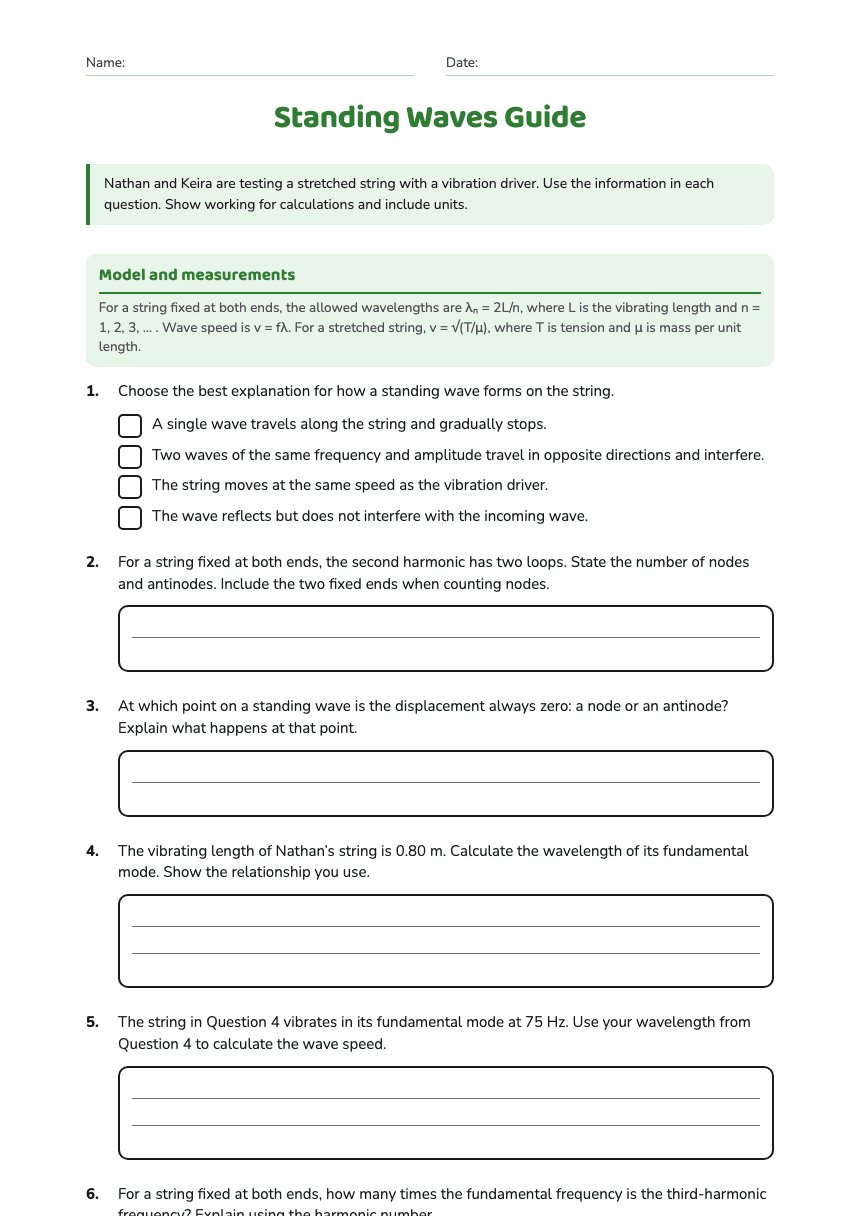
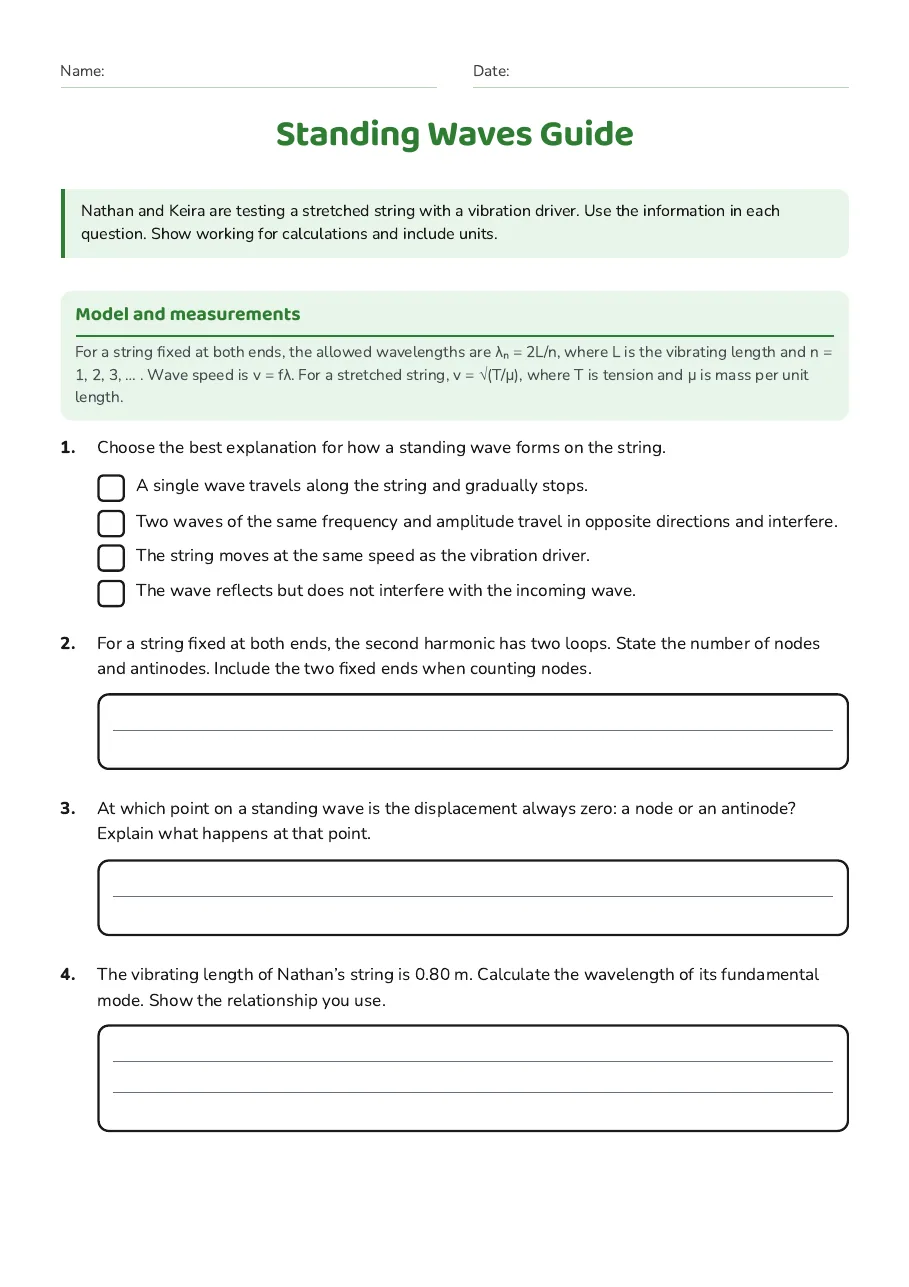
Model and measurements
For a string fixed at both ends, the allowed wavelengths are λₙ = 2L/n, where L is the vibrating length and n = 1, 2, 3, … . Wave speed is v = fλ. For a stretched string, v = √(T/μ), where T is tension and μ is mass per unit length.
- A single wave travels along the string and gradually stops.
- Two waves of the same frequency and amplitude travel in opposite directions and interfere.
- The string moves at the same speed as the vibration driver.
- The wave reflects but does not interfere with the incoming wave.
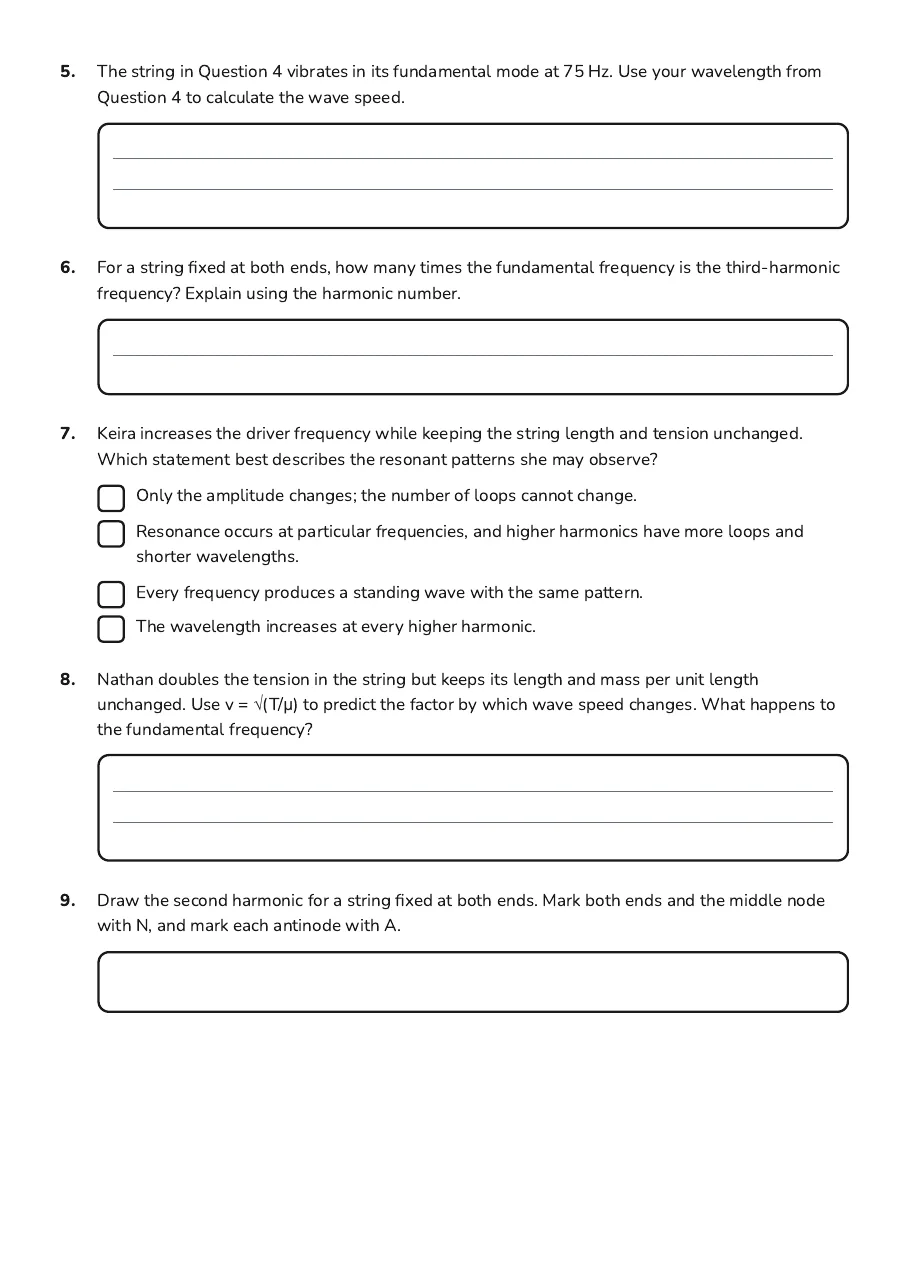
- Only the amplitude changes; the number of loops cannot change.
- Resonance occurs at particular frequencies, and higher harmonics have more loops and shorter wavelengths.
- Every frequency produces a standing wave with the same pattern.
- The wavelength increases at every higher harmonic.
3 printable pages
Page 1
Page 2
Page 3
About This Worksheet
Free in Kuraplan
Sign up free, grab the PDF, and customize it for your class.
Print-Ready
Formatted for standard paper. Clean layout, easy to read.
AI-Generated
Created with Kuraplan's AI, designed for real classroom use.
For Teachers & Parents
Use in classrooms, for homework, tutoring, or homeschool.
Need a custom version of this worksheet?
Kuraplan's AI generates custom worksheets in seconds — differentiated for every learner, aligned to your curriculum.
Generate Custom Worksheets — Free