Light in Different Cultures
A free science worksheet ready for your classroom. Open in Kuraplan to grab the print-ready PDF, customize it for your students, or generate a fresh version in seconds.
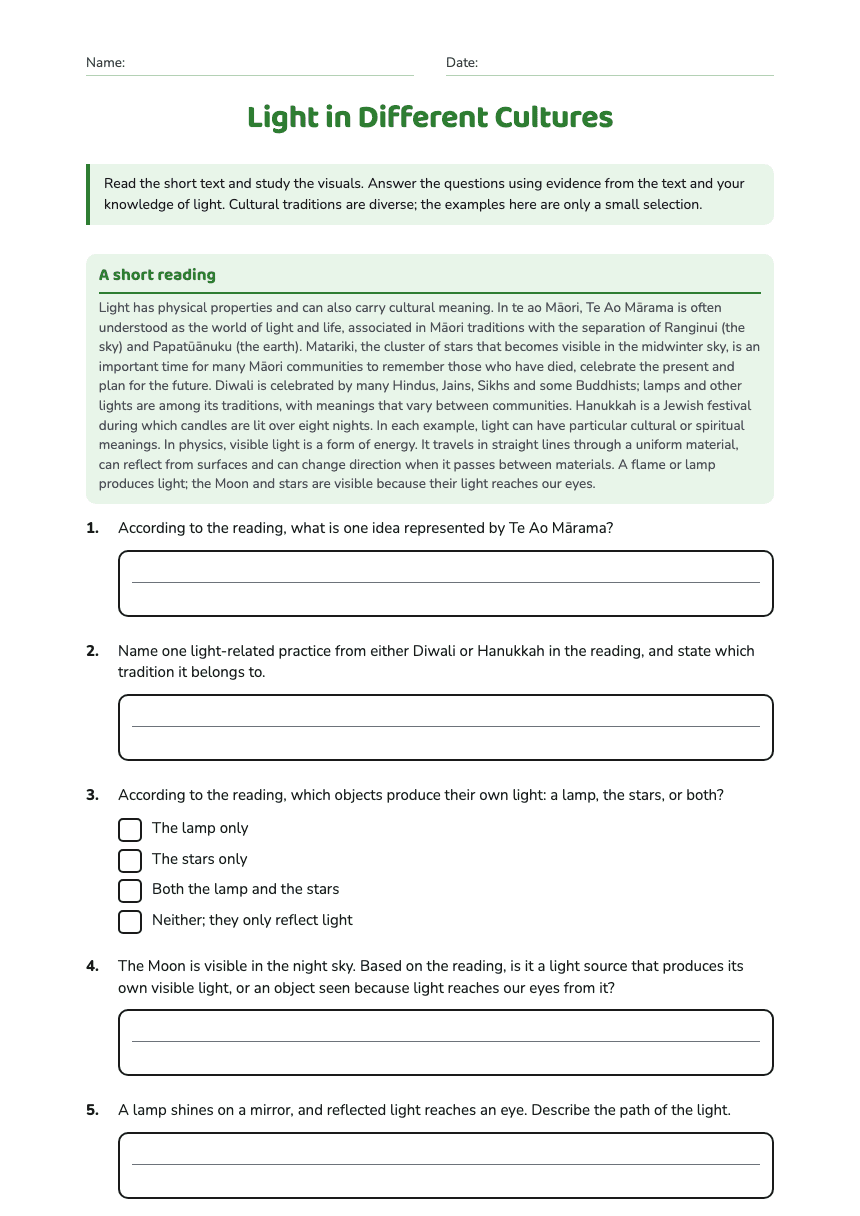
Light in Different Cultures
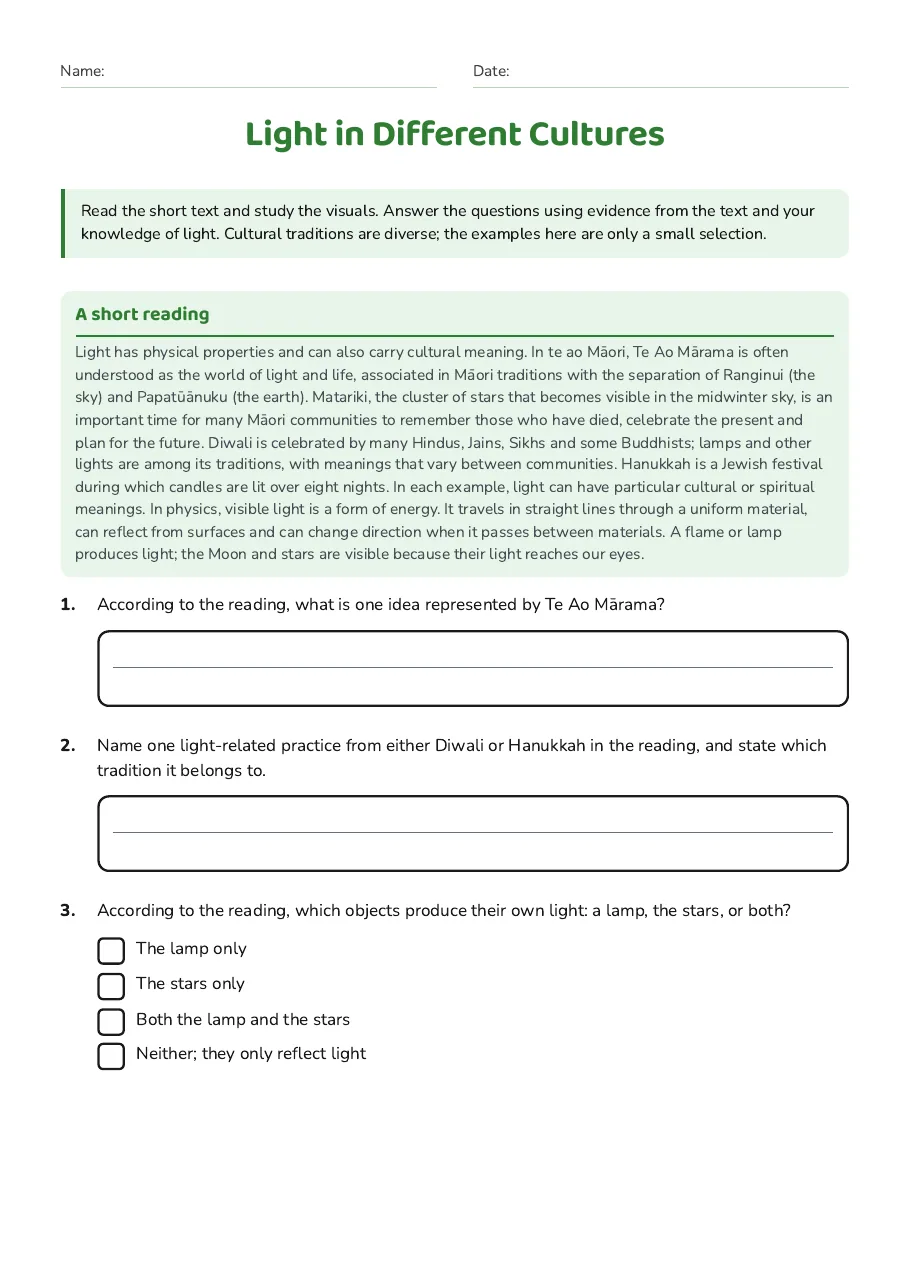
A short reading
Light has physical properties and can also carry cultural meaning. In te ao Māori, Te Ao Mārama is often understood as the world of light and life, associated in Māori traditions with the separation of Ranginui (the sky) and Papatūānuku (the earth). Matariki, the cluster of stars that becomes visible in the midwinter sky, is an important time for many Māori communities to remember those who have died, celebrate the present and plan for the future. Diwali is celebrated by many Hindus, Jains, Sikhs and some Buddhists; lamps and other lights are among its traditions, with meanings that vary between communities. Hanukkah is a Jewish festival during which candles are lit over eight nights. In each example, light can have particular cultural or spiritual meanings. In physics, visible light is a form of energy. It travels in straight lines through a uniform material, can reflect from surfaces and can change direction when it passes between materials. A flame or lamp produces light; the Moon and stars are visible because their light reaches our eyes.
- The lamp only
- The stars only
- Both the lamp and the stars
- Neither; they only reflect light
3 printable pages
Page 1
Page 2
Page 3
About This Worksheet
Free in Kuraplan
Sign up free, grab the PDF, and customize it for your class.
Print-Ready
Formatted for standard paper. Clean layout, easy to read.
AI-Generated
Created with Kuraplan's AI, designed for real classroom use.
For Teachers & Parents
Use in classrooms, for homework, tutoring, or homeschool.
Need a custom version of this worksheet?
Kuraplan's AI generates custom worksheets in seconds — differentiated for every learner, aligned to your curriculum.
Generate Custom Worksheets — Free