Local History Source Evaluation
A free english worksheet ready for your classroom. Open in Kuraplan to grab the print-ready PDF, customize it for your students, or generate a fresh version in seconds.
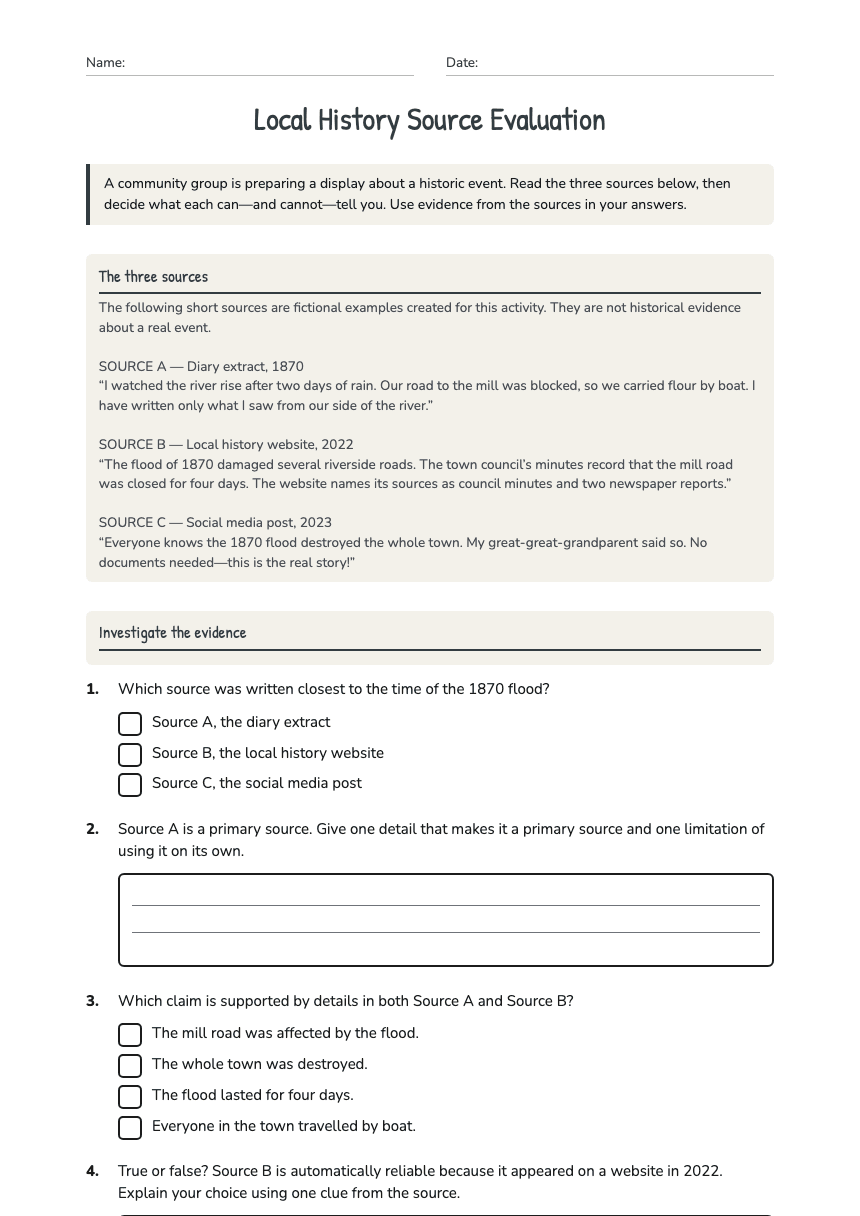
Local History Source Evaluation
The three sources
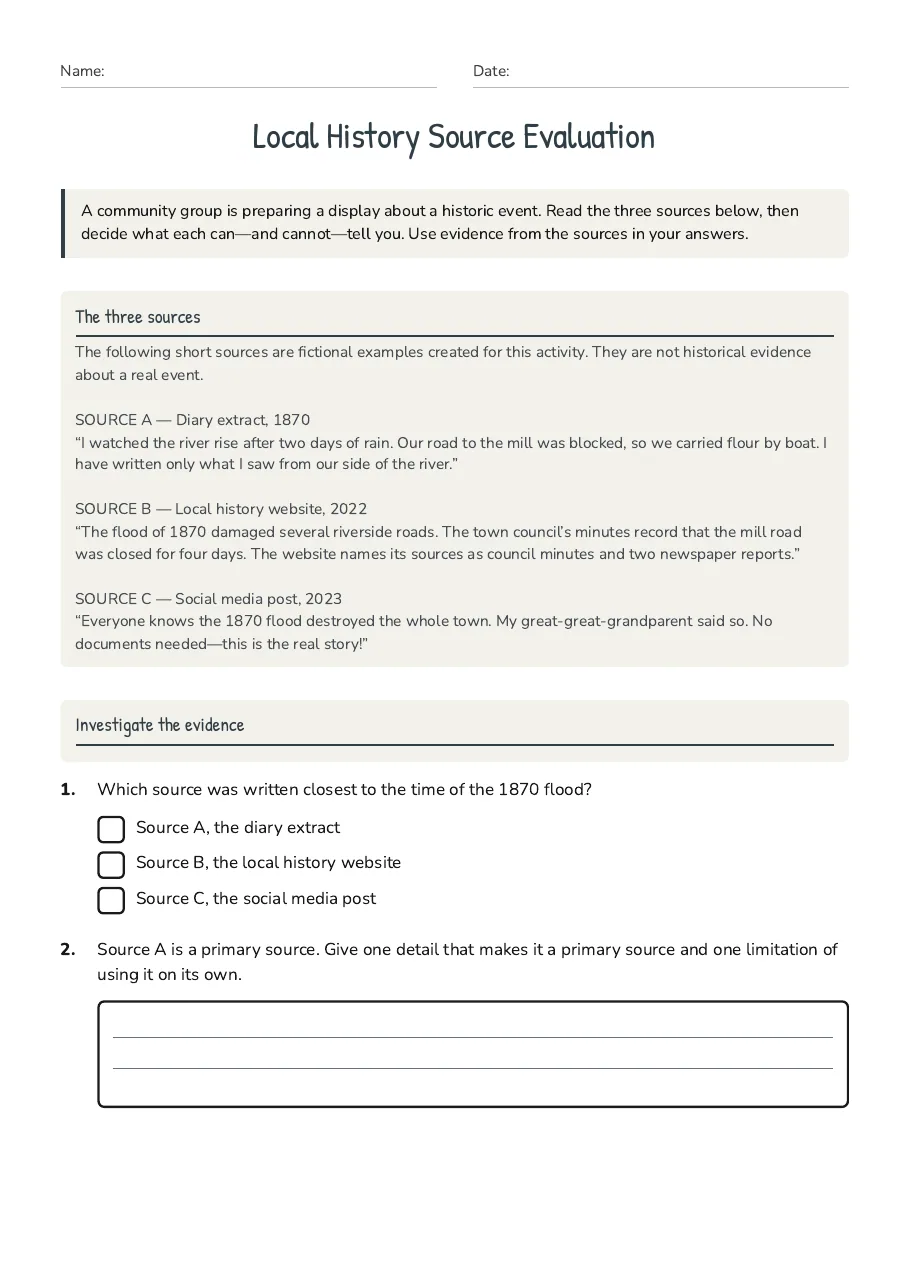
The following short sources are fictional examples created for this activity. They are not historical evidence about a real event. SOURCE A — Diary extract, 1870 “I watched the river rise after two days of rain. Our road to the mill was blocked, so we carried flour by boat. I have written only what I saw from our side of the river.” SOURCE B — Local history website, 2022 “The flood of 1870 damaged several riverside roads. The town council’s minutes record that the mill road was closed for four days. The website names its sources as council minutes and two newspaper reports.” SOURCE C — Social media post, 2023 “Everyone knows the 1870 flood destroyed the whole town. My great-great-grandparent said so. No documents needed—this is the real story!”
Investigate the evidence
- Source A, the diary extract
- Source B, the local history website
- Source C, the social media post
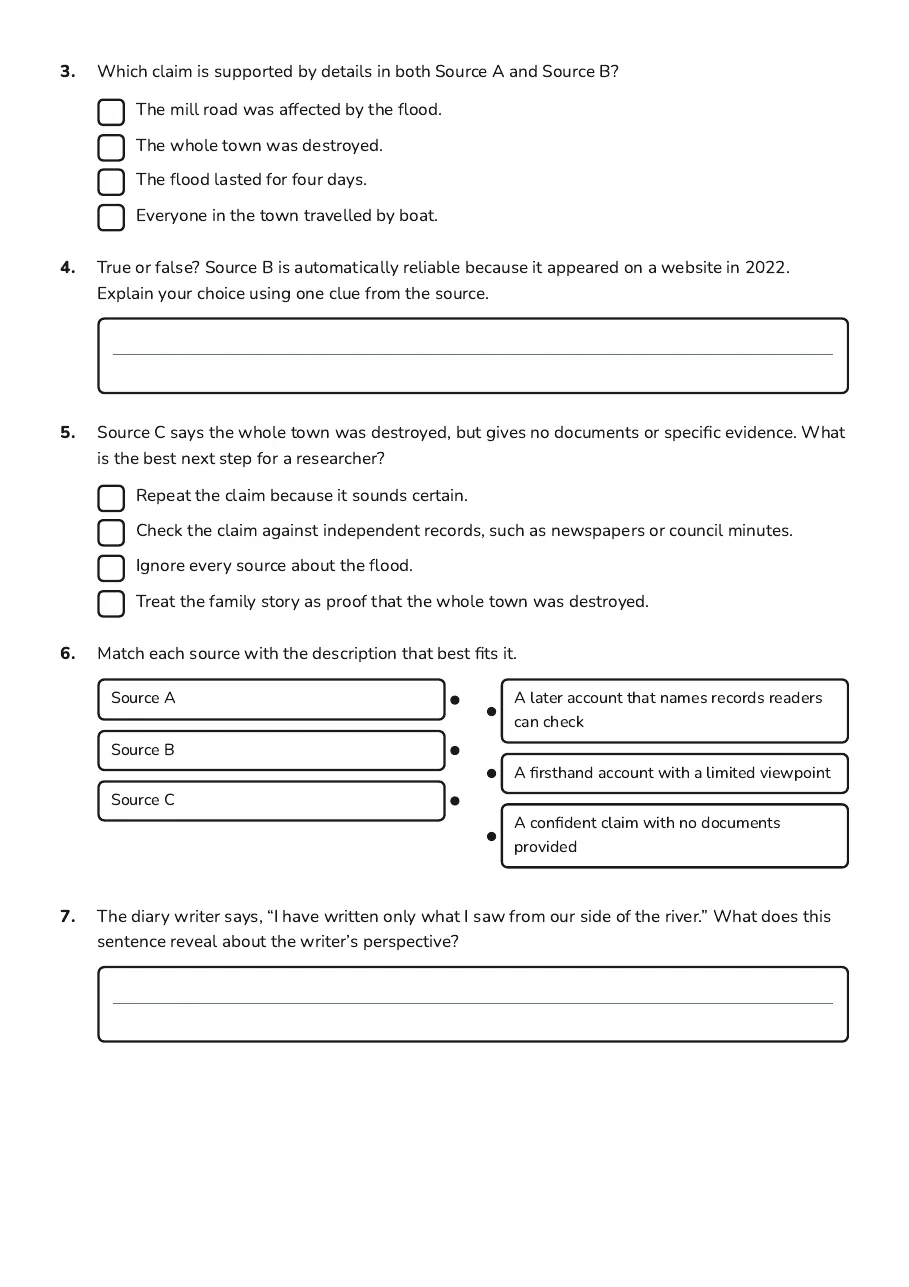
- The mill road was affected by the flood.
- The whole town was destroyed.
- The flood lasted for four days.
- Everyone in the town travelled by boat.
- Repeat the claim because it sounds certain.
- Check the claim against independent records, such as newspapers or council minutes.
- Ignore every source about the flood.
- Treat the family story as proof that the whole town was destroyed.
- Source A
- Source B
- Source C
- A later account that names records readers can check
- A firsthand account with a limited viewpoint
- A confident claim with no documents provided
3 printable pages
Page 1
Page 2

Page 3
About This Worksheet
Free in Kuraplan
Sign up free, grab the PDF, and customize it for your class.
Print-Ready
Formatted for standard paper. Clean layout, easy to read.
AI-Generated
Created with Kuraplan's AI, designed for real classroom use.
For Teachers & Parents
Use in classrooms, for homework, tutoring, or homeschool.
Need a custom version of this worksheet?
Kuraplan's AI generates custom worksheets in seconds — differentiated for every learner, aligned to your curriculum.
Generate Custom Worksheets — Free