Lung Gas Exchange Worksheet
A free science worksheet ready for your classroom. Open in Kuraplan to grab the print-ready PDF, customize it for your students, or generate a fresh version in seconds.
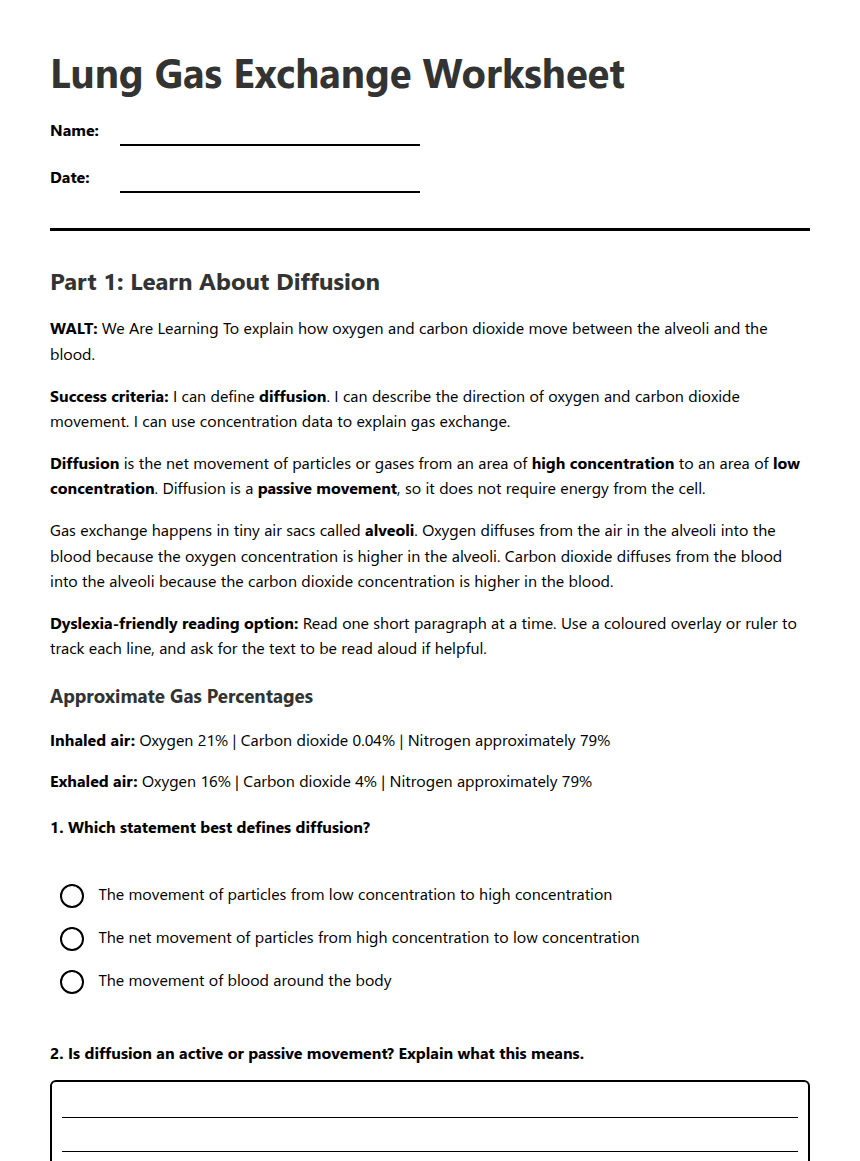
Lung Gas Exchange Worksheet
Part 1: Learn About Diffusion
WALT: We Are Learning To explain how oxygen and carbon dioxide move between the alveoli and the blood.
Success criteria: I can define diffusion. I can describe the direction of oxygen and carbon dioxide movement. I can use concentration data to explain gas exchange.
Diffusion is the net movement of particles or gases from an area of high concentration to an area of low concentration. Diffusion is a passive movement, so it does not require energy from the cell.
Gas exchange happens in tiny air sacs called alveoli. Oxygen diffuses from the air in the alveoli into the blood because the oxygen concentration is higher in the alveoli. Carbon dioxide diffuses from the blood into the alveoli because the carbon dioxide concentration is higher in the blood.
Dyslexia-friendly reading option: Read one short paragraph at a time. Use a coloured overlay or ruler to track each line, and ask for the text to be read aloud if helpful.
Approximate Gas Percentages
Inhaled air: Oxygen 21% | Carbon dioxide 0.04% | Nitrogen approximately 79%
Exhaled air: Oxygen 16% | Carbon dioxide 4% | Nitrogen approximately 79%
Air sacs where gas exchange occurs: ____________________
Gas moving from the alveoli into the blood: ____________________
Gas moving from the blood into the alveoli: ____________________
Liquid tissue that carries gases around the body: ____________________
Part 2: Apply Your Understanding
Oxygen diffuses from the ____________________ into the ____________________ because its concentration is higher in the alveoli.
Carbon dioxide diffuses from the ____________________ into the ____________________ because its concentration is higher in the blood.
Inhaled air contains ________% oxygen. Exhaled air contains ________% oxygen.
Oxygen decreases by approximately ________ percentage points as air passes through the lungs.
Carbon dioxide increases from ________% in inhaled air to ________% in exhaled air.
Answer Key and Learning Support
1. The net movement of particles from an area of high concentration to an area of low concentration.
2. Passive movement. It does not require energy from the cell.
3. Alveoli; oxygen; carbon dioxide; blood.
4. Alveoli; blood; blood; alveoli.
5. Oxygen concentration is high in the alveoli and lower in the blood, so oxygen diffuses into the blood.
6. Carbon dioxide concentration is high in the blood and lower in the alveoli, so carbon dioxide diffuses from the blood into the alveoli.
7. 21%; 16%; 5 percentage points; 0.04%; 4%.
8. Oxygen is taken into the blood, while carbon dioxide is removed from the blood and breathed out.
9. Oxygen moves from the alveoli into the blood; carbon dioxide moves from the blood into the alveoli; nitrogen is approximately 79% in both.
10. Answers should mention oxygen diffusing into the blood and carbon dioxide diffusing out of the blood into the alveoli.
Differentiation Strategies
Use a word bank containing: alveoli, blood, oxygen, carbon dioxide, high concentration, low concentration, diffusion, passive. Provide a partially completed sentence frame or allow students to explain answers orally. Pair students for the data questions and read the information aloud for learners who need support.
Extension Activities
Explain how thin alveolar walls, a large alveolar surface area, and a good blood supply help diffusion happen quickly. Research how exercise changes breathing rate and explain why the body needs faster gas exchange during exercise.
NZ Curriculum link: Year 9 Science, Te Mātaiaho: human transport systems and the movement of substances, including diffusion and the movement of gases in and out of the blood.
About This Worksheet
Free in Kuraplan
Sign up free, grab the PDF, and customize it for your class.
Print-Ready
Formatted for standard paper. Clean layout, easy to read.
AI-Generated
Created with Kuraplan's AI, designed for real classroom use.
For Teachers & Parents
Use in classrooms, for homework, tutoring, or homeschool.
Need a custom version of this worksheet?
Kuraplan's AI generates custom worksheets in seconds — differentiated for every learner, aligned to your curriculum.
Generate Custom Worksheets — Free