EnglishFreePrintable

Matariki Narrative Planning

A free english worksheet ready for your classroom. Open in Kuraplan to grab the print-ready PDF, customize it for your students, or generate a fresh version in seconds.
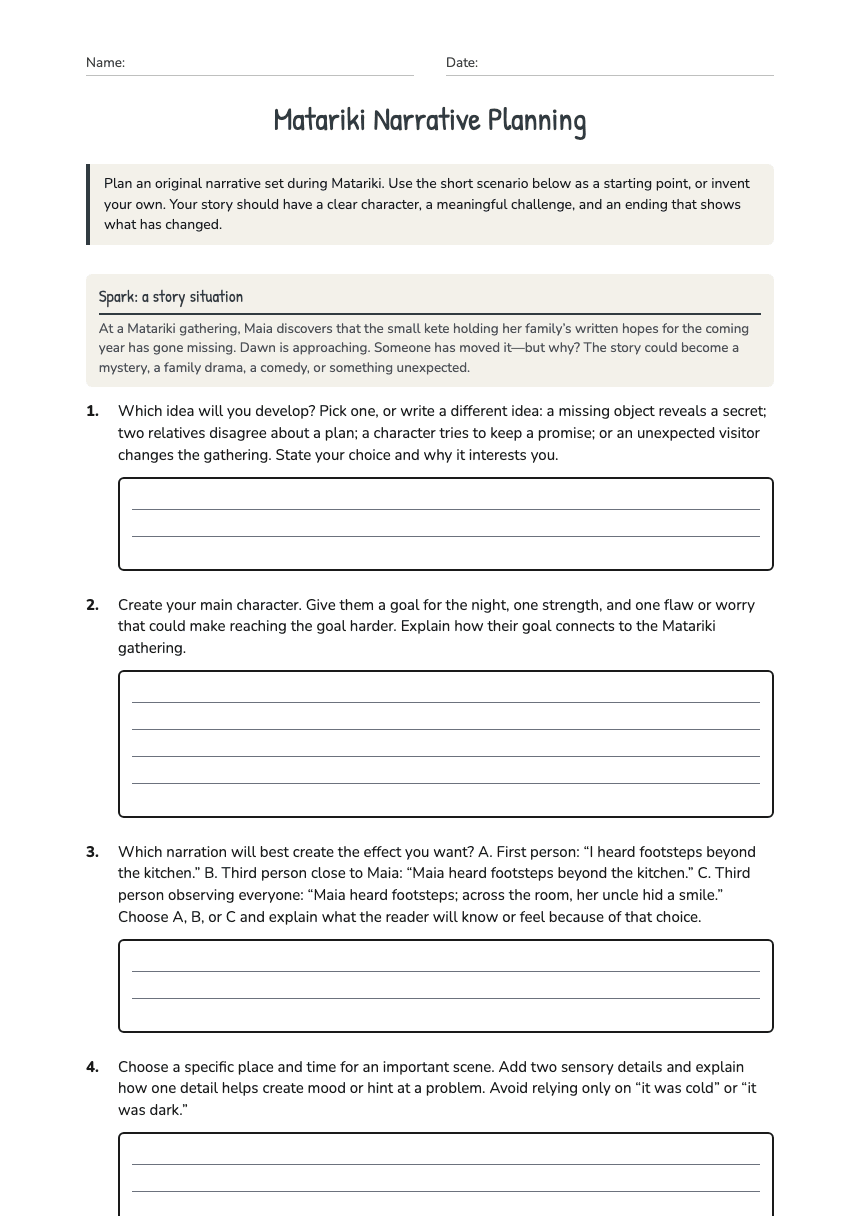
Matariki Narrative Planning worksheet preview
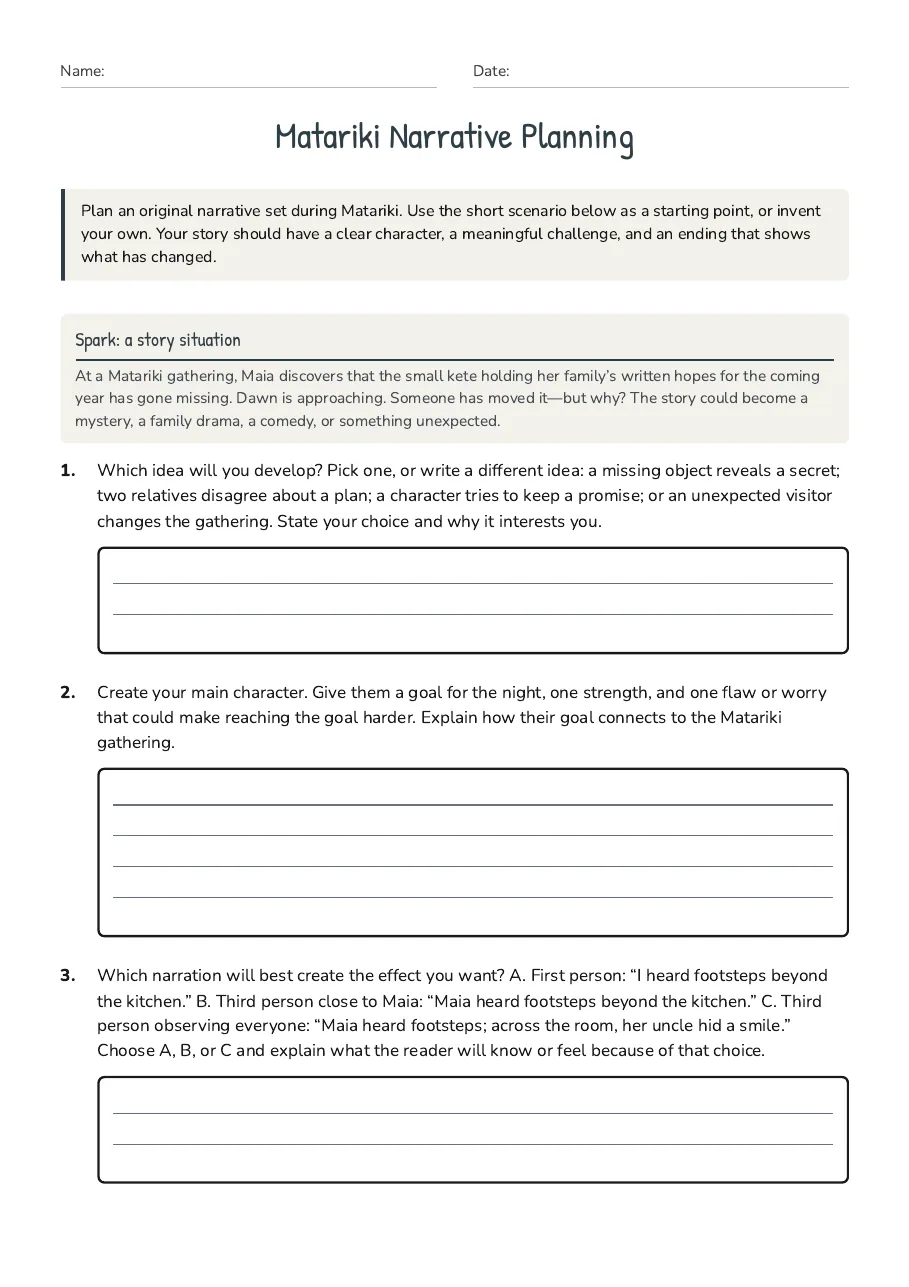
Name:Date:

Matariki Narrative Planning

Plan an original narrative set during Matariki. Use the short scenario below as a starting point, or invent your own. Your story should have a clear character, a meaningful challenge, and an ending that shows what has changed.

Spark: a story situation

At a Matariki gathering, Maia discovers that the small kete holding her family’s written hopes for the coming year has gone missing. Dawn is approaching. Someone has moved it—but why? The story could become a mystery, a family drama, a comedy, or something unexpected.

1.Which idea will you develop? Pick one, or write a different idea: a missing object reveals a secret; two relatives disagree about a plan; a character tries to keep a promise; or an unexpected visitor changes the gathering. State your choice and why it interests you.
2.Create your main character. Give them a goal for the night, one strength, and one flaw or worry that could make reaching the goal harder. Explain how their goal connects to the Matariki gathering.
3.Which narration will best create the effect you want? A. First person: “I heard footsteps beyond the kitchen.” B. Third person close to Maia: “Maia heard footsteps beyond the kitchen.” C. Third person observing everyone: “Maia heard footsteps; across the room, her uncle hid a smile.” Choose A, B, or C and explain what the reader will know or feel because of that choice.
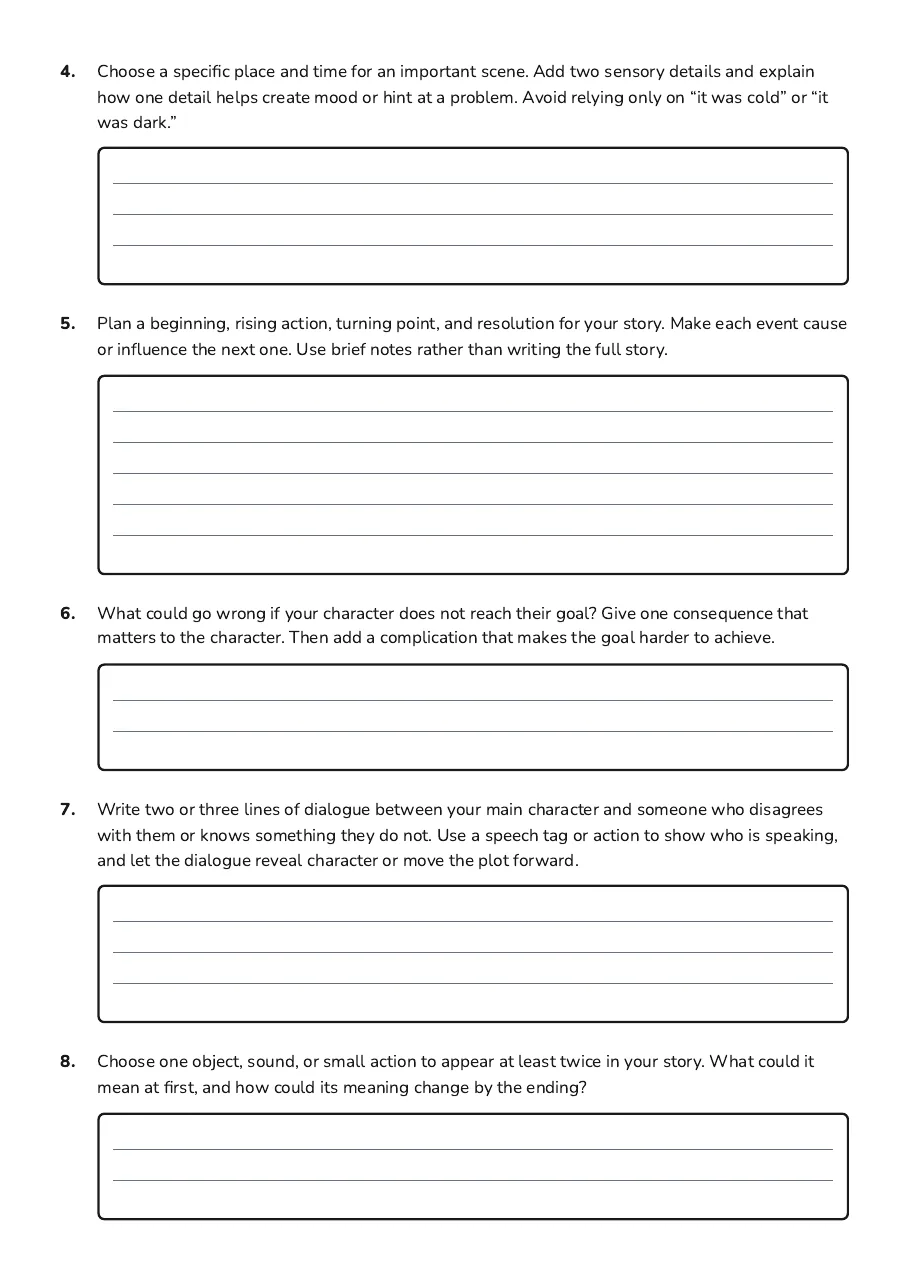
4.Choose a specific place and time for an important scene. Add two sensory details and explain how one detail helps create mood or hint at a problem. Avoid relying only on “it was cold” or “it was dark.”
5.Plan a beginning, rising action, turning point, and resolution for your story. Make each event cause or influence the next one. Use brief notes rather than writing the full story.
6.What could go wrong if your character does not reach their goal? Give one consequence that matters to the character. Then add a complication that makes the goal harder to achieve.
7.Write two or three lines of dialogue between your main character and someone who disagrees with them or knows something they do not. Use a speech tag or action to show who is speaking, and let the dialogue reveal character or move the plot forward.
8.Choose one object, sound, or small action to appear at least twice in your story. What could it mean at first, and how could its meaning change by the ending?
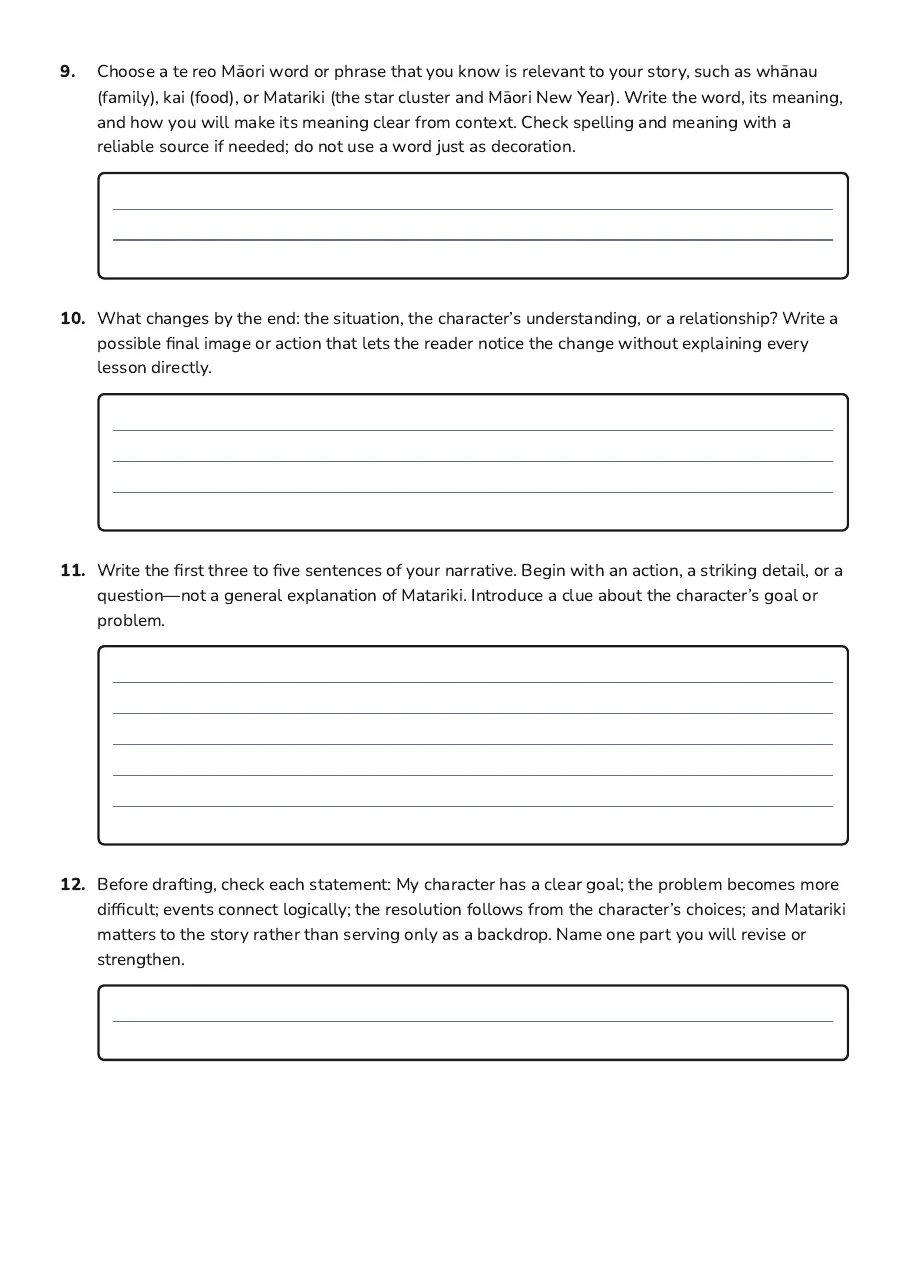
9.Choose a te reo Māori word or phrase that you know is relevant to your story, such as whānau (family), kai (food), or Matariki (the star cluster and Māori New Year). Write the word, its meaning, and how you will make its meaning clear from context. Check spelling and meaning with a reliable source if needed; do not use a word just as decoration.
10.What changes by the end: the situation, the character’s understanding, or a relationship? Write a possible final image or action that lets the reader notice the change without explaining every lesson directly.
11.Write the first three to five sentences of your narrative. Begin with an action, a striking detail, or a question—not a general explanation of Matariki. Introduce a clue about the character’s goal or problem.
12.Before drafting, check each statement: My character has a clear goal; the problem becomes more difficult; events connect logically; the resolution follows from the character’s choices; and Matariki matters to the story rather than serving only as a backdrop. Name one part you will revise or strengthen.

3 printable pages

  • Matariki Narrative Planning, page 1 of 3: Spark: a story situation

    Page 1

  • Matariki Narrative Planning, page 2 of 3: 4. Choose a specific place and time for an important scene. Add two sensory details and…

    Page 2

  • Matariki Narrative Planning, page 3 of 3: 9. Choose a te reo Mā ori word or phrase that you know is relevant to your story, such as…

    Page 3

About This Worksheet

Free in Kuraplan

Sign up free, grab the PDF, and customize it for your class.

Print-Ready

Formatted for standard paper. Clean layout, easy to read.

AI-Generated

Created with Kuraplan's AI, designed for real classroom use.

For Teachers & Parents

Use in classrooms, for homework, tutoring, or homeschool.

Need a custom version of this worksheet?

Kuraplan's AI generates custom worksheets in seconds — differentiated for every learner, aligned to your curriculum.

Generate Custom Worksheets — Free
No credit card Curriculum-aligned Under 60 seconds