EnglishFreePrintable

Narrative Language Features

A free english worksheet ready for your classroom. Open in Kuraplan to grab the print-ready PDF, customize it for your students, or generate a fresh version in seconds.
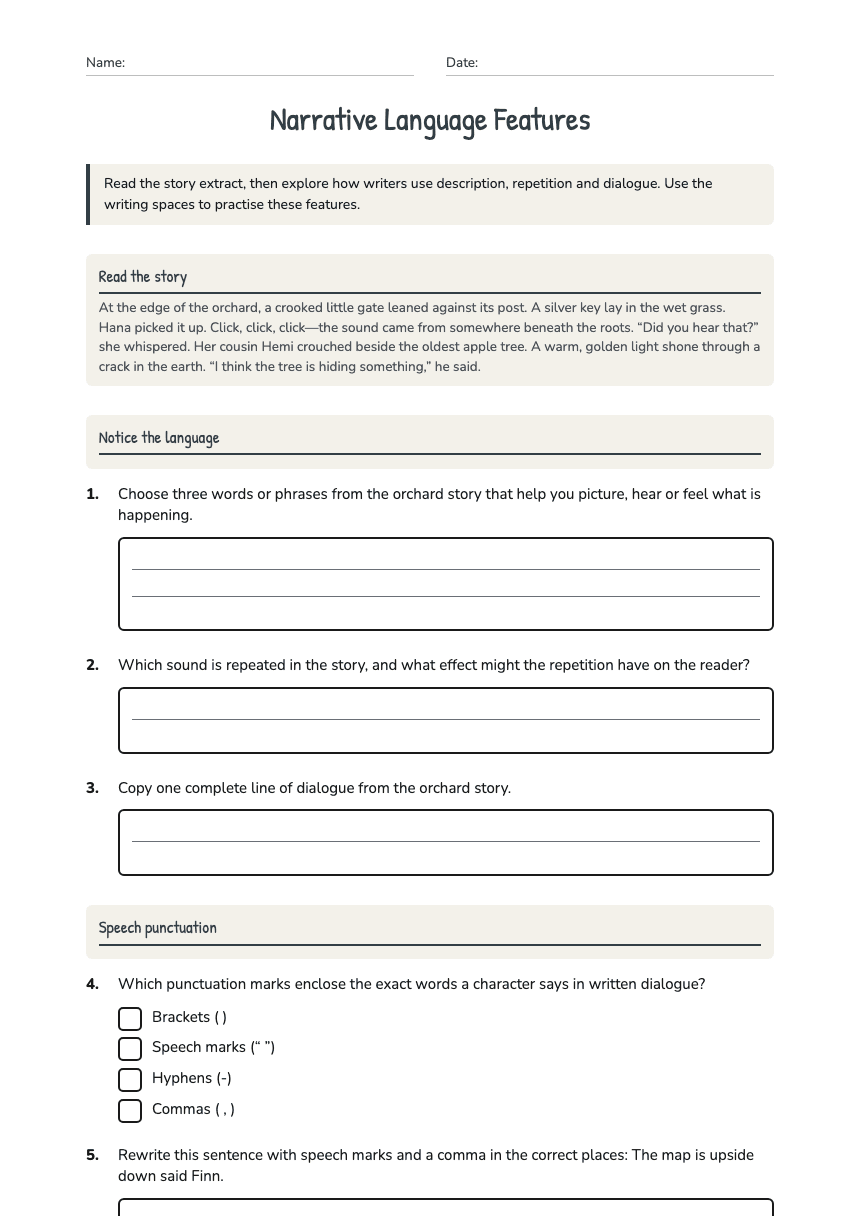
Narrative Language Features worksheet preview
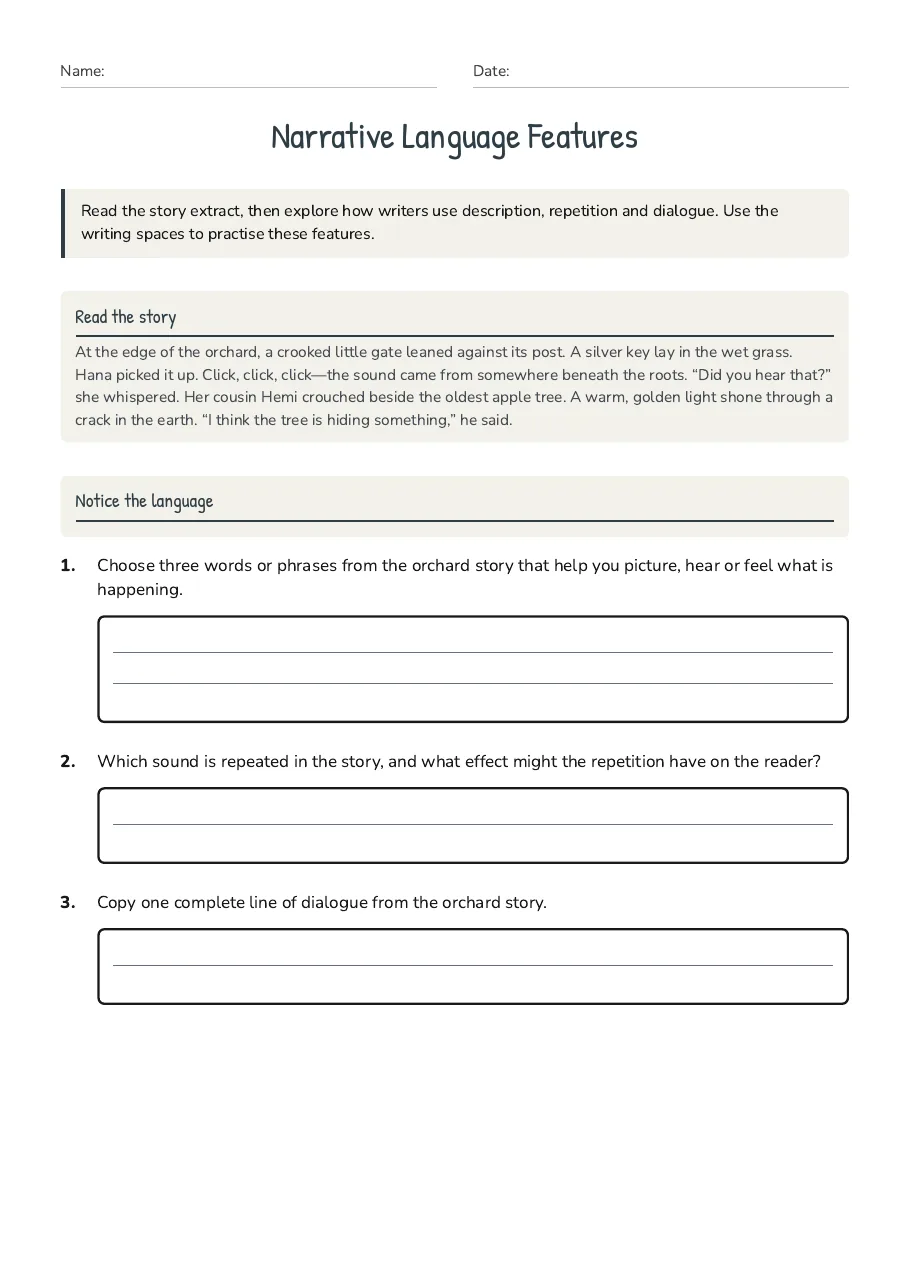
Name:Date:

Narrative Language Features

Read the story extract, then explore how writers use description, repetition and dialogue. Use the writing spaces to practise these features.

Read the story

At the edge of the orchard, a crooked little gate leaned against its post. A silver key lay in the wet grass. Hana picked it up. Click, click, click—the sound came from somewhere beneath the roots. “Did you hear that?” she whispered. Her cousin Hemi crouched beside the oldest apple tree. A warm, golden light shone through a crack in the earth. “I think the tree is hiding something,” he said.

Notice the language

1.Choose three words or phrases from the orchard story that help you picture, hear or feel what is happening.
2.Which sound is repeated in the story, and what effect might the repetition have on the reader?
3.Copy one complete line of dialogue from the orchard story.

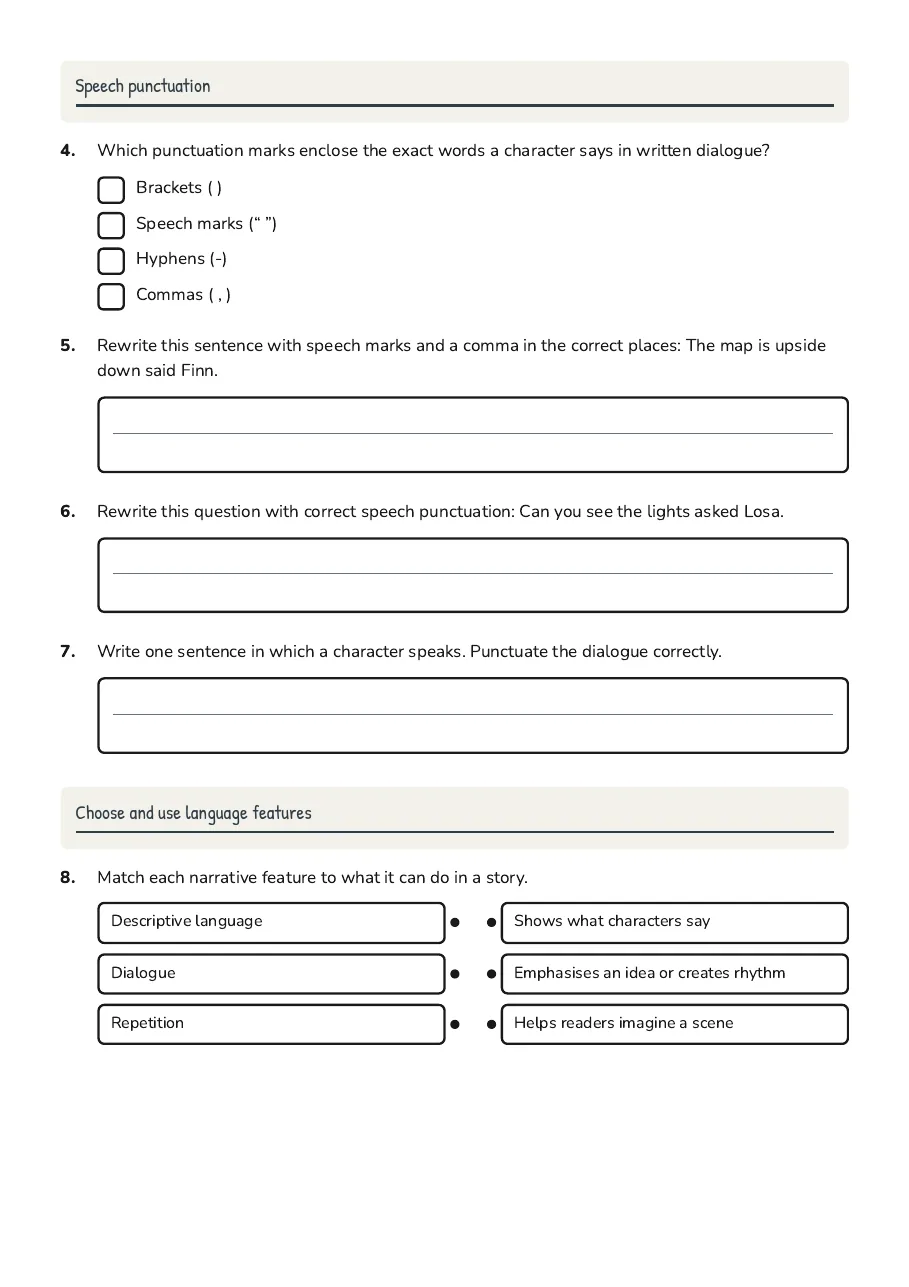
Speech punctuation

4.Which punctuation marks enclose the exact words a character says in written dialogue?
  • Brackets ( )
  • Speech marks (“ ”)
  • Hyphens (-)
  • Commas ( , )
5.Rewrite this sentence with speech marks and a comma in the correct places: The map is upside down said Finn.
6.Rewrite this question with correct speech punctuation: Can you see the lights asked Losa.
7.Write one sentence in which a character speaks. Punctuate the dialogue correctly.

Choose and use language features

8.Match each narrative feature to what it can do in a story.
  • Descriptive language
  • Dialogue
  • Repetition
  • Shows what characters say
  • Emphasises an idea or creates rhythm
  • Helps readers imagine a scene
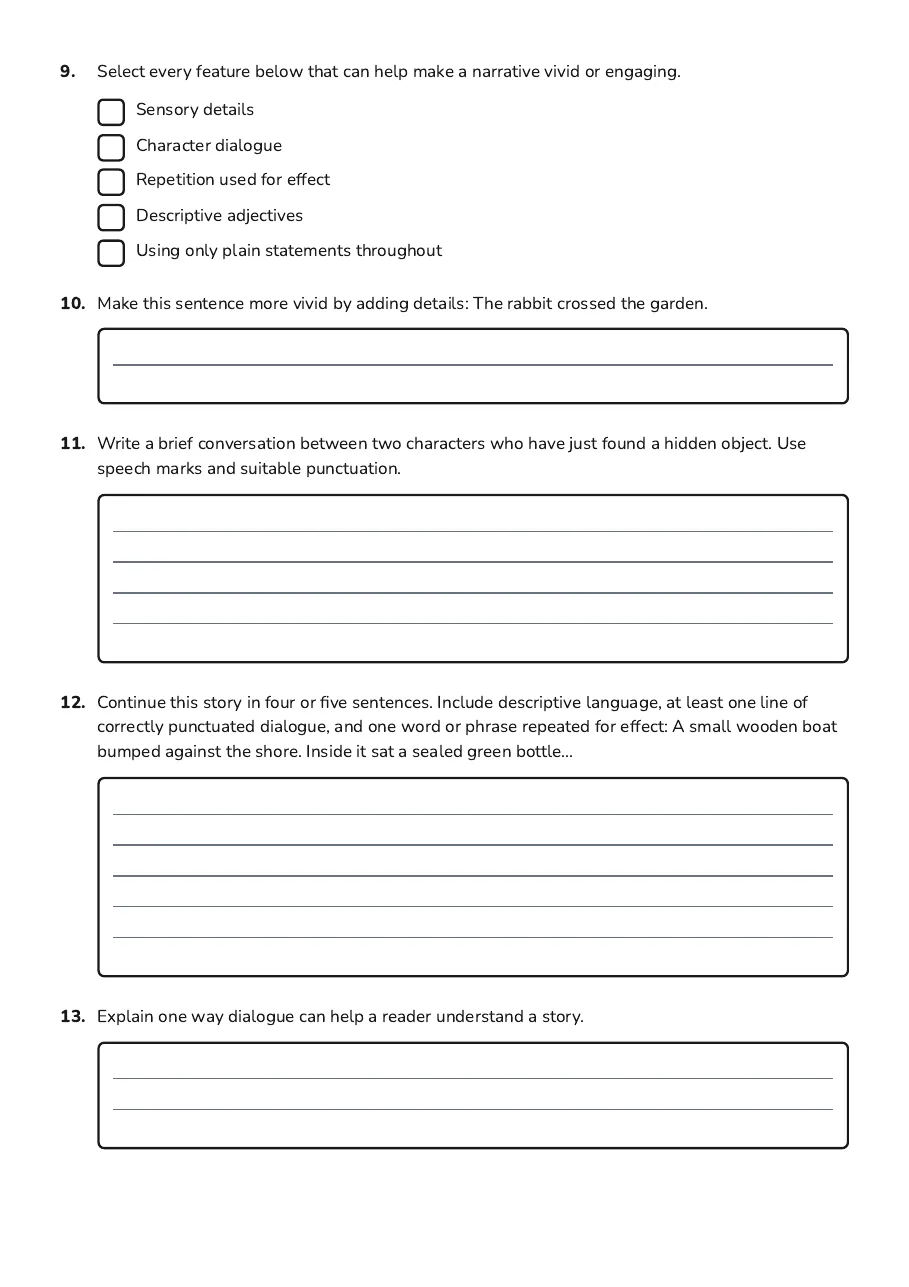
9.Select every feature below that can help make a narrative vivid or engaging.
  • Sensory details
  • Character dialogue
  • Repetition used for effect
  • Descriptive adjectives
  • Using only plain statements throughout
10.Make this sentence more vivid by adding details: The rabbit crossed the garden.
11.Write a brief conversation between two characters who have just found a hidden object. Use speech marks and suitable punctuation.
12.Continue this story in four or five sentences. Include descriptive language, at least one line of correctly punctuated dialogue, and one word or phrase repeated for effect: A small wooden boat bumped against the shore. Inside it sat a sealed green bottle...
13.Explain one way dialogue can help a reader understand a story.
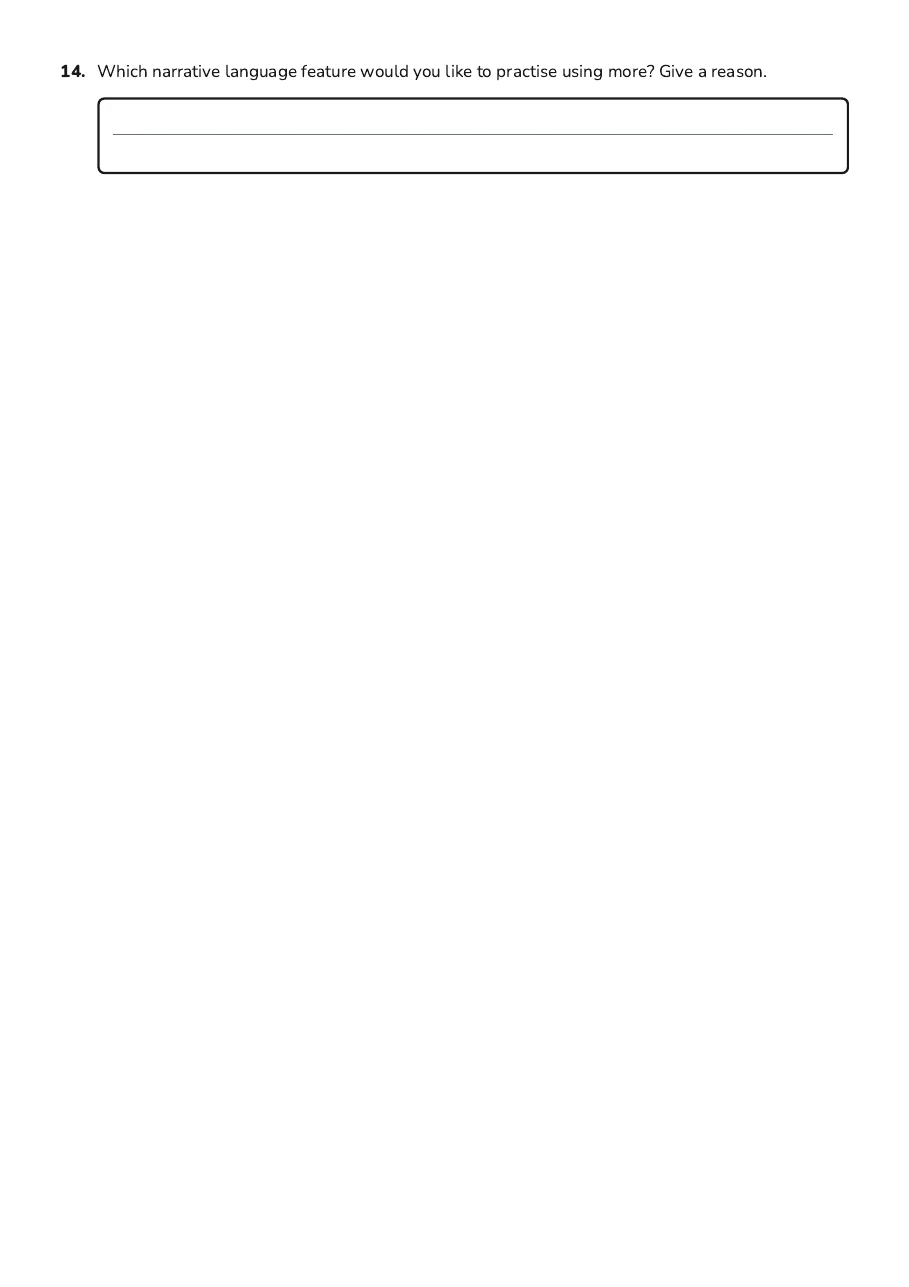
14.Which narrative language feature would you like to practise using more? Give a reason.

4 printable pages

  • Narrative Language Features, page 1 of 4: Read the story, Notice the language

    Page 1

  • Narrative Language Features, page 2 of 4: Speech punctuation, Choose and use language features

    Page 2

  • Narrative Language Features, page 3 of 4: 9. Select every feature below that can help make a narrative vivid or engaging.

    Page 3

  • Narrative Language Features, page 4 of 4: 14. Which narrative language feature would you like to practise using more? Give a reason.

    Page 4

About This Worksheet

Free in Kuraplan

Sign up free, grab the PDF, and customize it for your class.

Print-Ready

Formatted for standard paper. Clean layout, easy to read.

AI-Generated

Created with Kuraplan's AI, designed for real classroom use.

For Teachers & Parents

Use in classrooms, for homework, tutoring, or homeschool.

Need a custom version of this worksheet?

Kuraplan's AI generates custom worksheets in seconds — differentiated for every learner, aligned to your curriculum.

Generate Custom Worksheets — Free
No credit card Curriculum-aligned Under 60 seconds