ScienceFreePrintable

Photosynthesis and Chloroplasts Revision

A free science worksheet ready for your classroom. Open in Kuraplan to grab the print-ready PDF, customize it for your students, or generate a fresh version in seconds.
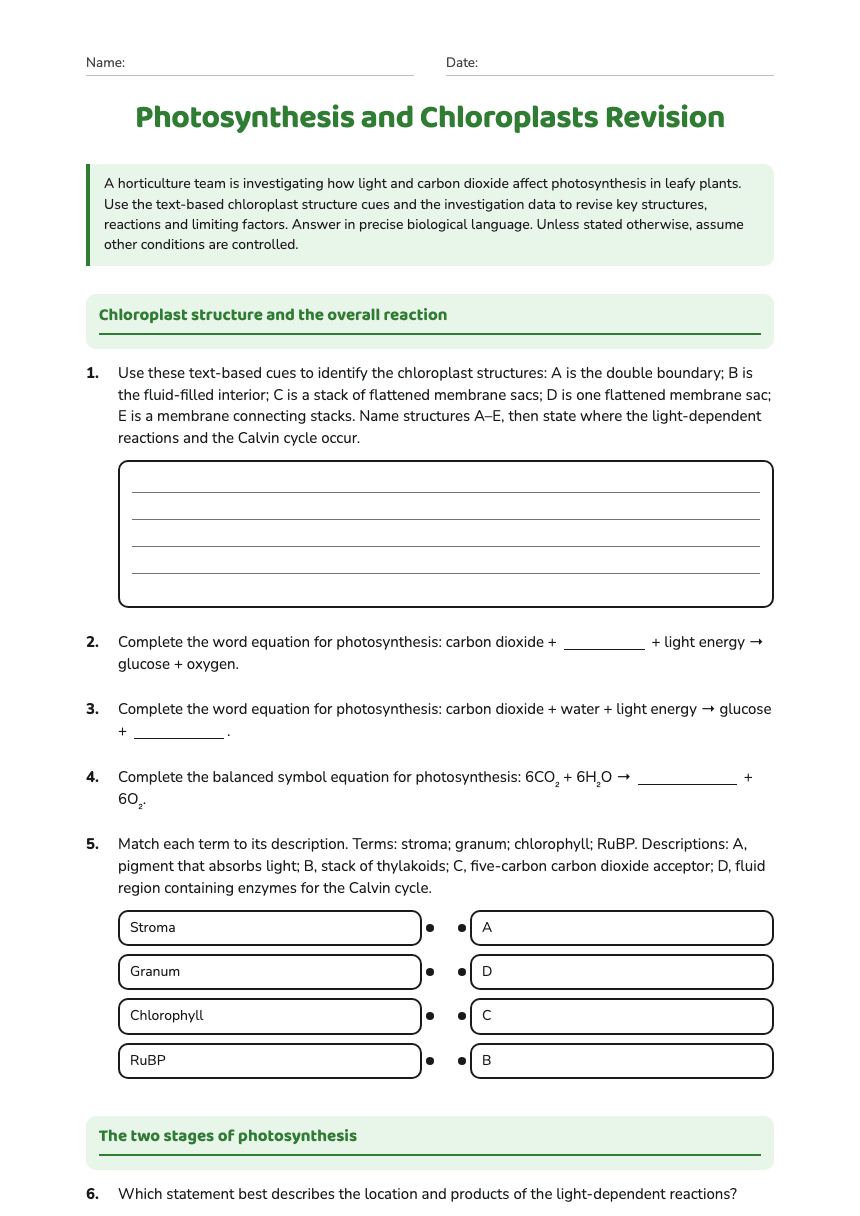
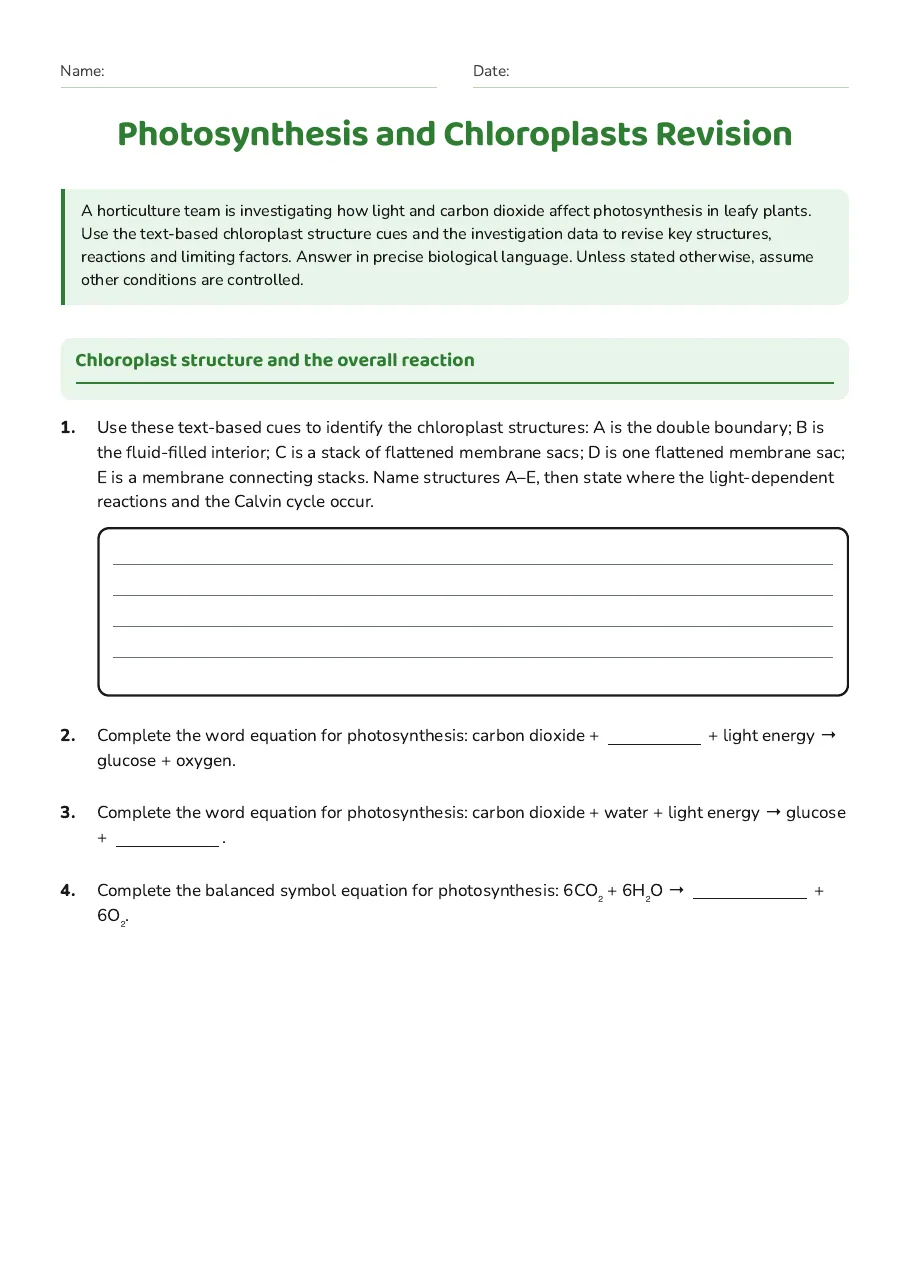
Photosynthesis and Chloroplasts Revision worksheet preview

Photosynthesis and Chloroplasts Revision

Worksheet illustration

Part 1: Structures and Key Terms

Learning intentions: I can identify chloroplast structures, describe their functions, and write the photosynthesis equations.

Instructions: Answer all questions using accurate biological terminology. Use complete sentences for explanation questions.

1. Draw and label a chloroplast. Include the chloroplast envelope, stroma, grana, thylakoids and lamellae. Add one brief function for each labelled structure.
2. Match each term to its description by writing the correct letter beside each term.
1. Stroma _____
2. Granum _____
3. Lamellae _____
4. Chlorophyll _____
5. RuBP _____
A. Pigment that absorbs light energy
B. Fluid-filled region where the Calvin cycle occurs
C. Five-carbon carbon dioxide acceptor
D. Stack of thylakoids
E. Membranes connecting grana
3. Complete both equations for photosynthesis.

Word equation: carbon dioxide + __________ + light energy → glucose + __________

Balanced chemical equation: 6CO2 + 6H2O → __________ + 6O2

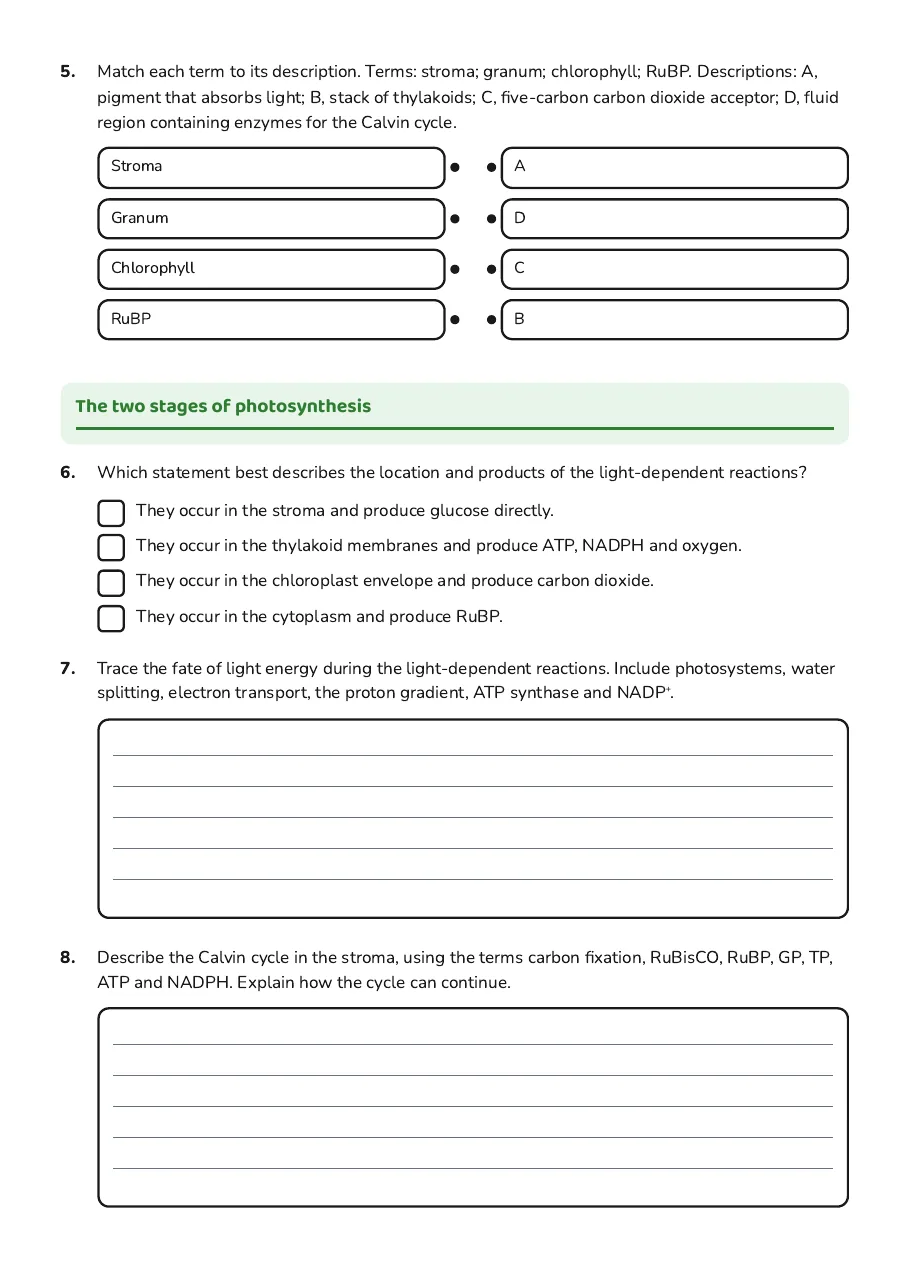
Part 2: The Two Stages of Photosynthesis

4. Which location is the main site of the light-dependent reactions?

Stroma

Thylakoid membrane

Chloroplast envelope

Cytoplasm

5. Explain how light energy is converted into ATP and NADPH during the light-dependent reactions. Include chlorophyll or photosystems, photolysis, electron transport and the role of the thylakoid membrane.
6. Describe the main steps of the Calvin cycle in the stroma. Include carbon fixation, RuBisCO, GP, TP, regeneration of RuBP, and the use of ATP and NADPH.
7. Compare the light-dependent reactions and the Calvin cycle under these headings: location, inputs, outputs and dependence on light. Organise your comparison in a two-column table in the space below.
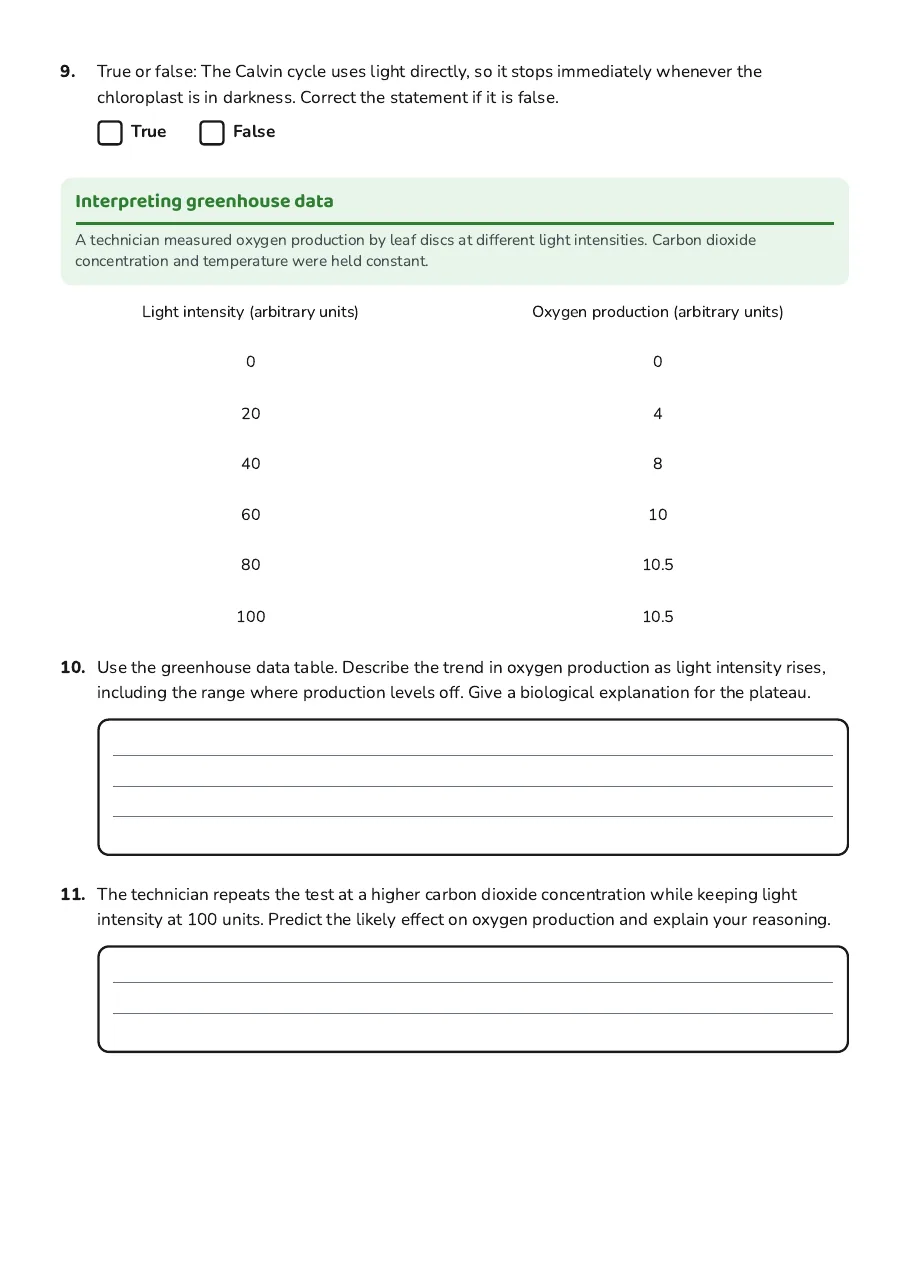
8. A plant was tested at different light intensities. Its rate of photosynthesis was recorded as follows: 0 units of light: 0; 20 units: 4; 40 units: 8; 60 units: 10; 80 units: 10.5; 100 units: 10.5.

a) Describe the pattern in the data.

b) Explain why the rate stops increasing at high light intensity.

c) Name two other factors that can limit the rate of photosynthesis.

Part 3: NCEA-Style Practice and Self-Assessment

9. Achievement: State the effect of increasing carbon dioxide concentration on the rate of photosynthesis when carbon dioxide is initially limiting.
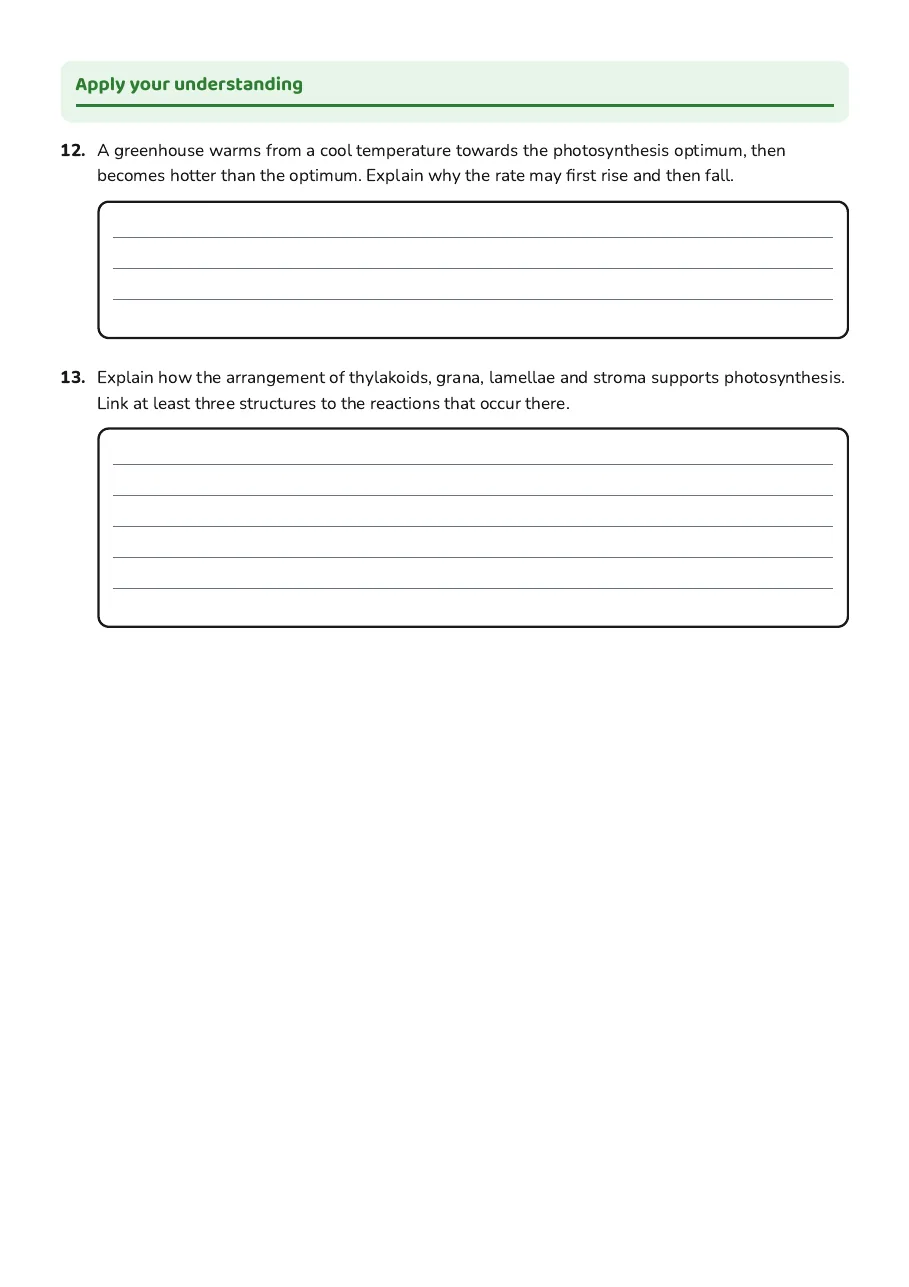
10. Merit: Explain why increasing temperature usually increases the rate of photosynthesis up to an optimum, but causes the rate to decrease above the optimum.
11. Excellence: Explain how chloroplast structure is related to the function of photosynthesis. Link the chloroplast envelope, stroma, thylakoids, grana and lamellae to the light-dependent reactions and the Calvin cycle.

Concise Answer Key

1. Envelope surrounds the chloroplast; stroma is the site of the Calvin cycle; grana are stacks of thylakoids; thylakoid membranes contain photosystems and electron carriers; lamellae connect grana and help transfer materials between them.

2. 1-B, 2-D, 3-E, 4-A, 5-C.

3. Word equation: carbon dioxide + water + light energy → glucose + oxygen. Balanced equation: 6CO2 + 6H2O → C6H12O6 + 6O2.

4. Thylakoid membrane. 5. Light excites chlorophyll in photosystems; water undergoes photolysis, releasing electrons, hydrogen ions and oxygen; electrons pass along carriers; the proton gradient drives ATP synthase; NADP+ is reduced to NADPH.

6. RuBisCO attaches CO2 to RuBP; unstable molecules form GP; ATP and NADPH convert GP to TP; some TP forms glucose and the remainder regenerates RuBP using ATP.

7. Light-dependent reactions: thylakoid membranes; require light and water; produce ATP, NADPH and oxygen. Calvin cycle: stroma; uses CO2, ATP and NADPH; produces TP; does not use light directly.

8. Rate rises, then levels off; another factor becomes limiting, such as carbon dioxide concentration, temperature or enzyme capacity. 9. Rate increases until another factor becomes limiting. 10. Enzyme-controlled reactions speed up to an optimum; above it, enzymes lose their shape and the rate falls.

Self-Assessment Checklist

Tick each statement when you can do it confidently.

I can label the main parts of a chloroplast.

I can write the word and balanced equations for photosynthesis.

I can describe the light-dependent reactions.

I can explain the Calvin cycle using GP, TP and RuBP.

I can interpret a photosynthesis rate graph or data set.

I can link chloroplast structure to its function.

About This Worksheet

Free in Kuraplan

Sign up free, grab the PDF, and customize it for your class.

Print-Ready

Formatted for standard paper. Clean layout, easy to read.

AI-Generated

Created with Kuraplan's AI, designed for real classroom use.

For Teachers & Parents

Use in classrooms, for homework, tutoring, or homeschool.

Need a custom version of this worksheet?

Kuraplan's AI generates custom worksheets in seconds — differentiated for every learner, aligned to your curriculum.

Generate Custom Worksheets — Free
No credit card Curriculum-aligned Under 60 seconds