ScienceFreePrintable

Plants for Wellbeing Exploration

A free science worksheet ready for your classroom. Open in Kuraplan to grab the print-ready PDF, customize it for your students, or generate a fresh version in seconds.
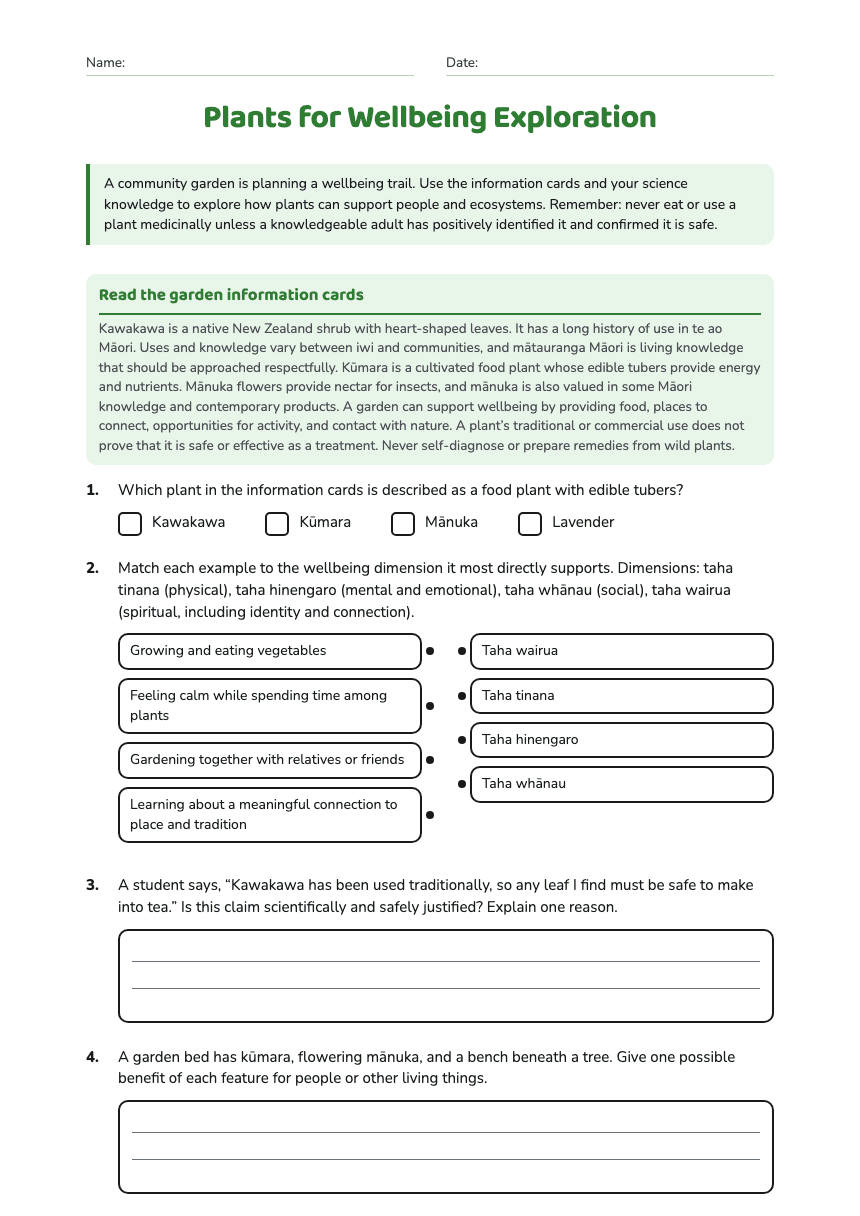
Plants for Wellbeing Exploration worksheet preview
Name:Date:

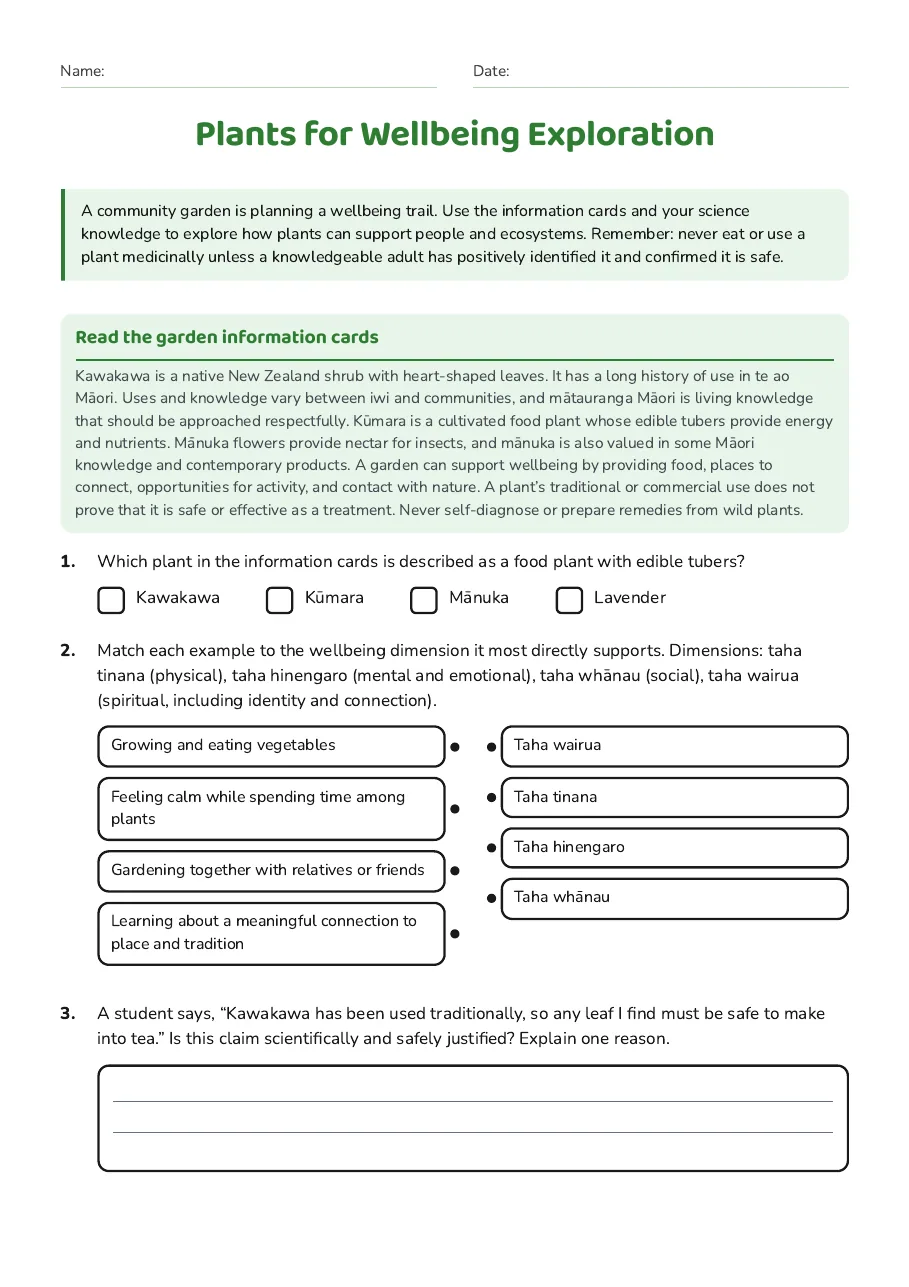
Plants for Wellbeing Exploration

A community garden is planning a wellbeing trail. Use the information cards and your science knowledge to explore how plants can support people and ecosystems. Remember: never eat or use a plant medicinally unless a knowledgeable adult has positively identified it and confirmed it is safe.

Read the garden information cards

Kawakawa is a native New Zealand shrub with heart-shaped leaves. It has a long history of use in te ao Māori. Uses and knowledge vary between iwi and communities, and mātauranga Māori is living knowledge that should be approached respectfully. Kūmara is a cultivated food plant whose edible tubers provide energy and nutrients. Mānuka flowers provide nectar for insects, and mānuka is also valued in some Māori knowledge and contemporary products. A garden can support wellbeing by providing food, places to connect, opportunities for activity, and contact with nature. A plant’s traditional or commercial use does not prove that it is safe or effective as a treatment. Never self-diagnose or prepare remedies from wild plants.

1.Which plant in the information cards is described as a food plant with edible tubers?
  • Kawakawa
  • Kūmara
  • Mānuka
  • Lavender
2.Match each example to the wellbeing dimension it most directly supports. Dimensions: taha tinana (physical), taha hinengaro (mental and emotional), taha whānau (social), taha wairua (spiritual, including identity and connection).
  • Growing and eating vegetables
  • Feeling calm while spending time among plants
  • Gardening together with relatives or friends
  • Learning about a meaningful connection to place and tradition
  • Taha wairua
  • Taha tinana
  • Taha hinengaro
  • Taha whānau
3.A student says, “Kawakawa has been used traditionally, so any leaf I find must be safe to make into tea.” Is this claim scientifically and safely justified? Explain one reason.
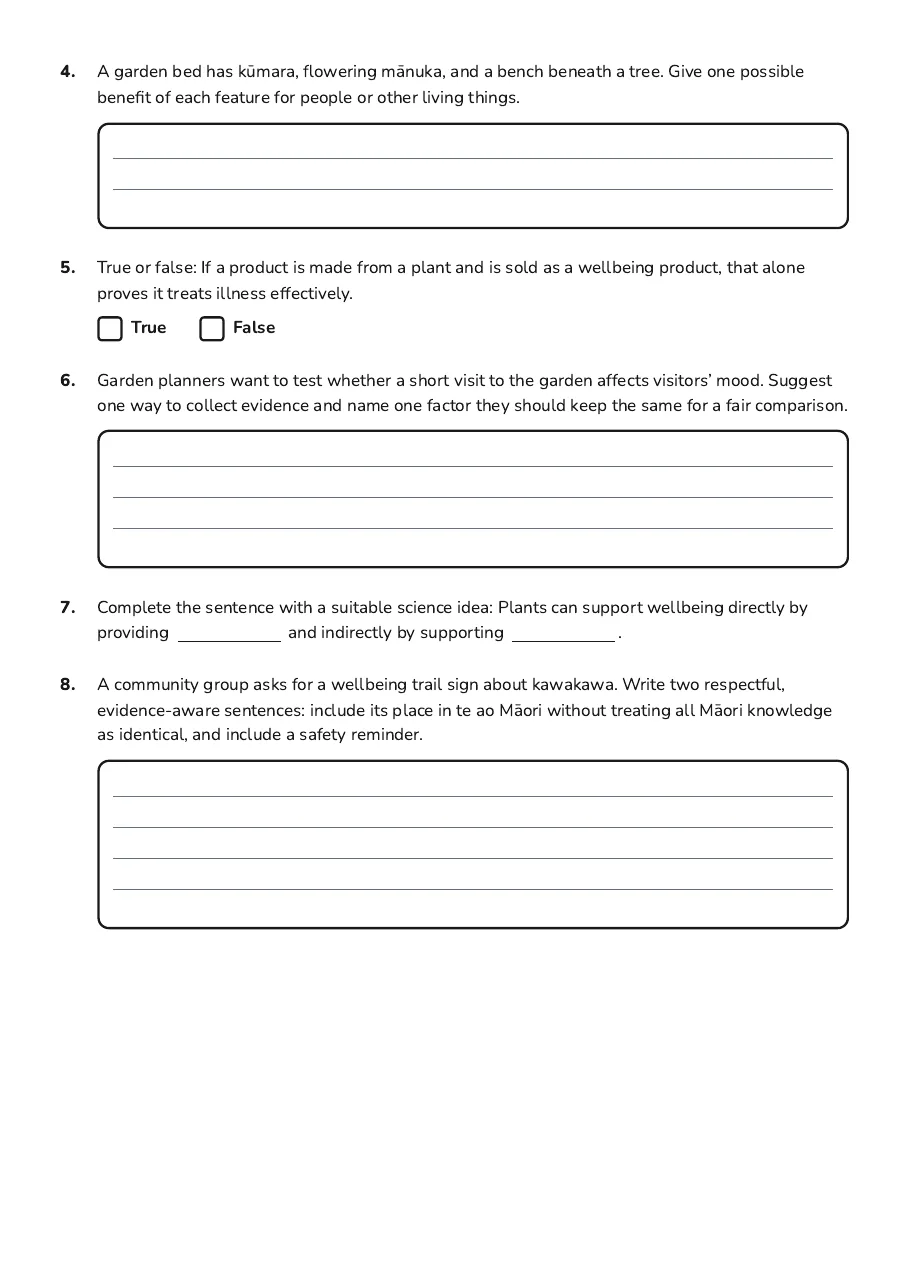
4.A garden bed has kūmara, flowering mānuka, and a bench beneath a tree. Give one possible benefit of each feature for people or other living things.
5.True or false: If a product is made from a plant and is sold as a wellbeing product, that alone proves it treats illness effectively.
TrueFalse
6.Garden planners want to test whether a short visit to the garden affects visitors’ mood. Suggest one way to collect evidence and name one factor they should keep the same for a fair comparison.
7.Complete the sentence with a suitable science idea: Plants can support wellbeing directly by providing and indirectly by supporting .
8.A community group asks for a wellbeing trail sign about kawakawa. Write two respectful, evidence-aware sentences: include its place in te ao Māori without treating all Māori knowledge as identical, and include a safety reminder.

2 printable pages

  • Plants for Wellbeing Exploration, page 1 of 2: Read the garden information cards

    Page 1

  • Plants for Wellbeing Exploration, page 2 of 2: 4. A garden bed has kū mara, flowering mā nuka, and a bench beneath a tree. Give one…

    Page 2

About This Worksheet

Free in Kuraplan

Sign up free, grab the PDF, and customize it for your class.

Print-Ready

Formatted for standard paper. Clean layout, easy to read.

AI-Generated

Created with Kuraplan's AI, designed for real classroom use.

For Teachers & Parents

Use in classrooms, for homework, tutoring, or homeschool.

Need a custom version of this worksheet?

Kuraplan's AI generates custom worksheets in seconds — differentiated for every learner, aligned to your curriculum.

Generate Custom Worksheets — Free
No credit card Curriculum-aligned Under 60 seconds