ScienceFreePrintable

Storm Impact Habitat Simulation

A free science worksheet ready for your classroom. Open in Kuraplan to grab the print-ready PDF, customize it for your students, or generate a fresh version in seconds.
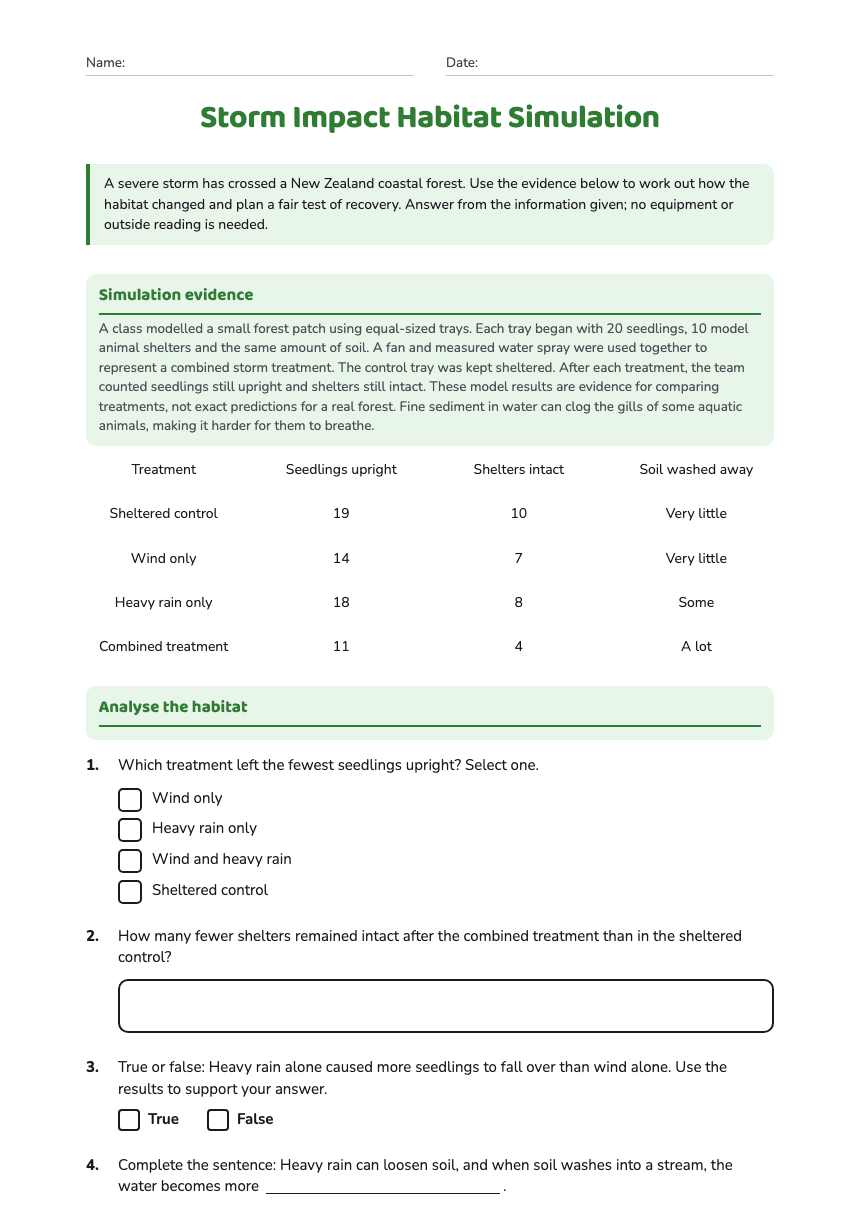
Storm Impact Habitat Simulation worksheet preview
Name:Date:

Storm Impact Habitat Simulation

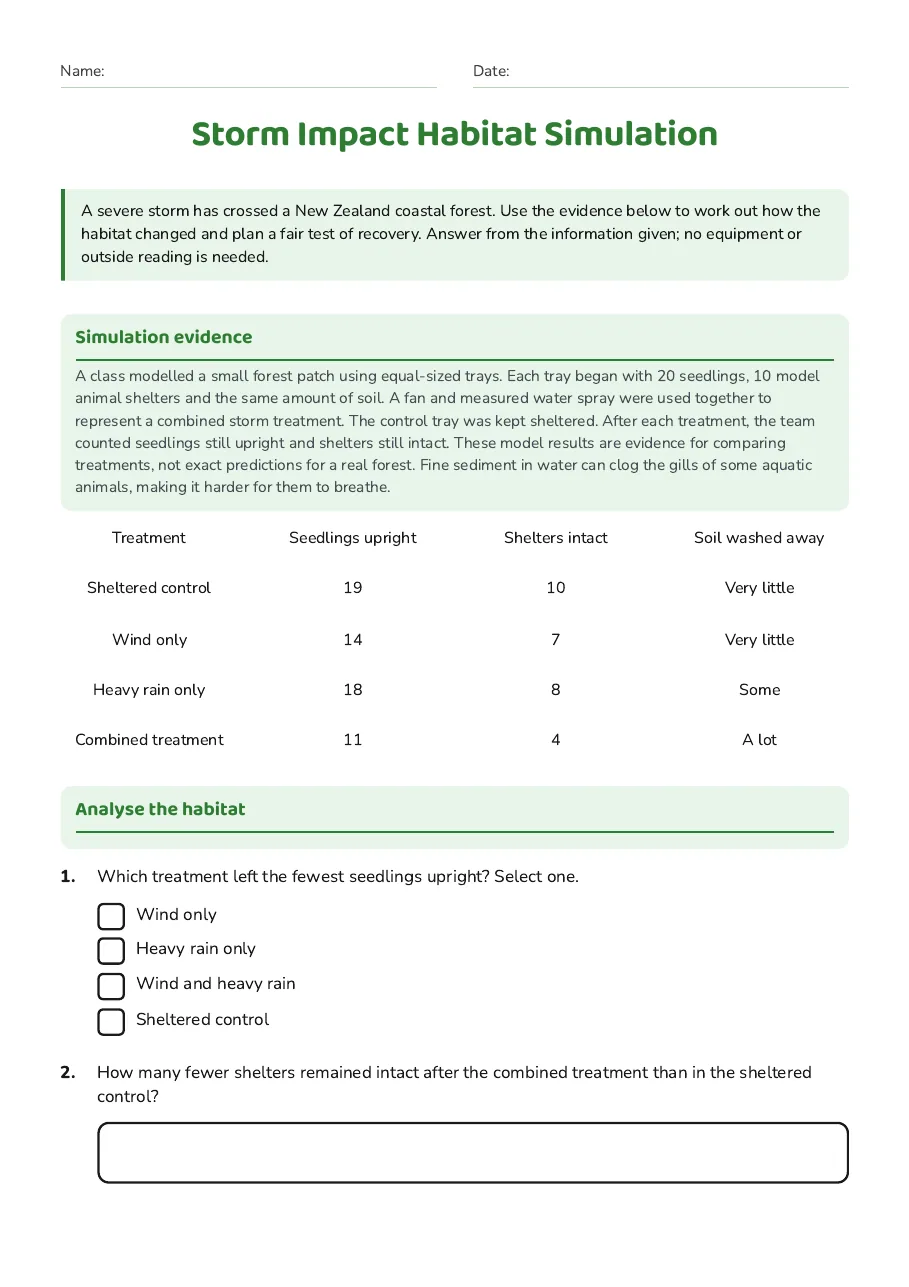
A severe storm has crossed a New Zealand coastal forest. Use the evidence below to work out how the habitat changed and plan a fair test of recovery. Answer from the information given; no equipment or outside reading is needed.

Simulation evidence

A class modelled a small forest patch using equal-sized trays. Each tray began with 20 seedlings, 10 model animal shelters and the same amount of soil. A fan and measured water spray were used together to represent a combined storm treatment. The control tray was kept sheltered. After each treatment, the team counted seedlings still upright and shelters still intact. These model results are evidence for comparing treatments, not exact predictions for a real forest. Fine sediment in water can clog the gills of some aquatic animals, making it harder for them to breathe.

Treatment

Seedlings upright

Shelters intact

Soil washed away

Sheltered control

19

10

Very little

Wind only

14

7

Very little

Heavy rain only

18

8

Some

Combined treatment

11

4

A lot

Analyse the habitat

1.Which treatment left the fewest seedlings upright? Select one.
  • Wind only
  • Heavy rain only
  • Wind and heavy rain
  • Sheltered control
2.How many fewer shelters remained intact after the combined treatment than in the sheltered control?
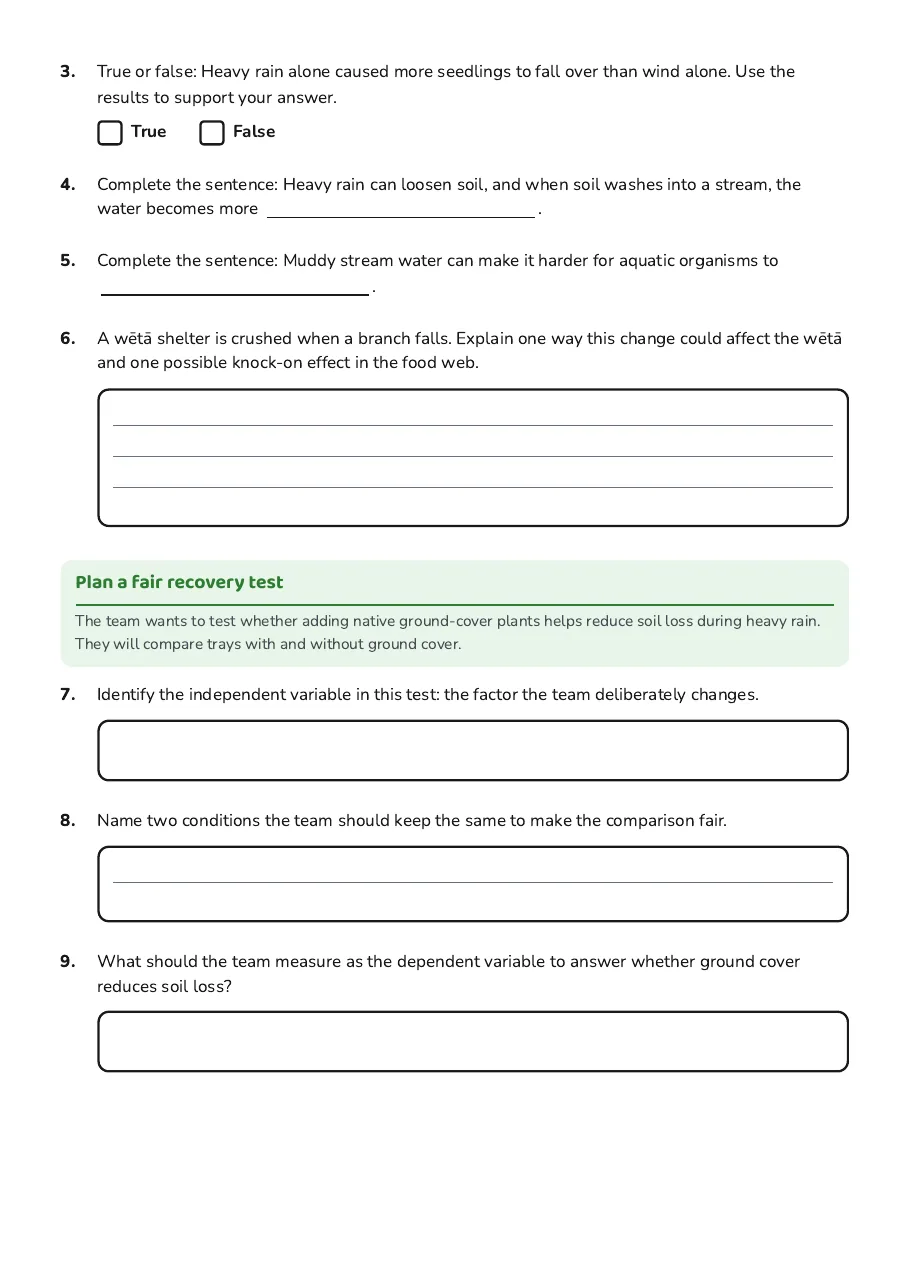
3.True or false: Heavy rain alone caused more seedlings to fall over than wind alone. Use the results to support your answer.
TrueFalse
4.Complete the sentence: Heavy rain can loosen soil, and when soil washes into a stream, the water becomes more .
5.Complete the sentence: Muddy stream water can make it harder for aquatic organisms to .
6.A wētā shelter is crushed when a branch falls. Explain one way this change could affect the wētā and one possible knock-on effect in the food web.

Plan a fair recovery test

The team wants to test whether adding native ground-cover plants helps reduce soil loss during heavy rain. They will compare trays with and without ground cover.

7.Identify the independent variable in this test: the factor the team deliberately changes.
8.Name two conditions the team should keep the same to make the comparison fair.
9.What should the team measure as the dependent variable to answer whether ground cover reduces soil loss?
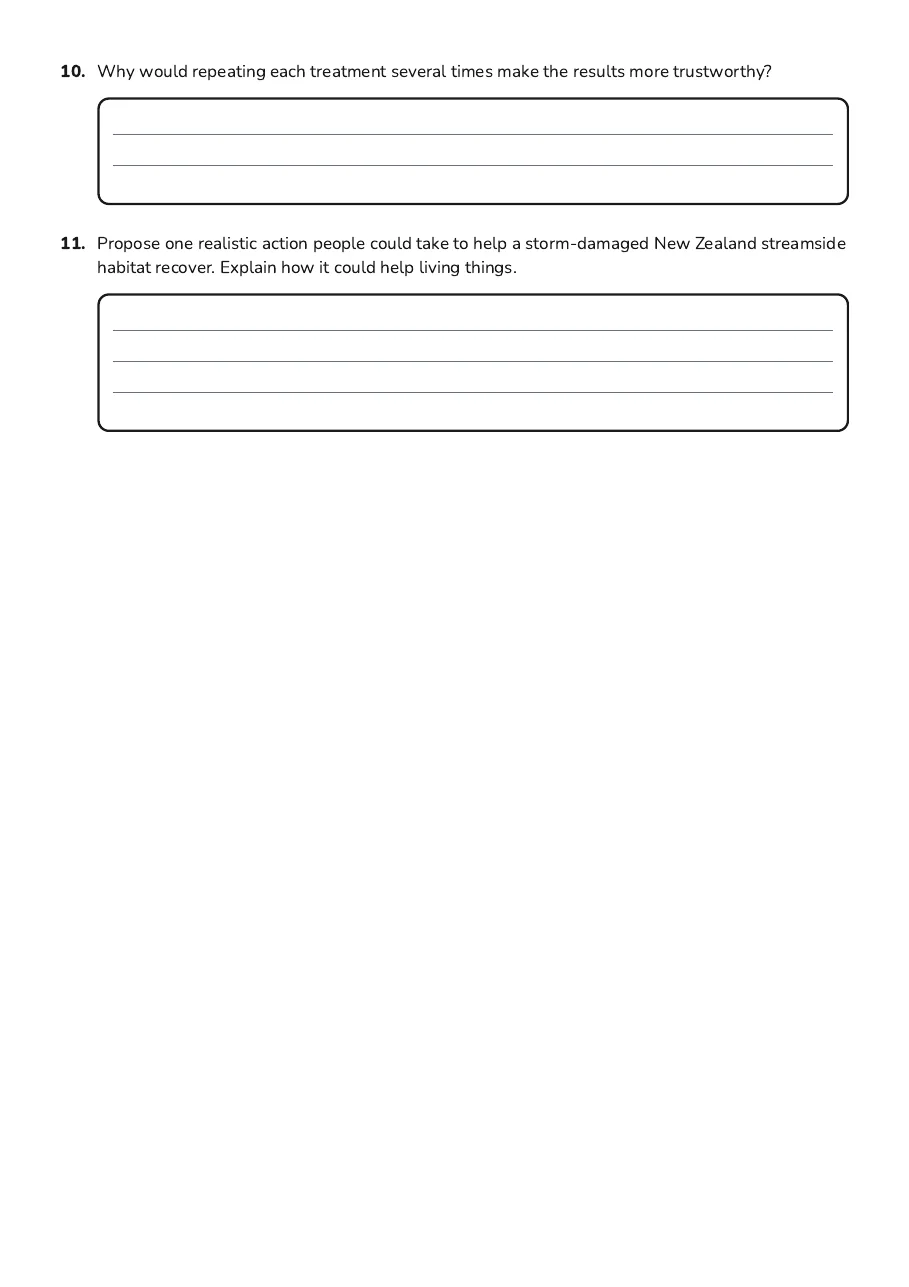
10.Why would repeating each treatment several times make the results more trustworthy?
11.Propose one realistic action people could take to help a storm-damaged New Zealand streamside habitat recover. Explain how it could help living things.

3 printable pages

  • Storm Impact Habitat Simulation, page 1 of 3: Simulation evidence, Analyse the habitat

    Page 1

  • Storm Impact Habitat Simulation, page 2 of 3: Plan a fair recovery test

    Page 2

  • Storm Impact Habitat Simulation, page 3 of 3: 10. Why would repeating each treatment several times make the results more trustworthy?

    Page 3

About This Worksheet

Free in Kuraplan

Sign up free, grab the PDF, and customize it for your class.

Print-Ready

Formatted for standard paper. Clean layout, easy to read.

AI-Generated

Created with Kuraplan's AI, designed for real classroom use.

For Teachers & Parents

Use in classrooms, for homework, tutoring, or homeschool.

Need a custom version of this worksheet?

Kuraplan's AI generates custom worksheets in seconds — differentiated for every learner, aligned to your curriculum.

Generate Custom Worksheets — Free
No credit card Curriculum-aligned Under 60 seconds