ScienceFreePrintable
States of Matter Classification
A free science worksheet ready for your classroom. Open in Kuraplan to grab the print-ready PDF, customize it for your students, or generate a fresh version in seconds.
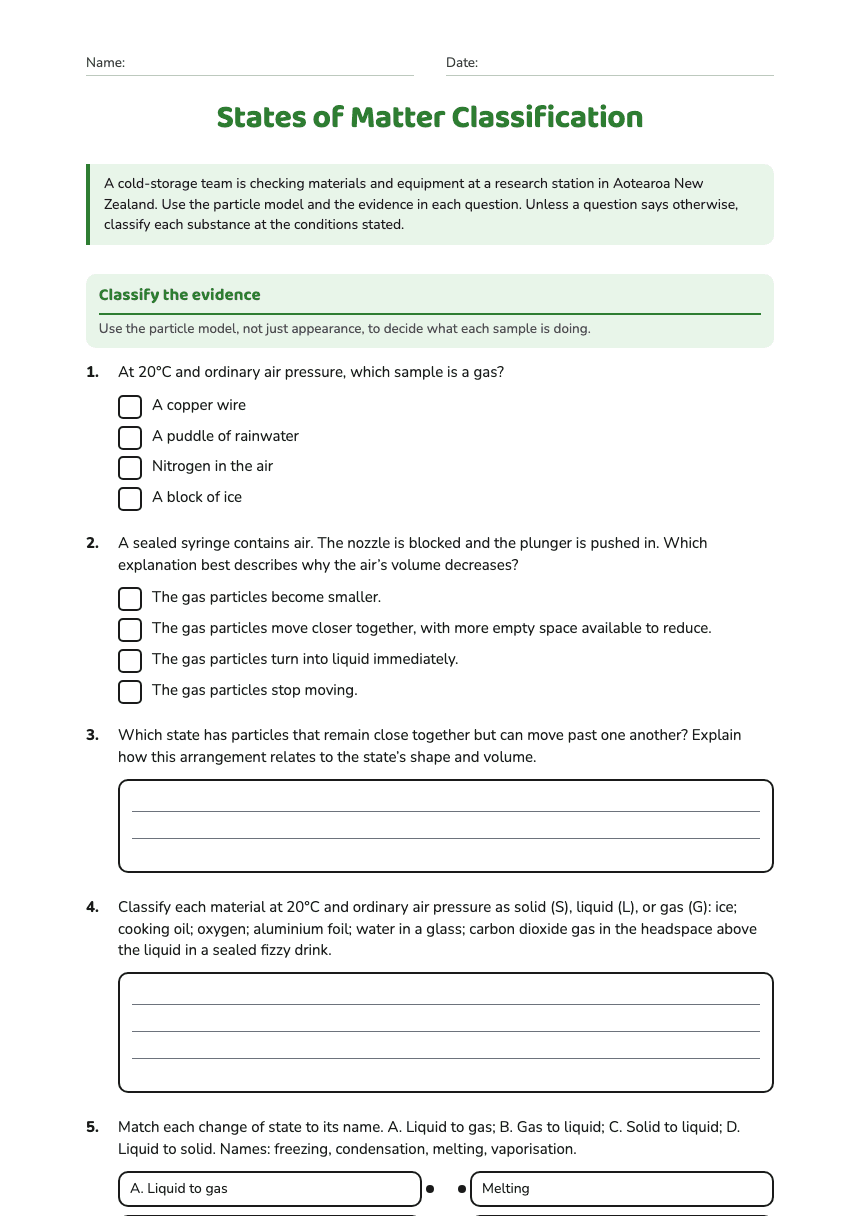
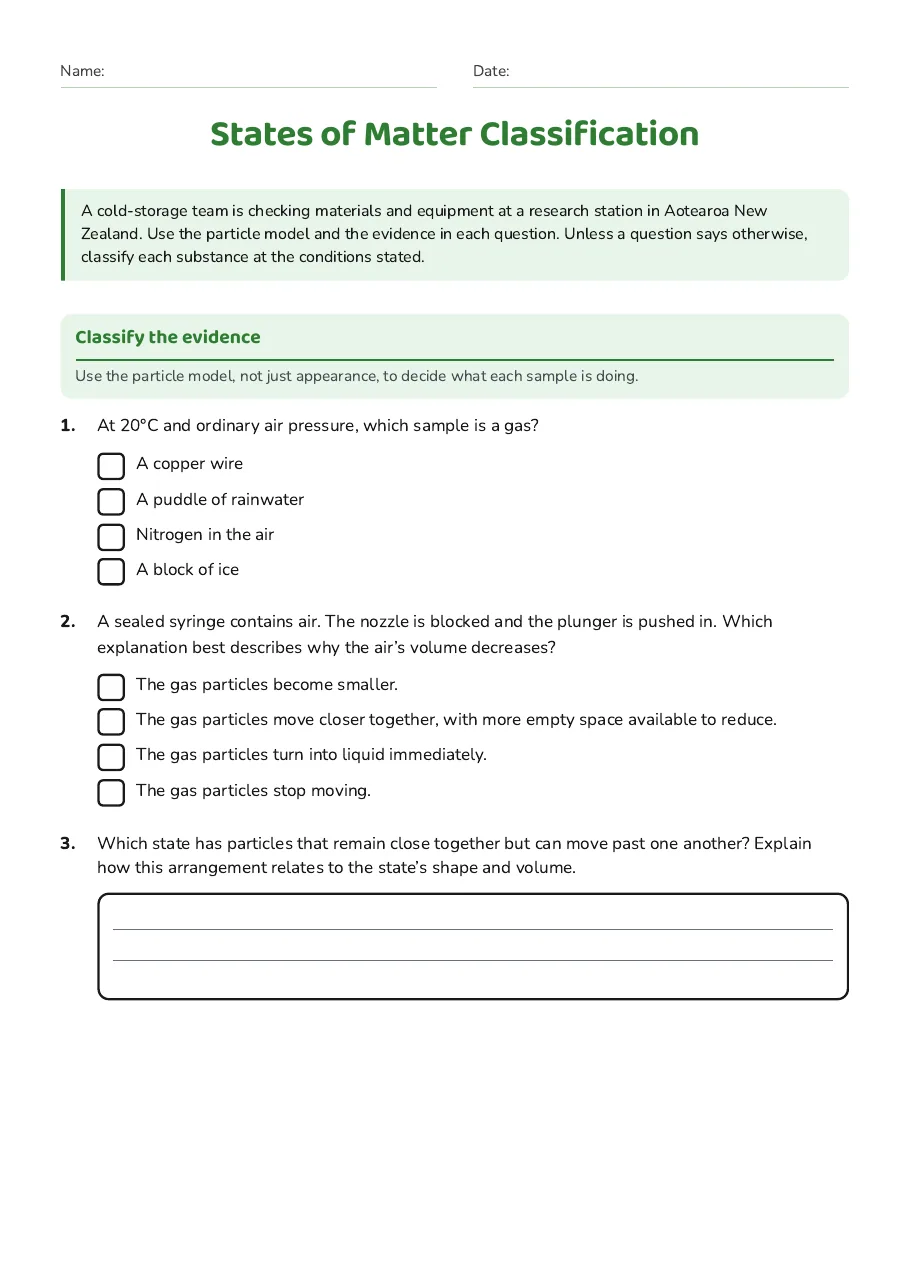
Name:Date:
States of Matter Classification
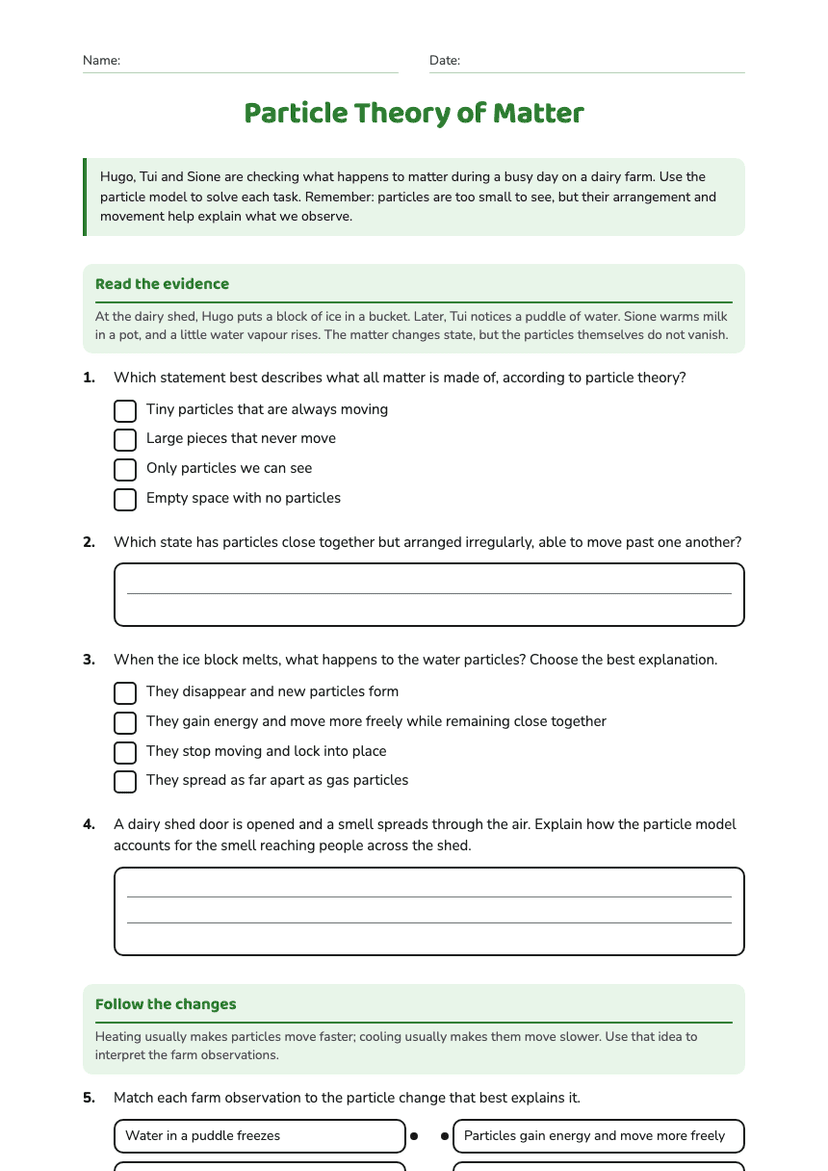
A cold-storage team is checking materials and equipment at a research station in Aotearoa New Zealand. Use the particle model and the evidence in each question. Unless a question says otherwise, classify each substance at the conditions stated.
Classify the evidence
Use the particle model, not just appearance, to decide what each sample is doing.
1.At 20°C and ordinary air pressure, which sample is a gas?
- A copper wire
- A puddle of rainwater
- Nitrogen in the air
- A block of ice
2.A sealed syringe contains air. The nozzle is blocked and the plunger is pushed in. Which explanation best describes why the air’s volume decreases?
- The gas particles become smaller.
- The gas particles move closer together, with more empty space available to reduce.
- The gas particles turn into liquid immediately.
- The gas particles stop moving.
3.Which state has particles that remain close together but can move past one another? Explain how this arrangement relates to the state’s shape and volume.
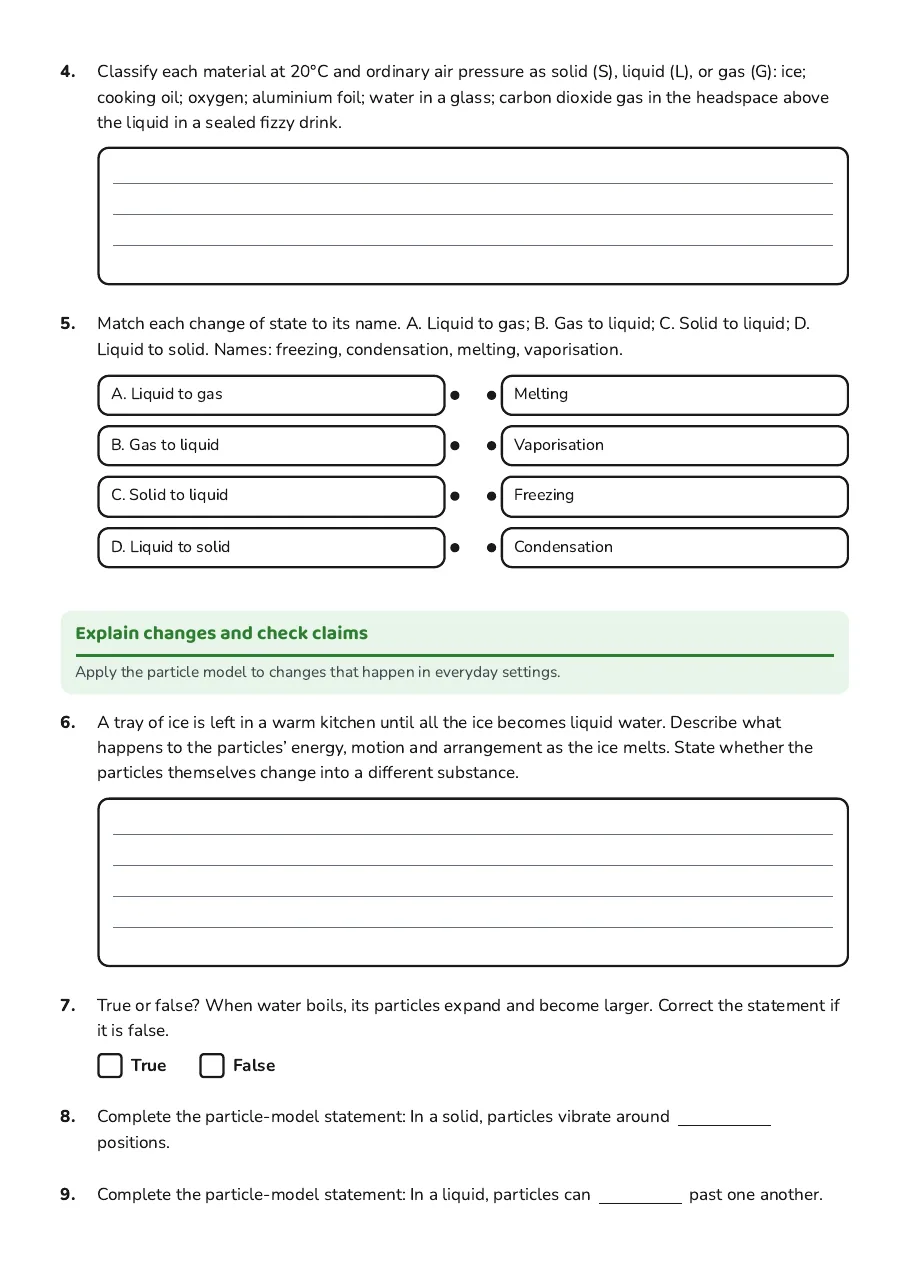
4.Classify each material at 20°C and ordinary air pressure as solid (S), liquid (L), or gas (G): ice; cooking oil; oxygen; aluminium foil; water in a glass; carbon dioxide gas in the headspace above the liquid in a sealed fizzy drink.
5.Match each change of state to its name. A. Liquid to gas; B. Gas to liquid; C. Solid to liquid; D. Liquid to solid. Names: freezing, condensation, melting, vaporisation.
- A. Liquid to gas
- B. Gas to liquid
- C. Solid to liquid
- D. Liquid to solid
- Melting
- Vaporisation
- Freezing
- Condensation
Explain changes and check claims
Apply the particle model to changes that happen in everyday settings.
6.A tray of ice is left in a warm kitchen until all the ice becomes liquid water. Describe what happens to the particles’ energy, motion and arrangement as the ice melts. State whether the particles themselves change into a different substance.
7.True or false? When water boils, its particles expand and become larger. Correct the statement if it is false.
TrueFalse
8.Complete the particle-model statement: In a solid, particles vibrate around positions.
9.Complete the particle-model statement: In a liquid, particles can past one another.
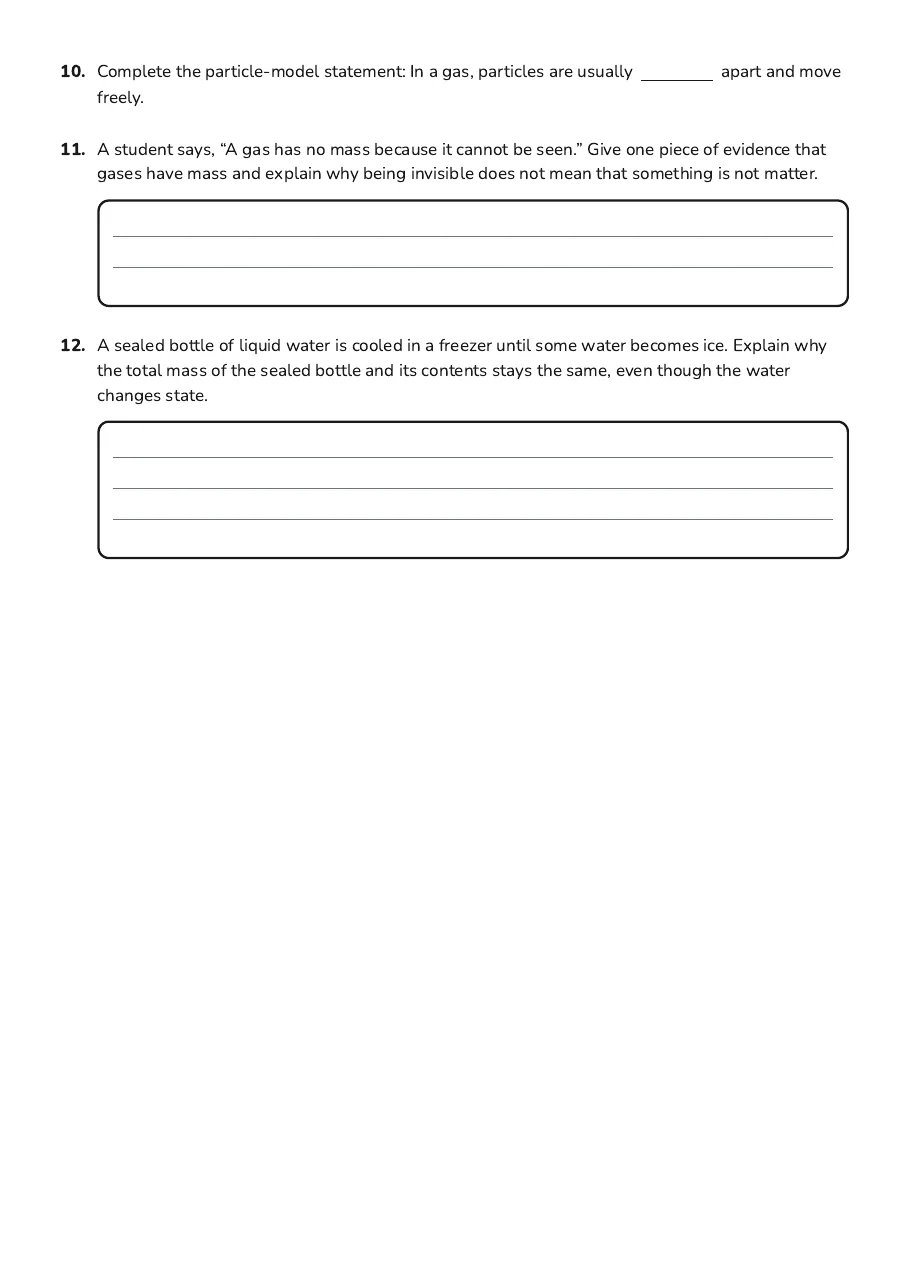
10.Complete the particle-model statement: In a gas, particles are usually apart and move freely.
11.A student says, “A gas has no mass because it cannot be seen.” Give one piece of evidence that gases have mass and explain why being invisible does not mean that something is not matter.
12.A sealed bottle of liquid water is cooled in a freezer until some water becomes ice. Explain why the total mass of the sealed bottle and its contents stays the same, even though the water changes state.
3 printable pages
Page 1
Page 2
Page 3
About This Worksheet
Free in Kuraplan
Sign up free, grab the PDF, and customize it for your class.
Print-Ready
Formatted for standard paper. Clean layout, easy to read.
AI-Generated
Created with Kuraplan's AI, designed for real classroom use.
For Teachers & Parents
Use in classrooms, for homework, tutoring, or homeschool.
Need a custom version of this worksheet?
Kuraplan's AI generates custom worksheets in seconds — differentiated for every learner, aligned to your curriculum.
Generate Custom Worksheets — Free No credit card Curriculum-aligned Under 60 seconds