ScienceFreePrintable

States of Matter Exploration

A free science worksheet ready for your classroom. Open in Kuraplan to grab the print-ready PDF, customize it for your students, or generate a fresh version in seconds.
States of Matter Exploration worksheet preview
Name:Date:

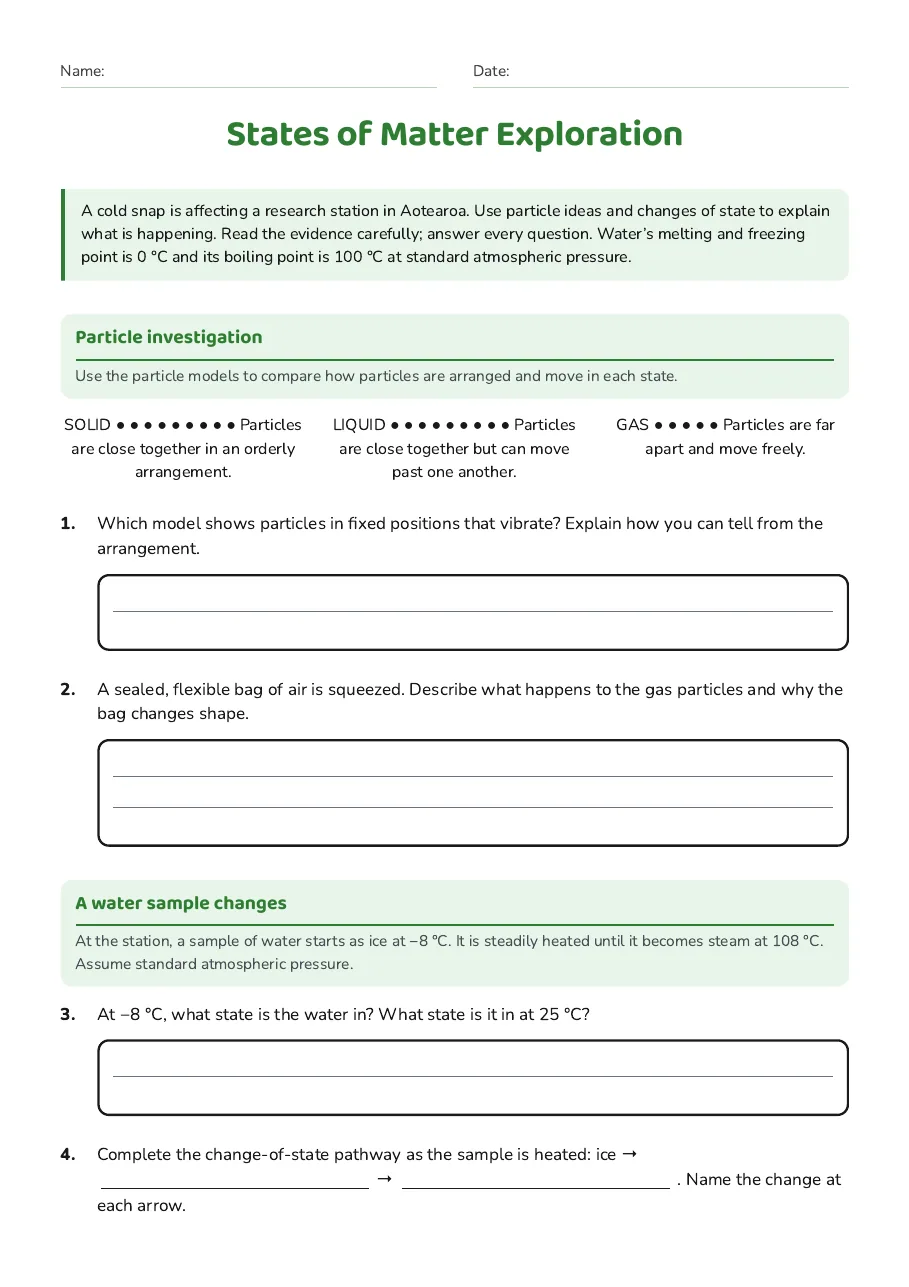
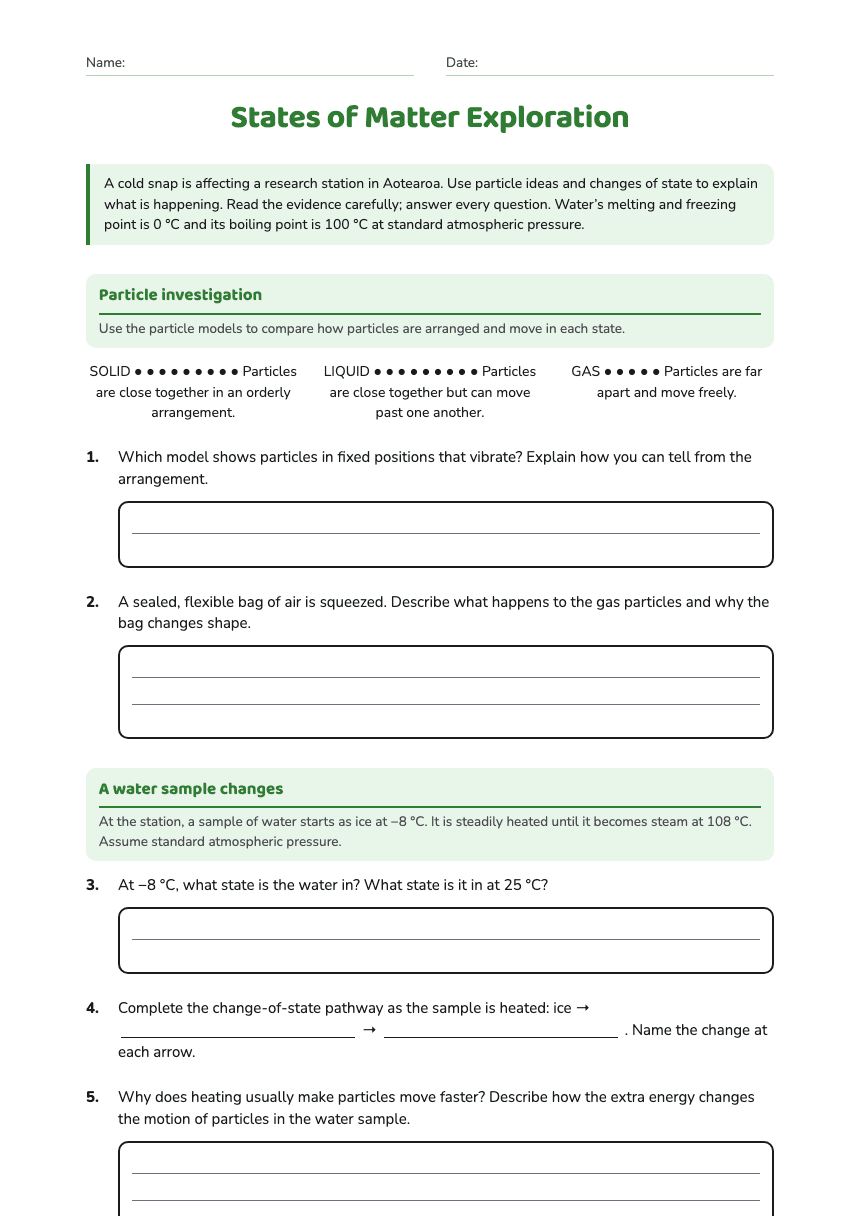
States of Matter Exploration

A cold snap is affecting a research station in Aotearoa. Use particle ideas and changes of state to explain what is happening. Read the evidence carefully; answer every question. Water’s melting and freezing point is 0 °C and its boiling point is 100 °C at standard atmospheric pressure.

Particle investigation

Use the particle models to compare how particles are arranged and move in each state.

SOLID ● ● ● ● ● ● ● ● ● Particles are close together in an orderly arrangement.

LIQUID ● ● ● ● ● ● ● ● ● Particles are close together but can move past one another.

GAS ● ● ● ● ● Particles are far apart and move freely.

1.Which model shows particles in fixed positions that vibrate? Explain how you can tell from the arrangement.
2.A sealed, flexible bag of air is squeezed. Describe what happens to the gas particles and why the bag changes shape.

A water sample changes

At the station, a sample of water starts as ice at −8 °C. It is steadily heated until it becomes steam at 108 °C. Assume standard atmospheric pressure.

3.At −8 °C, what state is the water in? What state is it in at 25 °C?
4.Complete the change-of-state pathway as the sample is heated: ice → → . Name the change at each arrow.
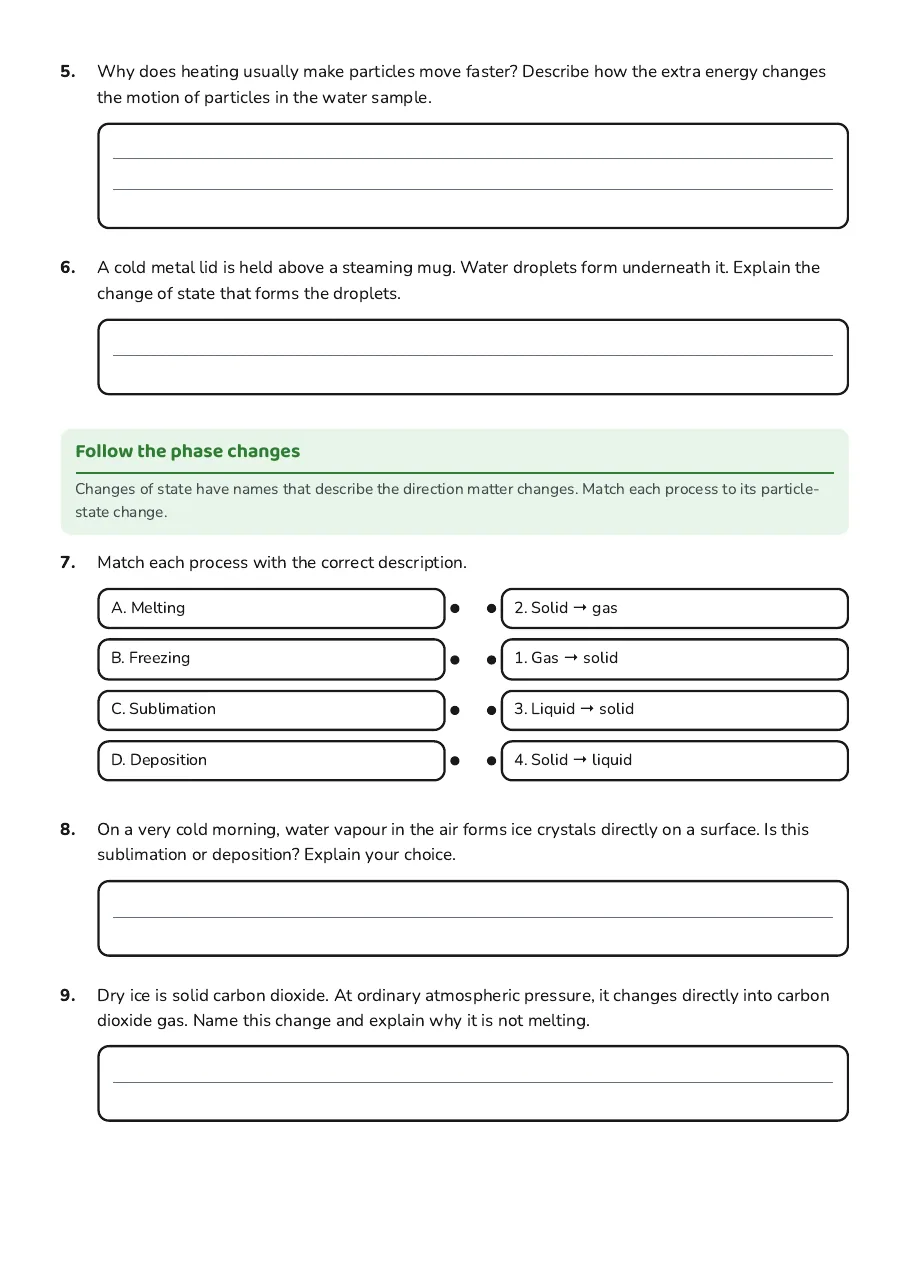
5.Why does heating usually make particles move faster? Describe how the extra energy changes the motion of particles in the water sample.
6.A cold metal lid is held above a steaming mug. Water droplets form underneath it. Explain the change of state that forms the droplets.

Follow the phase changes

Changes of state have names that describe the direction matter changes. Match each process to its particle-state change.

7.Match each process with the correct description.
  • A. Melting
  • B. Freezing
  • C. Sublimation
  • D. Deposition
  • 2. Solid → gas
  • 1. Gas → solid
  • 3. Liquid → solid
  • 4. Solid → liquid
8.On a very cold morning, water vapour in the air forms ice crystals directly on a surface. Is this sublimation or deposition? Explain your choice.
9.Dry ice is solid carbon dioxide. At ordinary atmospheric pressure, it changes directly into carbon dioxide gas. Name this change and explain why it is not melting.
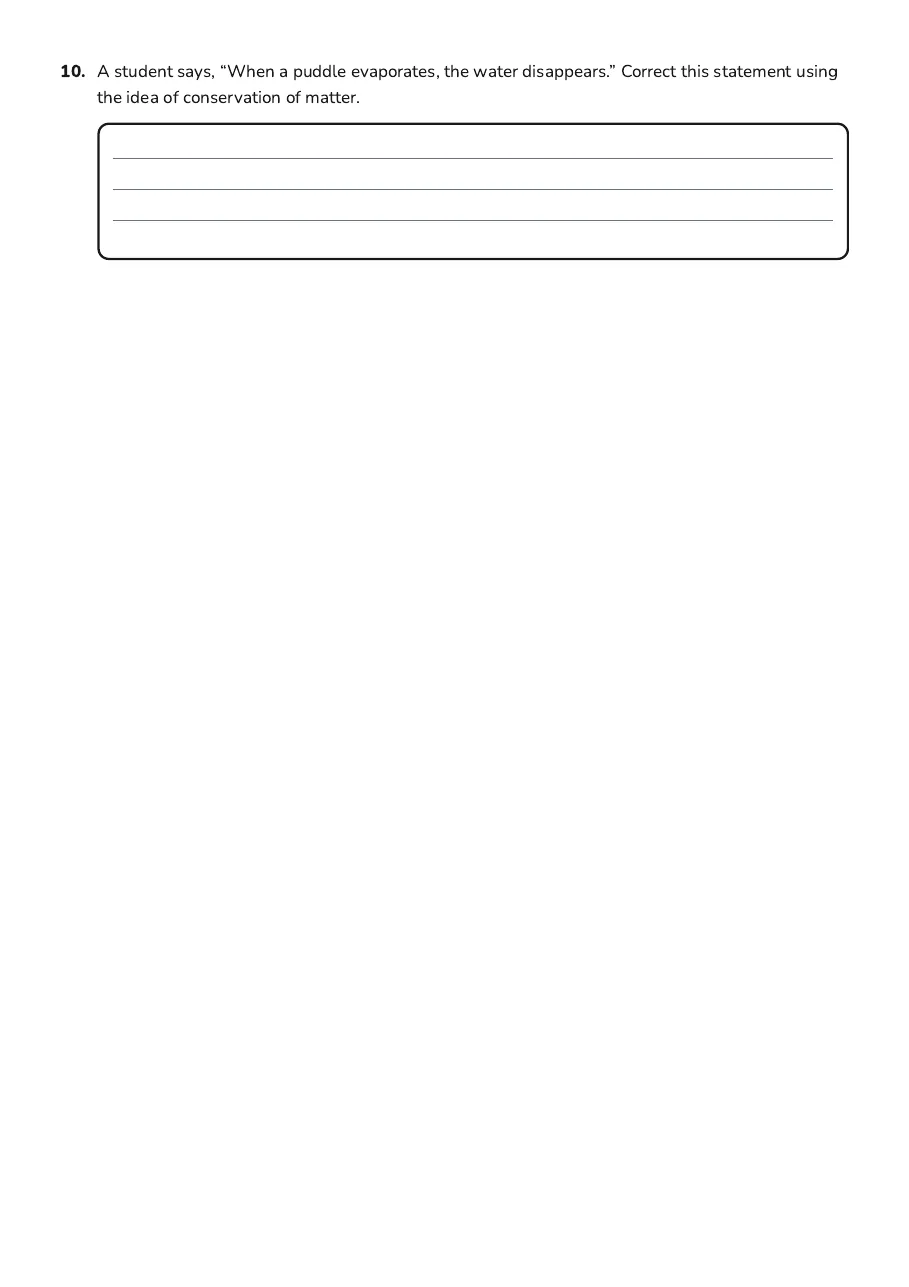
10.A student says, “When a puddle evaporates, the water disappears.” Correct this statement using the idea of conservation of matter.

3 printable pages

  • States of Matter Exploration, page 1 of 3: Particle investigation, A water sample changes

    Page 1

  • States of Matter Exploration, page 2 of 3: Follow the phase changes

    Page 2

  • States of Matter Exploration, page 3 of 3: 10. A student says, “When a puddle evaporates, the water disappears.” Correct this…

    Page 3

About This Worksheet

Free in Kuraplan

Sign up free, grab the PDF, and customize it for your class.

Print-Ready

Formatted for standard paper. Clean layout, easy to read.

AI-Generated

Created with Kuraplan's AI, designed for real classroom use.

For Teachers & Parents

Use in classrooms, for homework, tutoring, or homeschool.

Need a custom version of this worksheet?

Kuraplan's AI generates custom worksheets in seconds — differentiated for every learner, aligned to your curriculum.

Generate Custom Worksheets — Free
No credit card Curriculum-aligned Under 60 seconds