EnglishFreePrintable

Storyboarding with Twister

A free english worksheet ready for your classroom. Open in Kuraplan to grab the print-ready PDF, customize it for your students, or generate a fresh version in seconds.
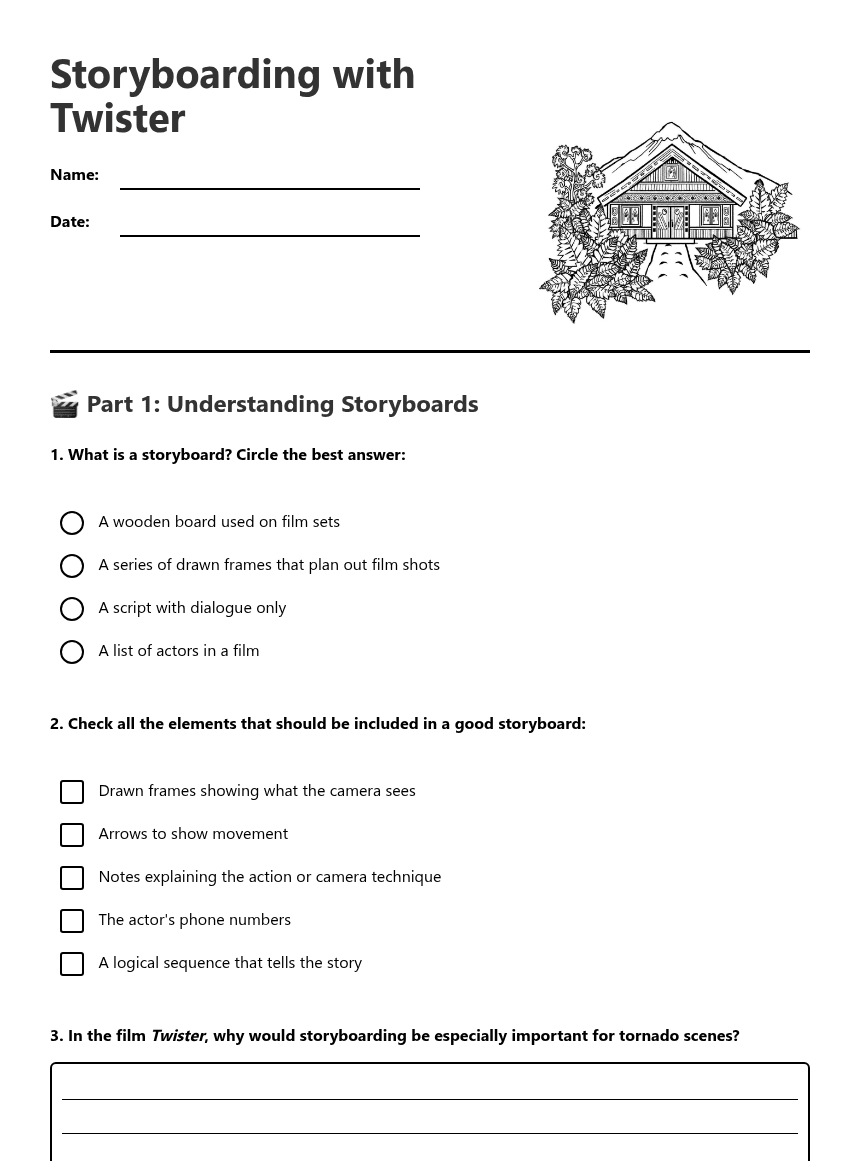
Storyboarding with Twister worksheet preview

Storyboarding with Twister

Storyboarding with Twister

Film camera and storyboard illustration

🎬 Part 1: Understanding Storyboards

1. What is a storyboard? Circle the best answer:

A wooden board used on film sets

A series of drawn frames that plan out film shots

A script with dialogue only

A list of actors in a film

2. Check all the elements that should be included in a good storyboard:

Drawn frames showing what the camera sees

Arrows to show movement

Notes explaining the action or camera technique

The actor's phone numbers

A logical sequence that tells the story

3. In the film Twister, why would storyboarding be especially important for tornado scenes?

📹 Part 2: Camera Techniques

4. Match each camera shot with its description:
1. Close-up
2. Wide shot
3. Medium shot
4. Pan
A. Shows the whole scene/location
B. Camera moves horizontally left or right
C. Shows character from waist up
D. Shows face or object in detail
5. Fill in the blanks about camera movement:

When the camera moves closer to show more detail, this is called a ________ in. When the camera moves further away to show more of the scene, this is called a ________ out. Arrows in storyboards are used to show ________ and camera __________.

🌪️ Part 3: Planning Your Weather Scene

6. Choose a weather event for your storyboard scene. Circle your choice:

Approaching thunderstorm

Heavy rain starting

Strong wind blowing

Tornado forming

Other: ________________

7. Describe your scene in 2-3 sentences. What will happen? Who are the characters?
8. List 3 different camera shots you will use in your storyboard:

Shot 1: _________________________

Shot 2: _________________________

Shot 3: _________________________

🎨 Part 4: Create Your Storyboard

9. Draw your 6-frame storyboard below. Include arrows for movement and write notes under each frame:

Frame 1:

Notes: ________________________________

Frame 2:

Notes: ________________________________

Frame 3:

Notes: ________________________________

Frame 4:

Notes: ________________________________

Frame 5:

Notes: ________________________________

Frame 6:

Notes: ________________________________

🔍 Part 5: Peer Review

10. Exchange your storyboard with a partner. Check off what your partner included:

At least 6 frames drawn

Arrows showing movement

Clear notes under each frame

Frames arranged in logical order

Story makes sense

11. Write one positive comment about your partner's storyboard:
12. Suggest one improvement for your partner's storyboard:

💭 Part 6: Reflection

13. How confident do you feel about creating storyboards? Circle your answer:

Very confident - I could teach someone else

Confident - I understand the main ideas

Somewhat confident - I need a bit more practice

Not confident - I need more help

14. What was the most challenging part of creating your storyboard?
15. How do you think storyboarding helps filmmakers plan their movies?

About This Worksheet

Free in Kuraplan

Sign up free, grab the PDF, and customize it for your class.

Print-Ready

Formatted for standard paper. Clean layout, easy to read.

AI-Generated

Created with Kuraplan's AI, designed for real classroom use.

For Teachers & Parents

Use in classrooms, for homework, tutoring, or homeschool.

Need a custom version of this worksheet?

Kuraplan's AI generates custom worksheets in seconds — differentiated for every learner, aligned to your curriculum.

Generate Custom Worksheets — Free
No credit card Curriculum-aligned Under 60 seconds