Television History Reading Quiz
A free english worksheet ready for your classroom. Open in Kuraplan to grab the print-ready PDF, customize it for your students, or generate a fresh version in seconds.
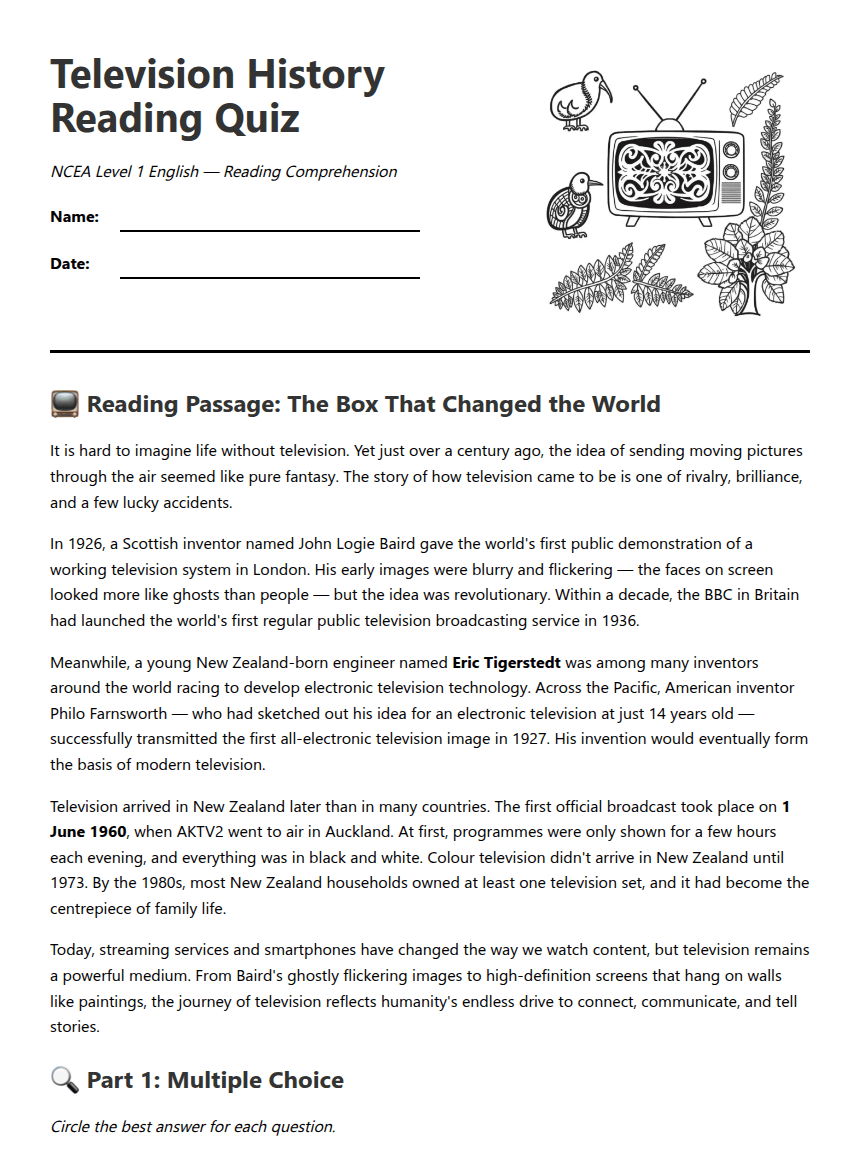
Television History Reading Quiz
NCEA Level 1 English — Reading Comprehension
📺 Reading Passage: The Box That Changed the World
It is hard to imagine life without television. Yet just over a century ago, the idea of sending moving pictures through the air seemed like pure fantasy. The story of how television came to be is one of rivalry, brilliance, and a few lucky accidents.
In 1926, a Scottish inventor named John Logie Baird gave the world's first public demonstration of a working television system in London. His early images were blurry and flickering — the faces on screen looked more like ghosts than people — but the idea was revolutionary. Within a decade, the BBC in Britain had launched the world's first regular public television broadcasting service in 1936.
Meanwhile, a young New Zealand-born engineer named Eric Tigerstedt was among many inventors around the world racing to develop electronic television technology. Across the Pacific, American inventor Philo Farnsworth — who had sketched out his idea for an electronic television at just 14 years old — successfully transmitted the first all-electronic television image in 1927. His invention would eventually form the basis of modern television.
Television arrived in New Zealand later than in many countries. The first official broadcast took place on 1 June 1960, when AKTV2 went to air in Auckland. At first, programmes were only shown for a few hours each evening, and everything was in black and white. Colour television didn't arrive in New Zealand until 1973. By the 1980s, most New Zealand households owned at least one television set, and it had become the centrepiece of family life.
Today, streaming services and smartphones have changed the way we watch content, but television remains a powerful medium. From Baird's ghostly flickering images to high-definition screens that hang on walls like paintings, the journey of television reflects humanity's endless drive to connect, communicate, and tell stories.
🔍 Part 1: Multiple Choice
Circle the best answer for each question.
✏️ Part 2: Short Answer
Answer in full sentences where possible.
About This Worksheet
Free in Kuraplan
Sign up free, grab the PDF, and customize it for your class.
Print-Ready
Formatted for standard paper. Clean layout, easy to read.
AI-Generated
Created with Kuraplan's AI, designed for real classroom use.
For Teachers & Parents
Use in classrooms, for homework, tutoring, or homeschool.
Need a custom version of this worksheet?
Kuraplan's AI generates custom worksheets in seconds — differentiated for every learner, aligned to your curriculum.
Generate Custom Worksheets — Free