ScienceFreePrintable

Atomic Structure

A free science worksheet ready for your classroom. Open in Kuraplan to grab the print-ready PDF, customize it for your students, or generate a fresh version in seconds.
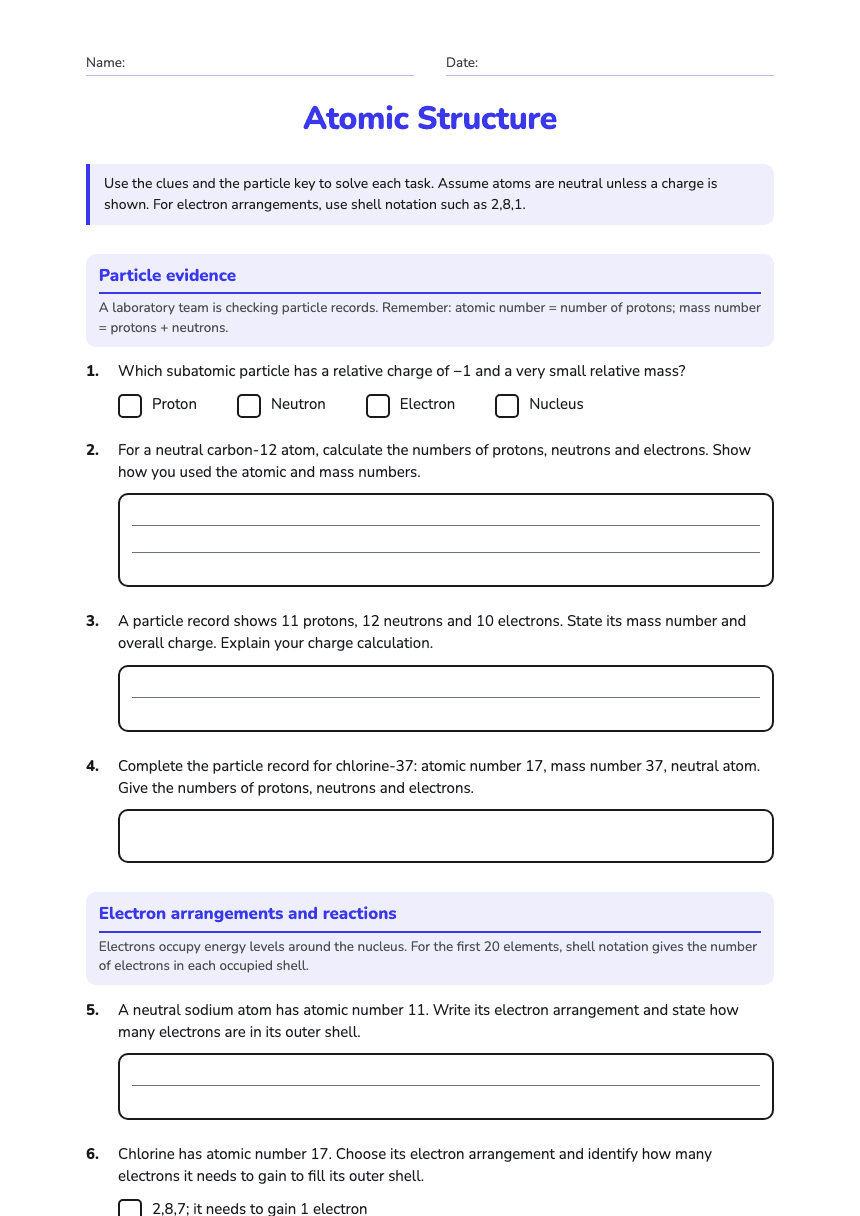
Atomic Structure worksheet preview
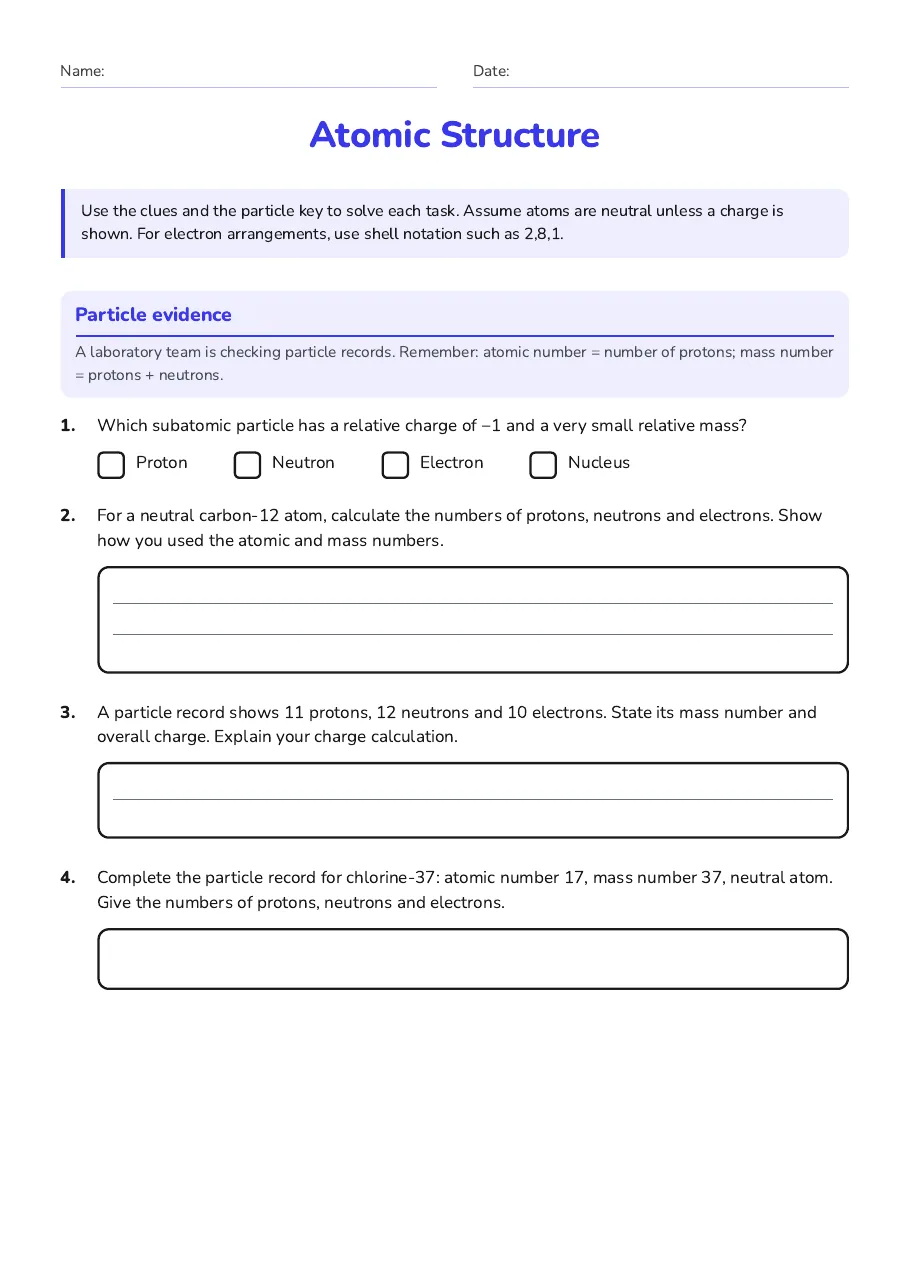
Name:Date:

Atomic Structure

Use the clues and the particle key to solve each task. Assume atoms are neutral unless a charge is shown. For electron arrangements, use shell notation such as 2,8,1.

Particle evidence

A laboratory team is checking particle records. Remember: atomic number = number of protons; mass number = protons + neutrons.

1.Which subatomic particle has a relative charge of −1 and a very small relative mass?
  • Proton
  • Neutron
  • Electron
  • Nucleus
2.For a neutral carbon-12 atom, calculate the numbers of protons, neutrons and electrons. Show how you used the atomic and mass numbers.
3.A particle record shows 11 protons, 12 neutrons and 10 electrons. State its mass number and overall charge. Explain your charge calculation.
4.Complete the particle record for chlorine-37: atomic number 17, mass number 37, neutral atom. Give the numbers of protons, neutrons and electrons.

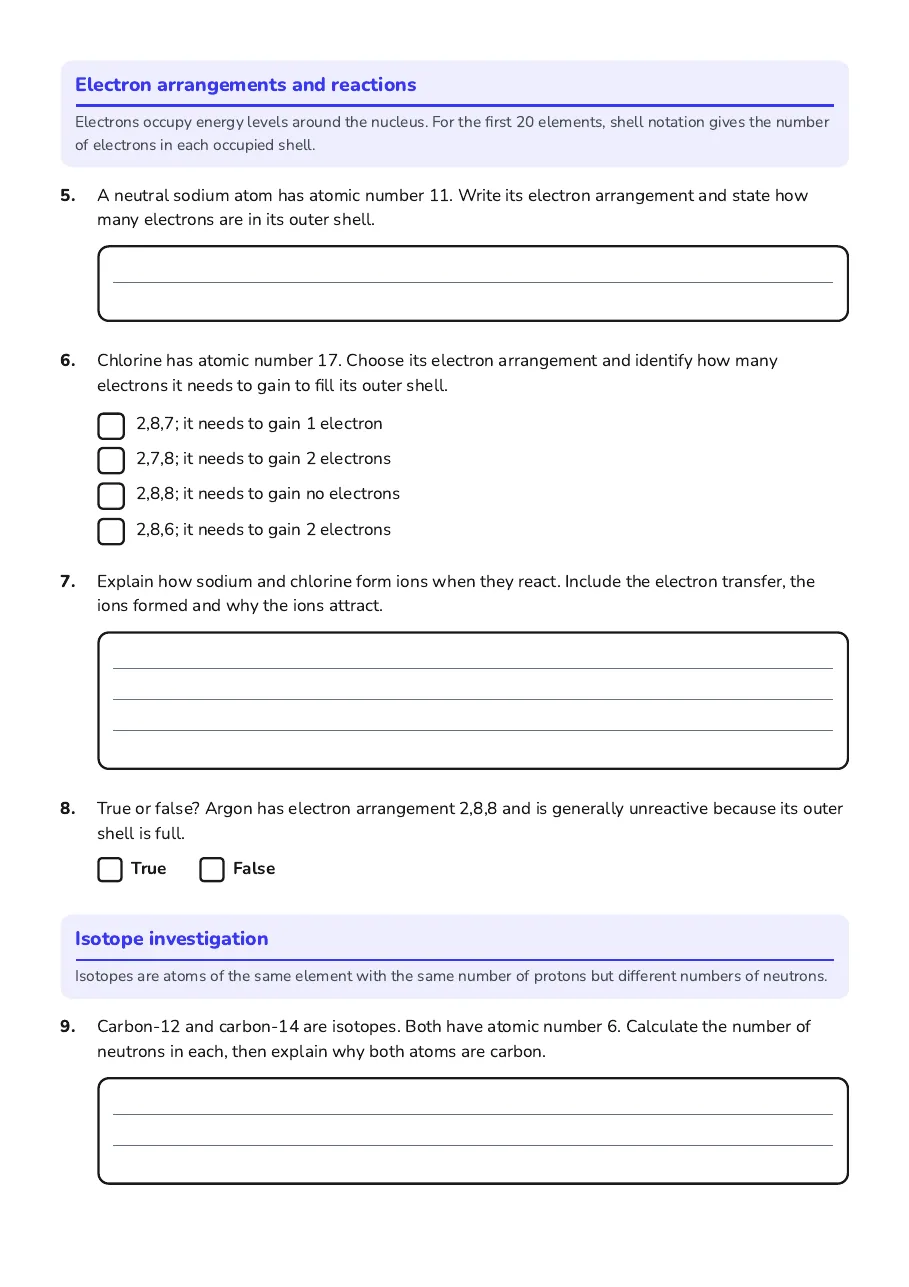
Electron arrangements and reactions

Electrons occupy energy levels around the nucleus. For the first 20 elements, shell notation gives the number of electrons in each occupied shell.

5.A neutral sodium atom has atomic number 11. Write its electron arrangement and state how many electrons are in its outer shell.
6.Chlorine has atomic number 17. Choose its electron arrangement and identify how many electrons it needs to gain to fill its outer shell.
  • 2,8,7; it needs to gain 1 electron
  • 2,7,8; it needs to gain 2 electrons
  • 2,8,8; it needs to gain no electrons
  • 2,8,6; it needs to gain 2 electrons
7.Explain how sodium and chlorine form ions when they react. Include the electron transfer, the ions formed and why the ions attract.
8.True or false? Argon has electron arrangement 2,8,8 and is generally unreactive because its outer shell is full.
TrueFalse

Isotope investigation

Isotopes are atoms of the same element with the same number of protons but different numbers of neutrons.

9.Carbon-12 and carbon-14 are isotopes. Both have atomic number 6. Calculate the number of neutrons in each, then explain why both atoms are carbon.
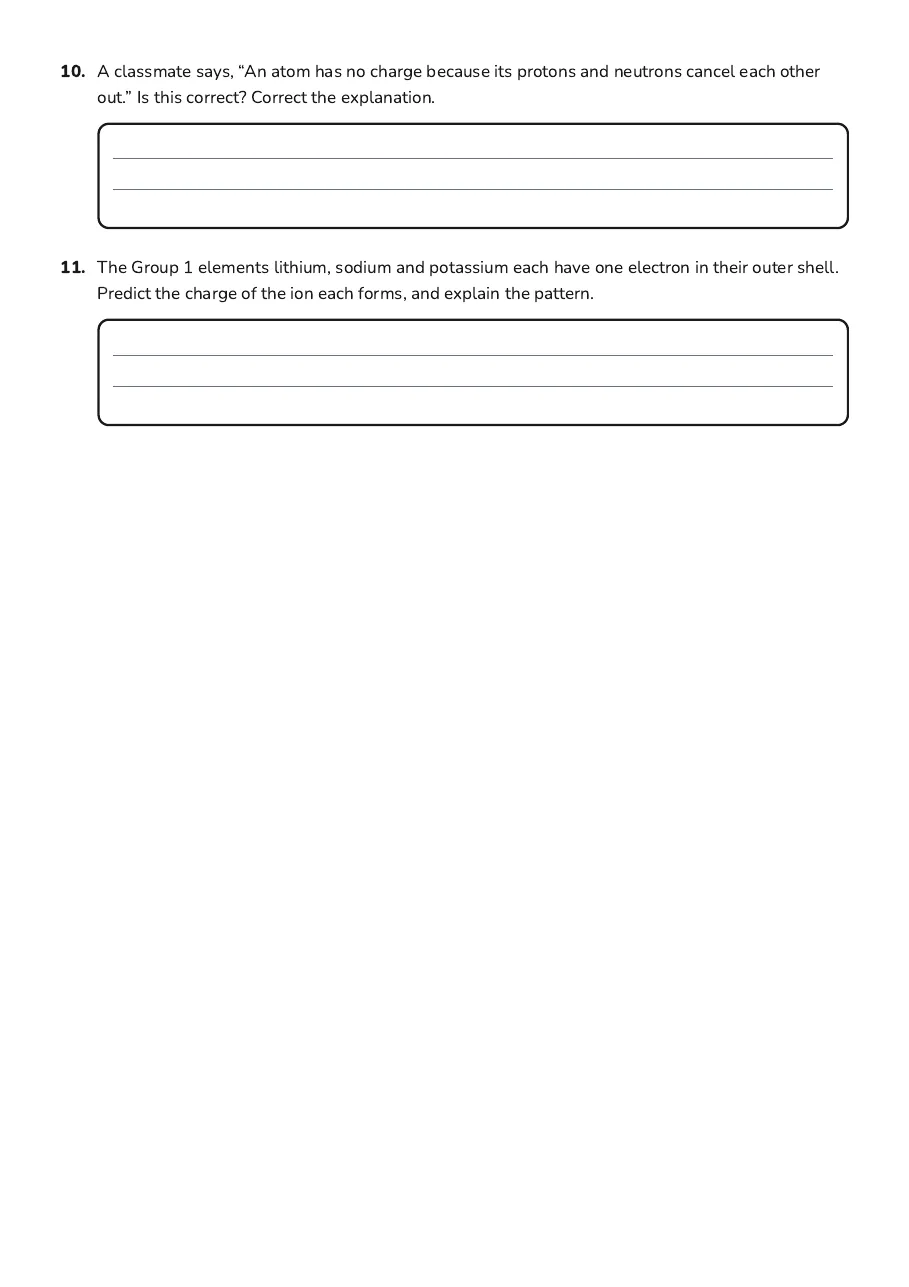
10.A classmate says, “An atom has no charge because its protons and neutrons cancel each other out.” Is this correct? Correct the explanation.
11.The Group 1 elements lithium, sodium and potassium each have one electron in their outer shell. Predict the charge of the ion each forms, and explain the pattern.

3 printable pages

  • Atomic Structure, page 1 of 3: Particle evidence

    Page 1

  • Atomic Structure, page 2 of 3: Electron arrangements and reactions, Isotope investigation

    Page 2

  • Atomic Structure, page 3 of 3: 10. A classmate says, “An atom has no charge because its protons and neutrons cancel each…

    Page 3

About This Worksheet

Free in Kuraplan

Sign up free, grab the PDF, and customize it for your class.

Print-Ready

Formatted for standard paper. Clean layout, easy to read.

AI-Generated

Created with Kuraplan's AI, designed for real classroom use.

For Teachers & Parents

Use in classrooms, for homework, tutoring, or homeschool.

Need a custom version of this worksheet?

Kuraplan's AI generates custom worksheets in seconds — differentiated for every learner, aligned to your curriculum.

Generate Custom Worksheets — Free
No credit card Curriculum-aligned Under 60 seconds