ScienceFreePrintable

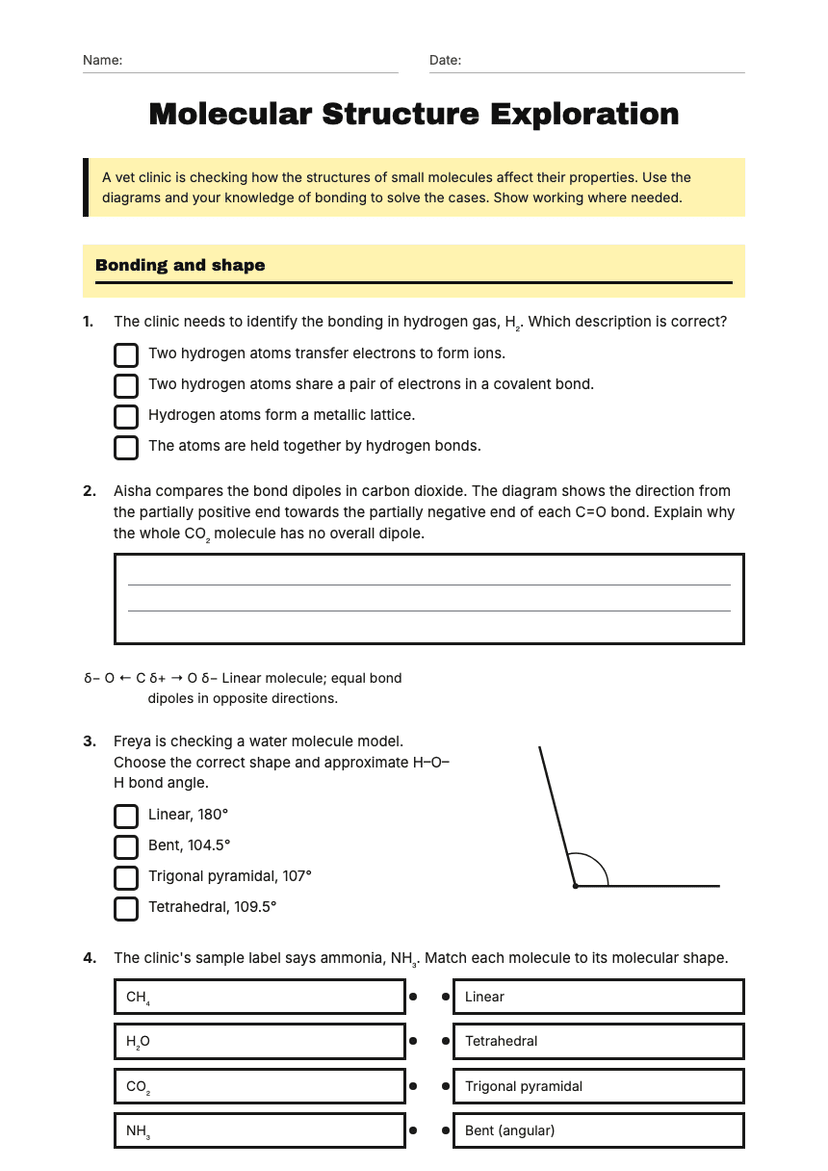
Molecular Structure Exploration

A free science worksheet ready for your classroom. Open in Kuraplan to grab the print-ready PDF, customize it for your students, or generate a fresh version in seconds.
Molecular Structure Exploration worksheet preview
Name:Date:

Molecular Structure Exploration

You are helping a materials team identify small molecules. Use the evidence on this sheet to connect bonding, electron pairs, molecular shape and properties. Show working or reasoning where asked.

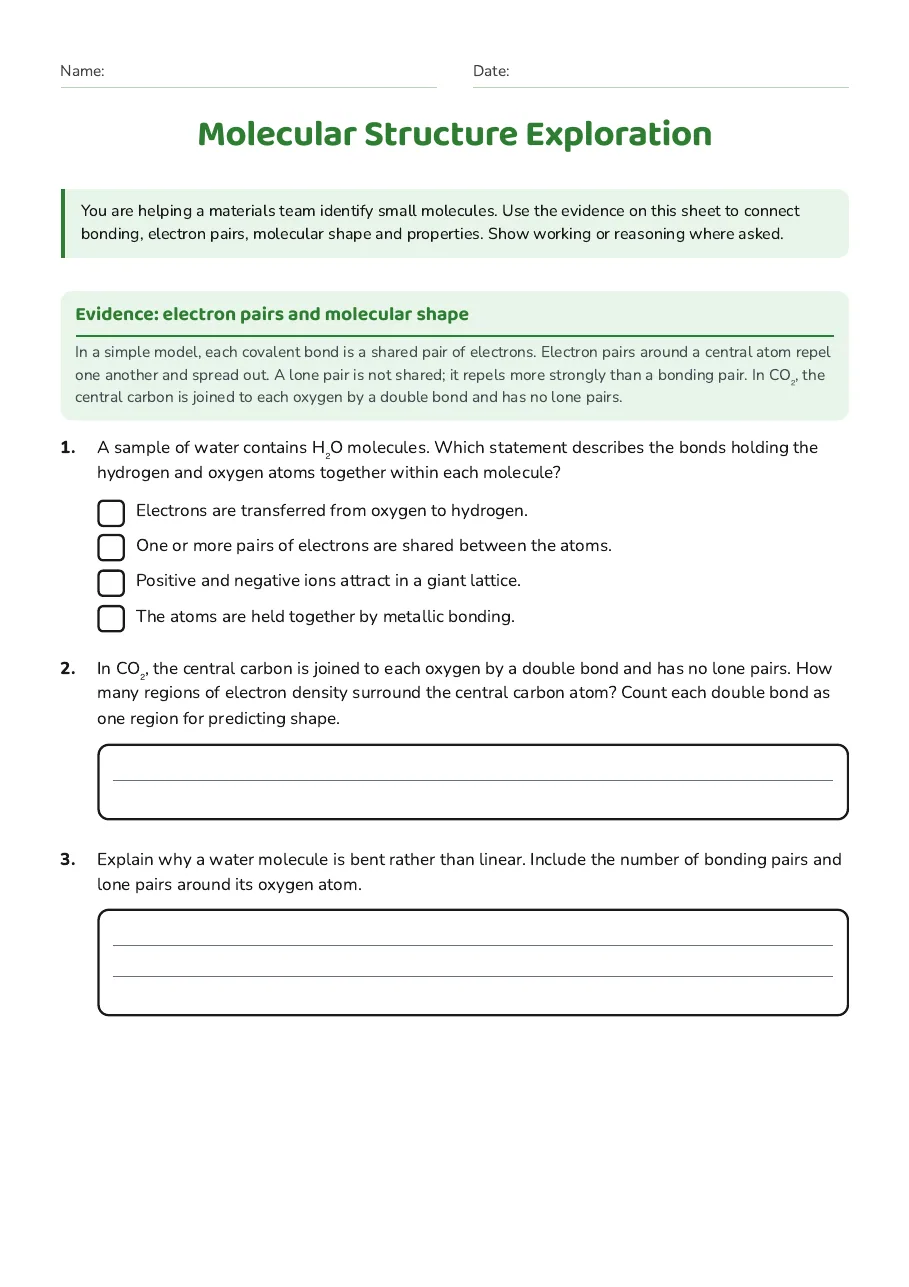
Evidence: electron pairs and molecular shape

In a simple model, each covalent bond is a shared pair of electrons. Electron pairs around a central atom repel one another and spread out. A lone pair is not shared; it repels more strongly than a bonding pair. In CO₂, the central carbon is joined to each oxygen by a double bond and has no lone pairs.

1.A sample of water contains H₂O molecules. Which statement describes the bonds holding the hydrogen and oxygen atoms together within each molecule?
  • Electrons are transferred from oxygen to hydrogen.
  • One or more pairs of electrons are shared between the atoms.
  • Positive and negative ions attract in a giant lattice.
  • The atoms are held together by metallic bonding.
2.In CO₂, the central carbon is joined to each oxygen by a double bond and has no lone pairs. How many regions of electron density surround the central carbon atom? Count each double bond as one region for predicting shape.
3.Explain why a water molecule is bent rather than linear. Include the number of bonding pairs and lone pairs around its oxygen atom.
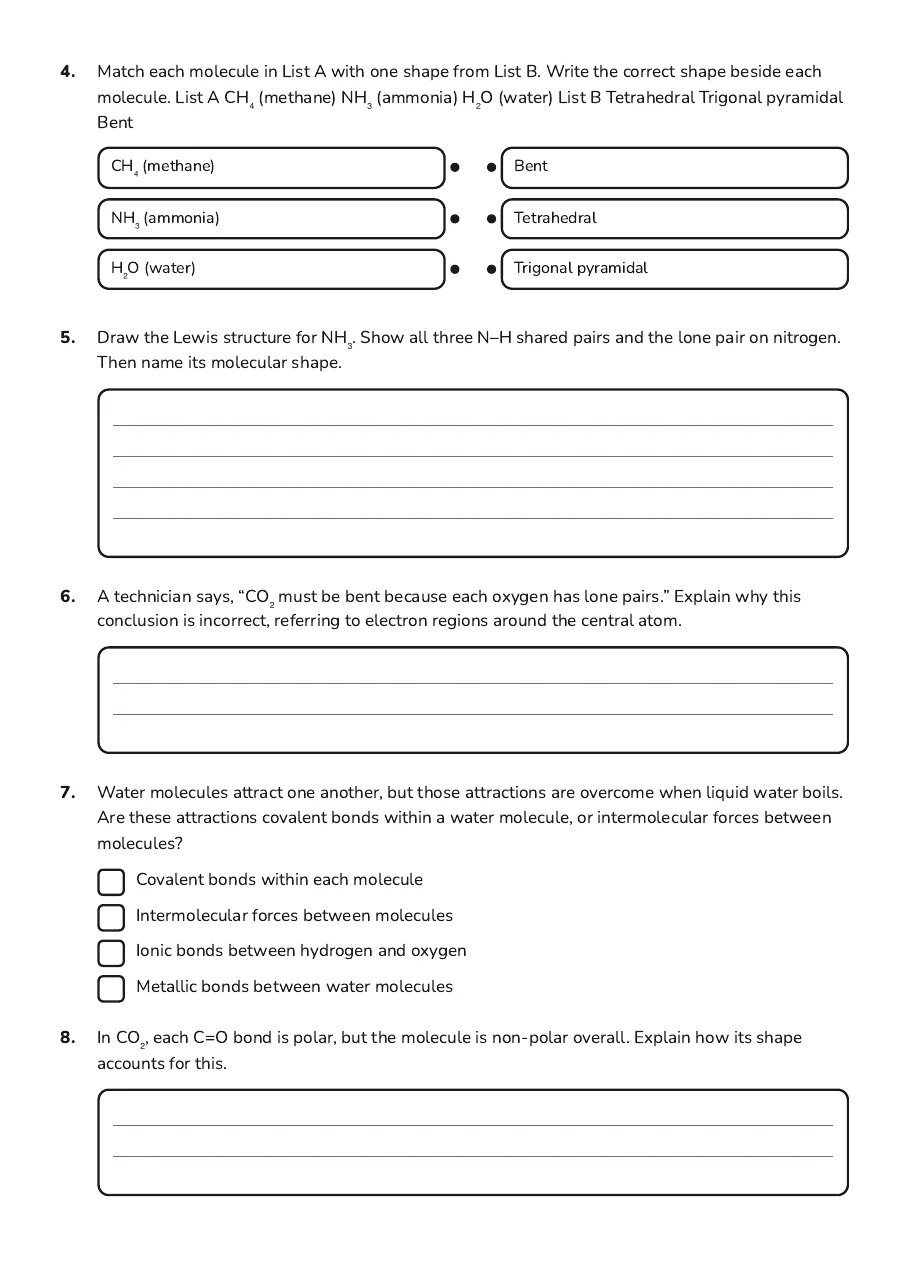
4.Match each molecule in List A with one shape from List B. Write the correct shape beside each molecule. List A CH₄ (methane) NH₃ (ammonia) H₂O (water) List B Tetrahedral Trigonal pyramidal Bent
  • CH₄ (methane)
  • NH₃ (ammonia)
  • H₂O (water)
  • Bent
  • Tetrahedral
  • Trigonal pyramidal
5.Draw the Lewis structure for NH₃. Show all three N–H shared pairs and the lone pair on nitrogen. Then name its molecular shape.
6.A technician says, “CO₂ must be bent because each oxygen has lone pairs.” Explain why this conclusion is incorrect, referring to electron regions around the central atom.
7.Water molecules attract one another, but those attractions are overcome when liquid water boils. Are these attractions covalent bonds within a water molecule, or intermolecular forces between molecules?
  • Covalent bonds within each molecule
  • Intermolecular forces between molecules
  • Ionic bonds between hydrogen and oxygen
  • Metallic bonds between water molecules
8.In CO₂, each C=O bond is polar, but the molecule is non-polar overall. Explain how its shape accounts for this.
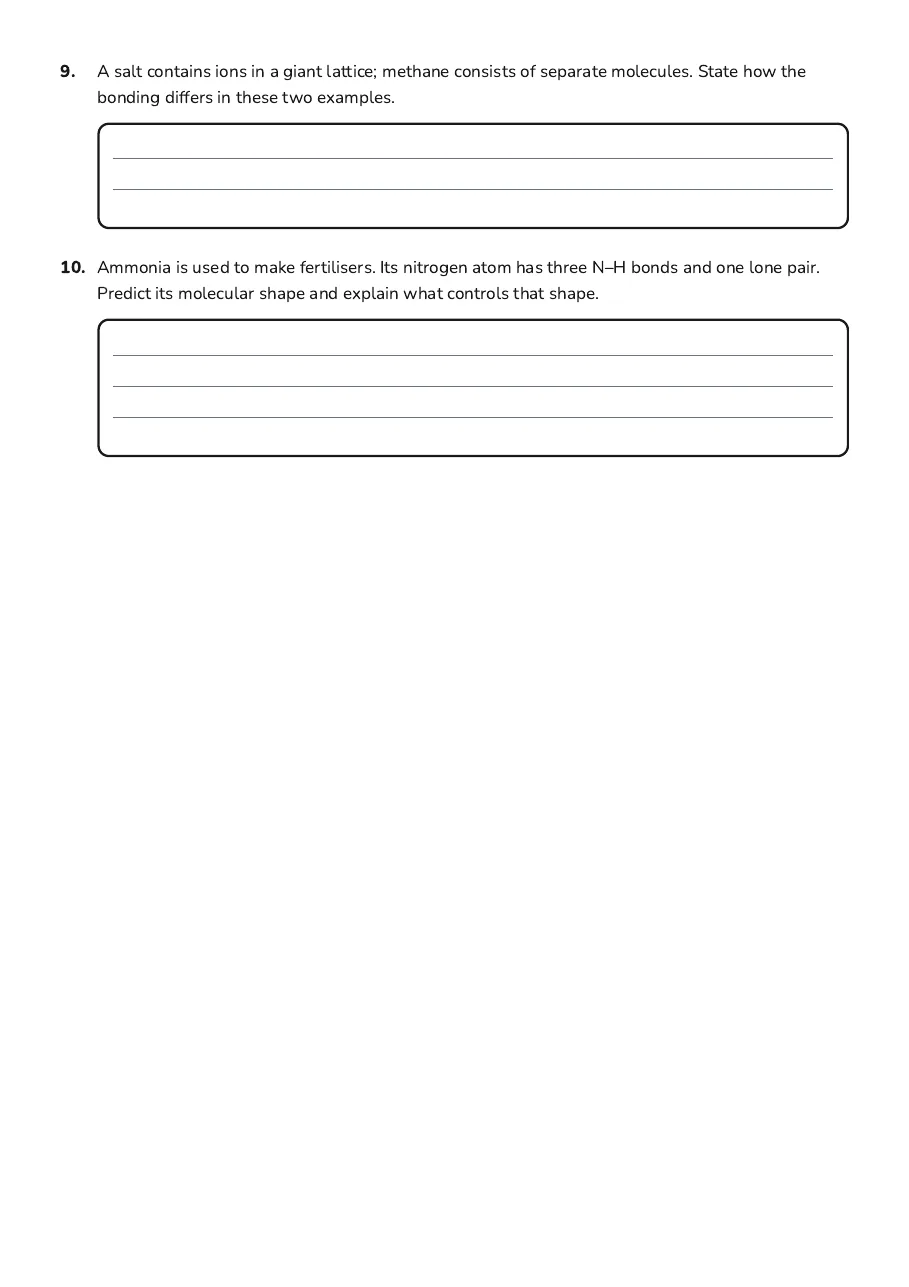
9.A salt contains ions in a giant lattice; methane consists of separate molecules. State how the bonding differs in these two examples.
10.Ammonia is used to make fertilisers. Its nitrogen atom has three N–H bonds and one lone pair. Predict its molecular shape and explain what controls that shape.

3 printable pages

  • Molecular Structure Exploration, page 1 of 3: Evidence: electron pairs and molecular shape

    Page 1

  • Molecular Structure Exploration, page 2 of 3: 4. Match each molecule in List A with one shape from List B. Write the correct shape…

    Page 2

  • Molecular Structure Exploration, page 3 of 3: 9. A salt contains ions in a giant lattice; methane consists of separate molecules. State…

    Page 3

About This Worksheet

Free in Kuraplan

Sign up free, grab the PDF, and customize it for your class.

Print-Ready

Formatted for standard paper. Clean layout, easy to read.

AI-Generated

Created with Kuraplan's AI, designed for real classroom use.

For Teachers & Parents

Use in classrooms, for homework, tutoring, or homeschool.

Need a custom version of this worksheet?

Kuraplan's AI generates custom worksheets in seconds — differentiated for every learner, aligned to your curriculum.

Generate Custom Worksheets — Free
No credit card Curriculum-aligned Under 60 seconds