Divine Right and Macbeth
A free english worksheet ready for your classroom. Open in Kuraplan to grab the print-ready PDF, customize it for your students, or generate a fresh version in seconds.
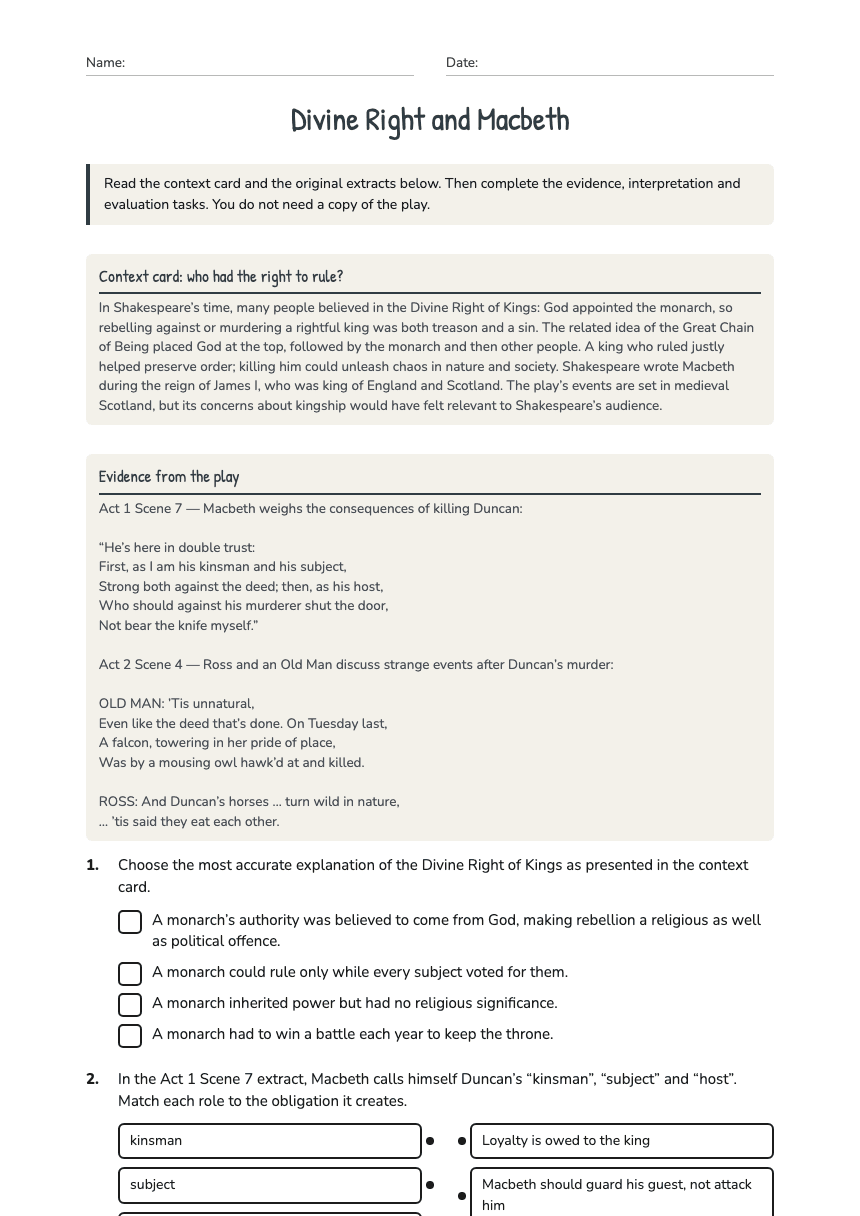
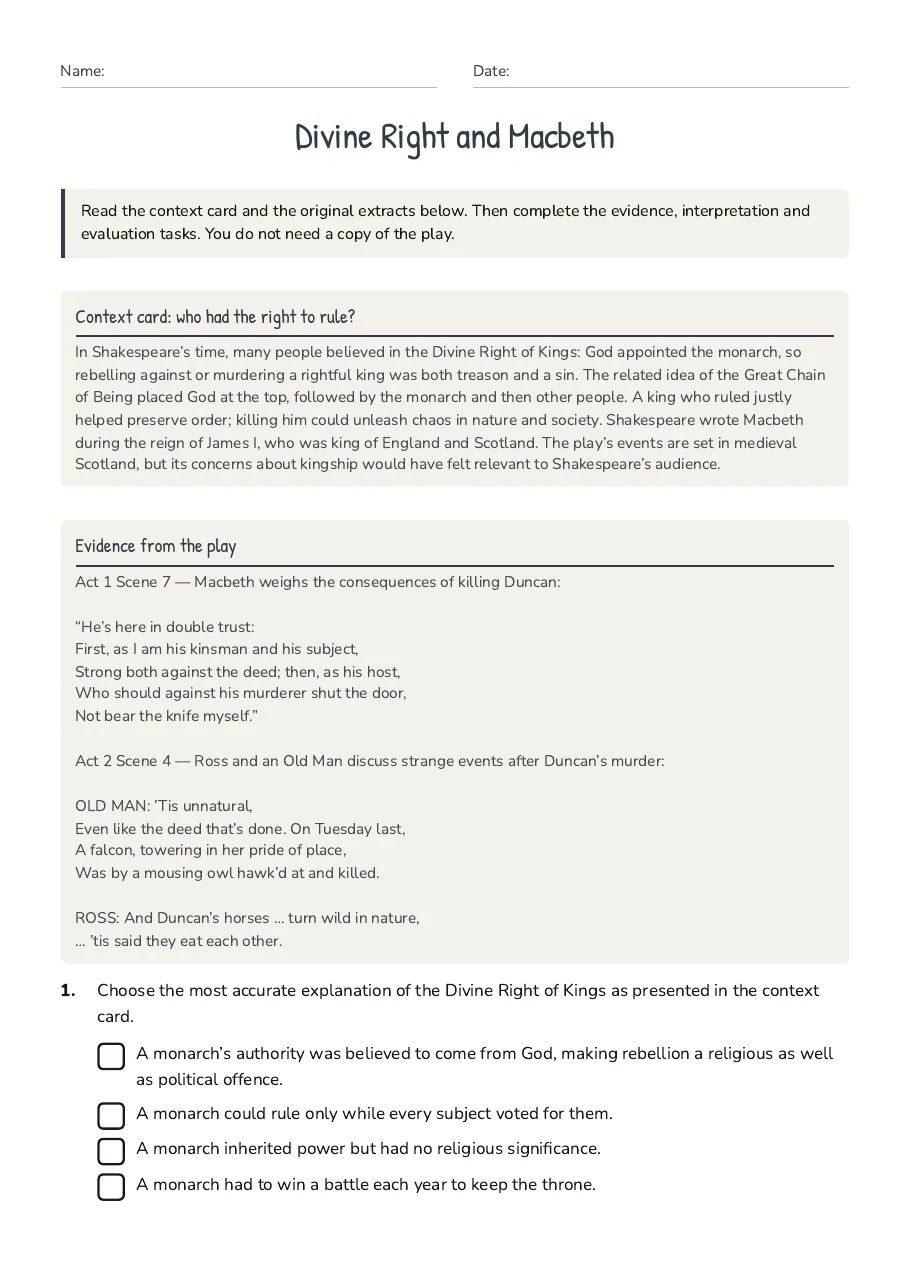
Divine Right and Macbeth
Context card: who had the right to rule?
In Shakespeare’s time, many people believed in the Divine Right of Kings: God appointed the monarch, so rebelling against or murdering a rightful king was both treason and a sin. The related idea of the Great Chain of Being placed God at the top, followed by the monarch and then other people. A king who ruled justly helped preserve order; killing him could unleash chaos in nature and society. Shakespeare wrote Macbeth during the reign of James I, who was king of England and Scotland. The play’s events are set in medieval Scotland, but its concerns about kingship would have felt relevant to Shakespeare’s audience.
Evidence from the play
Act 1 Scene 7 — Macbeth weighs the consequences of killing Duncan: “He’s here in double trust: First, as I am his kinsman and his subject, Strong both against the deed; then, as his host, Who should against his murderer shut the door, Not bear the knife myself.” Act 2 Scene 4 — Ross and an Old Man discuss strange events after Duncan’s murder: OLD MAN: ’Tis unnatural, Even like the deed that’s done. On Tuesday last, A falcon, towering in her pride of place, Was by a mousing owl hawk’d at and killed. ROSS: And Duncan’s horses … turn wild in nature, … ’tis said they eat each other.
- A monarch’s authority was believed to come from God, making rebellion a religious as well as political offence.
- A monarch could rule only while every subject voted for them.
- A monarch inherited power but had no religious significance.
- A monarch had to win a battle each year to keep the throne.
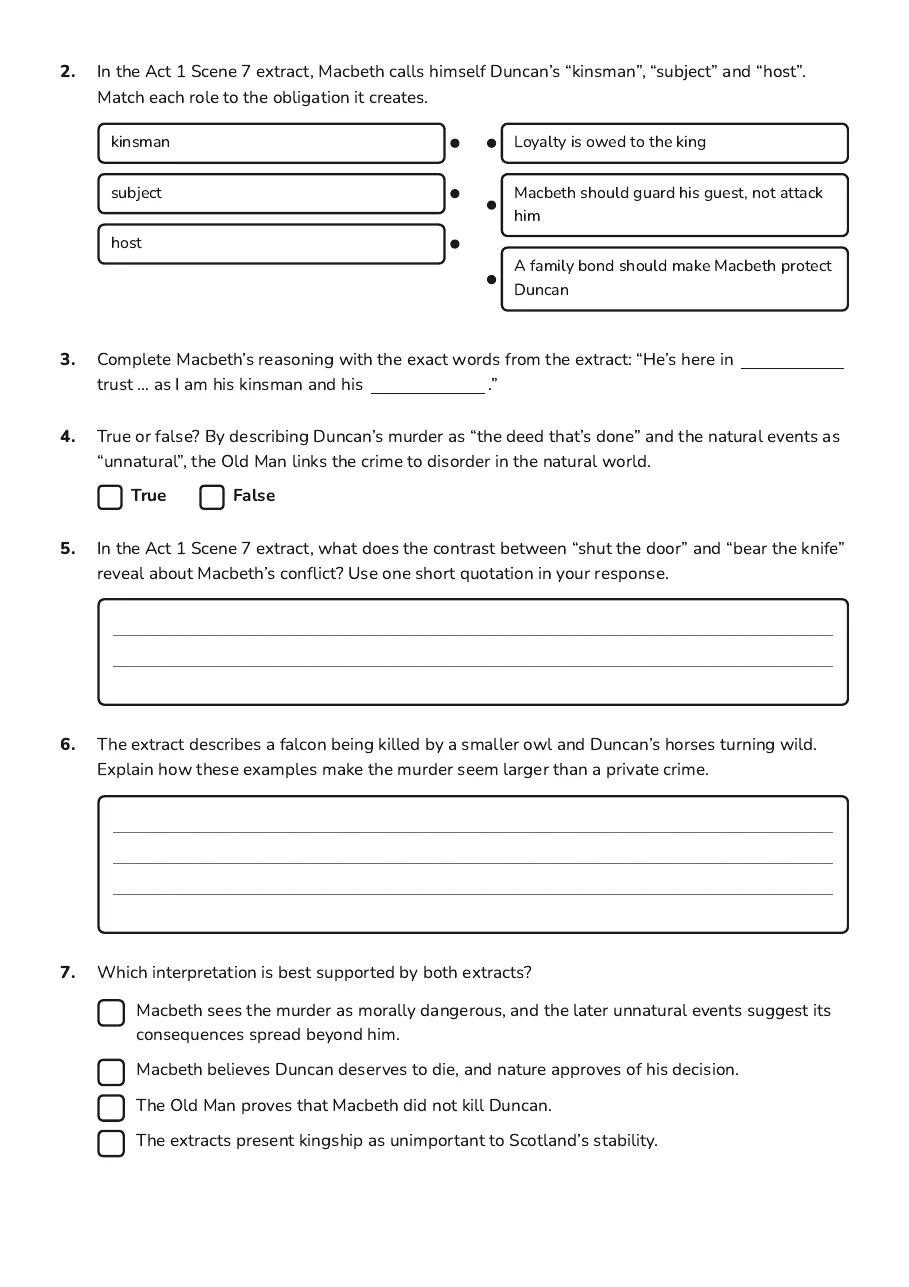
- kinsman
- subject
- host
- Loyalty is owed to the king
- Macbeth should guard his guest, not attack him
- A family bond should make Macbeth protect Duncan
- Macbeth sees the murder as morally dangerous, and the later unnatural events suggest its consequences spread beyond him.
- Macbeth believes Duncan deserves to die, and nature approves of his decision.
- The Old Man proves that Macbeth did not kill Duncan.
- The extracts present kingship as unimportant to Scotland’s stability.
3 printable pages
Page 1
Page 2
Page 3
About This Worksheet
Free in Kuraplan
Sign up free, grab the PDF, and customize it for your class.
Print-Ready
Formatted for standard paper. Clean layout, easy to read.
AI-Generated
Created with Kuraplan's AI, designed for real classroom use.
For Teachers & Parents
Use in classrooms, for homework, tutoring, or homeschool.
Need a custom version of this worksheet?
Kuraplan's AI generates custom worksheets in seconds — differentiated for every learner, aligned to your curriculum.
Generate Custom Worksheets — Free