Bath Bomb Chemistry Reactions
A free science worksheet ready for your classroom. Open in Kuraplan to grab the print-ready PDF, customize it for your students, or generate a fresh version in seconds.
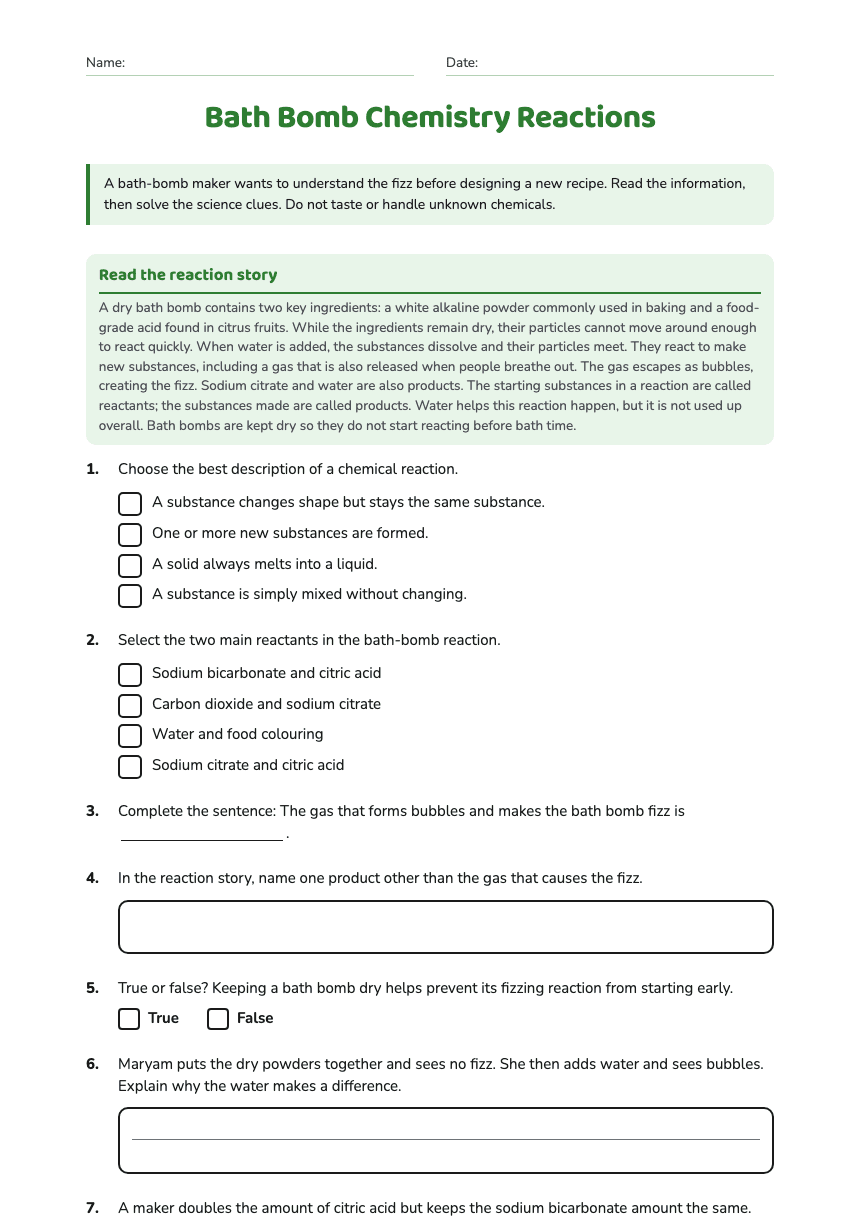
Bath Bomb Chemistry Reactions
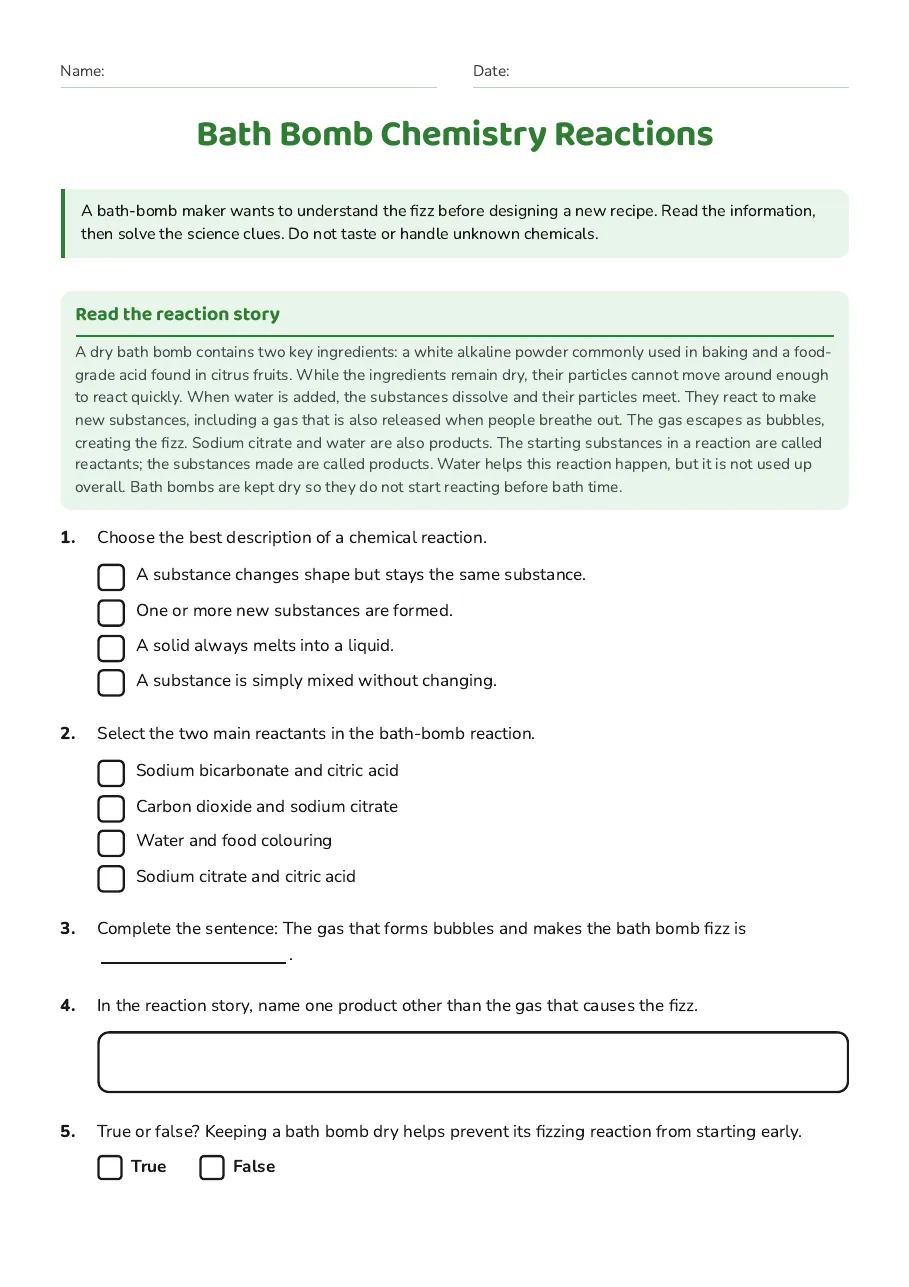
Read the reaction story
A dry bath bomb contains two key ingredients: a white alkaline powder commonly used in baking and a food-grade acid found in citrus fruits. While the ingredients remain dry, their particles cannot move around enough to react quickly. When water is added, the substances dissolve and their particles meet. They react to make new substances, including a gas that is also released when people breathe out. The gas escapes as bubbles, creating the fizz. Sodium citrate and water are also products. The starting substances in a reaction are called reactants; the substances made are called products. Water helps this reaction happen, but it is not used up overall. Bath bombs are kept dry so they do not start reacting before bath time.
- A substance changes shape but stays the same substance.
- One or more new substances are formed.
- A solid always melts into a liquid.
- A substance is simply mixed without changing.
- Sodium bicarbonate and citric acid
- Carbon dioxide and sodium citrate
- Water and food colouring
- Sodium citrate and citric acid
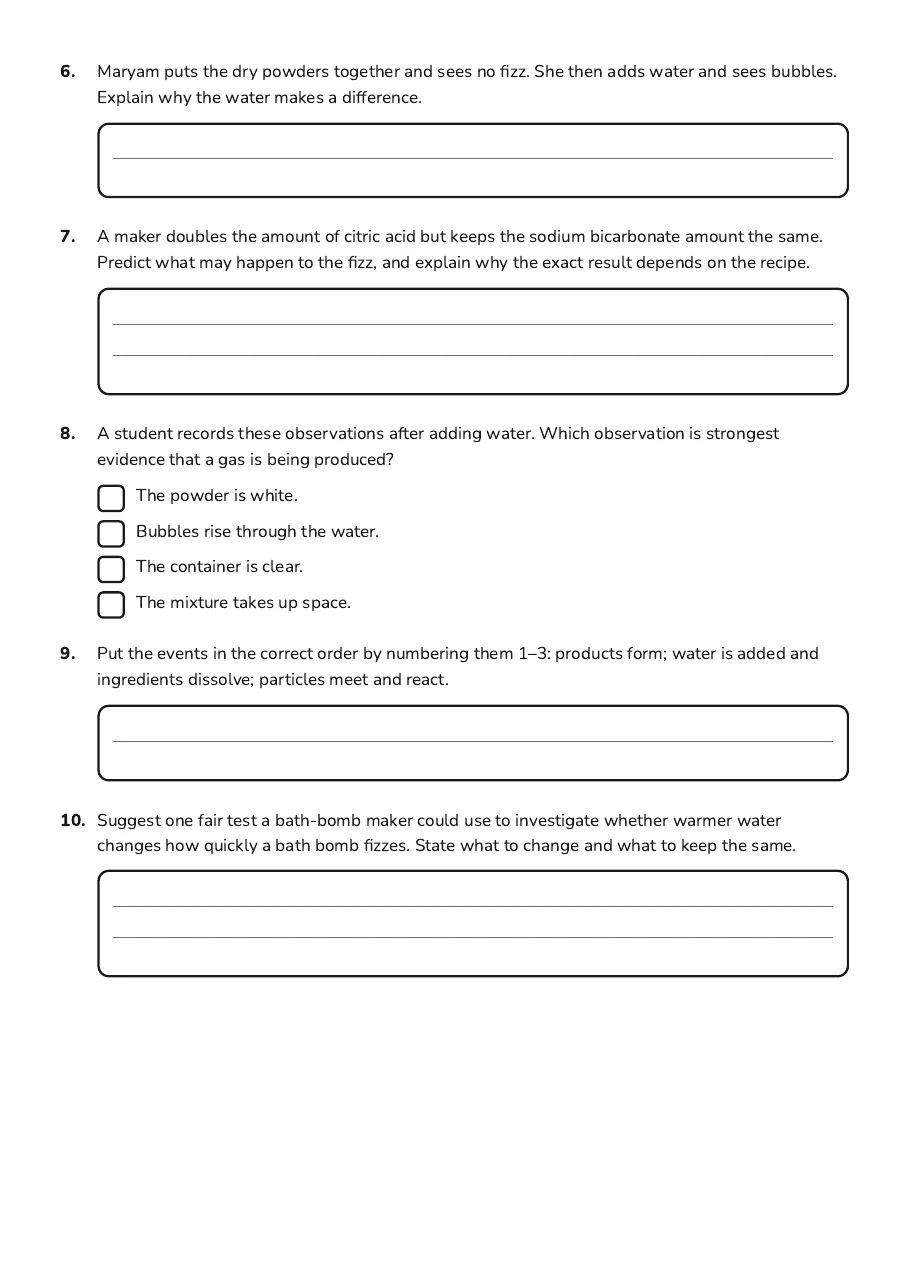
- The powder is white.
- Bubbles rise through the water.
- The container is clear.
- The mixture takes up space.
2 printable pages
Page 1
Page 2
About This Worksheet
Free in Kuraplan
Sign up free, grab the PDF, and customize it for your class.
Print-Ready
Formatted for standard paper. Clean layout, easy to read.
AI-Generated
Created with Kuraplan's AI, designed for real classroom use.
For Teachers & Parents
Use in classrooms, for homework, tutoring, or homeschool.
Need a custom version of this worksheet?
Kuraplan's AI generates custom worksheets in seconds — differentiated for every learner, aligned to your curriculum.
Generate Custom Worksheets — Free