ScienceFreePrintable
Fairground Ride Physics
A free science worksheet ready for your classroom. Open in Kuraplan to grab the print-ready PDF, customize it for your students, or generate a fresh version in seconds.
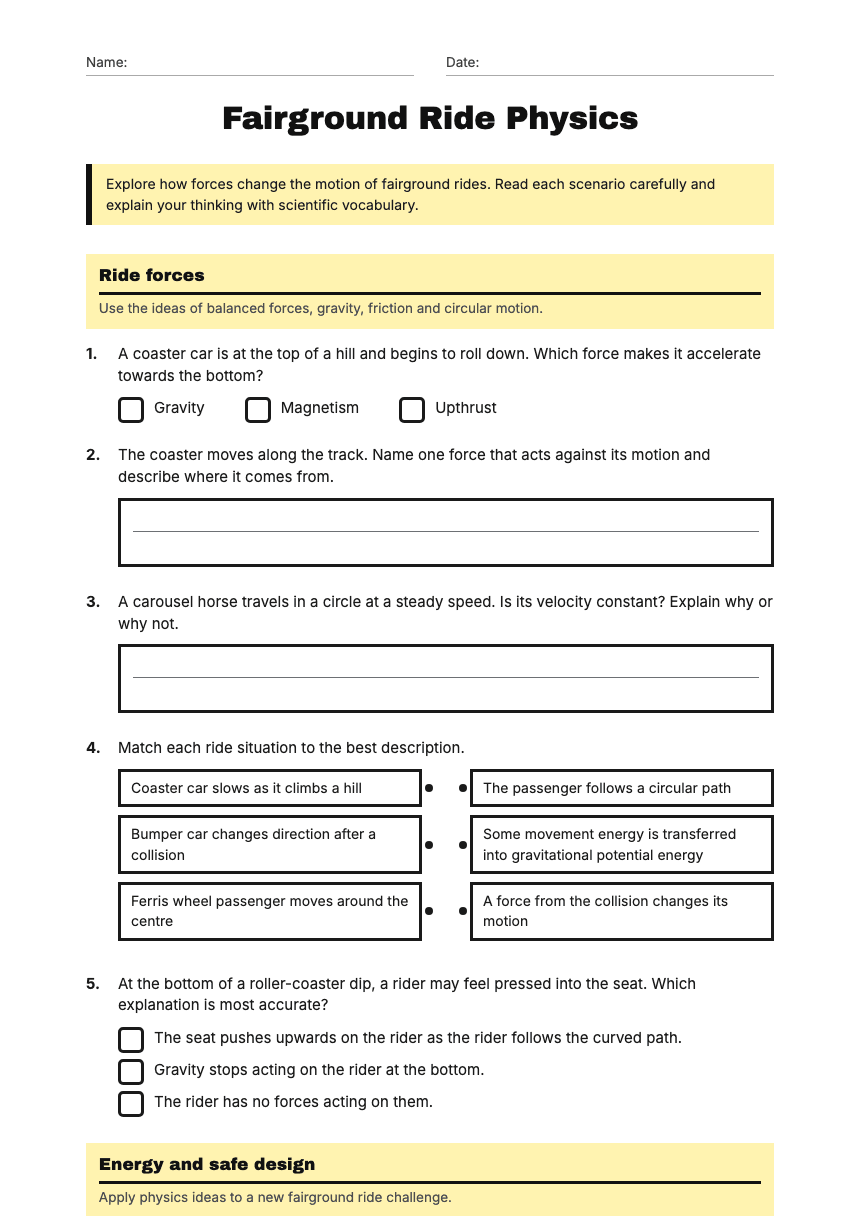
Name:Date:
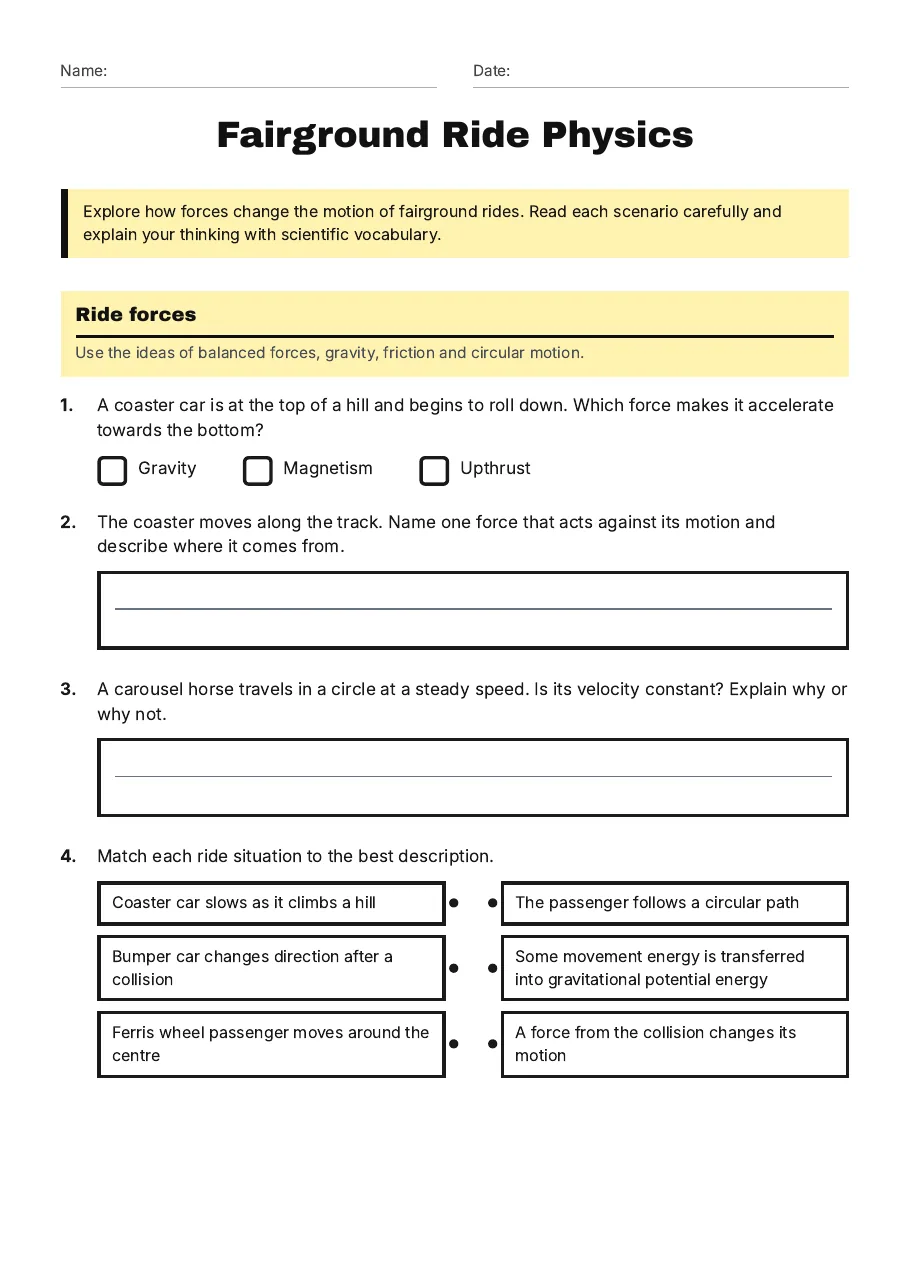
Fairground Ride Physics
Explore how forces change the motion of fairground rides. Read each scenario carefully and explain your thinking with scientific vocabulary.
Ride forces
Use the ideas of balanced forces, gravity, friction and circular motion.
1.A coaster car is at the top of a hill and begins to roll down. Which force makes it accelerate towards the bottom?
- Gravity
- Magnetism
- Upthrust
2.The coaster moves along the track. Name one force that acts against its motion and describe where it comes from.
3.A carousel horse travels in a circle at a steady speed. Is its velocity constant? Explain why or why not.
4.Match each ride situation to the best description.
- Coaster car slows as it climbs a hill
- Bumper car changes direction after a collision
- Ferris wheel passenger moves around the centre
- The passenger follows a circular path
- Some movement energy is transferred into gravitational potential energy
- A force from the collision changes its motion
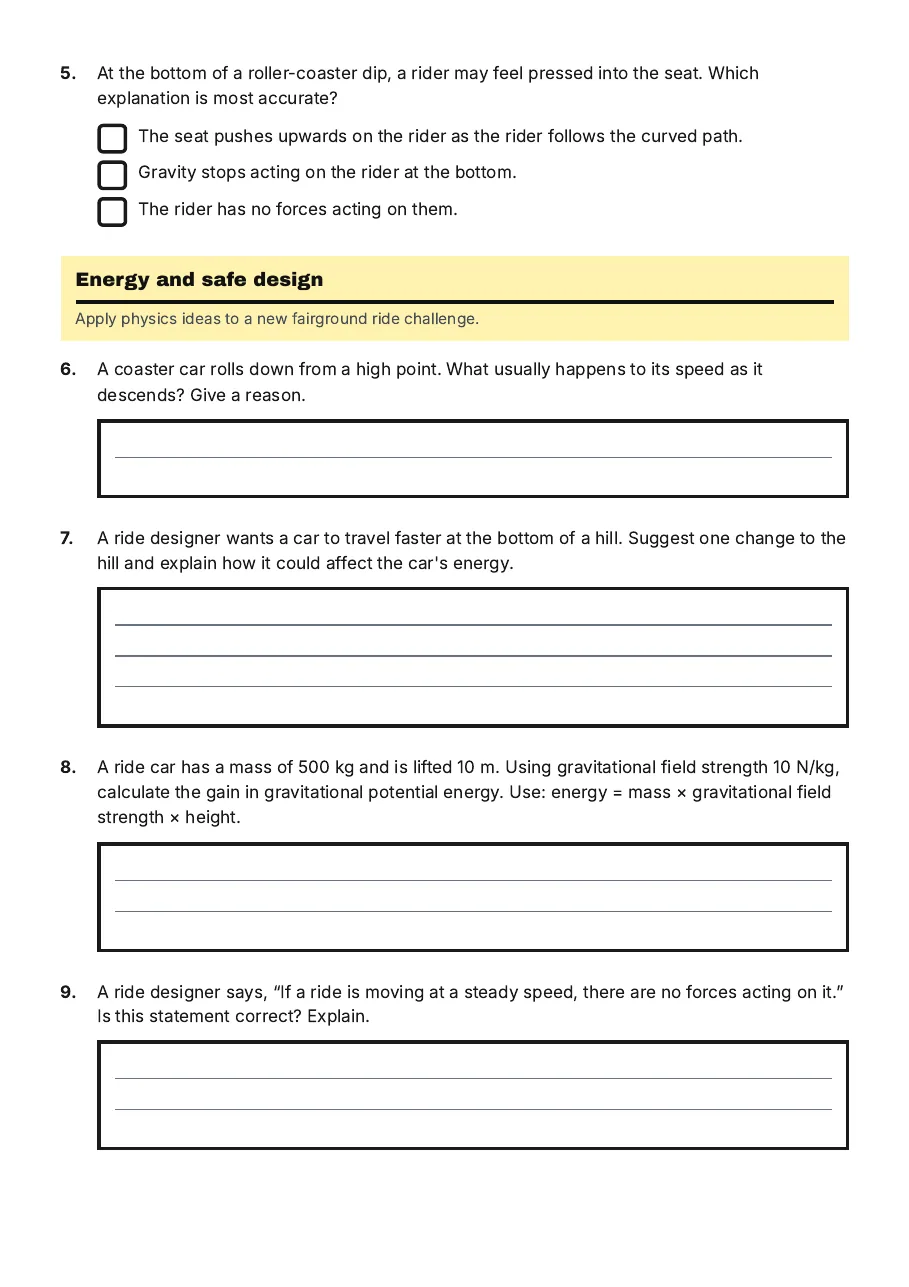
5.At the bottom of a roller-coaster dip, a rider may feel pressed into the seat. Which explanation is most accurate?
- The seat pushes upwards on the rider as the rider follows the curved path.
- Gravity stops acting on the rider at the bottom.
- The rider has no forces acting on them.
Energy and safe design
Apply physics ideas to a new fairground ride challenge.
6.A coaster car rolls down from a high point. What usually happens to its speed as it descends? Give a reason.
7.A ride designer wants a car to travel faster at the bottom of a hill. Suggest one change to the hill and explain how it could affect the car's energy.
8.A ride car has a mass of 500 kg and is lifted 10 m. Using gravitational field strength 10 N/kg, calculate the gain in gravitational potential energy. Use: energy = mass × gravitational field strength × height.
9.A ride designer says, “If a ride is moving at a steady speed, there are no forces acting on it.” Is this statement correct? Explain.
10.Sketch a simple fairground ride and add two labelled arrows to show forces acting on it. Then name one feature that would help keep riders safe.
3 printable pages
Page 1
Page 2

Page 3
About This Worksheet
Free in Kuraplan
Sign up free, grab the PDF, and customize it for your class.
Print-Ready
Formatted for standard paper. Clean layout, easy to read.
AI-Generated
Created with Kuraplan's AI, designed for real classroom use.
For Teachers & Parents
Use in classrooms, for homework, tutoring, or homeschool.
Need a custom version of this worksheet?
Kuraplan's AI generates custom worksheets in seconds — differentiated for every learner, aligned to your curriculum.
Generate Custom Worksheets — Free No credit card Curriculum-aligned Under 60 seconds