ScienceFreePrintable

Introduction to Ions

A free science worksheet ready for your classroom. Open in Kuraplan to grab the print-ready PDF, customize it for your students, or generate a fresh version in seconds.
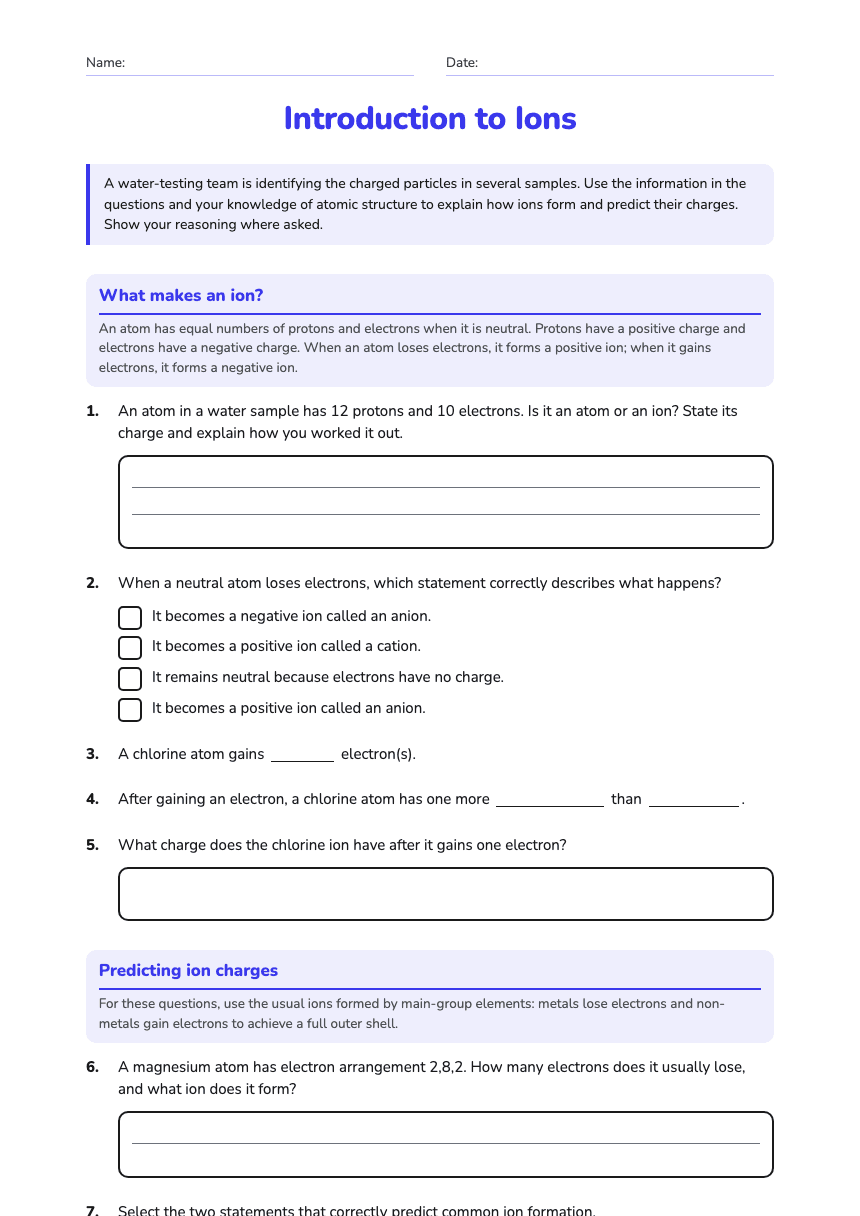
Introduction to Ions worksheet preview
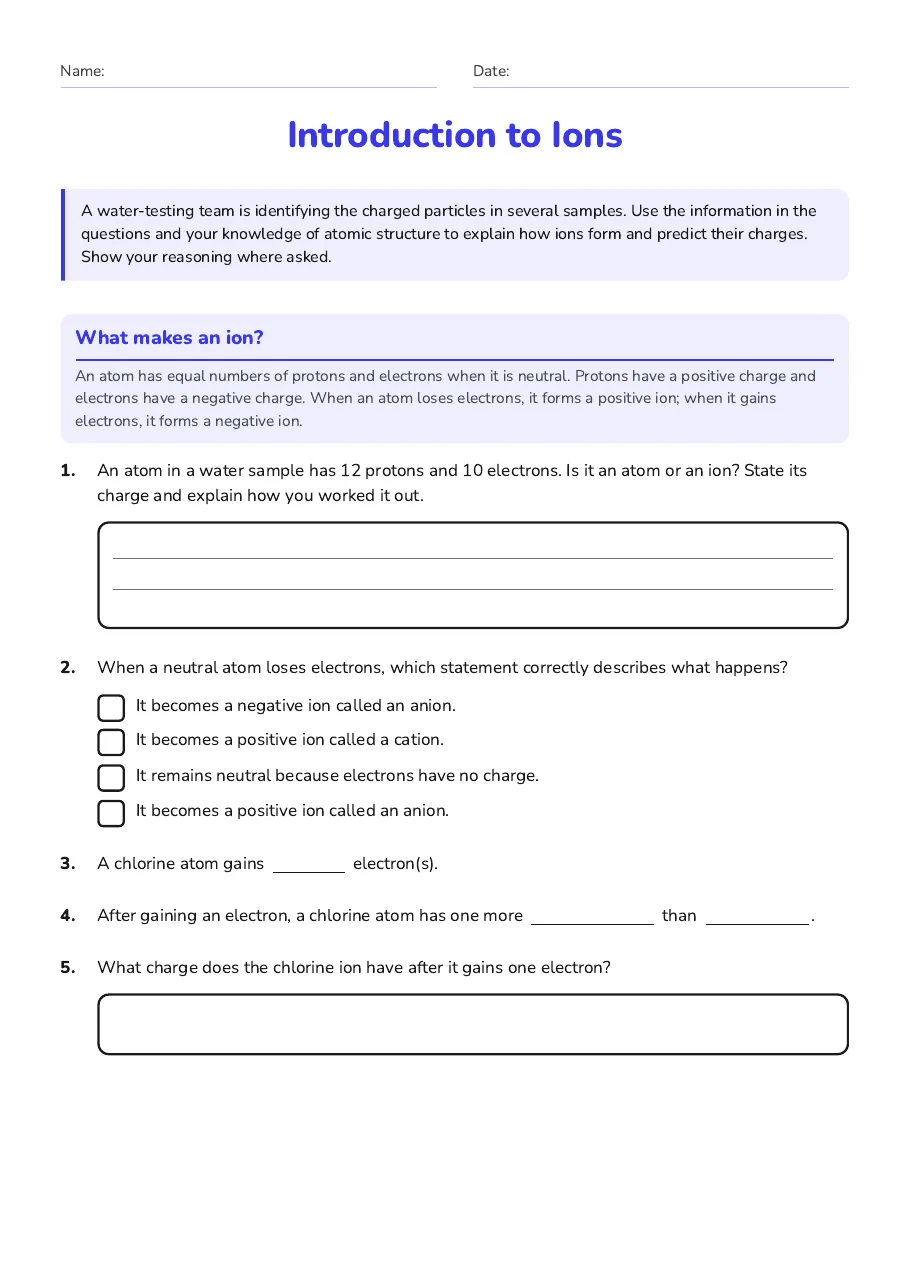
Name:Date:

Introduction to Ions

A water-testing team is identifying the charged particles in several samples. Use the information in the questions and your knowledge of atomic structure to explain how ions form and predict their charges. Show your reasoning where asked.

What makes an ion?

An atom has equal numbers of protons and electrons when it is neutral. Protons have a positive charge and electrons have a negative charge. When an atom loses electrons, it forms a positive ion; when it gains electrons, it forms a negative ion.

1.An atom in a water sample has 12 protons and 10 electrons. Is it an atom or an ion? State its charge and explain how you worked it out.
2.When a neutral atom loses electrons, which statement correctly describes what happens?
  • It becomes a negative ion called an anion.
  • It becomes a positive ion called a cation.
  • It remains neutral because electrons have no charge.
  • It becomes a positive ion called an anion.
3.A chlorine atom gains electron(s).
4.After gaining an electron, a chlorine atom has one more than .
5.What charge does the chlorine ion have after it gains one electron?

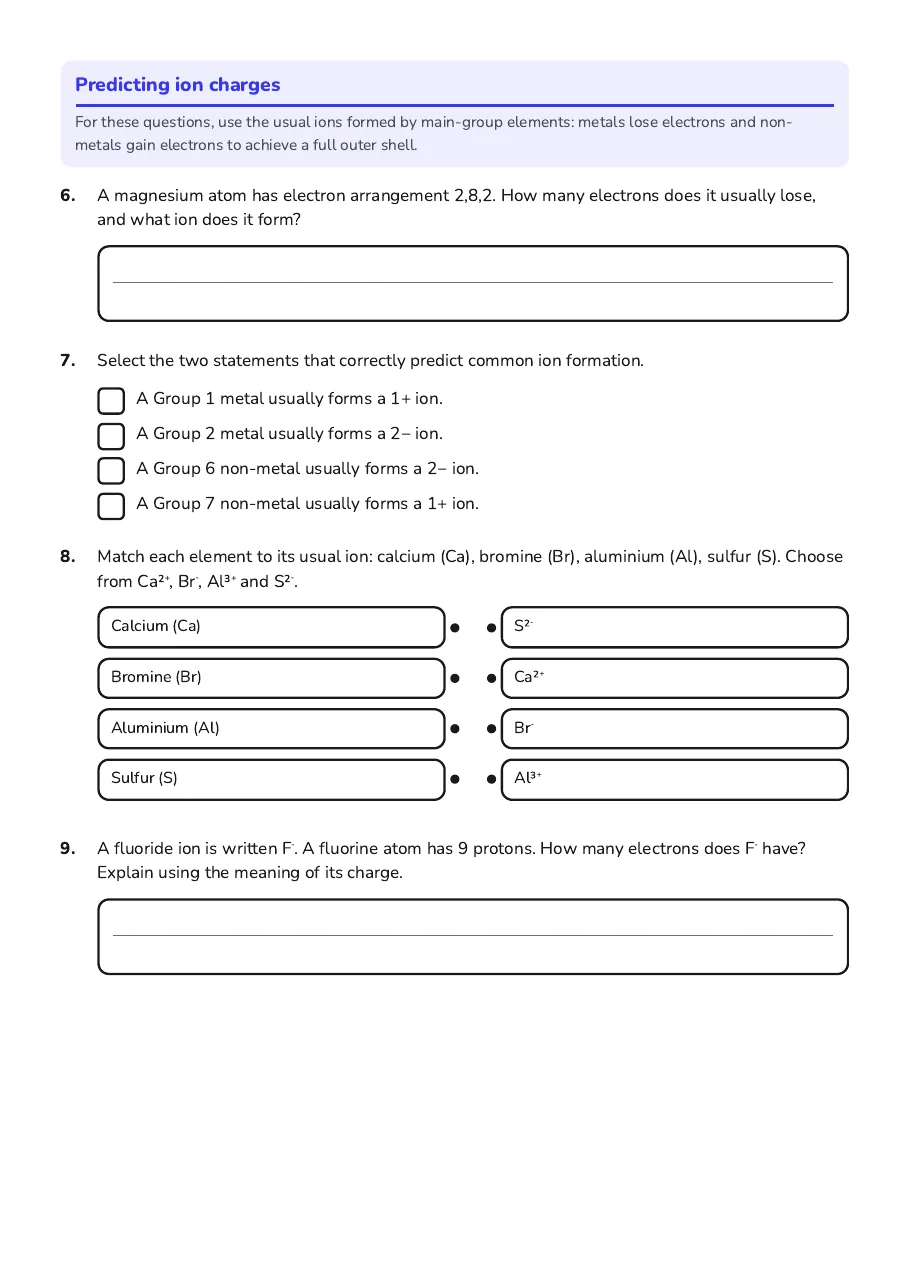
Predicting ion charges

For these questions, use the usual ions formed by main-group elements: metals lose electrons and non-metals gain electrons to achieve a full outer shell.

6.A magnesium atom has electron arrangement 2,8,2. How many electrons does it usually lose, and what ion does it form?
7.Select the two statements that correctly predict common ion formation.
  • A Group 1 metal usually forms a 1+ ion.
  • A Group 2 metal usually forms a 2− ion.
  • A Group 6 non-metal usually forms a 2− ion.
  • A Group 7 non-metal usually forms a 1+ ion.
8.Match each element to its usual ion: calcium (Ca), bromine (Br), aluminium (Al), sulfur (S). Choose from Ca²⁺, Br⁻, Al³⁺ and S²⁻.
  • Calcium (Ca)
  • Bromine (Br)
  • Aluminium (Al)
  • Sulfur (S)
  • S²⁻
  • Ca²⁺
  • Br⁻
  • Al³⁺
9.A fluoride ion is written F⁻. A fluorine atom has 9 protons. How many electrons does F⁻ have? Explain using the meaning of its charge.

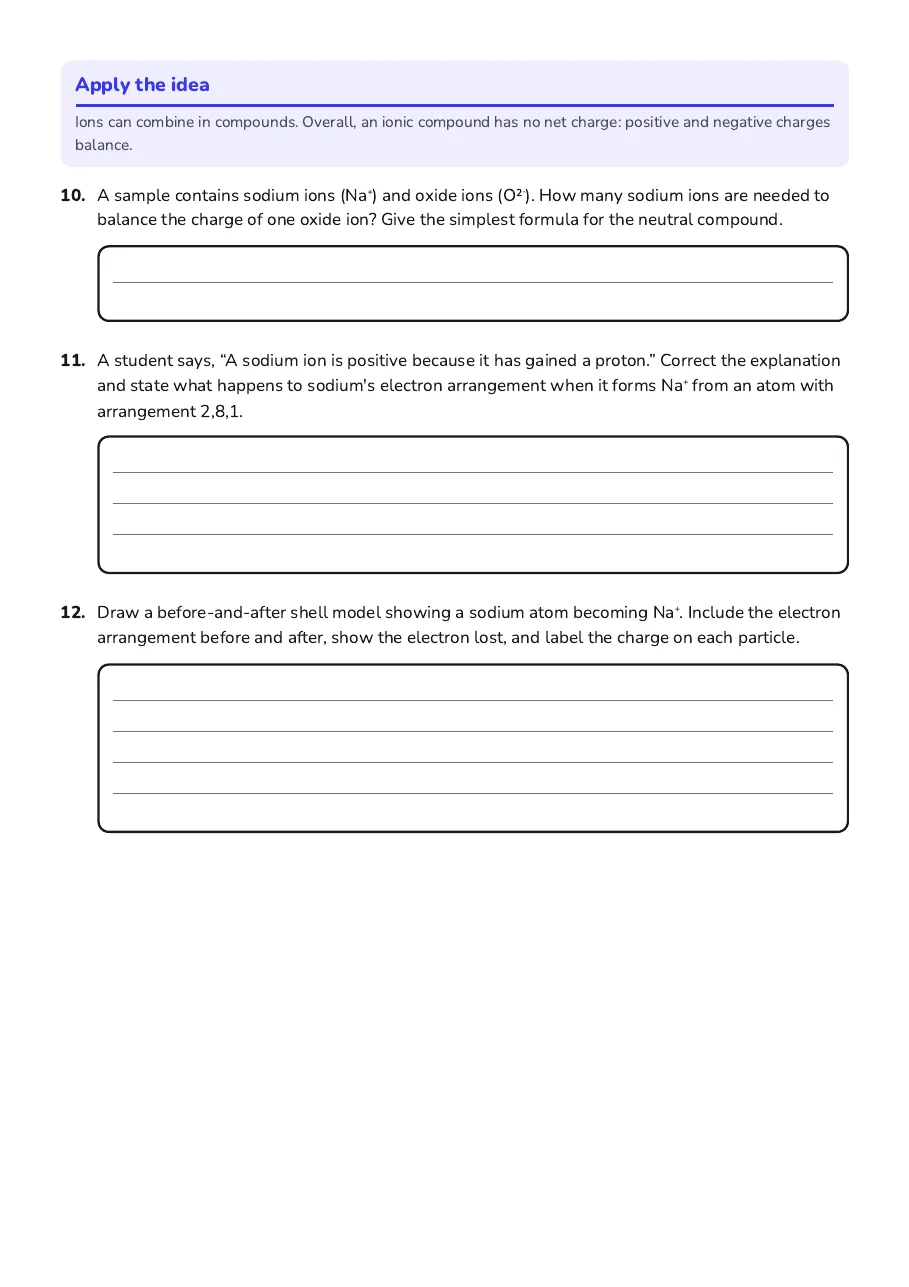
Apply the idea

Ions can combine in compounds. Overall, an ionic compound has no net charge: positive and negative charges balance.

10.A sample contains sodium ions (Na⁺) and oxide ions (O²⁻). How many sodium ions are needed to balance the charge of one oxide ion? Give the simplest formula for the neutral compound.
11.A student says, “A sodium ion is positive because it has gained a proton.” Correct the explanation and state what happens to sodium's electron arrangement when it forms Na⁺ from an atom with arrangement 2,8,1.
12.Draw a before-and-after shell model showing a sodium atom becoming Na⁺. Include the electron arrangement before and after, show the electron lost, and label the charge on each particle.

3 printable pages

  • Introduction to Ions, page 1 of 3: What makes an ion?

    Page 1

  • Introduction to Ions, page 2 of 3: Predicting ion charges

    Page 2

  • Introduction to Ions, page 3 of 3: Apply the idea

    Page 3

About This Worksheet

Free in Kuraplan

Sign up free, grab the PDF, and customize it for your class.

Print-Ready

Formatted for standard paper. Clean layout, easy to read.

AI-Generated

Created with Kuraplan's AI, designed for real classroom use.

For Teachers & Parents

Use in classrooms, for homework, tutoring, or homeschool.

Need a custom version of this worksheet?

Kuraplan's AI generates custom worksheets in seconds — differentiated for every learner, aligned to your curriculum.

Generate Custom Worksheets — Free
No credit card Curriculum-aligned Under 60 seconds