You've probably had this experience: you plan a thoughtful lesson, choose a standard, prepare attractive materials, and lead students through a lively activity. The class seems successful. Then the exit ticket asks students to demonstrate the exact skill in the standard, and the results don't match the confidence you felt during the lesson.
That gap doesn't necessarily mean the lesson was poor. It may mean the objective, instruction, materials, and assessment weren't pointing to the same learning target. Mentioning a standard at the top of a plan isn't the same as teaching students to meet it.
A standards aligned system helps schools check the entire instructional chain. It asks whether the curriculum defines the intended learning, whether teachers teach that learning, whether students practice the required performance, and whether assessments measure what students were asked to do. It also checks whether the materials, interventions, accessibility supports, and reporting tools reinforce the same expectations.
The practical question isn't, “Is this lesson aligned?” It's, “Can we trace the standard from the written curriculum to the unit, classroom activity, student work, assessment, and next instructional decision?”
That's the question we'll keep in view.
Introduction Why Alignment Feels Harder Than It Should
A teacher can work carefully and still create alignment drift. Consider a reading lesson built around a strong article. Students annotate, discuss the author's ideas, and answer thoughtful questions. The objective names a standard about constructing an explanation, but the final check asks students to select an answer from a multiple-choice list.
The activity may build useful background knowledge. The discussion may be energetic. Yet the assessment doesn't show whether students can construct an explanation. The lesson has quality, but the parts aren't fully coherent.
That's why alignment feels harder than it should. Teachers are often given standards, curriculum documents, pacing guides, assessments, intervention programs, and digital resources as separate pieces. Each piece may look reasonable on its own. The work becomes difficult when someone has to connect them and notice where the chain breaks.
A standard named in a lesson plan is a starting point, not proof of alignment.
A standards aligned system makes the connections visible. At the school level, leaders can examine whether grade-level expectations build from one year to the next and remain consistent across classrooms. At the unit level, teams can compare the intended standard with the content, tasks, materials, and assessments. At the classroom level, teachers can ask whether students are practicing the same knowledge and performance the standard requires.
This matters for more than compliance. If students receive different levels of rigor, practice different skills, or complete assessments that measure different expectations, the resulting data becomes harder to interpret. A low score might reflect a learning gap, or it might reveal that instruction and assessment were never matched.
The useful approach is not to add paperwork for its own sake. It's to create a simple way to follow the learning target through the system, then fix the point where it loses clarity.
What a Standards Aligned System Really Means
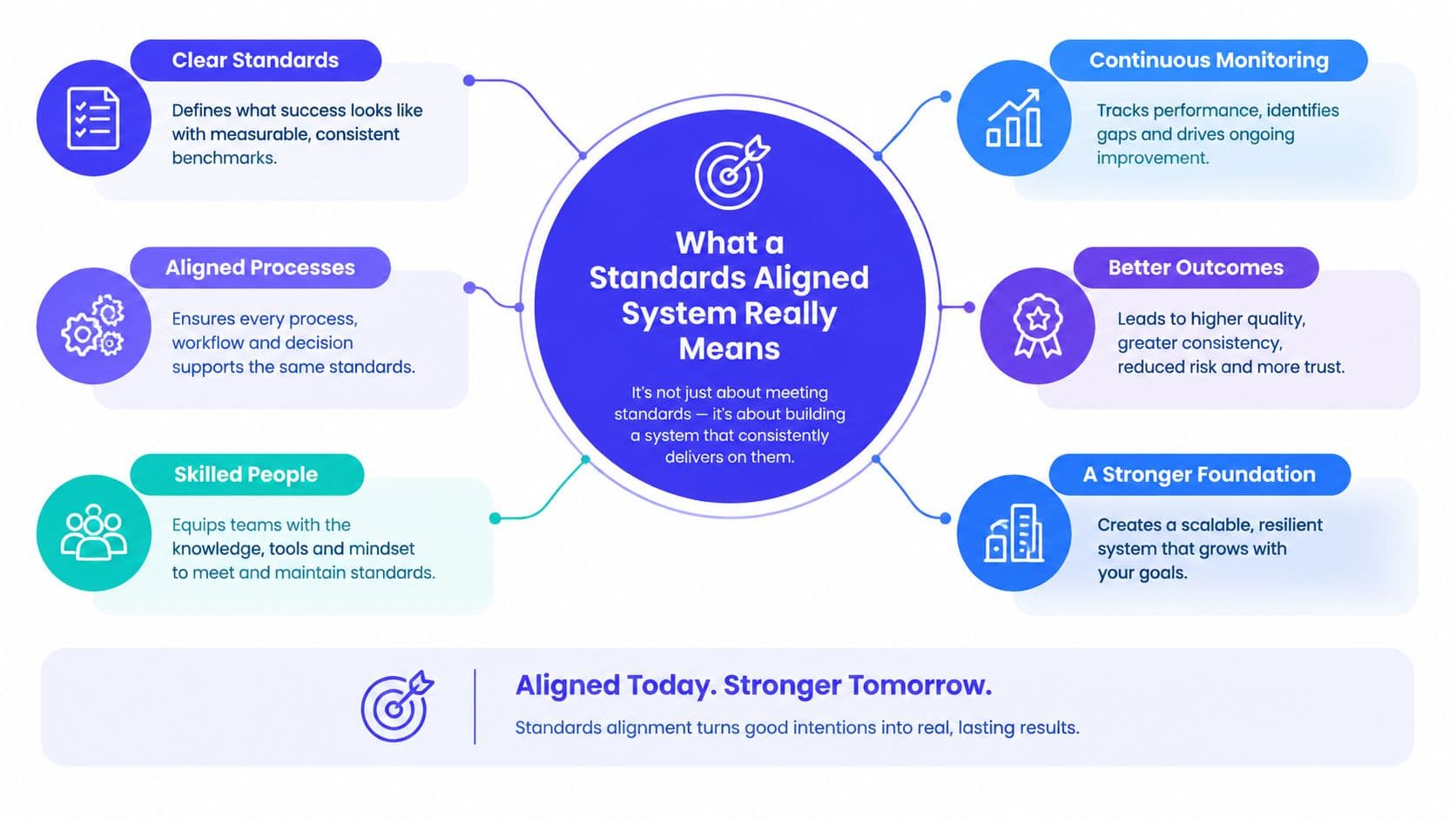
Think of a standards aligned system as a route map for learning. The standard identifies the destination. The curriculum lays out the route. Instruction gives students opportunities to travel that route. Assessment checks whether they can reach the destination independently.
If the destination says students should analyze how an idea develops, a lesson filled only with recall questions takes students somewhere else. If students are expected to write an argument, a sequence of lessons that offers only discussion and selected-response quizzes leaves out the central performance.
A coherent system connects several parts:
- Content standards describe what students should know.
- Performance standards clarify what students must do with that knowledge.
- Curriculum organizes knowledge and skills across units and grades.
- Instruction gives students meaningful practice with the intended work.
- Assessment collects evidence that matches the expected performance.
- Reporting and support communicate progress and respond to unfinished learning.
Paper alignment and lived alignment
A curriculum map can list every standard and still fail to guide classroom practice. Paper alignment appears in documents. Lived alignment appears in what students read, discuss, create, revise, and demonstrate.
The distinction matters because alignment must operate across the taught curriculum, the tested curriculum, and the supported curriculum. The taught curriculum is what teachers present. The tested curriculum is what assessments ask students to show. The supported curriculum includes instructional materials, scaffolds, interventions, accessibility features, and professional learning.
If those layers disagree, students receive mixed signals. A standard might demand reasoning, while the materials emphasize memorization and the assessment rewards recognition. The system has a label, but not a dependable learning path.
Standards-aligned systems became a major U.S. education reform priority after A Nation at Risk in 1983. The first federal law to explicitly require standards and aligned assessments was the Improving America's Schools Act of 1994, and the No Child Left Behind Act, signed in January 2002, carried that approach forward and strengthened standards-based reform as a centerpiece of federal accountability policy. RAND's historical review of standards-based reform describes the practical expectation clearly: states would define rigorous content standards and connect curriculum, instruction, and testing to them.
The goal isn't identical teaching in every classroom. Teachers still make professional decisions. The goal is a shared destination, a visible progression, and evidence that the route students take prepares them for the performance they must demonstrate.
Core Components That Make the System Work
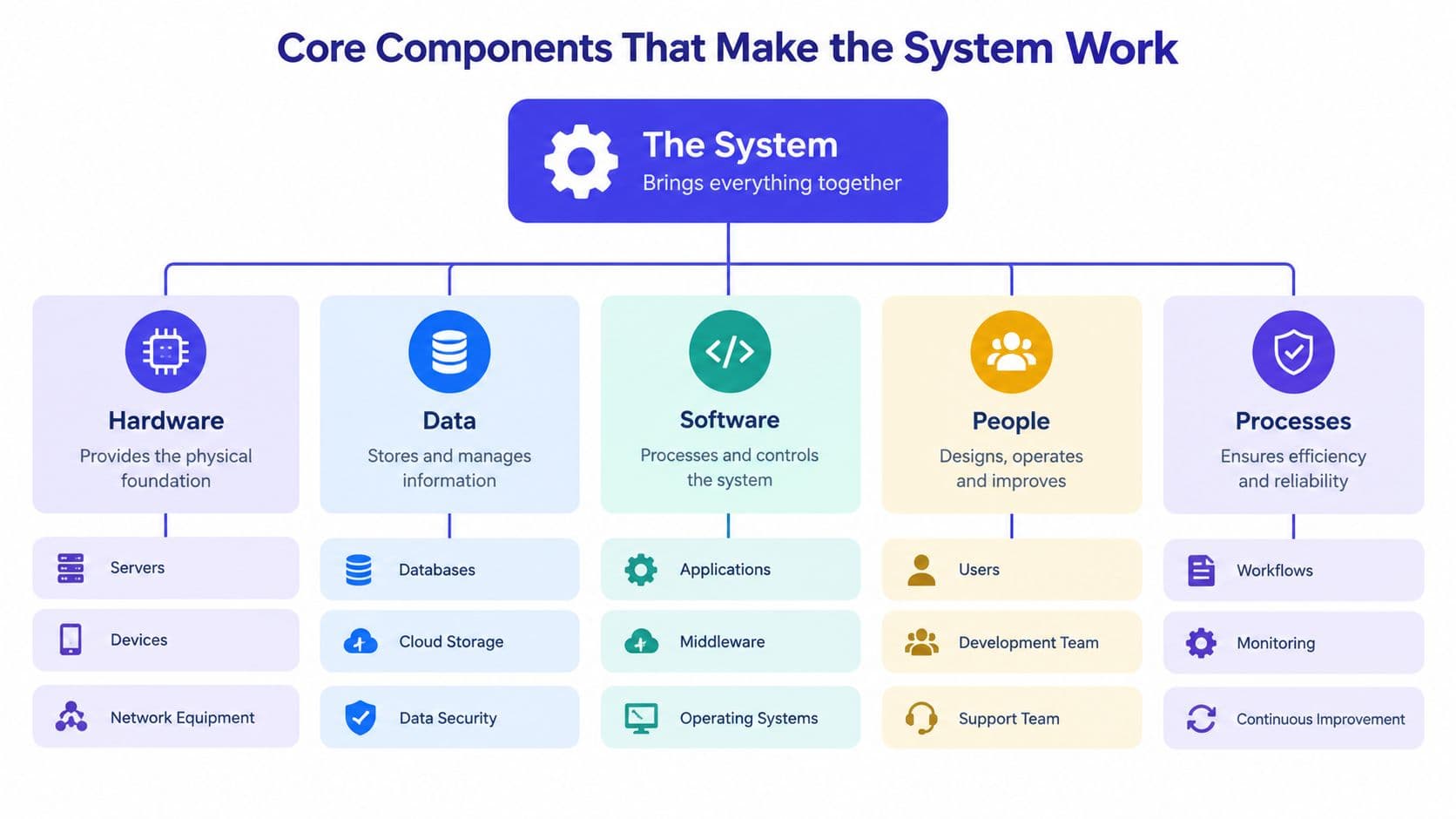
A standards-aligned system should work like a well-planned classroom routine. Teachers can see what students are learning, how the work grows in difficulty, which materials support it, and what evidence will show mastery. A standards list and pacing calendar alone cannot provide that view.
Six questions for checking alignment
Technical guidance offers dimensions that help teams examine more than shared keywords. Each question tests a different link in the instructional chain.
- Content match: Do instruction and assessment address the concepts and skills named in the standard?
- Depth match: Do students work at the level of thinking and complexity the standard describes?
- Emphasis: Do instructional time, tasks, and assessment attention reflect the standard's importance?
- Performance match: Do students demonstrate the type of performance the standard requires?
- Accessibility: Can learners access the content and show what they know with appropriate supports?
- Reporting: Do results describe performance in enough detail to guide a response?
These checks apply at the unit and classroom levels. A unit may appear aligned on paper while its daily tasks offer little practice with the required performance. Technical guidance on alignment and assessment validity explains why standards, expected performance, and assessments must connect if results are to support sound conclusions about student learning.
The curriculum spine
A curriculum should show a learning continuum, much like a staircase. Teachers need to see where a skill begins, how it becomes more demanding, and what students should do by the end of a unit or grade.
The American Federation of Teachers' curriculum review tool names five parts of a complete grade-by-grade curriculum:
- Learning continuum
- Instructional resources
- Instructional strategies
- Performance indicators
- Instructional plans
Performance indicators make mastery visible. They describe the expected level and what counts as “good enough,” giving teachers a shared reference for planning and feedback. The AFT curriculum evaluation tool provides a framework for reviewing these curriculum components.
Each missing part creates a practical problem. Without a continuum, teams may repeat or skip skills. Without usable resources, teachers must build materials alone. Without performance indicators, grading varies. Without links to assessment and intervention, teams can spot a gap but may not know how to respond.
Student-facing learning intentions and success criteria help translate standards into clear classroom language. This guide to learning intentions and success criteria supports that translation while keeping the expected performance visible to students.
Check the connections in practice
The components belong in one working chain. A unit plan should show how the standard shapes the sequence, how materials support the sequence, how activities develop the required performance, and how assessments gather suitable evidence.
Teams should also verify fidelity in the classroom. Compare the planned unit with what teachers assign, what students practice, and what assessments require. If overlap between instruction and assessment improves only slightly, or teachers rarely use the shared materials, the bottleneck may be usability and support rather than the standards map.
A polished curriculum with weak classroom use remains incomplete.
How to Tell If Your Lessons Are Truly Aligned
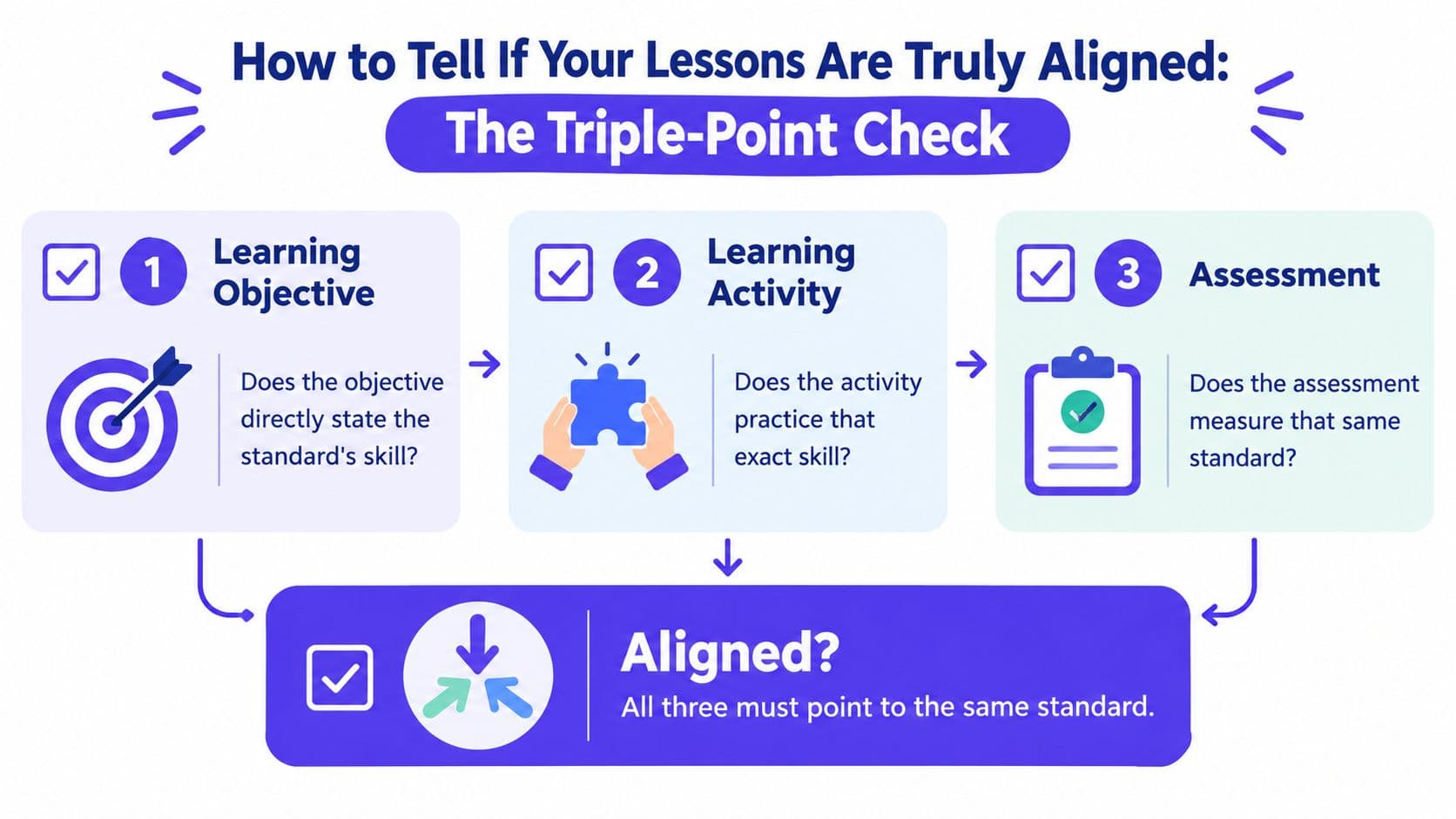
A lesson can look polished and still miss its standard. Check the full instructional chain: what students are expected to learn, what they are asked to do, what evidence they produce, and what support helps them reach the target. A useful starting point is the Triple-Point Check.
Write three headings on a planning page:
- Objective
- Student activity
- Assessment
Place the target standard beside each heading. Compare the verbs, content, and level of thinking. If the three parts describe different performances, the lesson has alignment drift. Use this check while learning how to write a lesson plan, then repeat it at the unit level so daily lessons build toward the intended performance.
Follow the verb
Standards verbs carry instructional weight. Explain, compare, justify, analyze, model, construct, and evaluate require different evidence from identify, list, recall, or define.
Suppose students must construct an explanation using evidence. The objective might say, “Students will construct an explanation that connects a claim to relevant evidence.” The activity should give them a phenomenon, sources, examples, or data to examine, followed by time to draft and revise.
The assessment should ask students to construct an explanation too. A multiple-choice quiz can check background knowledge, but it cannot by itself show mastery of that performance. This explanation of alignment drift shows why the assessment must match the standard's verb and skill.
Use a quick classroom audit
Before teaching, ask:
- Objective: What will students know or do by the end?
- Activity: Where will they practice that exact knowledge or performance?
- Assessment: What product or action will prove it?
- Support: Which scaffolds make the task accessible without changing the target?
- Feedback: What will students revise, explain, or try next?
After teaching, inspect student work and compare it with the planned unit. Check what teachers assigned, what students practiced, and what the assessment required. Engagement matters, but the work must show the target skill.
A slide deck, hands-on task, or worksheet can support learning while still missing the standard. Materials serve the performance. They do not define it.
Keep the required shifts visible
Planning tools can help teachers avoid drifting toward familiar activities. Achieve the Core's lesson-planning tool asks teachers to select a target standard or cluster and keep the required shifts central to the content, structure, and activities.
Teams should also check classroom use. If overlap between instruction and assessment improves only slightly, or teachers rarely use shared materials, the bottleneck may be usability, time, or support. The map may be accurate while implementation remains weak.
Digital tools can reduce the mechanical work of mapping objectives, tasks, and checks for understanding. Kuraplan can generate standards-aligned lesson and unit plans, worksheets, visuals, and assessment rubrics. Teachers still review the match and adjust materials for their students.
The professional judgment remains yours. A tool can surface a mismatch quickly, but you decide whether the task reflects the standard, students' needs, and the evidence you trust.
Benefits of a Coherent Standards Aligned Approach
Alignment earns its place in a school's improvement work when it makes classroom decisions clearer. Students benefit first because they encounter more consistent expectations. They're less likely to spend one lesson memorizing a concept and then face an assessment requiring an unfamiliar performance with no practice.
Teachers gain a shared language for planning and reviewing student work. A grade-level team can discuss whether students are ready to justify a claim, revise a model, or compare representations without starting from separate definitions of success. That shared understanding also helps teachers distinguish between a content gap and a performance gap.
What coherence changes day to day
A coherent system can help teams:
- Choose materials: Select resources because they support the target skill, not because they look engaging in isolation.
- Plan progression: Connect today's work to earlier learning and upcoming demands.
- Design support: Add scaffolds, language supports, or alternate access points without lowering the intended standard.
- Interpret evidence: Treat assessment results as information about a defined performance.
- Coordinate intervention: Address the same unfinished learning that classroom instruction and assessment have identified.
The Common Core era illustrates how widely a shared standards framework can shape system design. A widely cited estimate reported implementation in 42 states and the District of Columbia, reaching about 78% of U.S. students. Third Way's overview of Common Core adoption also notes that the framework allowed state-level implementation, including a 15% rule permitting states to add supplementary content beyond the shared standards.

The human payoff is often quieter than a test score. Teachers spend less time rebuilding disconnected materials, students understand what successful work looks like, and teams can focus meetings on student thinking instead of debating what the standard means from scratch.
Coherence doesn't remove complexity. It makes the complexity easier to manage.
Implementation Roadmap From Mapping to Classroom Impact
Build alignment in a sequence that respects teachers' time. Trying to repair every grade, subject, unit, and assessment at once usually produces a thick folder and little change in daily instruction.
Begin with a priority
Choose a grade-level cluster, course, or unit where the need is clear. Identify the standards students must learn and the performances they must demonstrate. Read the standards closely enough to separate the content from the action.
Create a simple map with columns for:
- Standard and supporting knowledge
- Expected student performance
- Unit and lesson location
- Instructional materials
- Practice tasks
- Assessment evidence
- Accessibility supports
- Intervention response
The map should make omissions and duplicates easy to see. It doesn't need to become a second curriculum.
Check breadth and depth
Map assessment items to the standards they measure. Don't rely on shared vocabulary. Ask whether each item measures the intended content and whether it asks students to perform at the intended depth.
Research on alignment methodologies describes item-to-standard mapping as a process that compares individual assessment items with one or more standards, then examines the breadth and depth of coverage. One widely cited framework uses about six items per broad content standard as a benchmark for categorical concurrence. The alignment methodology review provides the technical background.
That benchmark is a review aid, not a reason to create repetitive tests. The useful question is whether the assessment offers enough varied evidence to support the conclusion you want to make.
Align the sequence and materials
Next, place the standard into a teachable progression. Identify the knowledge students need first, the guided practice they need next, and the independent performance that will show readiness.
Review the actual resources teachers use. A material may mention the standard but provide practice at the wrong depth. Replace, supplement, or adapt it where necessary. Keep the teacher directions clear so alignment doesn't require a separate decoding session.
Design matched assessments
Build formative checks into the unit rather than waiting for a final test. Decide what students will say, write, model, solve, perform, or revise. Then create success criteria that help both teacher and student recognize the target.
Use common assessments when consistency matters, but review student work together. Teachers can preserve instructional style while calibrating what proficient performance looks like.
Add support and review
Connect intervention to the same standard and performance. A student who struggles to explain reasoning needs more than extra worksheets. That student may need vocabulary support, worked examples, guided rehearsal, feedback, or a different representation of the content.
Set a review date. Look at the unit map, student work, assessment evidence, and teacher experience. If the materials are aligned but teachers can't use them within real planning conditions, the system needs a usability fix, not another compliance reminder.
Measuring Fidelity and Impact Without Guesswork
A standards-aligned system can look tidy in a district plan while students experience something different. In one classroom, the unit may skip needed practice. In another, the task may be inaccessible. The assessment may then measure recall while the standard expects explanation, modeling, or application. Fidelity checks belong at the unit and classroom level, where the full instructional chain becomes visible.
Use six dimensions as a review lens: content match, depth match, emphasis, performance match, accessibility, and reporting. Check whether the taught curriculum, tested curriculum, and supports point toward the same student performance. A match on paper matters only when students receive suitable instruction and can show the intended learning.
A practical evidence set
Choose one unit and gather:
- The target standards and performance expectations
- The lesson sequence and assigned materials
- Samples of student tasks and supports
- Formative checks and the final assessment
- Student work showing different levels of success
- Teacher notes on what was usable and what required adaptation
- The instructional response that followed the evidence
Read the materials alongside the student work. Did students practice the target performance? Did the assessment sample that same skill? Did accessibility supports preserve the target rather than reduce it? Did teachers use the shared materials, or replace them because the resources did not fit the class?
Keep small gains in perspective. A synthesis of alignment research reported only a few percentage points of overlap increase over six years in several grade bands. This synthesis on educational standard alignment points to a practical conclusion: compare documents with classroom work, because stronger wording in a plan does not guarantee stronger instruction.
Teacher use is another revealing checkpoint. Independent coverage reported that 35% of ELA teachers, 51% of math teachers, and 6% of science teachers reported using at least one aligned curriculum weekly. EdReports' coverage of teacher use of aligned K-12 curriculum shows why availability alone cannot carry the system. If teachers cannot access, understand, or adapt materials efficiently, low usage identifies the bottleneck.
For performance-based checks, the 2026 diplomatic skills assessment guide demonstrates how to connect learning outcomes with observable evidence. Teams can also use these formative assessment examples to build checks that shape the next lesson instead of merely recording a score.
Fidelity review is a learning routine. It shows whether the shared plan helps students do the work the standard requires, and where teachers need better materials or support.
Kuraplan helps K-12 educators create standards-aligned lesson and unit plans, worksheets, visuals, and assessment rubrics while keeping objectives connected to evidence. Visit Kuraplan to turn a priority standard into a usable classroom sequence and check alignment before students encounter the assessment.