Cactus Hill Archaeology
A free social studies worksheet ready for your classroom. Open in Kuraplan to grab the print-ready PDF, customize it for your students, or generate a fresh version in seconds.
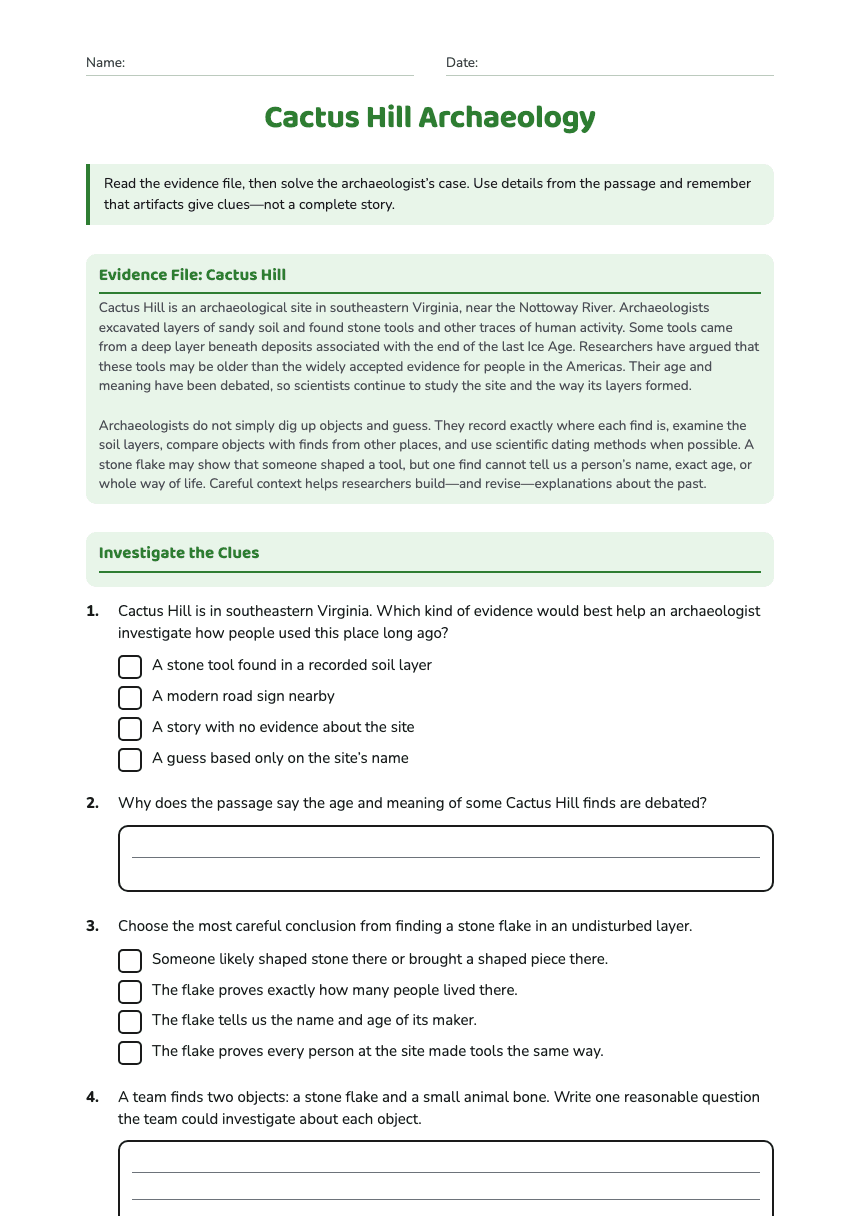
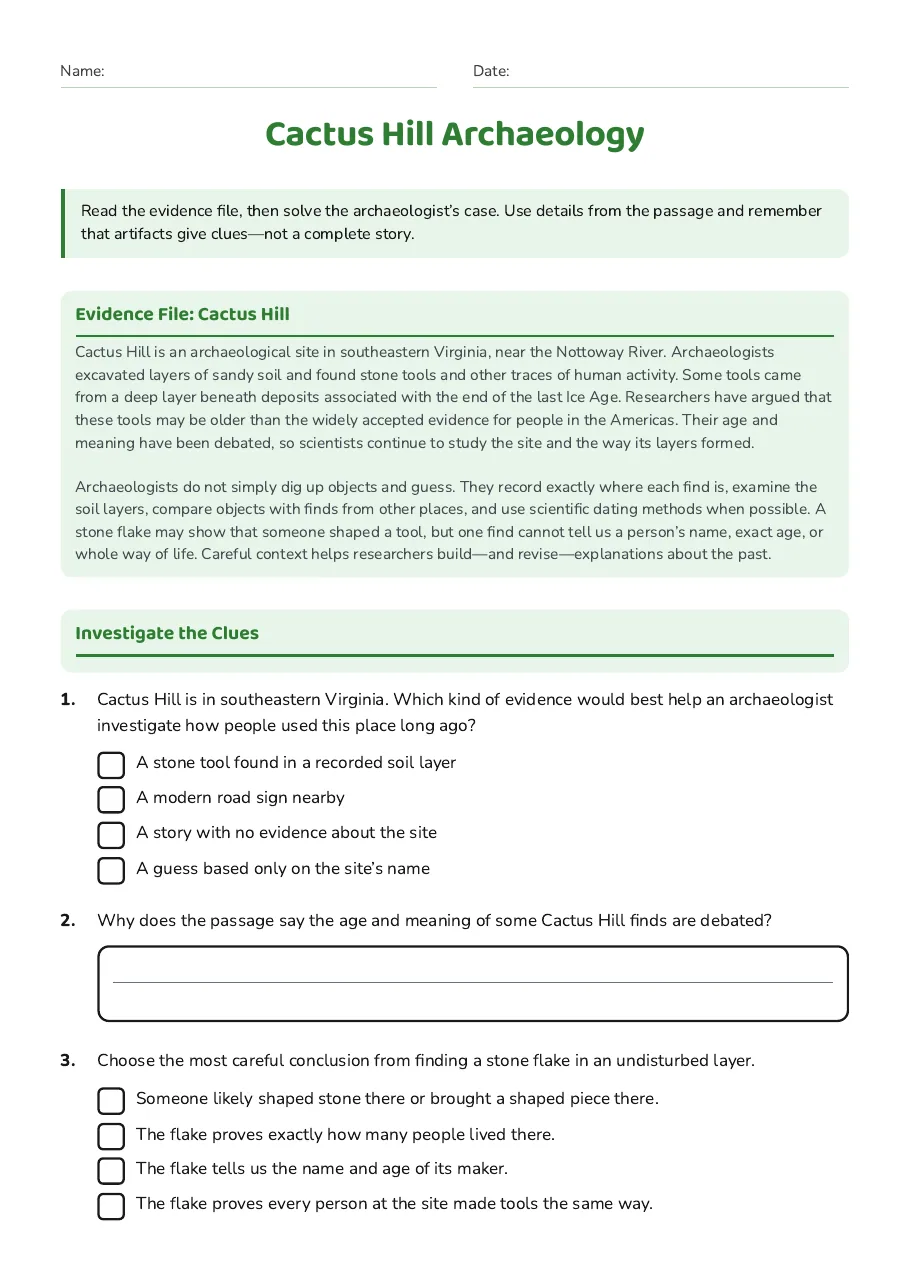
Cactus Hill Archaeology
Evidence File: Cactus Hill
Cactus Hill is an archaeological site in southeastern Virginia, near the Nottoway River. Archaeologists excavated layers of sandy soil and found stone tools and other traces of human activity. Some tools came from a deep layer beneath deposits associated with the end of the last Ice Age. Researchers have argued that these tools may be older than the widely accepted evidence for people in the Americas. Their age and meaning have been debated, so scientists continue to study the site and the way its layers formed. Archaeologists do not simply dig up objects and guess. They record exactly where each find is, examine the soil layers, compare objects with finds from other places, and use scientific dating methods when possible. A stone flake may show that someone shaped a tool, but one find cannot tell us a person’s name, exact age, or whole way of life. Careful context helps researchers build—and revise—explanations about the past.
Investigate the Clues
- A stone tool found in a recorded soil layer
- A modern road sign nearby
- A story with no evidence about the site
- A guess based only on the site’s name
- Someone likely shaped stone there or brought a shaped piece there.
- The flake proves exactly how many people lived there.
- The flake tells us the name and age of its maker.
- The flake proves every person at the site made tools the same way.
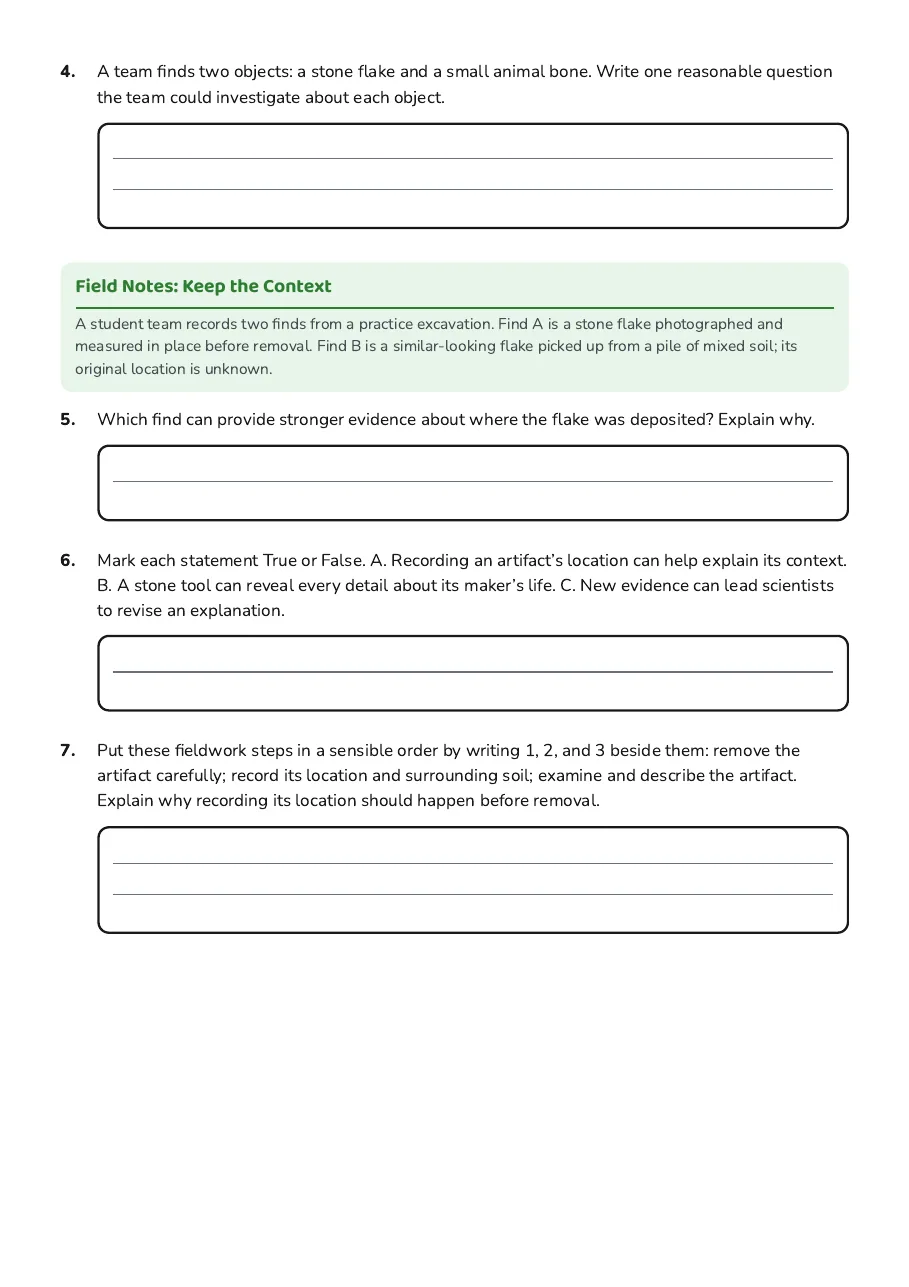
Field Notes: Keep the Context
A student team records two finds from a practice excavation. Find A is a stone flake photographed and measured in place before removal. Find B is a similar-looking flake picked up from a pile of mixed soil; its original location is unknown.
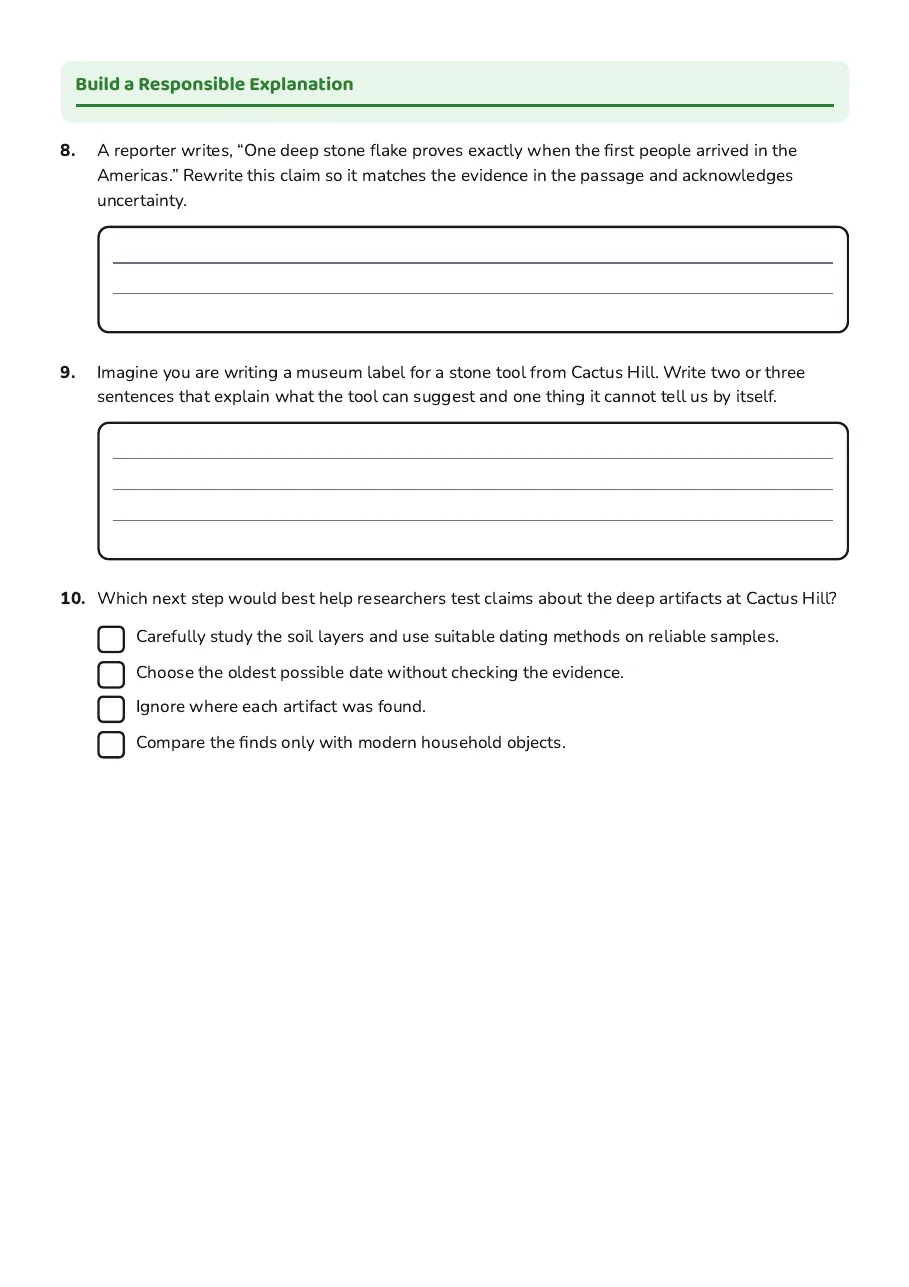
Build a Responsible Explanation
- Carefully study the soil layers and use suitable dating methods on reliable samples.
- Choose the oldest possible date without checking the evidence.
- Ignore where each artifact was found.
- Compare the finds only with modern household objects.
3 printable pages
Page 1
Page 2
Page 3
About This Worksheet
Free in Kuraplan
Sign up free, grab the PDF, and customize it for your class.
Print-Ready
Formatted for standard paper. Clean layout, easy to read.
AI-Generated
Created with Kuraplan's AI, designed for real classroom use.
For Teachers & Parents
Use in classrooms, for homework, tutoring, or homeschool.
Need a custom version of this worksheet?
Kuraplan's AI generates custom worksheets in seconds — differentiated for every learner, aligned to your curriculum.
Generate Custom Worksheets — Free