Creation Myths Comparative Analysis
A free english (ela) worksheet ready for your classroom. Open in Kuraplan to grab the print-ready PDF, customize it for your students, or generate a fresh version in seconds.

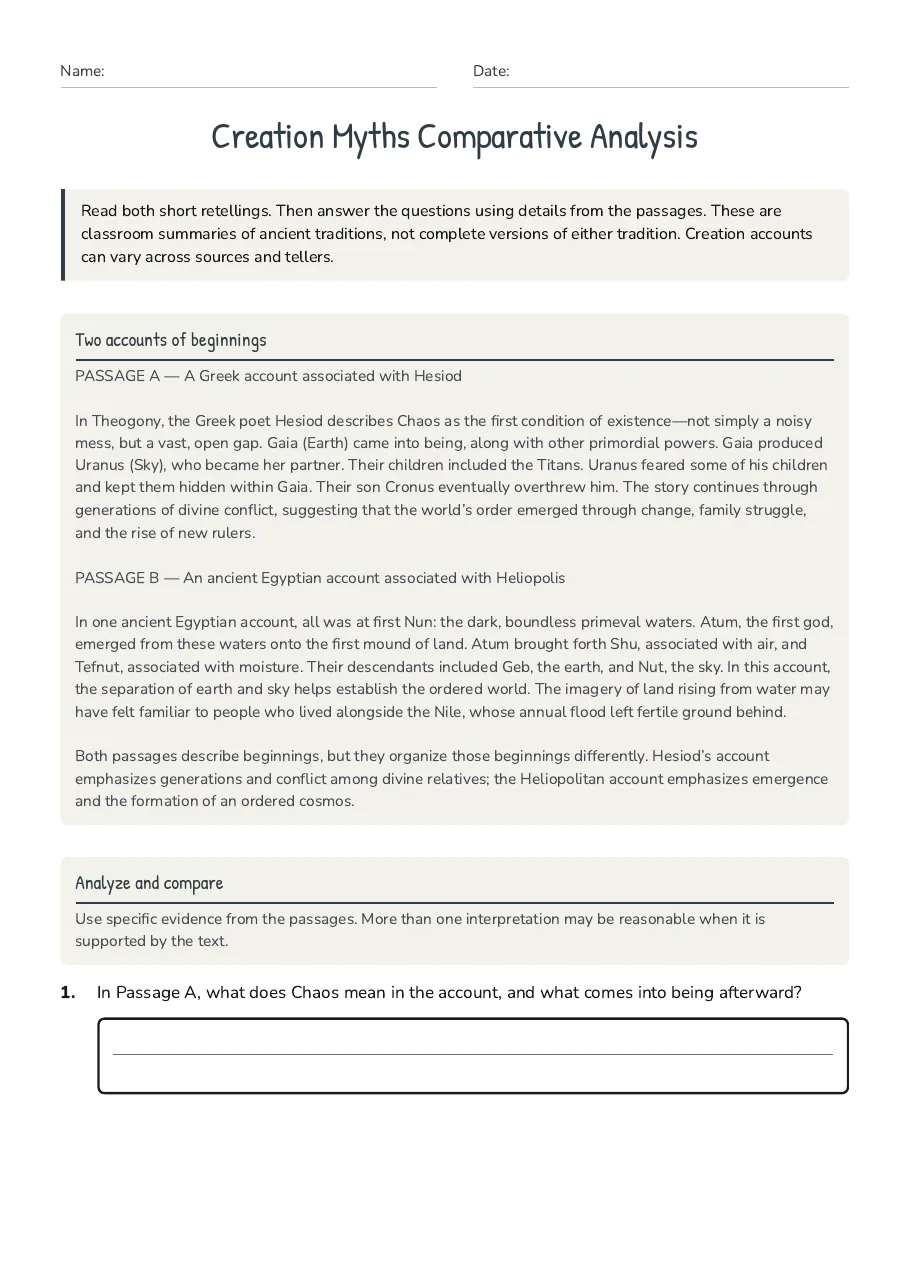
Creation Myths Comparative Analysis
Two accounts of beginnings
PASSAGE A — A Greek account associated with Hesiod In Theogony, the Greek poet Hesiod describes Chaos as the first condition of existence—not simply a noisy mess, but a vast, open gap. Gaia (Earth) came into being, along with other primordial powers. Gaia produced Uranus (Sky), who became her partner. Their children included the Titans. Uranus feared some of his children and kept them hidden within Gaia. Their son Cronus eventually overthrew him. The story continues through generations of divine conflict, suggesting that the world’s order emerged through change, family struggle, and the rise of new rulers. PASSAGE B — An ancient Egyptian account associated with Heliopolis In one ancient Egyptian account, all was at first Nun: the dark, boundless primeval waters. Atum, the first god, emerged from these waters onto the first mound of land. Atum brought forth Shu, associated with air, and Tefnut, associated with moisture. Their descendants included Geb, the earth, and Nut, the sky. In this account, the separation of earth and sky helps establish the ordered world. The imagery of land rising from water may have felt familiar to people who lived alongside the Nile, whose annual flood left fertile ground behind. Both passages describe beginnings, but they organize those beginnings differently. Hesiod’s account emphasizes generations and conflict among divine relatives; the Heliopolitan account emphasizes emergence and the formation of an ordered cosmos.
Analyze and compare
Use specific evidence from the passages. More than one interpretation may be reasonable when it is supported by the text.
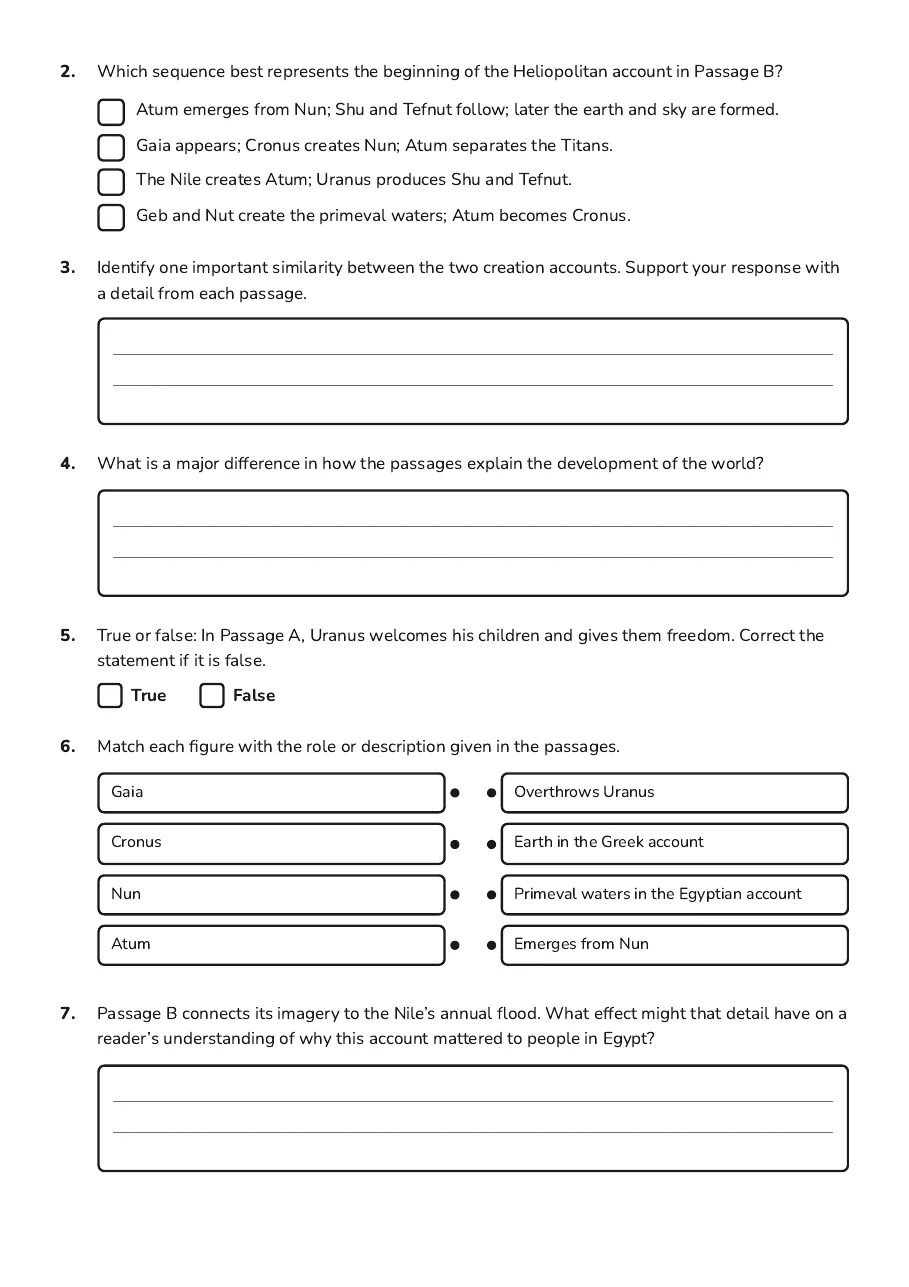
- Atum emerges from Nun; Shu and Tefnut follow; later the earth and sky are formed.
- Gaia appears; Cronus creates Nun; Atum separates the Titans.
- The Nile creates Atum; Uranus produces Shu and Tefnut.
- Geb and Nut create the primeval waters; Atum becomes Cronus.
- Gaia
- Cronus
- Nun
- Atum
- Overthrows Uranus
- Earth in the Greek account
- Primeval waters in the Egyptian account
- Emerges from Nun
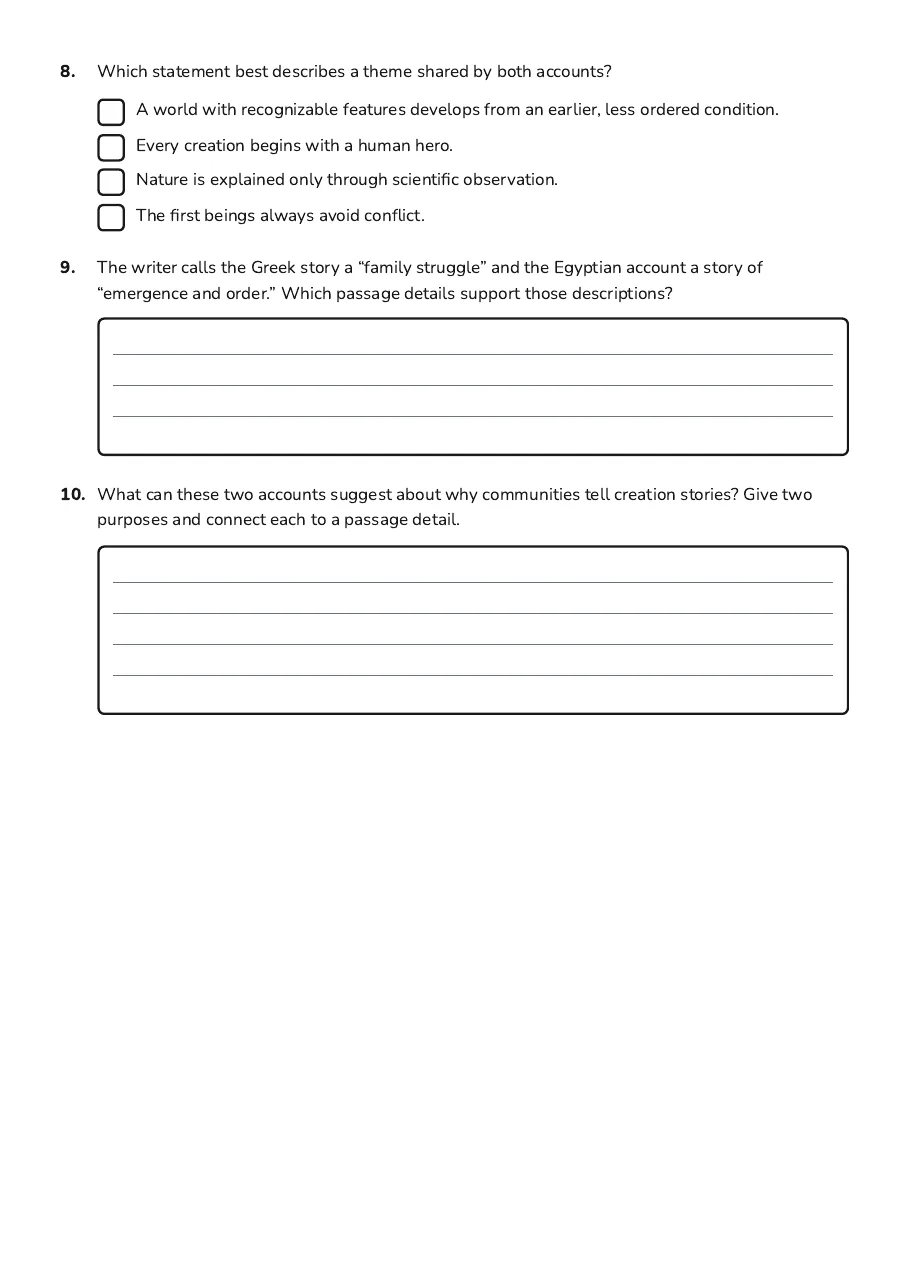
- A world with recognizable features develops from an earlier, less ordered condition.
- Every creation begins with a human hero.
- Nature is explained only through scientific observation.
- The first beings always avoid conflict.
3 printable pages
Page 1
Page 2
Page 3
About This Worksheet
Free in Kuraplan
Sign up free, grab the PDF, and customize it for your class.
Print-Ready
Formatted for standard paper. Clean layout, easy to read.
AI-Generated
Created with Kuraplan's AI, designed for real classroom use.
For Teachers & Parents
Use in classrooms, for homework, tutoring, or homeschool.
Need a custom version of this worksheet?
Kuraplan's AI generates custom worksheets in seconds — differentiated for every learner, aligned to your curriculum.
Generate Custom Worksheets — Free