ScienceFreePrintable

Equations of Motion Derivation

A free science worksheet ready for your classroom. Open in Kuraplan to grab the print-ready PDF, customize it for your students, or generate a fresh version in seconds.
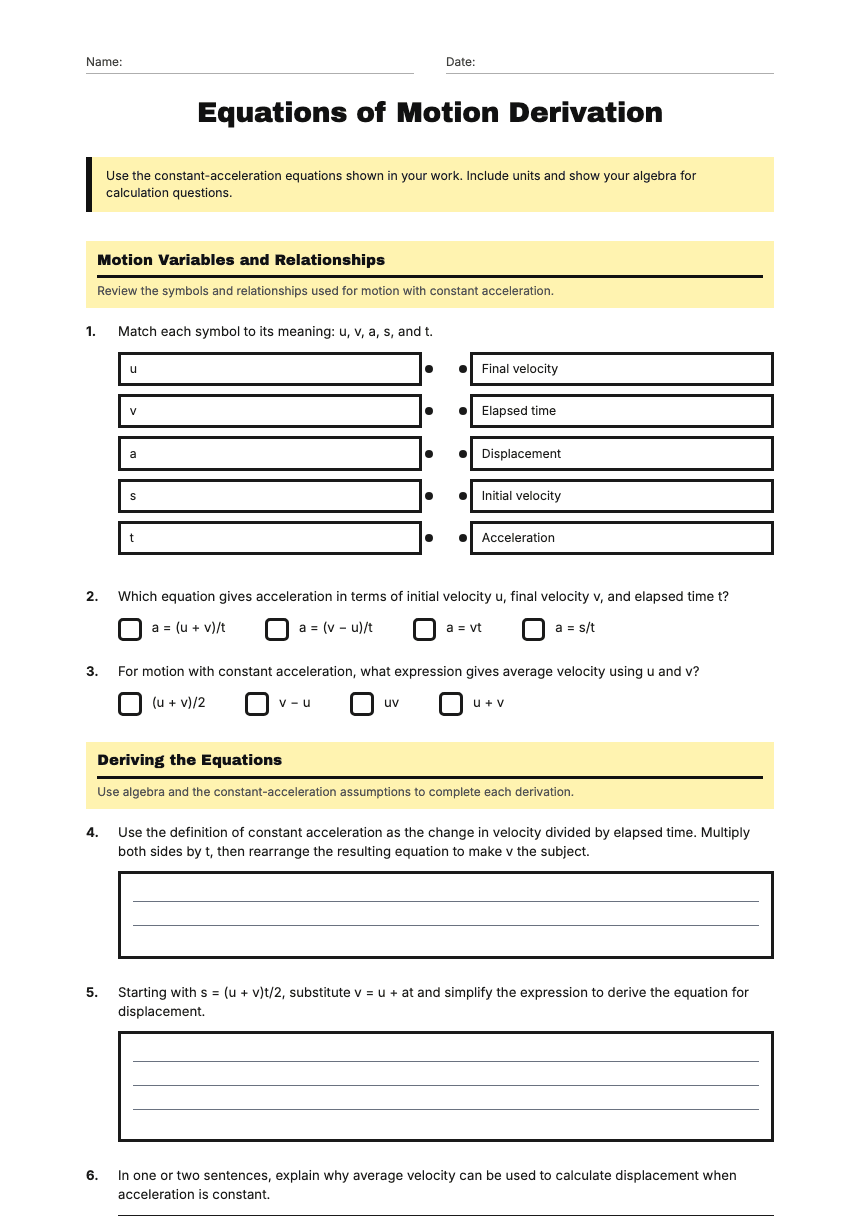
Equations of Motion Derivation worksheet preview
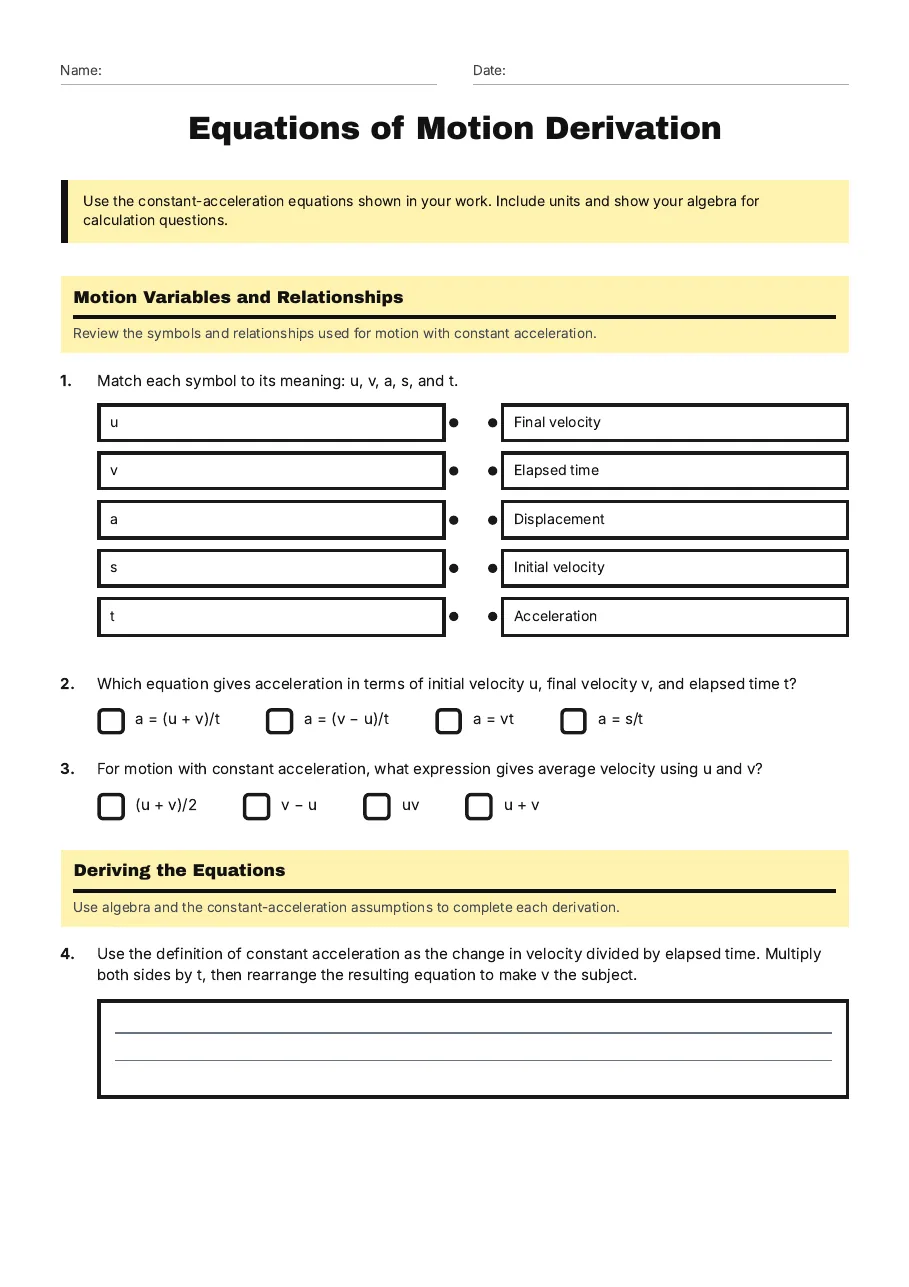
Name:Date:

Equations of Motion Derivation

Use the constant-acceleration equations shown in your work. Include units and show your algebra for calculation questions.

Motion Variables and Relationships

Review the symbols and relationships used for motion with constant acceleration.

1.Match each symbol to its meaning: u, v, a, s, and t.
  • u
  • v
  • a
  • s
  • t
  • Final velocity
  • Elapsed time
  • Displacement
  • Initial velocity
  • Acceleration
2.Which equation gives acceleration in terms of initial velocity u, final velocity v, and elapsed time t?
  • a = (u + v)/t
  • a = (v − u)/t
  • a = vt
  • a = s/t
3.For motion with constant acceleration, what expression gives average velocity using u and v?
  • (u + v)/2
  • v − u
  • uv
  • u + v

Deriving the Equations

Use algebra and the constant-acceleration assumptions to complete each derivation.

4.Use the definition of constant acceleration as the change in velocity divided by elapsed time. Multiply both sides by t, then rearrange the resulting equation to make v the subject.
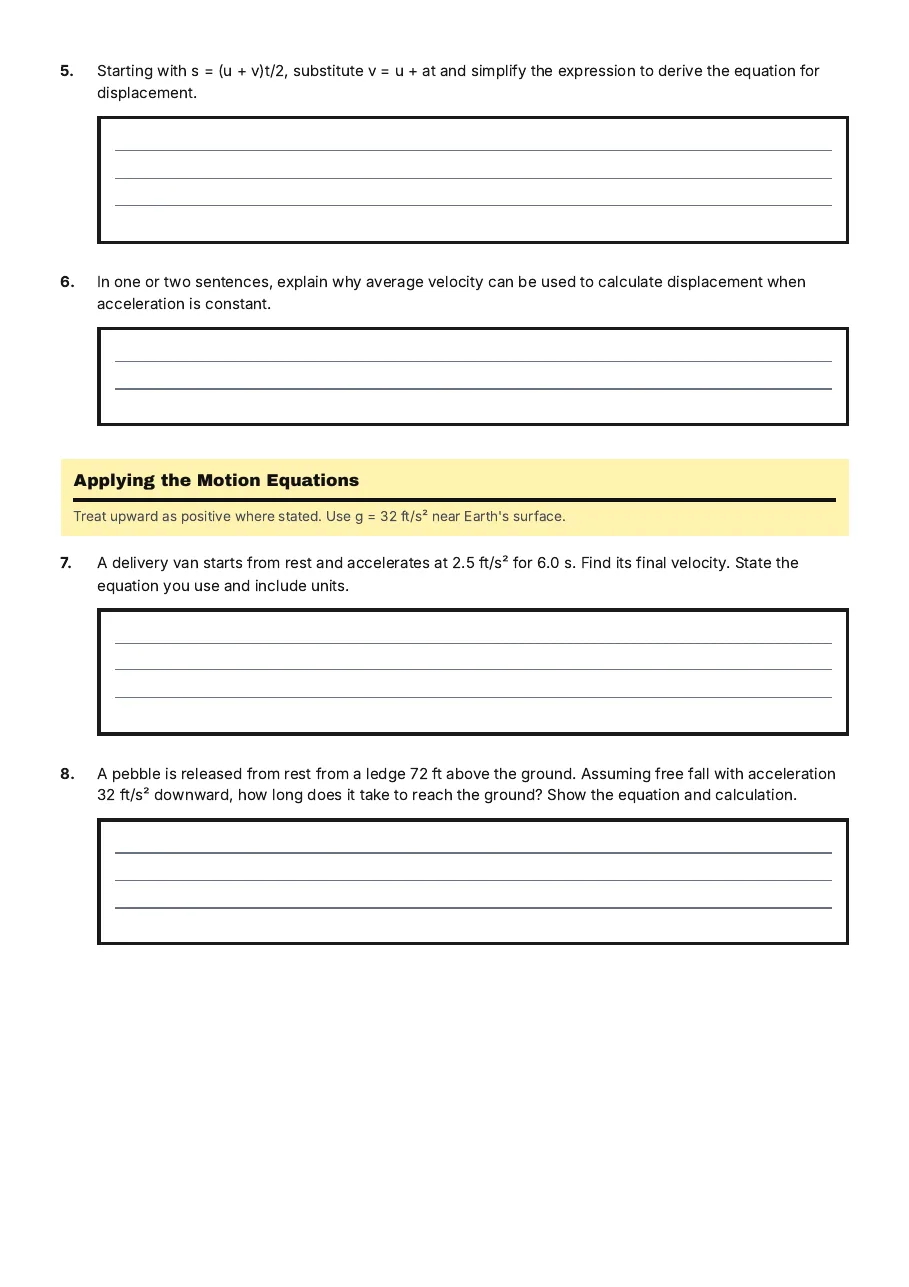
5.Starting with s = (u + v)t/2, substitute v = u + at and simplify the expression to derive the equation for displacement.
6.In one or two sentences, explain why average velocity can be used to calculate displacement when acceleration is constant.

Applying the Motion Equations

Treat upward as positive where stated. Use g = 32 ft/s² near Earth's surface.

7.A delivery van starts from rest and accelerates at 2.5 ft/s² for 6.0 s. Find its final velocity. State the equation you use and include units.
8.A pebble is released from rest from a ledge 72 ft above the ground. Assuming free fall with acceleration 32 ft/s² downward, how long does it take to reach the ground? Show the equation and calculation.
9.A model rocket starts from rest and has a net upward acceleration of 12 ft/s² for 5.0 s. Its engine then shuts off, and it continues upward under gravity alone (32 ft/s² downward) until it reaches its highest point. Find the total height gained from launch to the highest point. Show the powered-flight and coasting calculations.

3 printable pages

  • Equations of Motion Derivation, page 1 of 3: Motion Variables and Relationships, Deriving the Equations

    Page 1

  • Equations of Motion Derivation, page 2 of 3: Applying the Motion Equations

    Page 2

  • Equations of Motion Derivation, page 3 of 3: 9. A model rocket starts from rest and has a net upward acceleration of 12 ft/s² for 5.0…

    Page 3

About This Worksheet

Free in Kuraplan

Sign up free, grab the PDF, and customize it for your class.

Print-Ready

Formatted for standard paper. Clean layout, easy to read.

AI-Generated

Created with Kuraplan's AI, designed for real classroom use.

For Teachers & Parents

Use in classrooms, for homework, tutoring, or homeschool.

Need a custom version of this worksheet?

Kuraplan's AI generates custom worksheets in seconds — differentiated for every learner, aligned to your curriculum.

Generate Custom Worksheets — Free
No credit card Curriculum-aligned Under 60 seconds