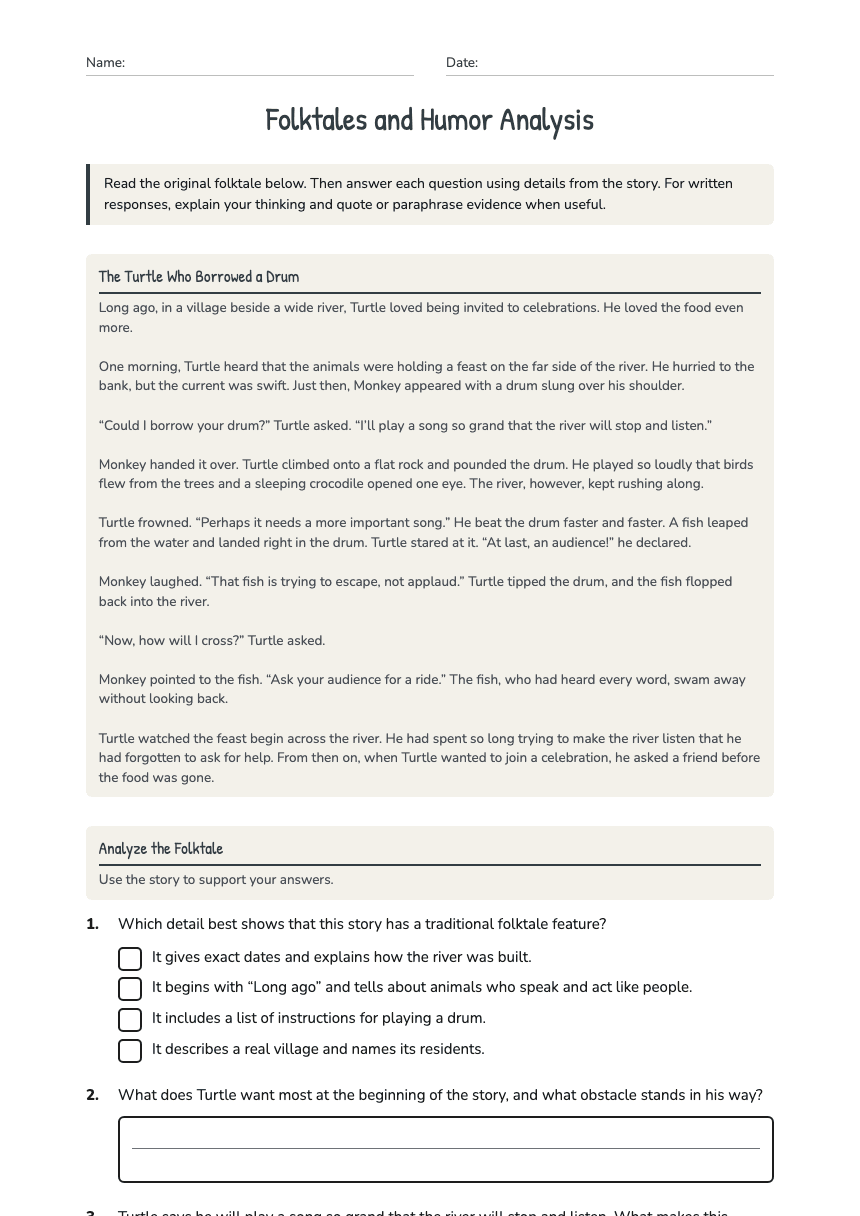
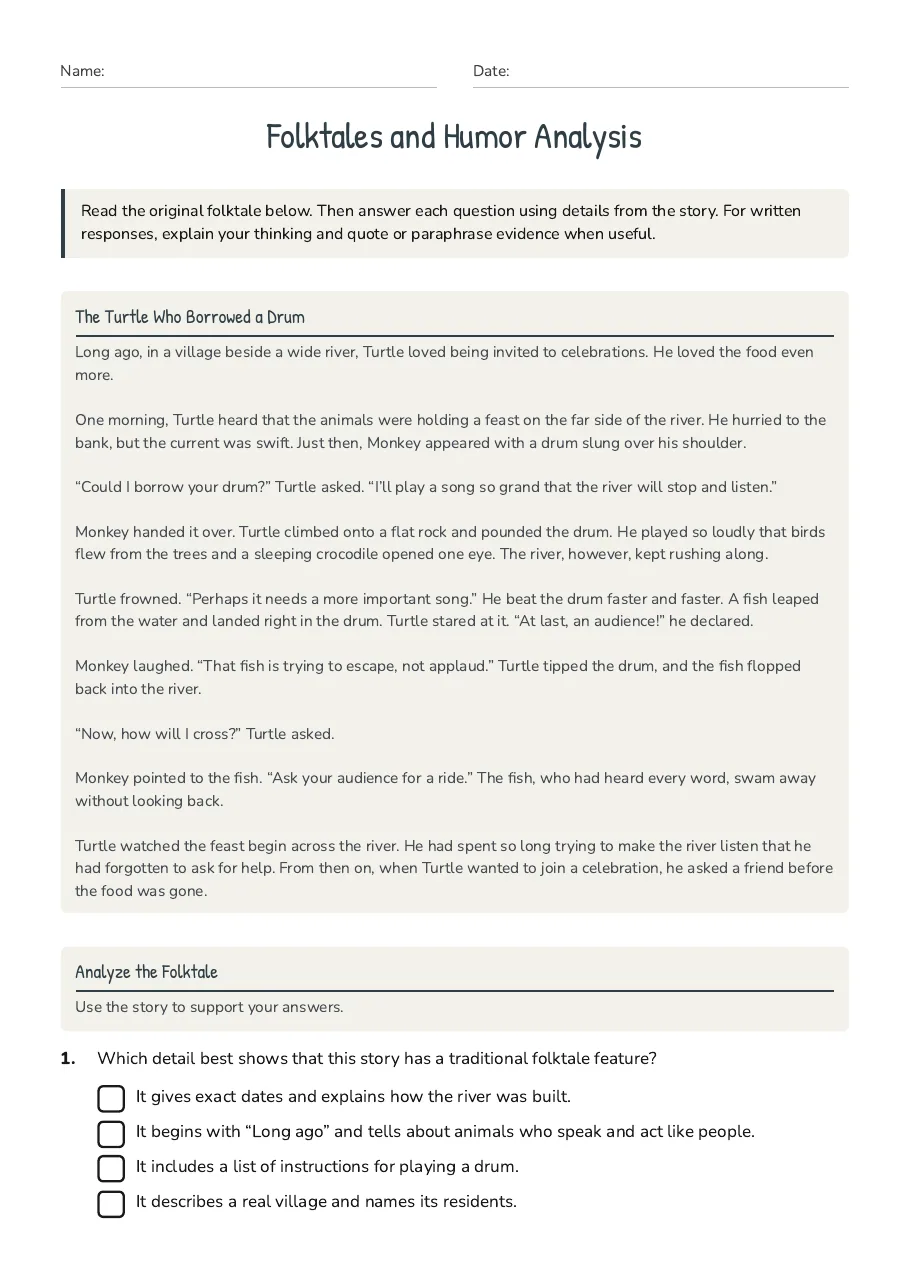
Folktales and Humor Analysis
A free english (ela) worksheet ready for your classroom. Open in Kuraplan to grab the print-ready PDF, customize it for your students, or generate a fresh version in seconds.
Folktales and Humor Analysis
The Turtle Who Borrowed a Drum
Long ago, in a village beside a wide river, Turtle loved being invited to celebrations. He loved the food even more. One morning, Turtle heard that the animals were holding a feast on the far side of the river. He hurried to the bank, but the current was swift. Just then, Monkey appeared with a drum slung over his shoulder. “Could I borrow your drum?” Turtle asked. “I’ll play a song so grand that the river will stop and listen.” Monkey handed it over. Turtle climbed onto a flat rock and pounded the drum. He played so loudly that birds flew from the trees and a sleeping crocodile opened one eye. The river, however, kept rushing along. Turtle frowned. “Perhaps it needs a more important song.” He beat the drum faster and faster. A fish leaped from the water and landed right in the drum. Turtle stared at it. “At last, an audience!” he declared. Monkey laughed. “That fish is trying to escape, not applaud.” Turtle tipped the drum, and the fish flopped back into the river. “Now, how will I cross?” Turtle asked. Monkey pointed to the fish. “Ask your audience for a ride.” The fish, who had heard every word, swam away without looking back. Turtle watched the feast begin across the river. He had spent so long trying to make the river listen that he had forgotten to ask for help. From then on, when Turtle wanted to join a celebration, he asked a friend before the food was gone.
Analyze the Folktale
Use the story to support your answers.
- It gives exact dates and explains how the river was built.
- It begins with “Long ago” and tells about animals who speak and act like people.
- It includes a list of instructions for playing a drum.
- It describes a real village and names its residents.
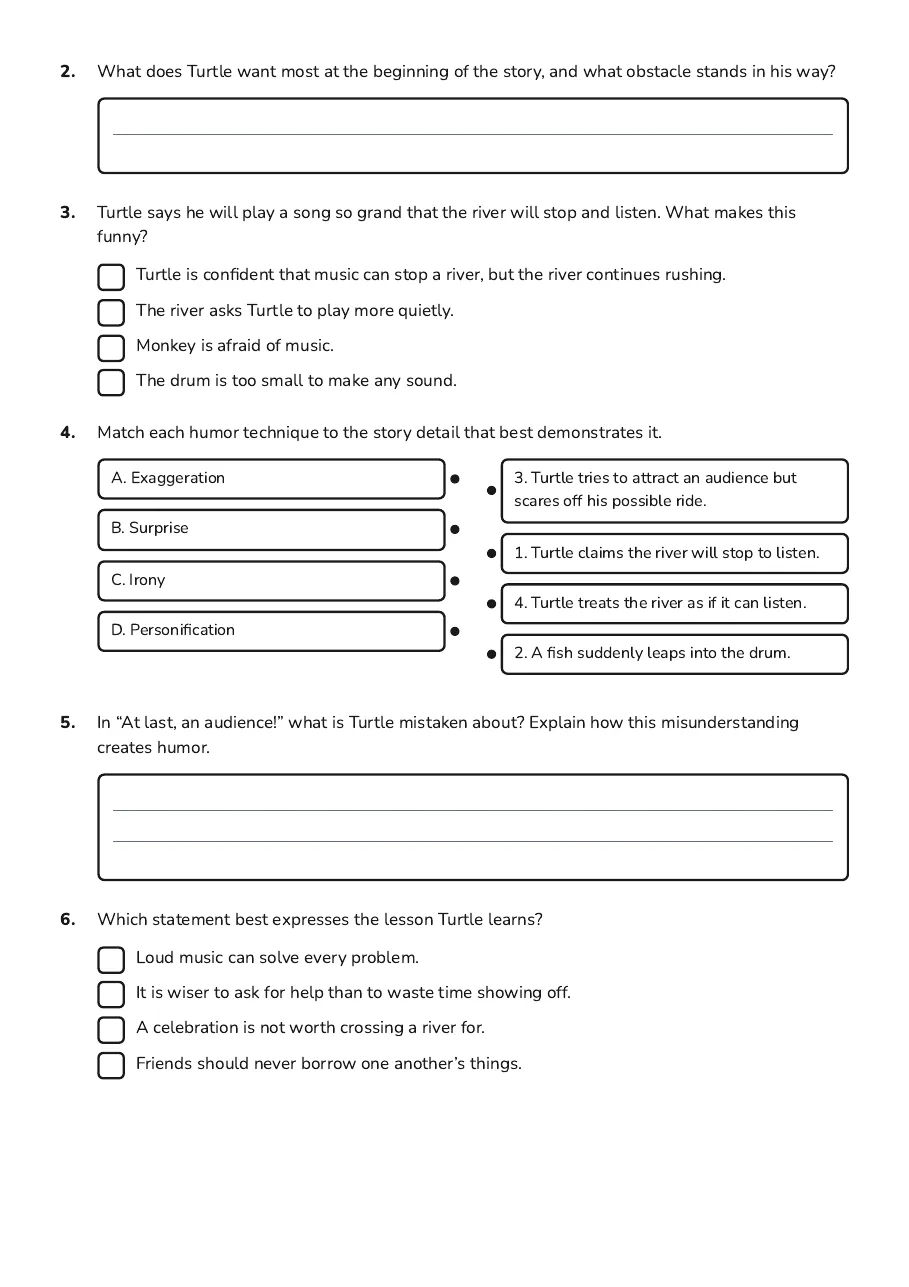
- Turtle is confident that music can stop a river, but the river continues rushing.
- The river asks Turtle to play more quietly.
- Monkey is afraid of music.
- The drum is too small to make any sound.
- A. Exaggeration
- B. Surprise
- C. Irony
- D. Personification
- 3. Turtle tries to attract an audience but scares off his possible ride.
- 1. Turtle claims the river will stop to listen.
- 4. Turtle treats the river as if it can listen.
- 2. A fish suddenly leaps into the drum.
- Loud music can solve every problem.
- It is wiser to ask for help than to waste time showing off.
- A celebration is not worth crossing a river for.
- Friends should never borrow one another’s things.
- “the current was swift”
- “a sleeping crocodile opened one eye”
- “the river will stop and listen”
- “the fish flopped back into the river”
3 printable pages
Page 1
Page 2
Page 3
About This Worksheet
Free in Kuraplan
Sign up free, grab the PDF, and customize it for your class.
Print-Ready
Formatted for standard paper. Clean layout, easy to read.
AI-Generated
Created with Kuraplan's AI, designed for real classroom use.
For Teachers & Parents
Use in classrooms, for homework, tutoring, or homeschool.
Need a custom version of this worksheet?
Kuraplan's AI generates custom worksheets in seconds — differentiated for every learner, aligned to your curriculum.
Generate Custom Worksheets — Free