Forces and Friction Investigation
A free science worksheet ready for your classroom. Open in Kuraplan to grab the print-ready PDF, customize it for your students, or generate a fresh version in seconds.
Forces and Friction Investigation
Part 1: Plan a Fair Test
Background: A force is a push or a pull. A force can change an object's motion. Friction is a force that acts when two surfaces rub together. Friction usually slows moving objects. Gravity pulls objects downward, and the surface pushes upward. Forces can be balanced or unbalanced.
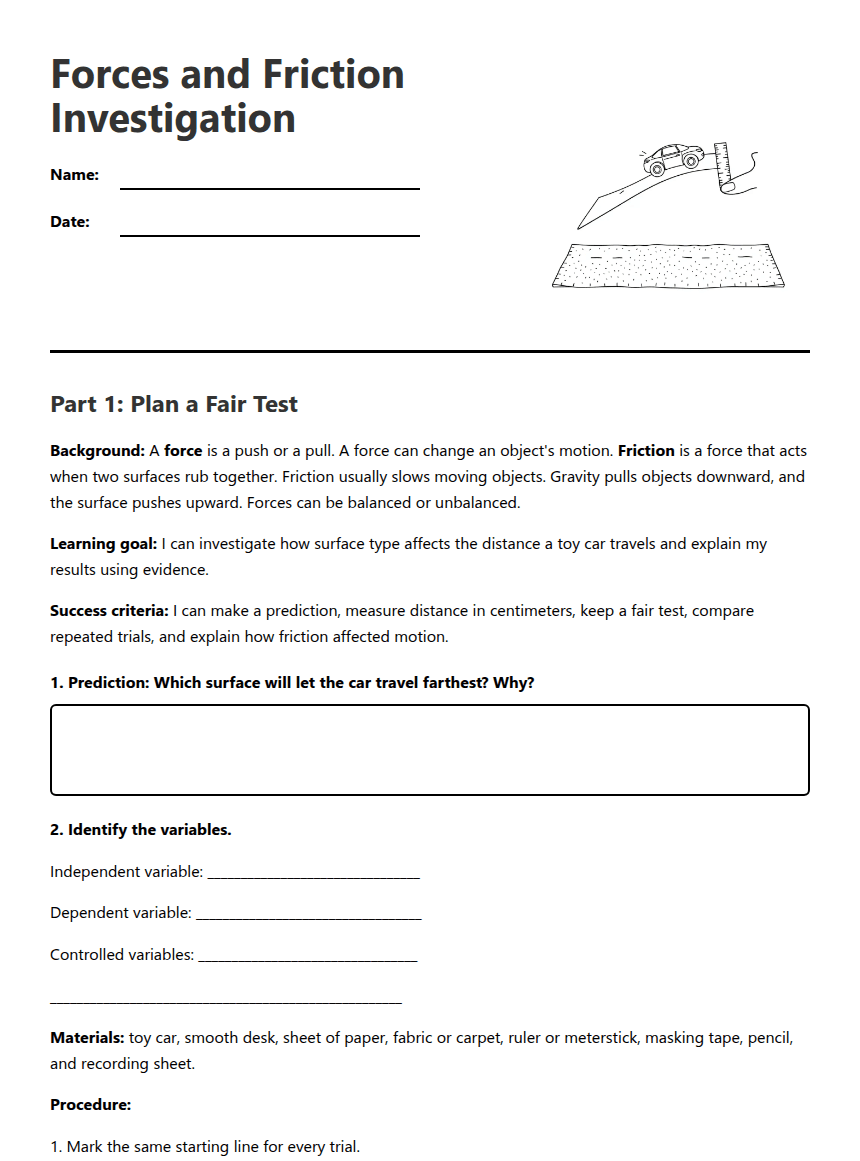
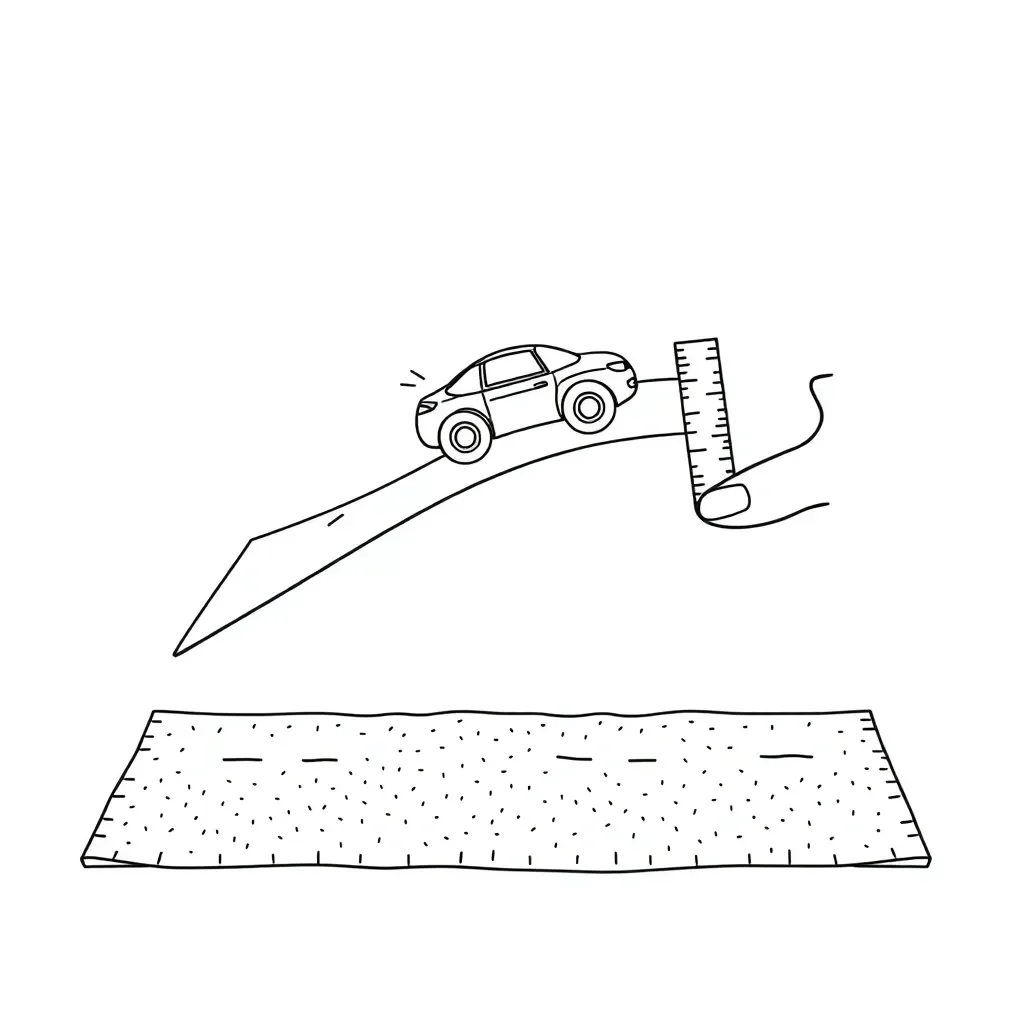
Learning goal: I can investigate how surface type affects the distance a toy car travels and explain my results using evidence.
Success criteria: I can make a prediction, measure distance in centimeters, keep a fair test, compare repeated trials, and explain how friction affected motion.
Independent variable: ________________________________
Dependent variable: __________________________________
Controlled variables: _________________________________
_____________________________________________________
Materials: toy car, smooth desk, sheet of paper, fabric or carpet, ruler or meterstick, masking tape, pencil, and recording sheet.
Procedure:
1. Mark the same starting line for every trial.
2. Place the first surface at the starting line.
3. Give the car one gentle, consistent push. Do not push harder for some surfaces.
4. Measure from the starting line to where the front of the car stops. Record the distance in centimeters.
5. Repeat three trials on the same surface.
6. Repeat Steps 2–5 for the other two surfaces.
7. Compare the distances and look for a pattern.
Safety reminder: Use gentle pushes. Keep cars and materials on the testing area. Walk carefully, and keep fingers away from wheels and moving objects.
Part 2: Test, Record, and Explain
Record distance in cm. Use the same car, starting line, and type of push each time.
Smooth desk: Trial 1: ______ cm Trial 2: ______ cm Trial 3: ______ cm Average: ______ cm
Paper: Trial 1: ______ cm Trial 2: ______ cm Trial 3: ______ cm Average: ______ cm
Fabric or carpet: Trial 1: ______ cm Trial 2: ______ cm Trial 3: ______ cm Average: ______ cm
Claim: The surface that affected the car's motion most was __________________________.
Evidence: My measurements show ________________________________________________.
Reasoning: This happened because friction __________________________________________.
Sentence frames:
The car traveled farther on __________________ because ______________________________.
The surface with more friction was __________________. My evidence is __________________.
I kept the test fair by ____________________________________________________________.
Vocabulary word bank: force—a push or pull; motion—a change in position; friction—a rubbing force that can slow motion; distance—how far something travels; average—a typical value found by combining measurements; evidence—observations or data that support an idea; variable—something that can change in an investigation.
Challenge extension: Change one condition, such as ramp height or the mass added to the car. Predict what will happen, test it fairly, and explain your result.
Support for Grades 5–6: Use a labeled force diagram, picture vocabulary, a partially completed data record, and a partner role. Compare “farther/shorter” before calculating averages.
Extension for Grades 7–8: Calculate each average, graph the results, explain sources of error, or investigate how changing ramp height or mass changes distance. Describe how the evidence could guide a bridge-design decision.
Literacy connection: This investigation practices following a sequence of steps and explaining how variables affect results (CCSS.ELA-LITERACY.RST.6-8.3). It also practices writing an informative explanation with evidence and reasoning (CCSS.ELA-LITERACY.WHST.6-8.2).
Teacher Answer and Discussion Key
Expected pattern: Results may vary. The car will often travel farthest on the smooth desk, a middle distance on paper, and the shortest distance on fabric or carpet. Rougher surfaces usually create more friction and slow the car sooner.
Question 1: Accept any reasonable prediction supported by an idea about surface texture or friction.
Question 2: Independent variable: surface type. Dependent variable: distance traveled in centimeters. Controlled variables may include the same car, starting point, push strength, measuring method, and number of trials.
Question 3: Accept diagrams showing applied push forward, friction backward, gravity downward, and surface support upward.
Questions 4–6: Accept observations and conclusions supported by student data. The surface with the shortest average distance likely had the greatest friction.
Question 7: A strong response includes a clear claim, at least one measurement or comparison as evidence, and reasoning that connects friction with the car slowing down.
Question 8: Answers will vary. Students should change only one condition and describe a prediction, measurement, and result. A taller ramp may increase speed and distance; added mass may change motion depending on the car and surface.
Assessment check: Look for a fair test, consistent units, repeated trials, accurate comparisons, force vocabulary, and an explanation that uses evidence.
About This Worksheet
Free in Kuraplan
Sign up free, grab the PDF, and customize it for your class.
Print-Ready
Formatted for standard paper. Clean layout, easy to read.
AI-Generated
Created with Kuraplan's AI, designed for real classroom use.
For Teachers & Parents
Use in classrooms, for homework, tutoring, or homeschool.
Need a custom version of this worksheet?
Kuraplan's AI generates custom worksheets in seconds — differentiated for every learner, aligned to your curriculum.
Generate Custom Worksheets — Free