Forces: Cornell Notes Example
A free science worksheet ready for your classroom. Open in Kuraplan to grab the print-ready PDF, customize it for your students, or generate a fresh version in seconds.
Forces: Cornell Notes Example
📋 Cornell Notes: Balanced & Unbalanced Forces
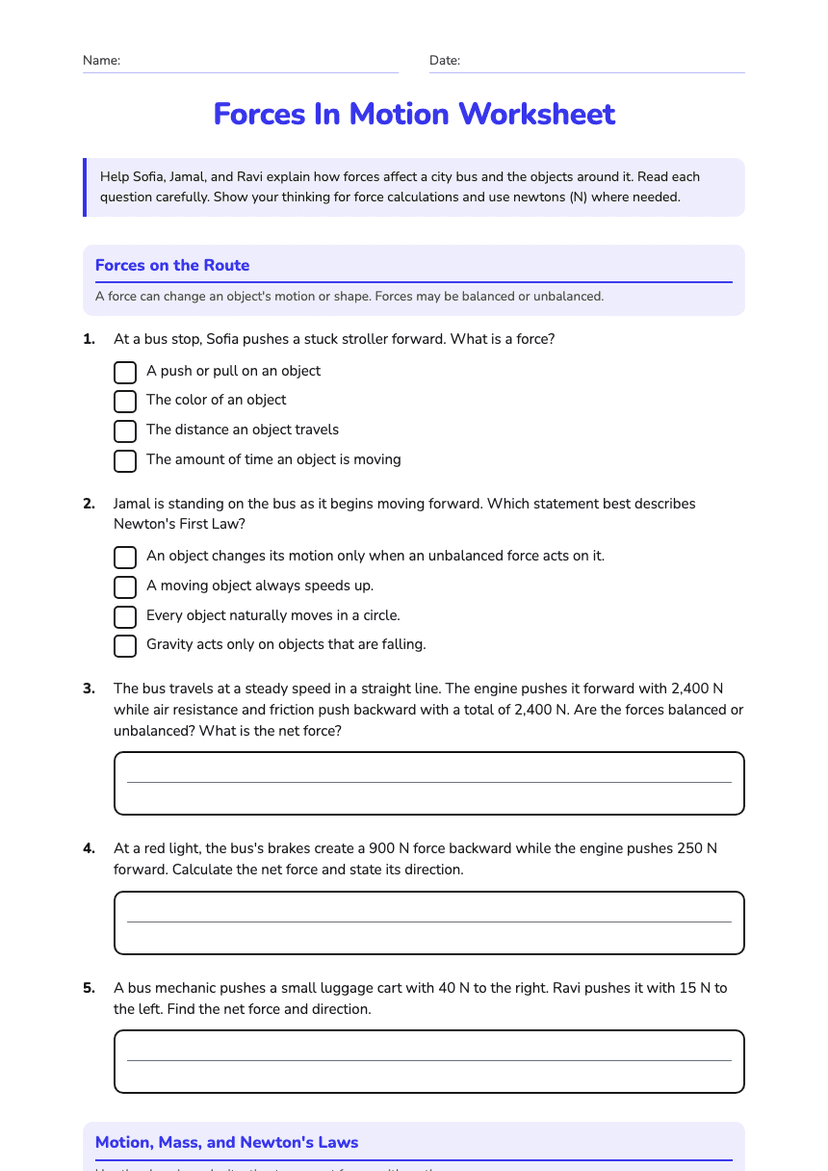
Topic: Balanced and Unbalanced Forces Class: 8th Grade Science Chapter/Unit: Forces & Motion
Directions: The left column contains the main ideas/cues. The right column contains the detailed notes. This is a completed example — study the format and the content!
| 🔑 Main Ideas / Cue Questions | 📝 Notes |
|---|---|
| What is a force? |
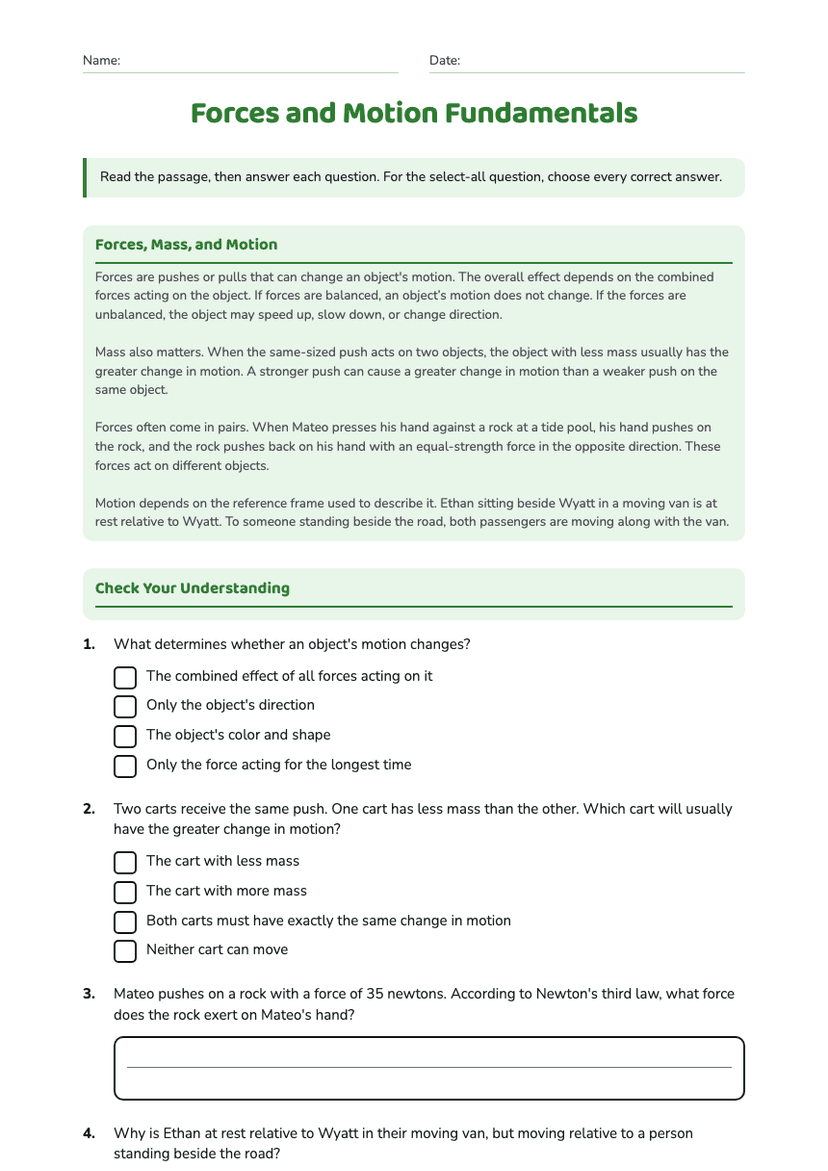
A force is a push or a pull acting on an object. • Forces have two properties: magnitude (size/strength) and direction. • Forces are measured in Newtons (N). |
| What is magnitude? |
Magnitude = the strength or size of a force. • A larger magnitude means a stronger force. • Example: A 10 N push is greater in magnitude than a 4 N push. • Magnitude is always a positive number. |
| What is direction? |
Direction = which way the force is pushing or pulling. • Forces acting in opposite directions work against each other. • Forces acting in the same direction add together. • We use + and − signs to show direction when calculating. |
| What is net force? How do you calculate it? |
Net force = the overall combined force acting on an object. • Same direction: Add the forces → Net Force = F₁ + F₂ Example: 5 N right + 3 N right = 8 N right • Opposite directions: Subtract the smaller from the larger → Net Force = F₁ − F₂ Example: 10 N right − 4 N left = 6 N right • The net force tells you the direction of motion. |
| What are balanced forces? |
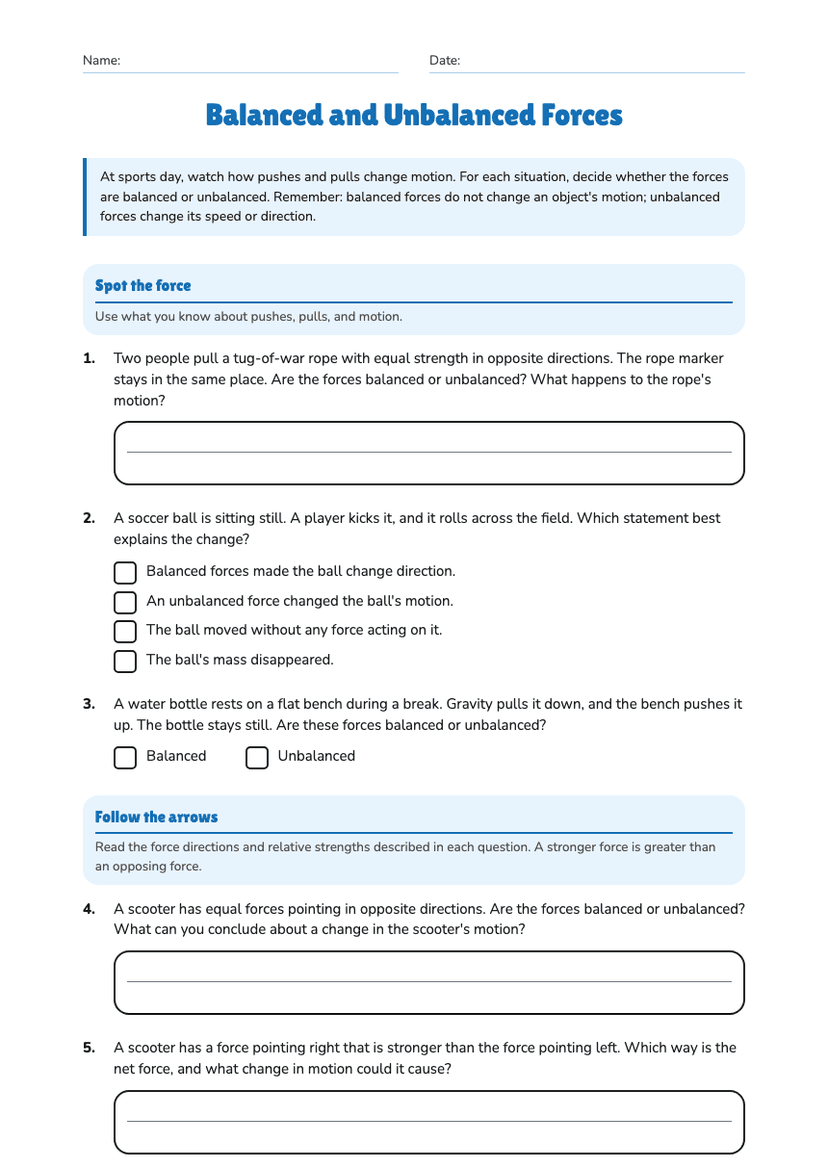
Balanced forces occur when all forces on an object cancel each other out. • Net force = 0 N • The object does NOT change its motion — it stays still or keeps moving at the same speed and direction. • Example: A book sitting on a desk — gravity pulls it down (9 N), the desk pushes up (9 N). Net force = 0 N. The book does not move. • Example: Two people pushing on opposite sides of a wall with equal force — the wall doesn't move. |
| What are unbalanced forces? |
Unbalanced forces occur when forces on an object do not cancel out. • Net force ≠ 0 N • The object changes its motion — it speeds up, slows down, or changes direction. • Example: Two students push a box — Student A pushes right with 12 N, Student B pushes left with 5 N. Net force = 7 N to the right. The box moves right. • Example: A soccer ball being kicked — the kick force is greater than friction, so the ball accelerates. |
| Balanced vs. Unbalanced — Quick Comparison |
Balanced: Net force = 0 N → No change in motion Unbalanced: Net force ≠ 0 N → Motion changes (acceleration) Key rule: If an object is at rest and stays at rest → balanced forces. If an object starts moving, speeds up, slows down, or turns → unbalanced forces. |
📝 Summary
Directions: In the box below, write a 4–6 sentence summary that ties together all the main ideas from your notes. Use the cue words from the left column to guide you. This example summary has been completed for you — read it carefully!
✅ Example Summary (completed):
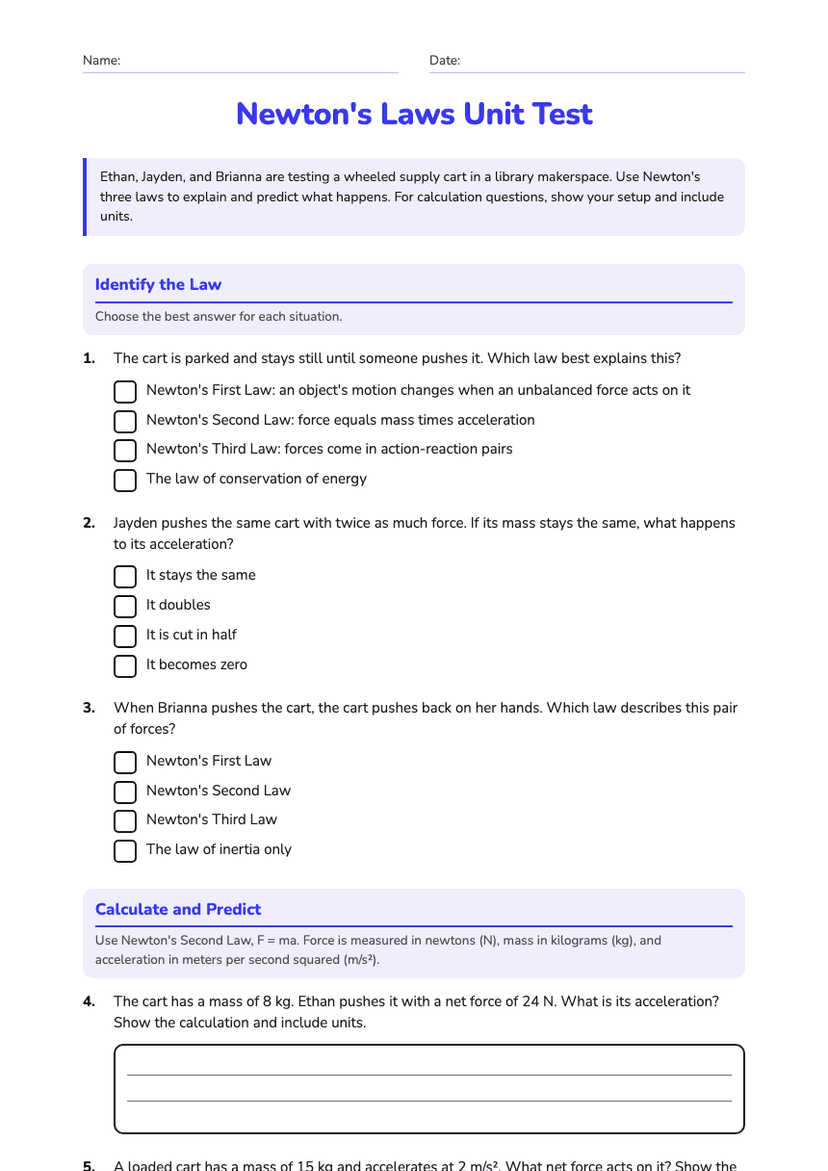
A force is a push or pull described by its magnitude (strength) and direction. When two or more forces act on an object, we calculate the net force by adding forces in the same direction or subtracting forces in opposite directions. If the net force equals zero, the forces are balanced and the object does not change its motion. If the net force is greater than zero, the forces are unbalanced and the object will change its speed or direction. Understanding balanced and unbalanced forces helps us explain and predict how objects move in everyday life.
🔍 Quick Check Questions
About This Worksheet
Free in Kuraplan
Sign up free, grab the PDF, and customize it for your class.
Print-Ready
Formatted for standard paper. Clean layout, easy to read.
AI-Generated
Created with Kuraplan's AI, designed for real classroom use.
For Teachers & Parents
Use in classrooms, for homework, tutoring, or homeschool.
Need a custom version of this worksheet?
Kuraplan's AI generates custom worksheets in seconds — differentiated for every learner, aligned to your curriculum.
Generate Custom Worksheets — Free