Henrietta Lacks Analysis Worksheet
A free english (ela) worksheet ready for your classroom. Open in Kuraplan to grab the print-ready PDF, customize it for your students, or generate a fresh version in seconds.
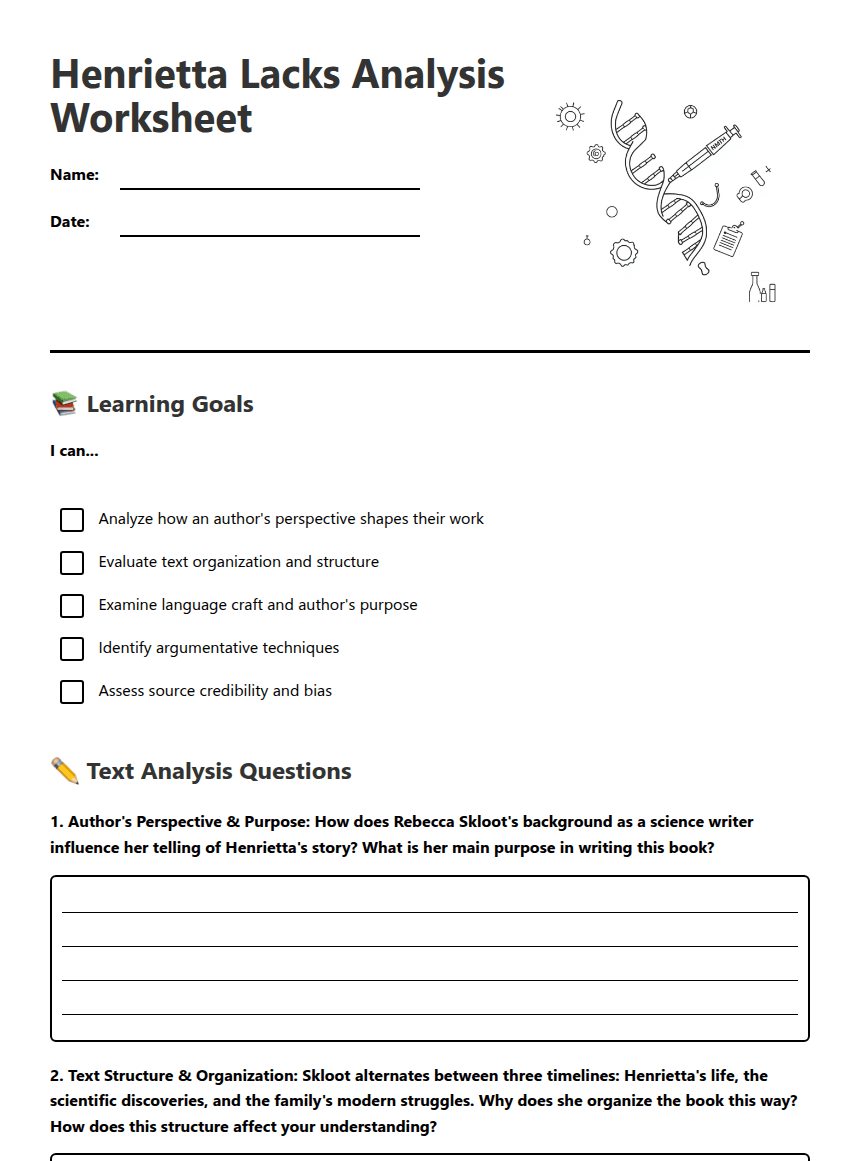
Henrietta Lacks Analysis Worksheet
📚 Learning Goals
I can...
✏️ Text Analysis Questions
🎧 Audio Resource: Listen to the NPR Fresh Air interview with Rebecca Skloot (www.npr.org/templates/story/story.php?storyId=123232331) where she discusses her research process and motivations. Use this 20-minute interview to understand her perspective as both journalist and storyteller.
Supporting Citation:
Skloot, Rebecca. The Immortal Life of Henrietta Lacks. Crown Publishers, 2010.
Annotation: Primary source providing author's perspective and narrative approach to combining scientific and personal history.
📹 Visual Resource: Watch the TED-Ed animated video "The Immortal Cells of Henrietta Lacks" (ed.ted.com/lessons/the-immortal-cells-of-henrietta-lacks) for a 4-minute overview of the scientific timeline. Also explore the Johns Hopkins Medicine interactive timeline (www.hopkinsmedicine.org/henriettalacks/timeline.html) to visualize the chronological structure Skloot navigates.
Supporting Citation:
Johns Hopkins Medicine. "The Legacy of Henrietta Lacks." hopkinsmedicine.org, 2020, www.hopkinsmedicine.org/henriettalacks/.
Annotation: Institutional perspective on the historical timeline and medical significance of HeLa cells.
🎬 Documentary Resource: View clips from the HBO documentary "The Immortal Life of Henrietta Lacks" (www.hbo.com/documentaries/the-immortal-life-of-henrietta-lacks) to see and hear family members speaking about their experiences. Pay attention to how visual and audio elements enhance the emotional impact of their stories.
Supporting Citation:
Lacks, Deborah, et al. "The Henrietta Lacks Foundation." henriettalacksfoundation.org, 2010.
Annotation: Family-established foundation providing direct family perspectives on ethical and financial issues.
🎙️ Podcast Resource: Listen to the Bioethics podcast episode "The HeLa Cell Line and Informed Consent" (www.bioethics.net/podcast/hela-consent) for expert discussion on how this case shaped modern medical ethics. This 30-minute episode provides context for evaluating Skloot's argumentative strategies.
Supporting Citation:
Turner, Sarah, et al. "Consent and Cell Lines: Lessons from HeLa." Nature Reviews Genetics, vol. 21, no. 4, 2020, pp. 243-252.
Annotation: Contemporary scientific analysis of consent issues in cell line research, connecting historical cases to modern practices.
📰 Article Resource: Read "Fact-Checking Medical Narratives: The Skloot Method" from The Persistent (www.thepersistent.org/fact-checking-medical-narratives) to understand her research methodology. This academic article analyzes how science writers verify historical medical information.
Supporting Citation:
Rodriguez, Maria. "Fact-Checking Medical Narratives: The Skloot Method." The Persistent, vol. 15, no. 3, 2018, pp. 75-89.
Annotation: Analysis of Skloot's research methodology and approach to verifying historical medical information.
📖 Annotated Bibliography
Primary and Secondary Sources for Analysis:
Skloot, Rebecca. The Immortal Life of Henrietta Lacks. Crown Publishers, 2010.
The primary text combining biography, science writing, and investigative journalism. Skloot spent over a decade researching Henrietta's story, interviewing family members, and examining the scientific impact of HeLa cells. Essential for understanding author's perspective, narrative structure, and ethical arguments about informed consent in medical research. Available in audiobook format for accessibility support.
Johns Hopkins Medicine. "The Legacy of Henrietta Lacks." hopkinsmedicine.org, 2020, www.hopkinsmedicine.org/henriettalacks/.
Official institutional response and historical account from the hospital where Henrietta was treated. Provides medical context, timeline of discoveries, and the institution's current perspective on ethical practices. Valuable for understanding how medical institutions address historical ethical lapses.
Lacks, Deborah, et al. "The Henrietta Lacks Foundation." henriettalacksfoundation.org, 2010.
Foundation established by Henrietta's family to provide scholarships and support for Lacks descendants. Offers direct family perspectives on the ongoing impact of HeLa cell research and their efforts to ensure ethical treatment of research subjects. Critical for understanding the family's voice in the ongoing conversation.
Turner, Sarah, et al. "Consent and Cell Lines: Lessons from HeLa." Nature Reviews Genetics, vol. 21, no. 4, 2020, pp. 243-252.
Peer-reviewed scientific article examining how the HeLa case influenced modern informed consent practices in genetic research. Provides contemporary scientific community's perspective on ethical standards and regulatory changes implemented since Henrietta's case.
Rodriguez, Maria. "Fact-Checking Medical Narratives: The Skloot Method." The Persistent, vol. 15, no. 3, 2018, pp. 75-89.
Academic analysis of Rebecca Skloot's research methodology and fact-checking processes. Examines how science writers verify conflicting historical accounts and balance multiple perspectives. Useful for evaluating source credibility and authorial techniques.
Washington, Harriet A. Medical Apartheid: The Dark History of Medical Experimentation on Black Americans from Colonial Times to the Present. Doubleday, 2006.
Comprehensive historical analysis of unethical medical experimentation on African Americans. Provides broader context for understanding Henrietta's case within systemic patterns of medical exploitation and racial bias in healthcare.
🎯 Success Criteria & Extensions
Success Criteria - I have:
Differentiation Options:
• Use audiobook version of "The Immortal Life of Henrietta Lacks" for dyslexia support and enhanced comprehension
• Work with a partner for discussion before writing
• Use graphic organizers to plan responses
• Focus on 3 questions instead of 5
• Reference the annotated bibliography for additional context
• Use the multimodal resources (videos, podcasts, interactive timelines) to support different learning styles
Extension for Advanced Learners:
About This Worksheet
Free in Kuraplan
Sign up free, grab the PDF, and customize it for your class.
Print-Ready
Formatted for standard paper. Clean layout, easy to read.
AI-Generated
Created with Kuraplan's AI, designed for real classroom use.
For Teachers & Parents
Use in classrooms, for homework, tutoring, or homeschool.
Need a custom version of this worksheet?
Kuraplan's AI generates custom worksheets in seconds — differentiated for every learner, aligned to your curriculum.
Generate Custom Worksheets — FreeMore English (ELA) Worksheets
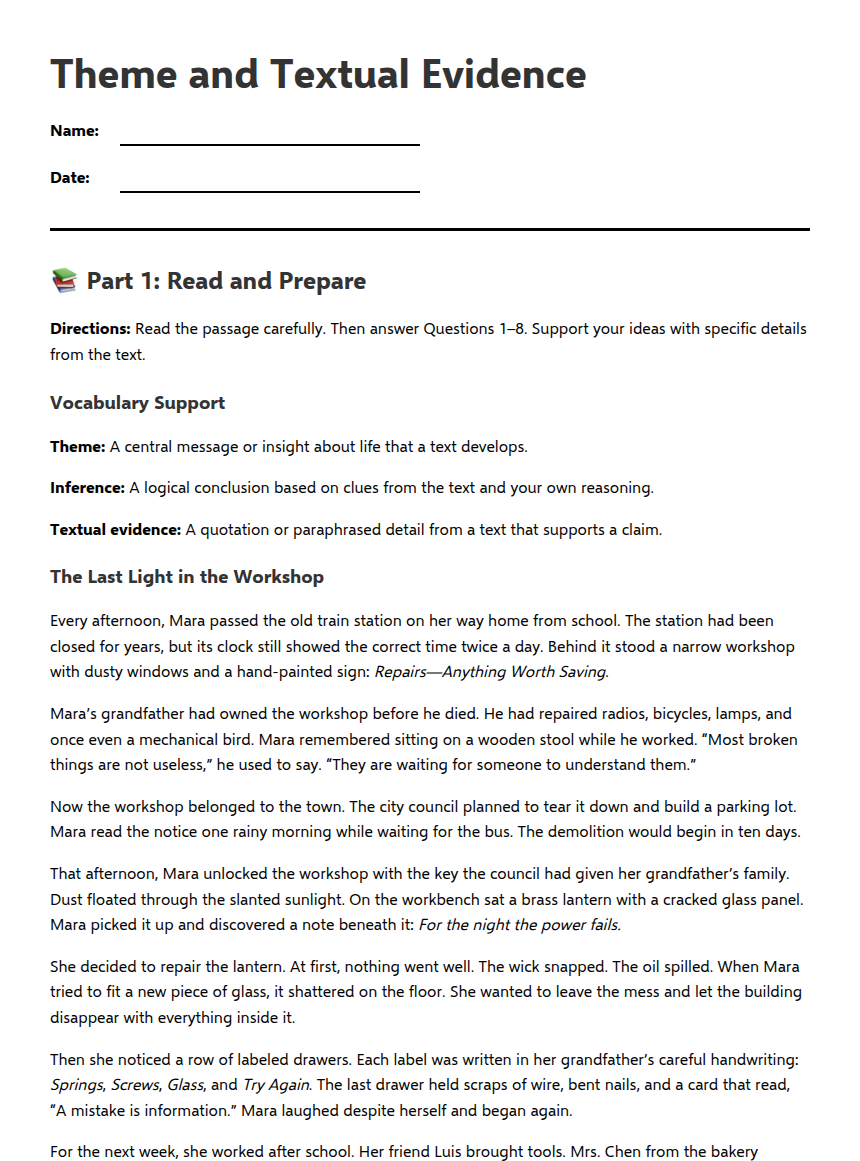
Theme and Textual Evidence
Free
The Magic Marker Mystery Worksheet
Free
Magic Marker Mystery Quiz
Free
The Magic Marker Mystery Worksheet
Free
Text Evidence and Inference Assessment
Free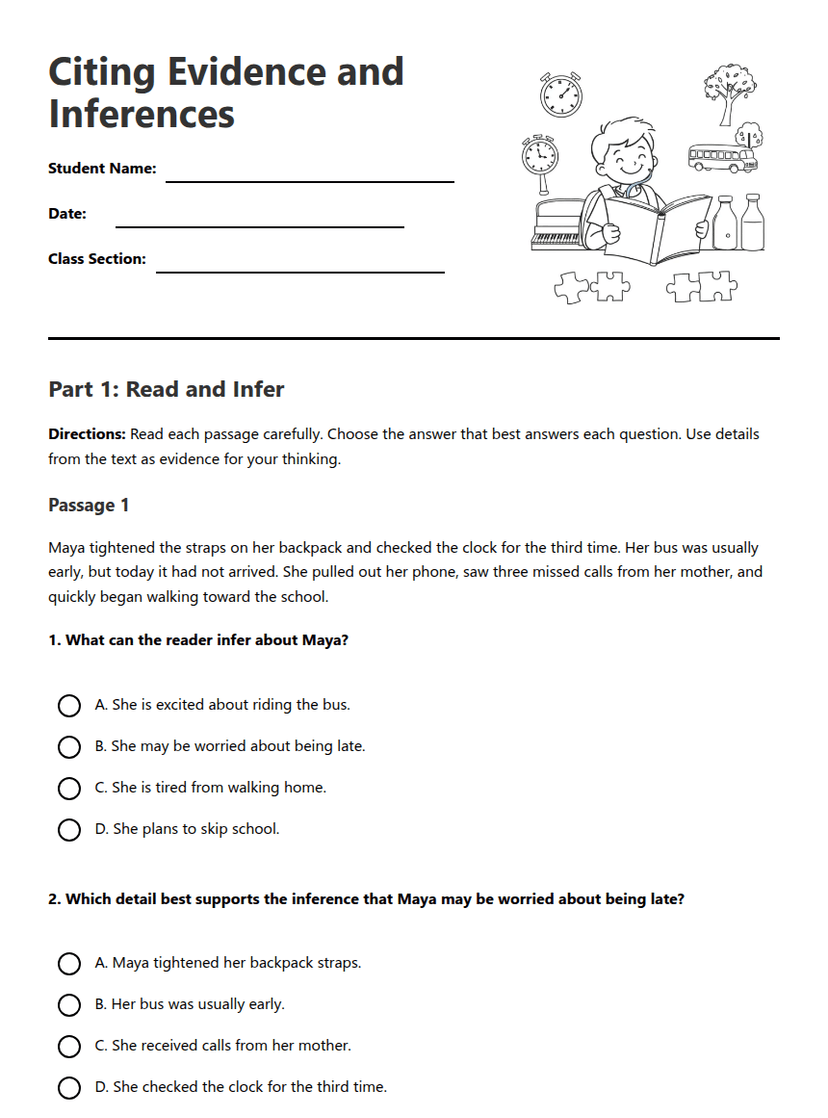
Citing Evidence and Inferences
Free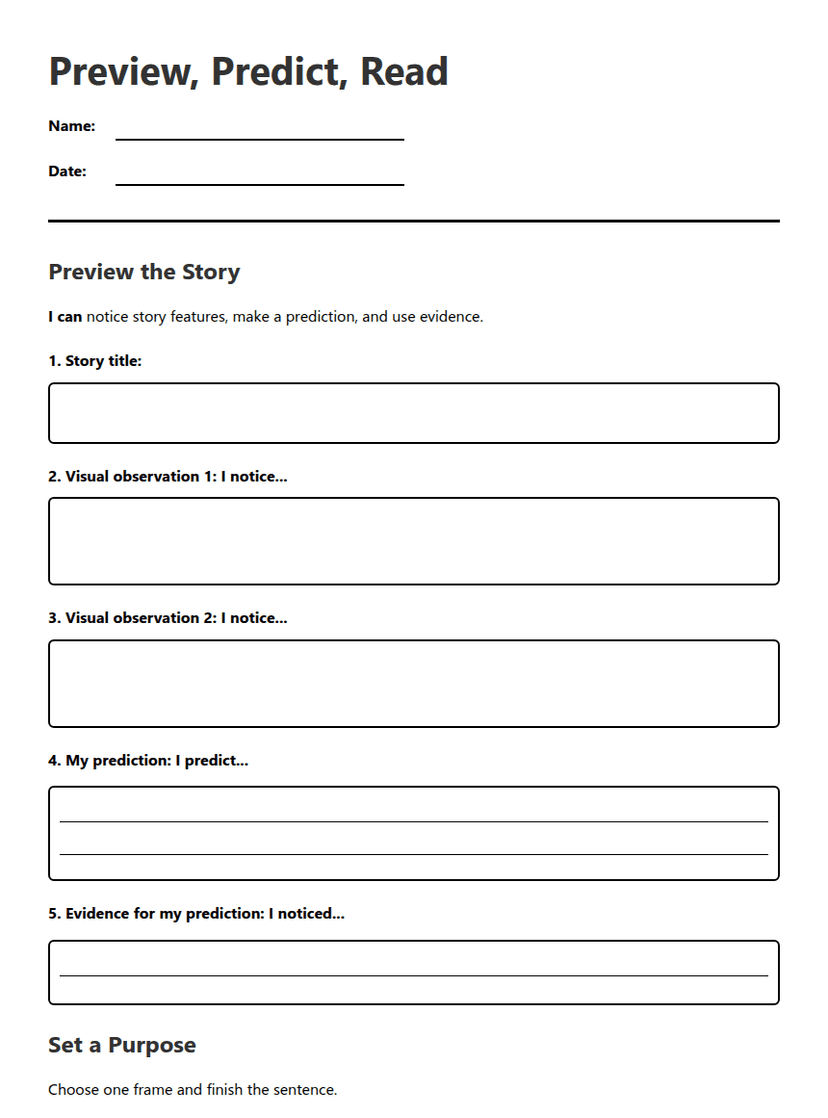
Preview, Predict, Read”】【
Free