🧠 Part 1: Multiple Choice
Circle the best answer for each question.
1. What is homeostasis?
The process of cells dividing to produce new cells
The body's ability to maintain a stable internal environment despite external changes
The breakdown of food into energy for the body
The transfer of genetic information from DNA to protein
2. In a negative feedback loop, what happens when a variable moves away from its set point?
The body amplifies the change to push the variable further away
The body takes no action and waits for the variable to self-correct
The body triggers a response that reverses the change and restores balance
The body permanently adjusts to the new level
3. Which of the following is the best example of a positive feedback loop?
Sweating when your body temperature rises above 98.6°F
Blood clotting at a wound site, where clotting factors amplify the process
Insulin release lowering blood glucose back to normal levels
Shivering when body temperature drops below normal
4. Which of the following best describes a key difference between negative and positive feedback?
Negative feedback amplifies a change; positive feedback reverses it
Negative feedback restores balance; positive feedback amplifies a change until an endpoint is reached
Positive feedback always harms the body; negative feedback always helps it
Both feedback types work to maintain the same set point at all times
✏️ Part 2: Short Answer
5. Define the term "set point" as it relates to homeostasis. Give one example from the human body.
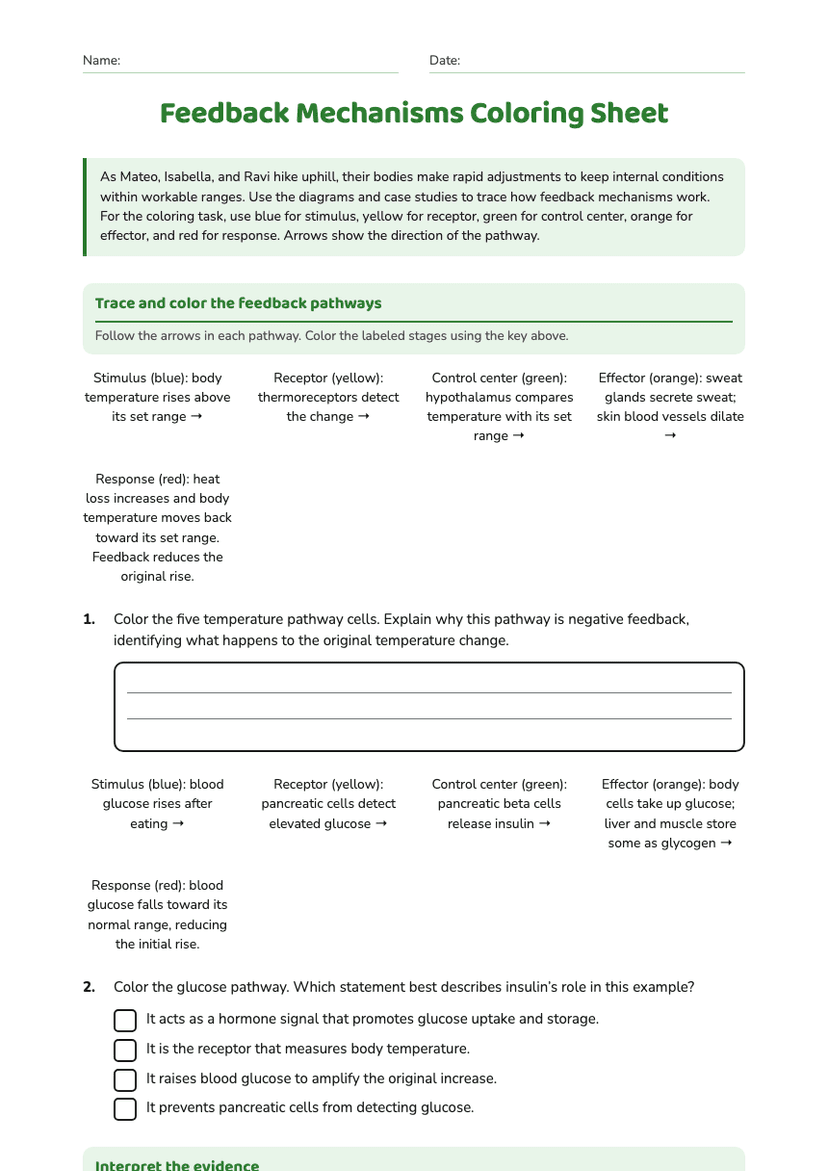
6. Body temperature regulation is a classic negative feedback example. Complete the sequence below:
Body temperature rises above 98.6°F → Receptor detects change → Control center (hypothalamus) sends signal → Effectors respond by: ___________________________ → Body temperature returns to 98.6°F → Response ___________________________ .
7. Explain why positive feedback loops are less common in the body than negative feedback loops. When are they useful?
8. Select ALL components that are part of every feedback loop:
Receptor (sensor)
Control center (integrator)
Effector (responds to signal)
DNA replication
Stimulus (change in variable)
🖊️ Part 3: Diagram & Application
9. Label the Feedback Loop Diagram. In the box below, draw and label a simple negative feedback loop using blood glucose regulation as your example. Include: stimulus, receptor, control center, effector, and response.
10. A patient's blood glucose level drops dangerously low. Describe the steps the body takes to correct this, identifying whether this is negative or positive feedback and why.
11. Matching: Match each scenario on the left to the correct feedback type on the right.
A. Childbirth contractions intensify as oxytocin is released
B. Shivering when body temperature falls below 98.6°F
C. Fever-reducing response when body temp rises too high
D. Breastfeeding triggers more milk production
1. Negative Feedback
2. Positive Feedback
12. Reflection: The Amoeba Sisters describe homeostasis as the body "Goldilocks-ing" its internal conditions. In your own words, explain what this means and why it matters for survival.