Hope Diamond Analysis
A free english (ela) worksheet ready for your classroom. Open in Kuraplan to grab the print-ready PDF, customize it for your students, or generate a fresh version in seconds.
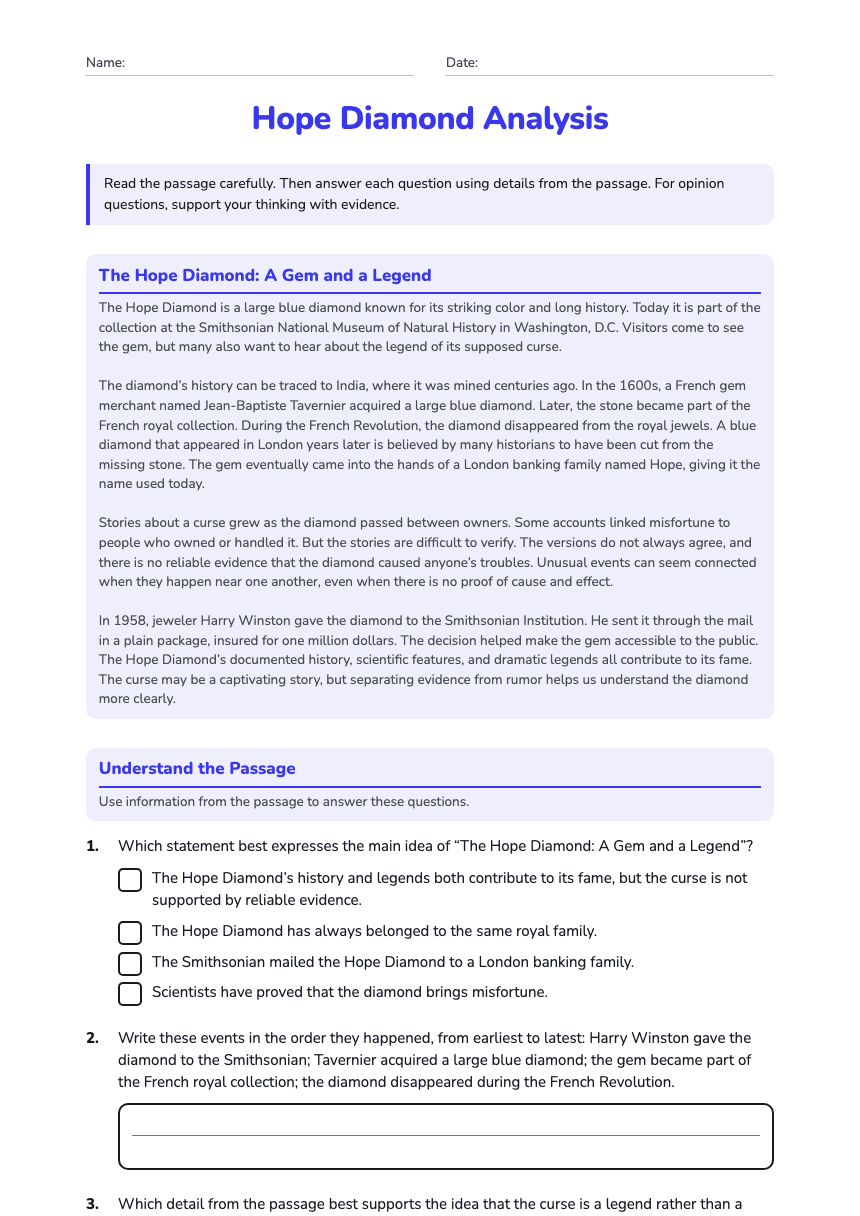
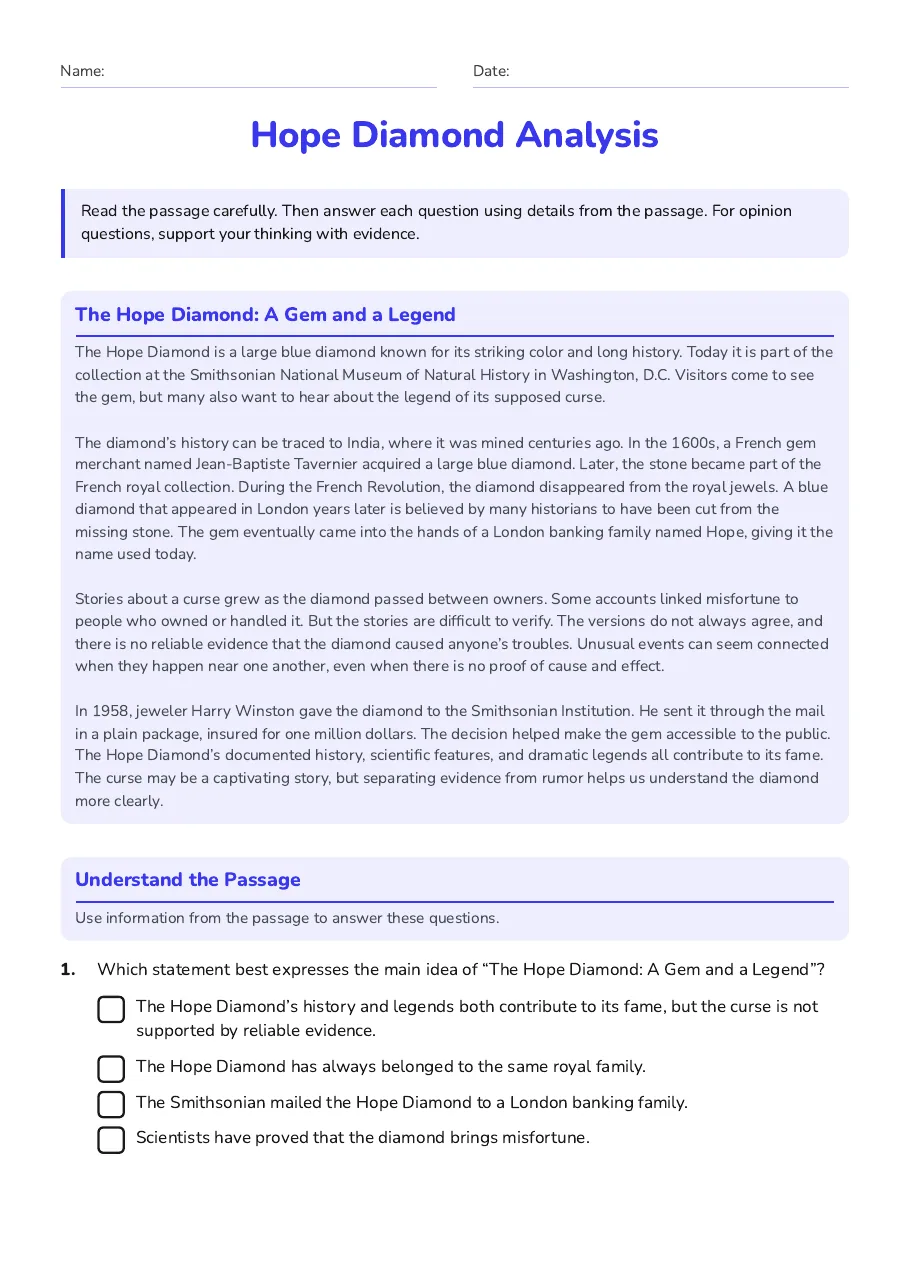
Hope Diamond Analysis
The Hope Diamond: A Gem and a Legend
The Hope Diamond is a large blue diamond known for its striking color and long history. Today it is part of the collection at the Smithsonian National Museum of Natural History in Washington, D.C. Visitors come to see the gem, but many also want to hear about the legend of its supposed curse. The diamond’s history can be traced to India, where it was mined centuries ago. In the 1600s, a French gem merchant named Jean-Baptiste Tavernier acquired a large blue diamond. Later, the stone became part of the French royal collection. During the French Revolution, the diamond disappeared from the royal jewels. A blue diamond that appeared in London years later is believed by many historians to have been cut from the missing stone. The gem eventually came into the hands of a London banking family named Hope, giving it the name used today. Stories about a curse grew as the diamond passed between owners. Some accounts linked misfortune to people who owned or handled it. But the stories are difficult to verify. The versions do not always agree, and there is no reliable evidence that the diamond caused anyone’s troubles. Unusual events can seem connected when they happen near one another, even when there is no proof of cause and effect. In 1958, jeweler Harry Winston gave the diamond to the Smithsonian Institution. He sent it through the mail in a plain package, insured for one million dollars. The decision helped make the gem accessible to the public. The Hope Diamond’s documented history, scientific features, and dramatic legends all contribute to its fame. The curse may be a captivating story, but separating evidence from rumor helps us understand the diamond more clearly.
Understand the Passage
Use information from the passage to answer these questions.
- The Hope Diamond’s history and legends both contribute to its fame, but the curse is not supported by reliable evidence.
- The Hope Diamond has always belonged to the same royal family.
- The Smithsonian mailed the Hope Diamond to a London banking family.
- Scientists have proved that the diamond brings misfortune.
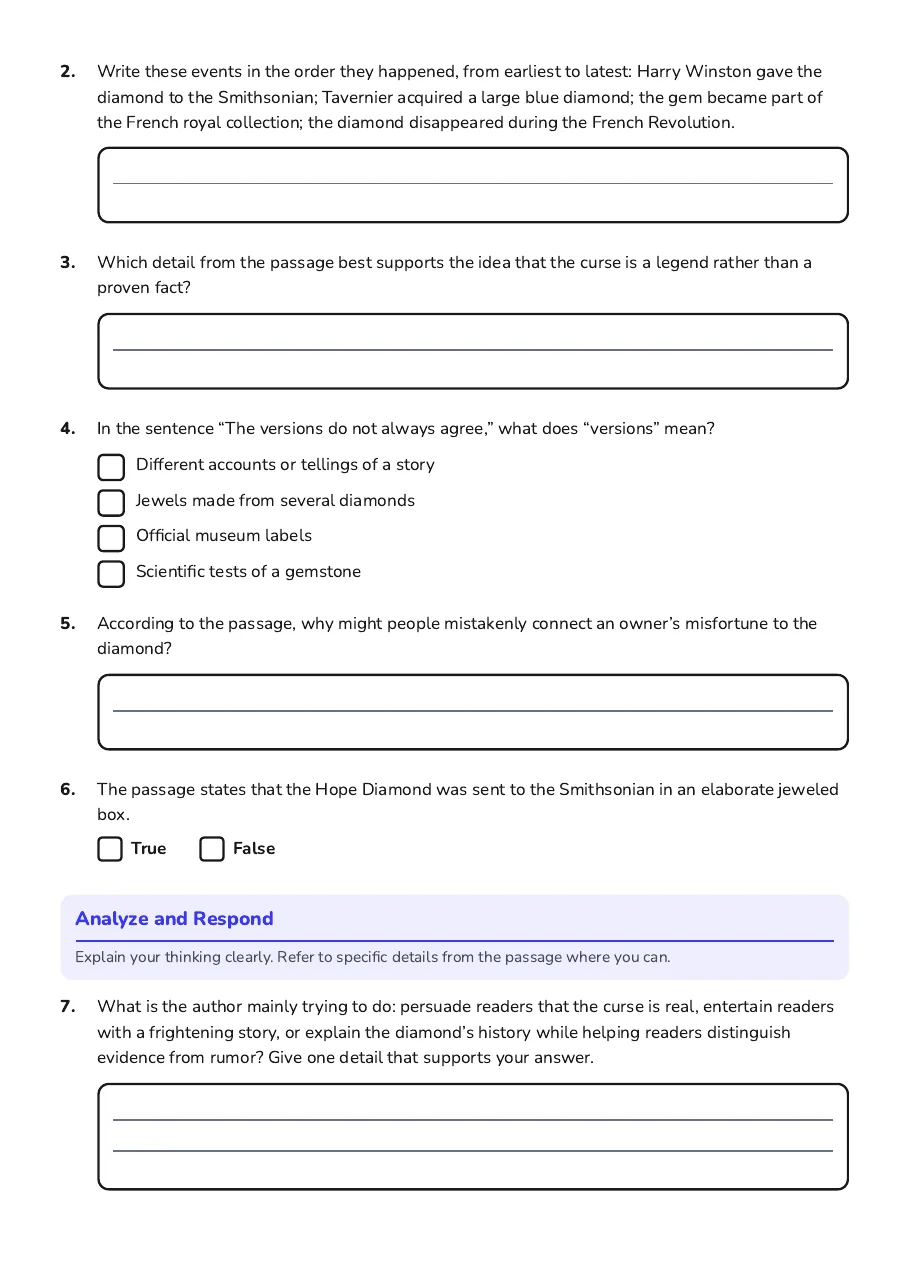
- Different accounts or tellings of a story
- Jewels made from several diamonds
- Official museum labels
- Scientific tests of a gemstone
Analyze and Respond
Explain your thinking clearly. Refer to specific details from the passage where you can.
3 printable pages
Page 1
Page 2
Page 3
About This Worksheet
Free in Kuraplan
Sign up free, grab the PDF, and customize it for your class.
Print-Ready
Formatted for standard paper. Clean layout, easy to read.
AI-Generated
Created with Kuraplan's AI, designed for real classroom use.
For Teachers & Parents
Use in classrooms, for homework, tutoring, or homeschool.
Need a custom version of this worksheet?
Kuraplan's AI generates custom worksheets in seconds — differentiated for every learner, aligned to your curriculum.
Generate Custom Worksheets — Free