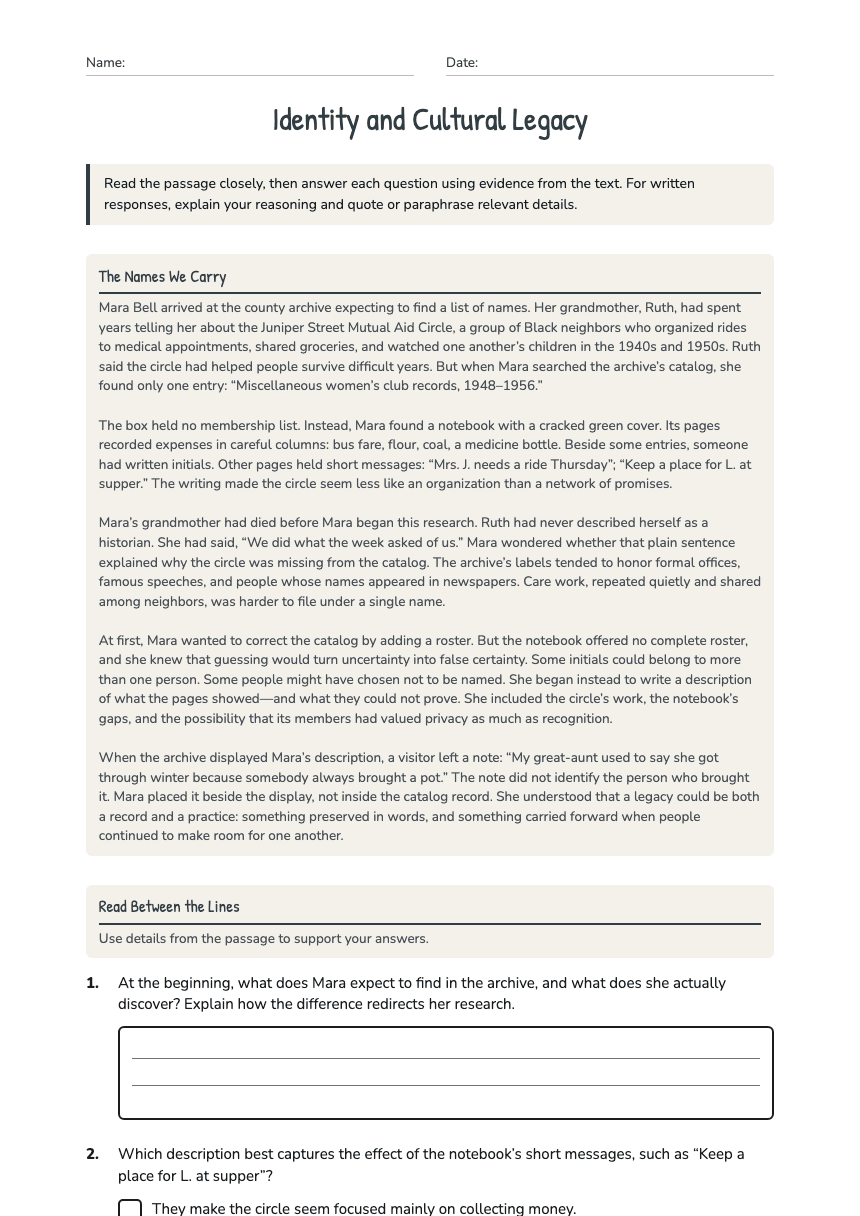
Identity and Cultural Legacy
A free english (ela) worksheet ready for your classroom. Open in Kuraplan to grab the print-ready PDF, customize it for your students, or generate a fresh version in seconds.
Identity and Cultural Legacy
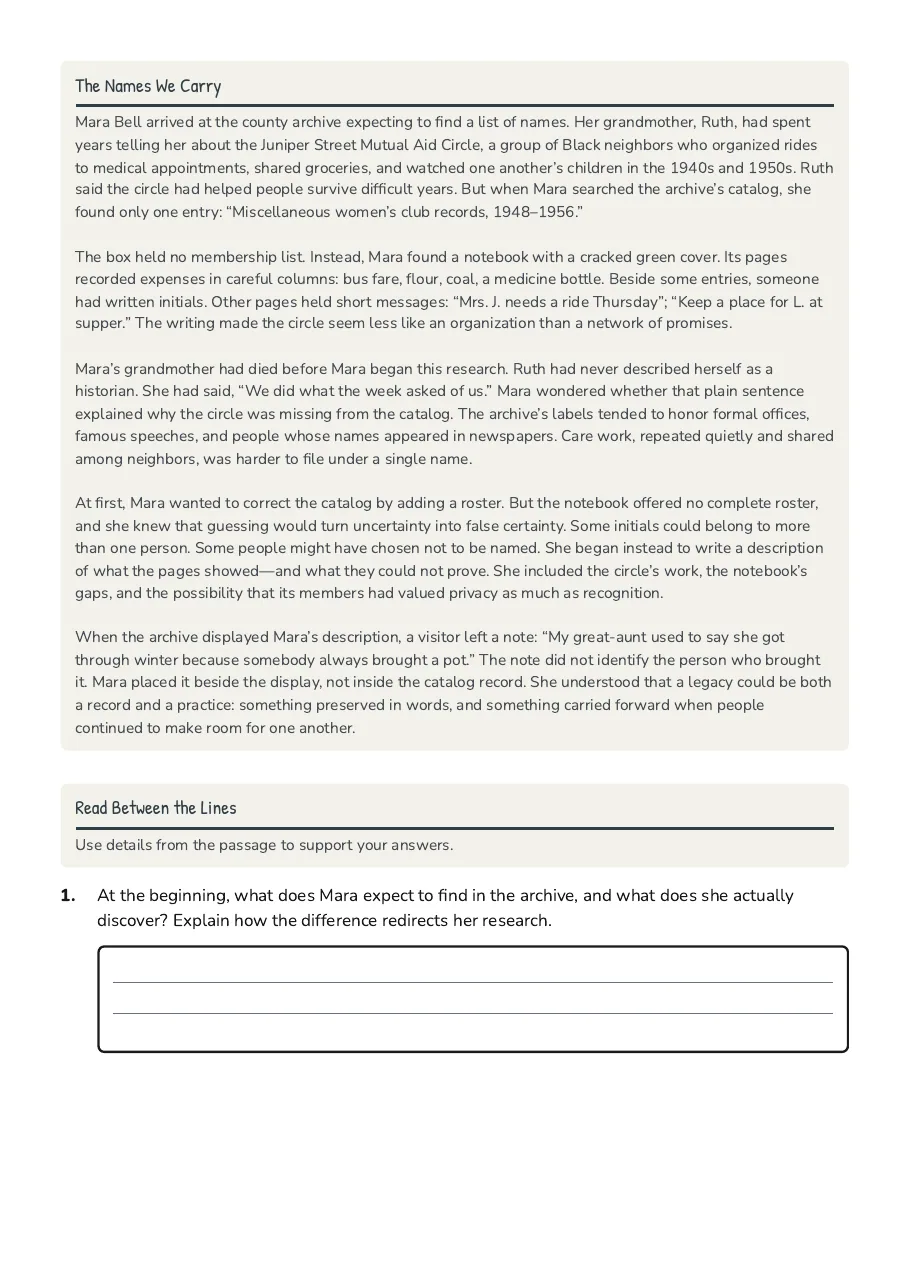
The Names We Carry
Mara Bell arrived at the county archive expecting to find a list of names. Her grandmother, Ruth, had spent years telling her about the Juniper Street Mutual Aid Circle, a group of Black neighbors who organized rides to medical appointments, shared groceries, and watched one another’s children in the 1940s and 1950s. Ruth said the circle had helped people survive difficult years. But when Mara searched the archive’s catalog, she found only one entry: “Miscellaneous women’s club records, 1948–1956.” The box held no membership list. Instead, Mara found a notebook with a cracked green cover. Its pages recorded expenses in careful columns: bus fare, flour, coal, a medicine bottle. Beside some entries, someone had written initials. Other pages held short messages: “Mrs. J. needs a ride Thursday”; “Keep a place for L. at supper.” The writing made the circle seem less like an organization than a network of promises. Mara’s grandmother had died before Mara began this research. Ruth had never described herself as a historian. She had said, “We did what the week asked of us.” Mara wondered whether that plain sentence explained why the circle was missing from the catalog. The archive’s labels tended to honor formal offices, famous speeches, and people whose names appeared in newspapers. Care work, repeated quietly and shared among neighbors, was harder to file under a single name. At first, Mara wanted to correct the catalog by adding a roster. But the notebook offered no complete roster, and she knew that guessing would turn uncertainty into false certainty. Some initials could belong to more than one person. Some people might have chosen not to be named. She began instead to write a description of what the pages showed—and what they could not prove. She included the circle’s work, the notebook’s gaps, and the possibility that its members had valued privacy as much as recognition. When the archive displayed Mara’s description, a visitor left a note: “My great-aunt used to say she got through winter because somebody always brought a pot.” The note did not identify the person who brought it. Mara placed it beside the display, not inside the catalog record. She understood that a legacy could be both a record and a practice: something preserved in words, and something carried forward when people continued to make room for one another.
Read Between the Lines
Use details from the passage to support your answers.
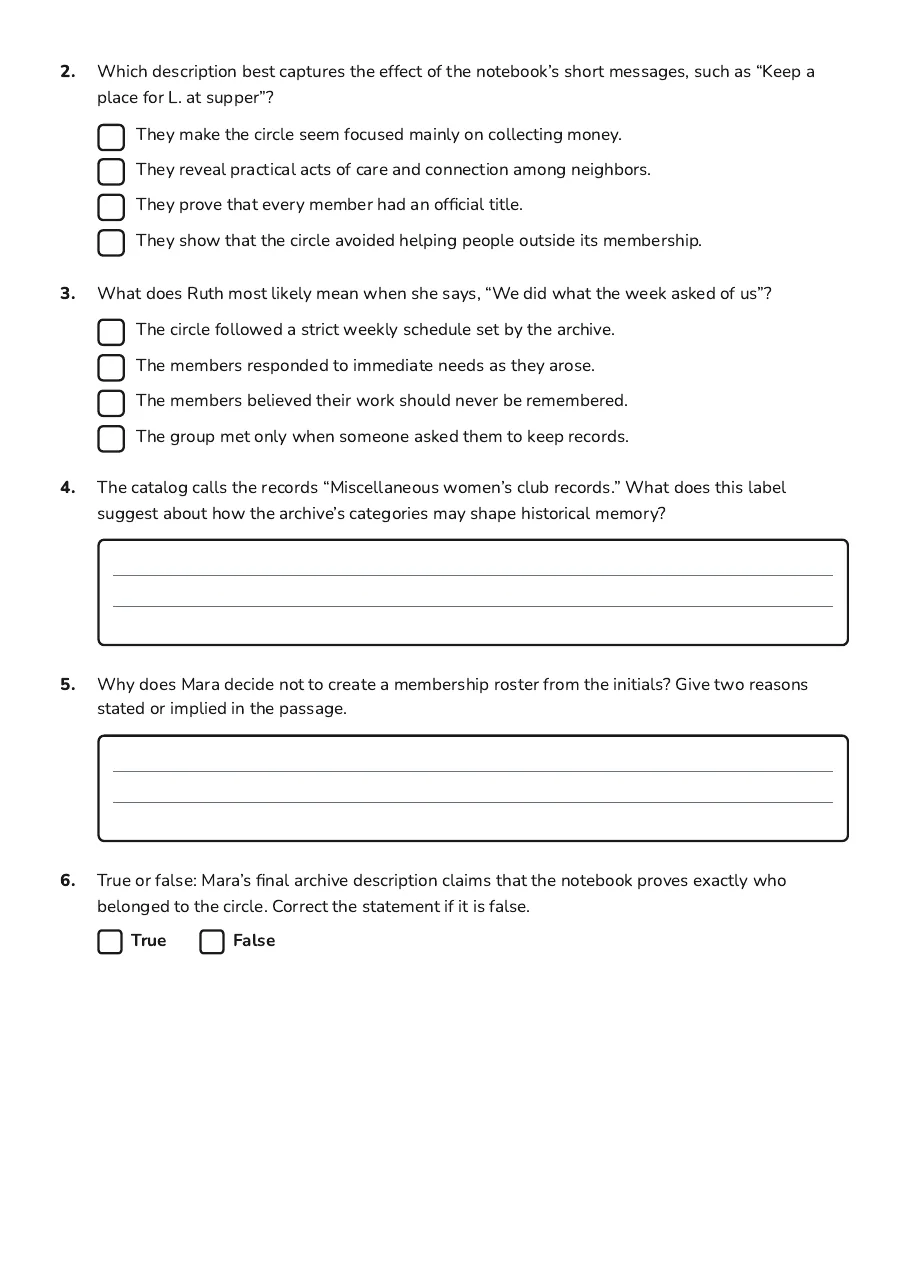
- They make the circle seem focused mainly on collecting money.
- They reveal practical acts of care and connection among neighbors.
- They prove that every member had an official title.
- They show that the circle avoided helping people outside its membership.
- The circle followed a strict weekly schedule set by the archive.
- The members responded to immediate needs as they arose.
- The members believed their work should never be remembered.
- The group met only when someone asked them to keep records.
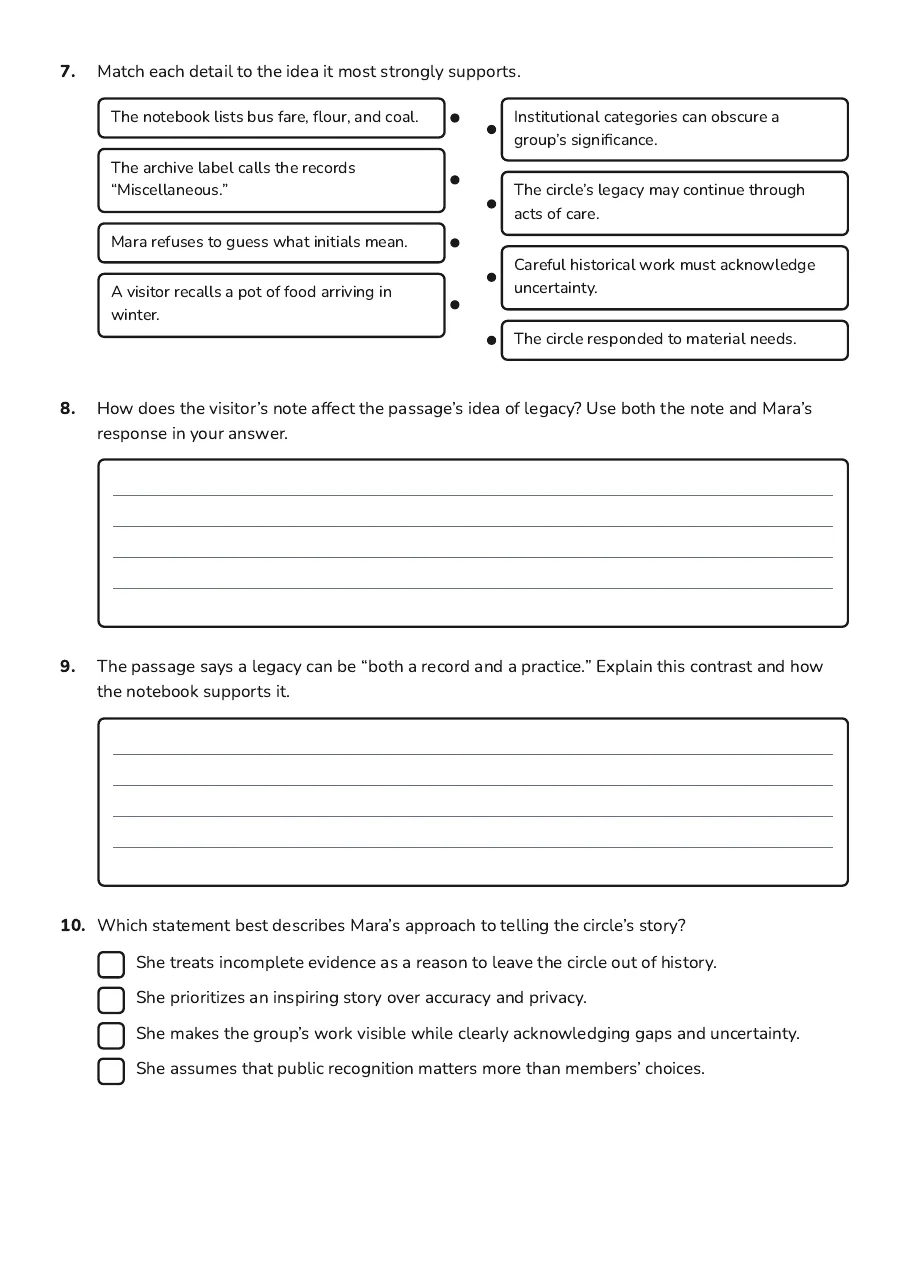
- The notebook lists bus fare, flour, and coal.
- The archive label calls the records “Miscellaneous.”
- Mara refuses to guess what initials mean.
- A visitor recalls a pot of food arriving in winter.
- Institutional categories can obscure a group’s significance.
- The circle’s legacy may continue through acts of care.
- Careful historical work must acknowledge uncertainty.
- The circle responded to material needs.
- She treats incomplete evidence as a reason to leave the circle out of history.
- She prioritizes an inspiring story over accuracy and privacy.
- She makes the group’s work visible while clearly acknowledging gaps and uncertainty.
- She assumes that public recognition matters more than members’ choices.
4 printable pages
Page 1
Page 2
Page 3
Page 4
About This Worksheet
Free in Kuraplan
Sign up free, grab the PDF, and customize it for your class.
Print-Ready
Formatted for standard paper. Clean layout, easy to read.
AI-Generated
Created with Kuraplan's AI, designed for real classroom use.
For Teachers & Parents
Use in classrooms, for homework, tutoring, or homeschool.
Need a custom version of this worksheet?
Kuraplan's AI generates custom worksheets in seconds — differentiated for every learner, aligned to your curriculum.
Generate Custom Worksheets — Free