Johnson vs Webster Comparison
A free english (ela) worksheet ready for your classroom. Open in Kuraplan to grab the print-ready PDF, customize it for your students, or generate a fresh version in seconds.
Johnson vs Webster Comparison

📖 Reading Passage: Two Dictionary Makers
Samuel Johnson (1709-1784) was an English writer who created A Dictionary of the English Language in 1755. Working alone for nine years, Johnson wrote definitions for over 40,000 words. His dictionary included quotes from famous authors to show how words were used. Johnson wanted to preserve traditional English spelling and grammar rules from British literature.
Noah Webster (1758-1843) was an American lexicographer who published An American Dictionary of the English Language in 1828. Webster believed American English should be different from British English. He simplified spellings (changing "colour" to "color" and "centre" to "center") and included American words and meanings. Webster's work became the foundation for modern American dictionaries.
Key Differences: Johnson focused on preserving traditional British English, while Webster wanted to create a distinctly American version of English. Johnson worked in the 1750s during colonial times, while Webster worked in the early 1800s after American independence. Their different goals shaped how Americans and British people spell and use English today.
🧠 Comprehension Questions
Johnson worked on his dictionary for _________ years.
💭 Discussion Questions
About This Worksheet
Free in Kuraplan
Sign up free, grab the PDF, and customize it for your class.
Print-Ready
Formatted for standard paper. Clean layout, easy to read.
AI-Generated
Created with Kuraplan's AI, designed for real classroom use.
For Teachers & Parents
Use in classrooms, for homework, tutoring, or homeschool.
Need a custom version of this worksheet?
Kuraplan's AI generates custom worksheets in seconds — differentiated for every learner, aligned to your curriculum.
Generate Custom Worksheets — FreeMore English (ELA) Worksheets
6th Grade ELA Vocabulary
Free
Antonyms Adventure Worksheet
Free
Reading and Vocabulary Skills
Free
Weather Vocabulary Exploration
Free
Dictionary Detectives Adventure
Free
Dictionary Detective Skills
Free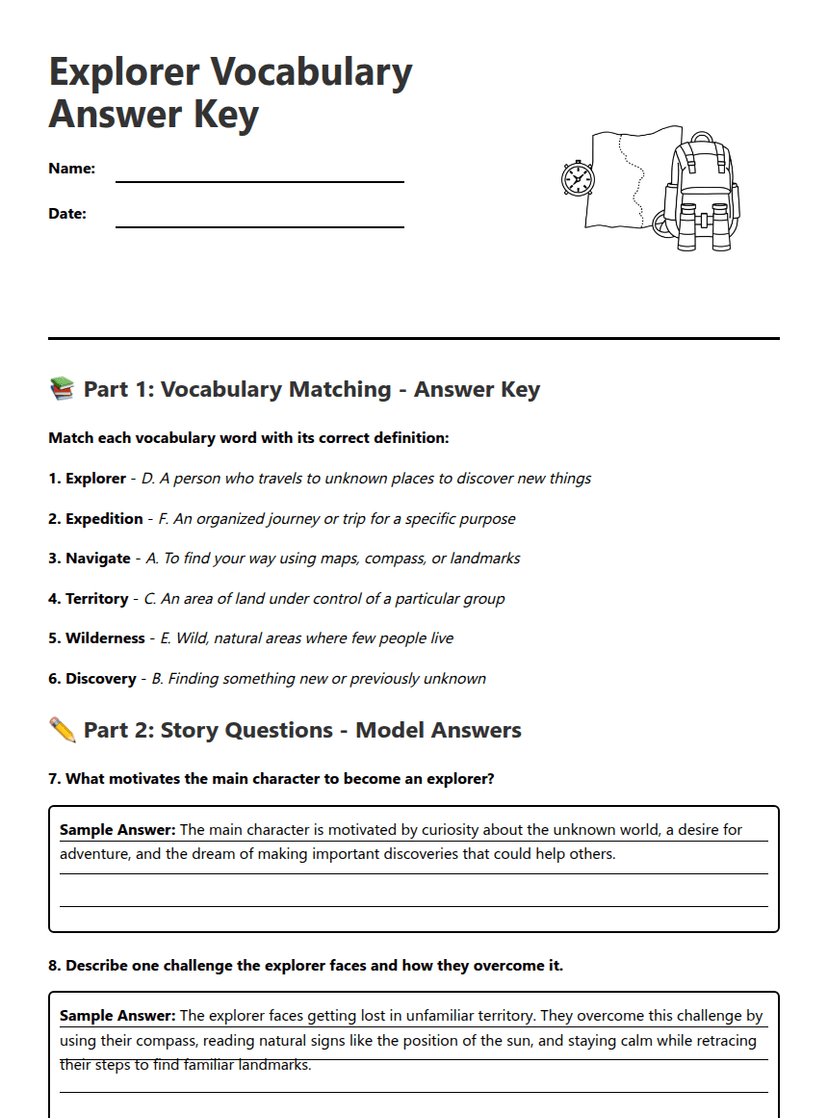
Explorer Vocabulary Answer Key
Free