Matter and Particles Investigation
A free science worksheet ready for your classroom. Open in Kuraplan to grab the print-ready PDF, customize it for your students, or generate a fresh version in seconds.
Matter and Particles Investigation
🔎 Page 1: What Is Matter?
I can explain that matter has mass and takes up space.
Success criteria: I can tell whether something is matter. I can draw tiny particles.
I think air is matter because ____________________________________________.
Word bank: mass space
Choose how to respond: draw, circle, speak, use a communication device, or dictate.
Support: Ask for the prompt to be read aloud. Use the word bank and a large-print copy.
⚪ Page 2: Particle Models
I can model how particles are arranged and move in solids, liquids, and gases.
Success criteria: I can show particle spacing and label particle movement.
Word bank: close together spread out vibrate slide move freely
Arrangement: ____________________ Movement: ____________________
Arrangement: ____________________ Movement: ____________________
Arrangement: ____________________ Movement: ____________________
I like __________________ because ________________________________________.
Support: Use hand motions for vibrate, slide, and move freely. You may draw or dictate.
Extension: Explain how spacing and movement are different in two states.
🧩 Page 3: Properties of Objects
I can describe and compare objects using their properties.
Success criteria: I can use property words to record what I observe.
Property word bank: color texture shape state hardness flexibility solubility
Directions: Observe three objects. Write, circle, draw, or dictate your answers.
Color: ____________________ Texture: ____________________
Shape: ____________________ State: ____________________
Hardness: ____________________ Flexibility: ____________________
Solubility:
dissolves does not dissolveColor: ____________________ Texture: ____________________
Shape: ____________________ State: ____________________
Hardness: ____________________ Flexibility: ____________________
Solubility:
dissolves does not dissolveColor: ____________________ Texture: ____________________
Shape: ____________________ State: ____________________
Hardness: ____________________ Flexibility: ____________________
Solubility:
dissolves does not dissolveBoth objects are ________________________________________________.
They are different because _______________________________________.
Support: Point to a property word, circle an option, use a real object, or dictate.
Extension: Add another property that helps compare the objects.
🧪 Page 4: Mixing Investigation
I can make a prediction and record observations when substances mix.
Success criteria: I can separate what I see from what I think.
Safety: Wear goggles. Do not taste. Pour carefully. Wash your hands.
I predict __________________________________ because ________________________________.
Color: ____________________ Visible particles:
yes noOther observation: ____________________________________________________
Salt visible:
yes noColor: ____________________ Other observation: __________________________
Bubbles:
yes noParticles visible:
yes noOther observation: ____________________________________________________
I observed __________________________________________________________.
I think __________________________________________________ may have happened.
Matter is made of ____________________. One property I can observe is ____________________.
One change I saw was __________________________________________________.
Support: A teacher or peer may read the directions. Draw, circle, speak, or dictate.
Extension: Use two observations to support your conclusion.
About This Worksheet
Free in Kuraplan
Sign up free, grab the PDF, and customize it for your class.
Print-Ready
Formatted for standard paper. Clean layout, easy to read.
AI-Generated
Created with Kuraplan's AI, designed for real classroom use.
For Teachers & Parents
Use in classrooms, for homework, tutoring, or homeschool.
Need a custom version of this worksheet?
Kuraplan's AI generates custom worksheets in seconds — differentiated for every learner, aligned to your curriculum.
Generate Custom Worksheets — FreeMore Science Worksheets
Changes Cut and Paste
Free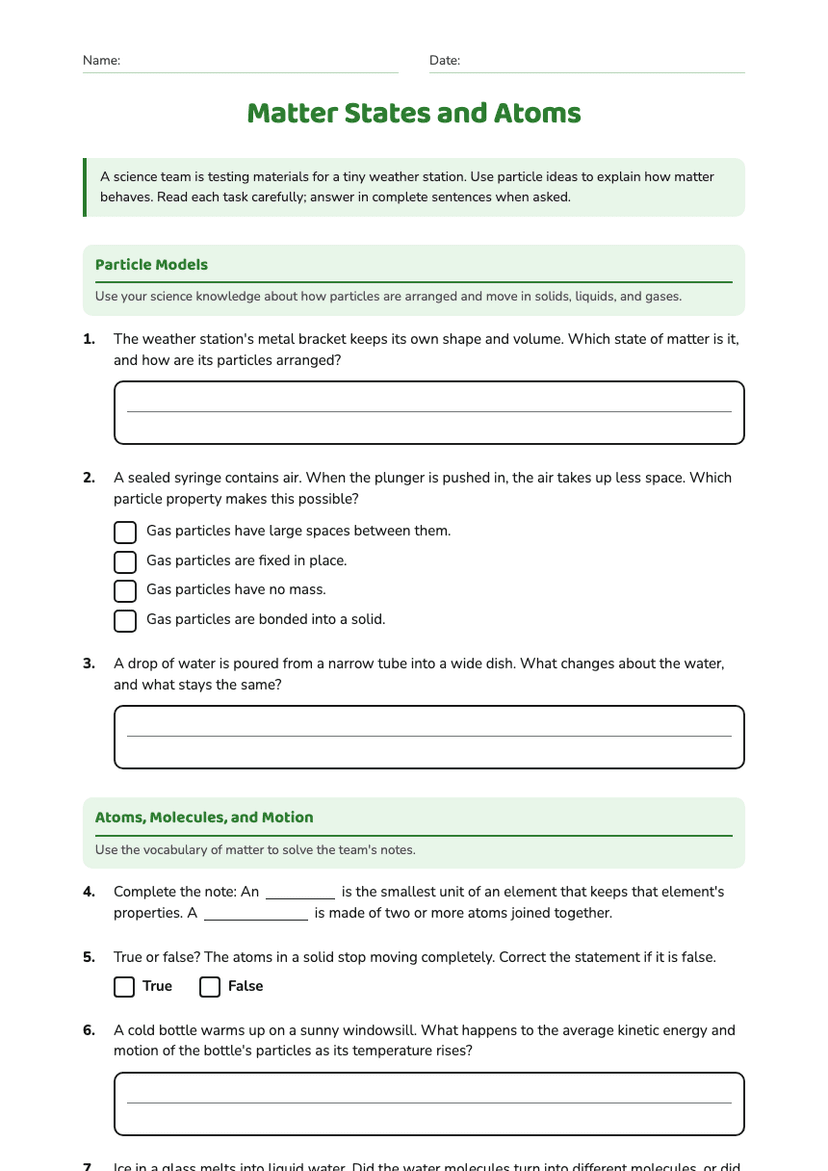
Matter States and Atoms
Free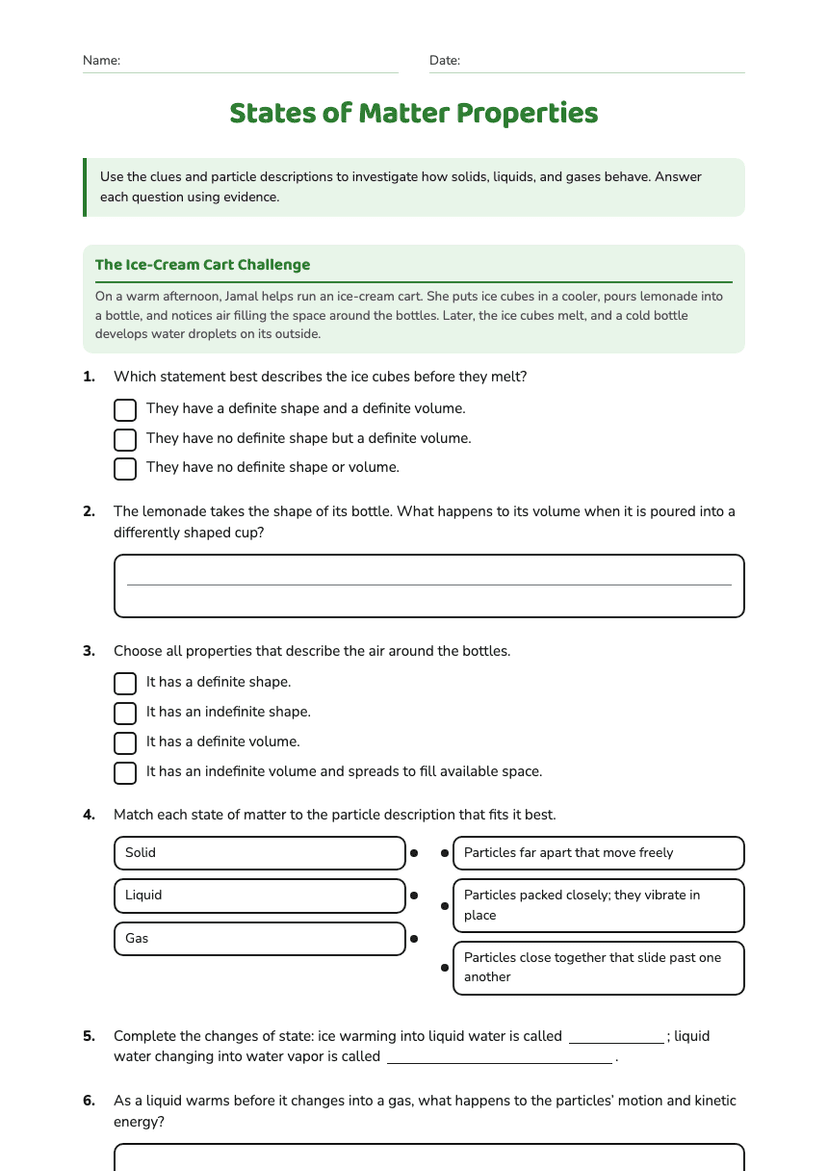
States of Matter Properties
Free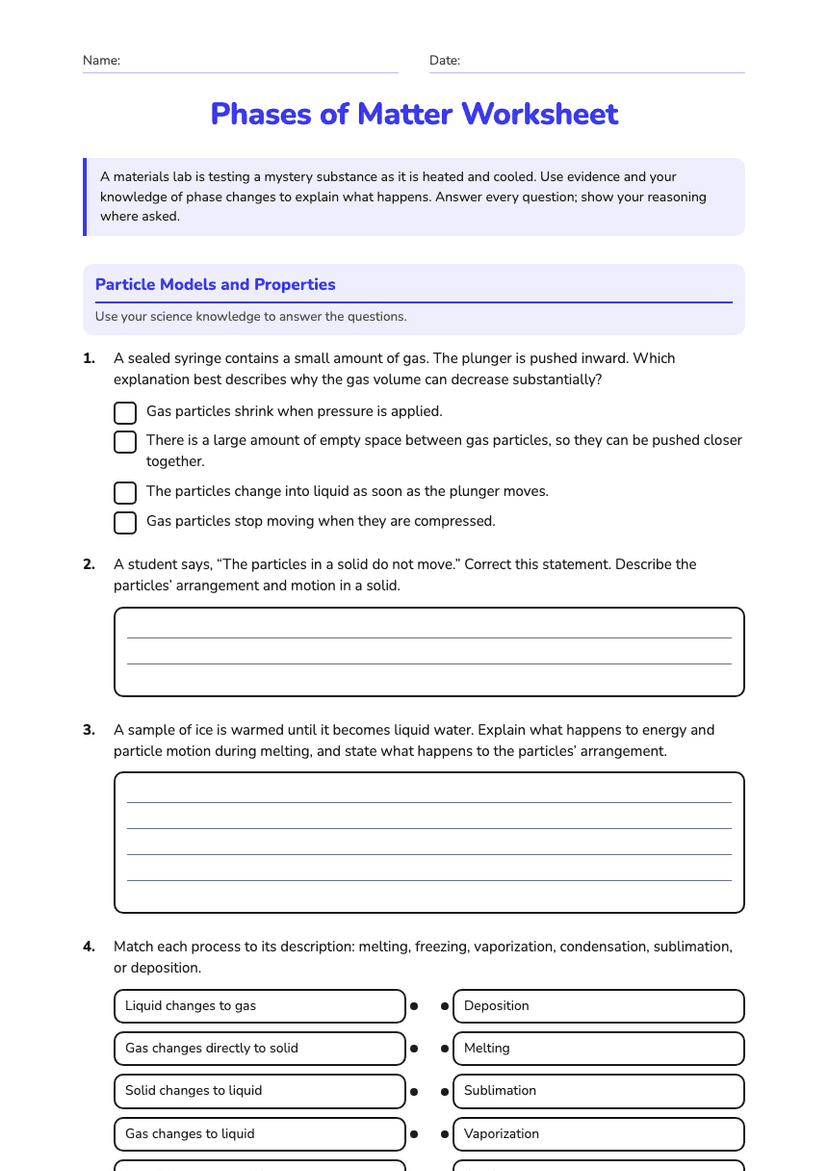
Phases of Matter Worksheet
Free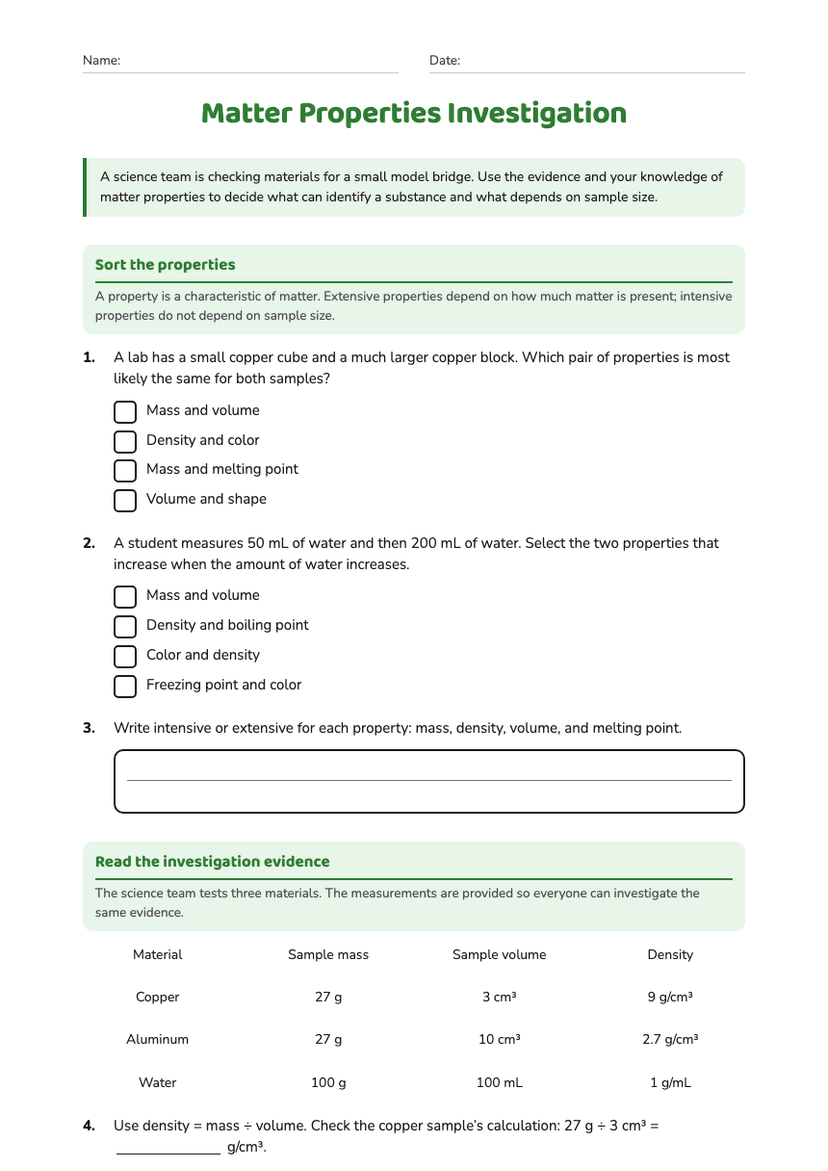
Matter Properties Investigation
Free
Matter Properties Exploration Worksheet
Free
Matter Changes
Free