Mixture Separation Investigation
A free science worksheet ready for your classroom. Open in Kuraplan to grab the print-ready PDF, customize it for your students, or generate a fresh version in seconds.
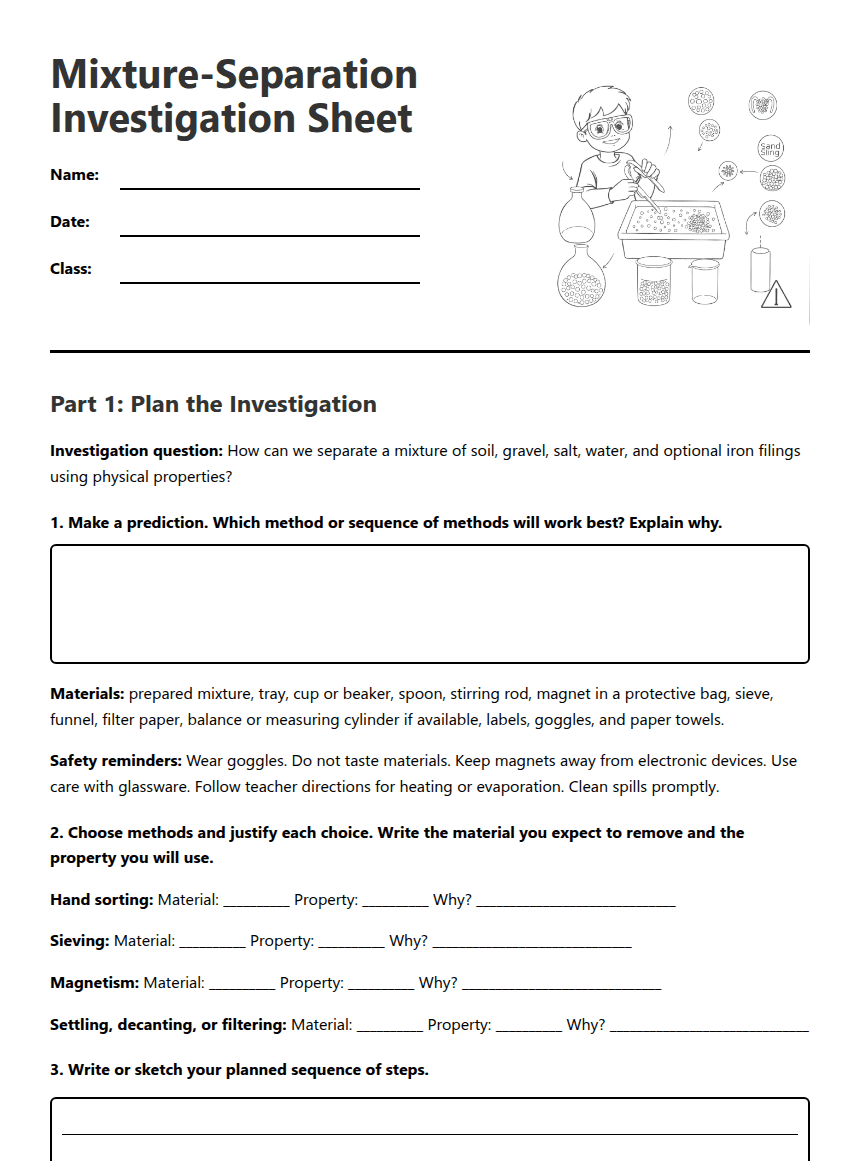
Mixture-Separation Investigation Sheet
Part 1: Plan the Investigation
Investigation question: How can we separate a mixture of soil, gravel, salt, water, and optional iron filings using physical properties?
Materials: prepared mixture, tray, cup or beaker, spoon, stirring rod, magnet in a protective bag, sieve, funnel, filter paper, balance or measuring cylinder if available, labels, goggles, and paper towels.
Safety reminders: Wear goggles. Do not taste materials. Keep magnets away from electronic devices. Use care with glassware. Follow teacher directions for heating or evaporation. Clean spills promptly.
Hand sorting: Material: __________ Property: __________ Why? ______________________________
Sieving: Material: __________ Property: __________ Why? ______________________________
Magnetism: Material: __________ Property: __________ Why? ______________________________
Settling, decanting, or filtering: Material: __________ Property: __________ Why? ______________________________
Success criteria:
I can choose a method based on a material property. I can work safely and share a team role. I can record observations and measurements with units.Part 2: Carry Out, Record, and Explain
Step 1: __________________________________________________________________________
Step 2: __________________________________________________________________________
Step 3: __________________________________________________________________________
Step 4: __________________________________________________________________________
Step 5: __________________________________________________________________________
Method: ____________________ Property used: ____________________
What happened? __________________________________________________________
Evidence or measurement: _________________________________________________
Method: ____________________ Property used: ____________________
What happened? __________________________________________________________
Evidence or measurement: _________________________________________________
Method: ____________________ Property used: ____________________
What happened? __________________________________________________________
Evidence or measurement: _________________________________________________
Claim: The most useful method was ___________________________________________
Evidence: I observed or measured ___________________________________________
Reasoning: This method worked because it used the property of __________________, so __________________________________________________________________
a. Did the materials change into new substances, or were they only separated? How do you know?
b. How could your team improve the procedure or recover more material?
Word bank: mixture • component • property • particle size • magnetism • sieve • filter • residue • evidence
Sentence starters: “I separated ______ by using ______ because...” “My evidence is...” “Matter was conserved because...”
Literacy focus: Describe the steps in order and write an evidence-based explanation (CCSS.ELA-LITERACY.RST.6-8.3 and WHST.6-8.1).
Optional extension: Design a more efficient separation sequence. Explain why the order matters. If possible, calculate the percentage recovered: mass recovered ÷ starting mass × 100.
Teacher Answer Guidance — Print as a Separate Final Page
Investigation question: Students should explain that different components can be separated because they have different physical properties.
Likely sequence: Hand sort or sieve large gravel first; use a protected magnet to remove iron filings if present; allow soil or gravel to settle; decant water carefully; filter remaining solid particles. Salt dissolved in water will pass through the filter, so evaporation or teacher-directed recovery is needed to obtain the salt.
Expected properties: Gravel and soil differ in particle size and texture. Iron filings respond to magnetism. Solid particles can be separated from water by settling, decanting, or filtration. Salt has solubility in water and may be recovered by evaporation.
Expected observations: A sieve holds larger particles while smaller particles pass through. A magnet attracts iron filings through the protective bag. Soil or gravel settles. Filter paper holds solid residue while water passes through. Salt may not be visible after dissolving.
Key concept: These are physical changes, not chemical changes. The components remain the same substances, and matter is conserved. Apparent mass loss may result from spills, residue left in equipment, or dissolved material that was not recovered.
CER guidance: Accept any claim supported by a correct property and observation. For example: “Filtering was useful because particle size allowed water to pass through while solid residue stayed in the filter.”
Reflection guidance: Strong responses mention that no new substance formed and suggest improvements such as labeling containers, pouring slowly, repeating filtration, rinsing residue carefully, measuring mass, or using a clearer separation order.
Differentiation strategies: Provide labeled equipment, picture vocabulary, sentence starters, a completed example, oral response or drawing options, reduced data entries, larger print, calculator access, and team roles such as materials manager, reader, recorder, measurer, and reporter.
Advanced learner prompts: Compare two sequences, justify the most efficient order, calculate percentage recovered, or connect the process to commercial water treatment.
Success criteria check: Look for safe teamwork, property-based method choices, ordered procedures, observations with units when available, evidence-based reasoning, and an explanation that matter was conserved.
About This Worksheet
Free in Kuraplan
Sign up free, grab the PDF, and customize it for your class.
Print-Ready
Formatted for standard paper. Clean layout, easy to read.
AI-Generated
Created with Kuraplan's AI, designed for real classroom use.
For Teachers & Parents
Use in classrooms, for homework, tutoring, or homeschool.
Need a custom version of this worksheet?
Kuraplan's AI generates custom worksheets in seconds — differentiated for every learner, aligned to your curriculum.
Generate Custom Worksheets — FreeMore Science Worksheets
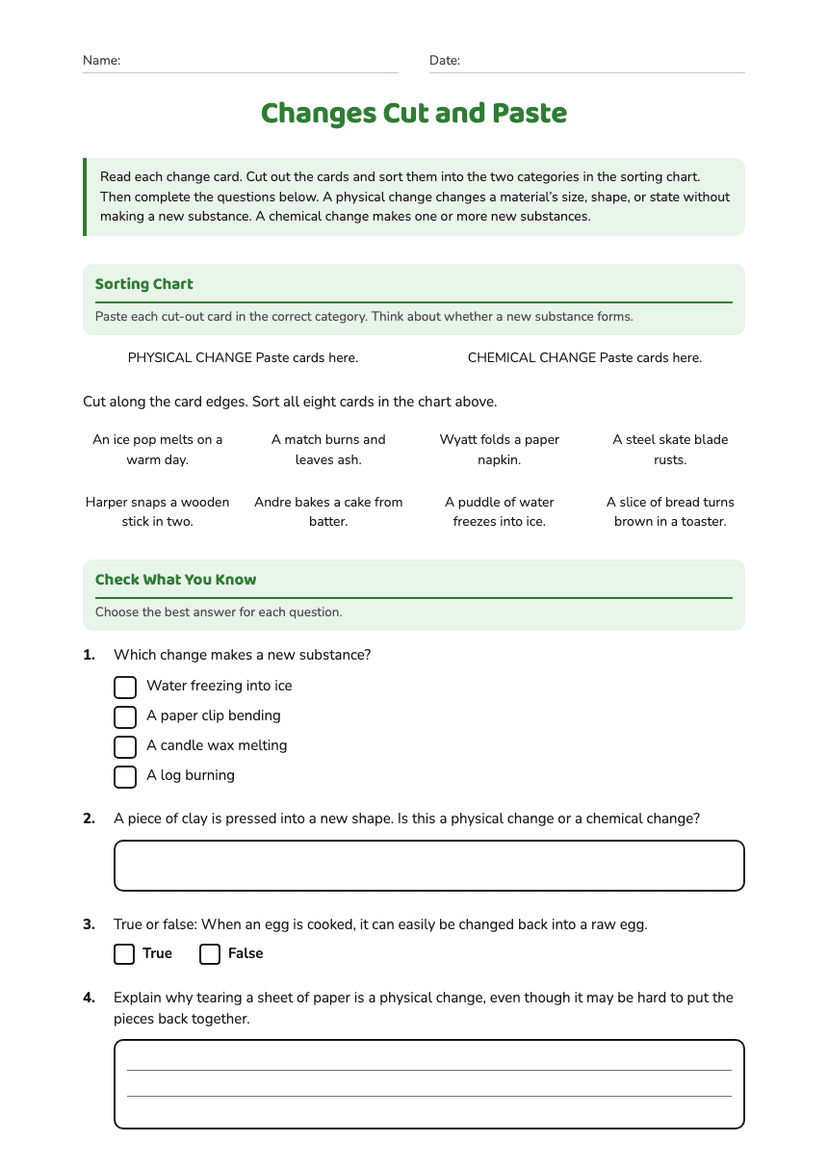
Changes Cut and Paste
Free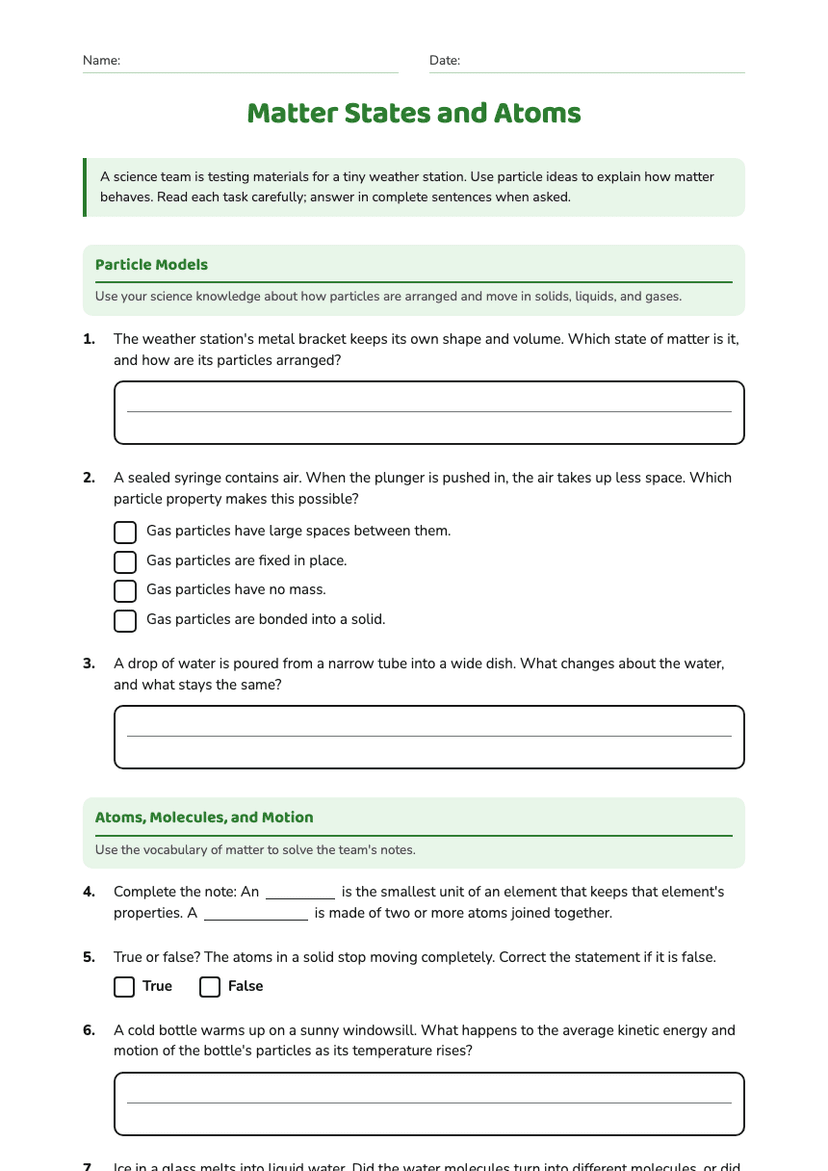
Matter States and Atoms
Free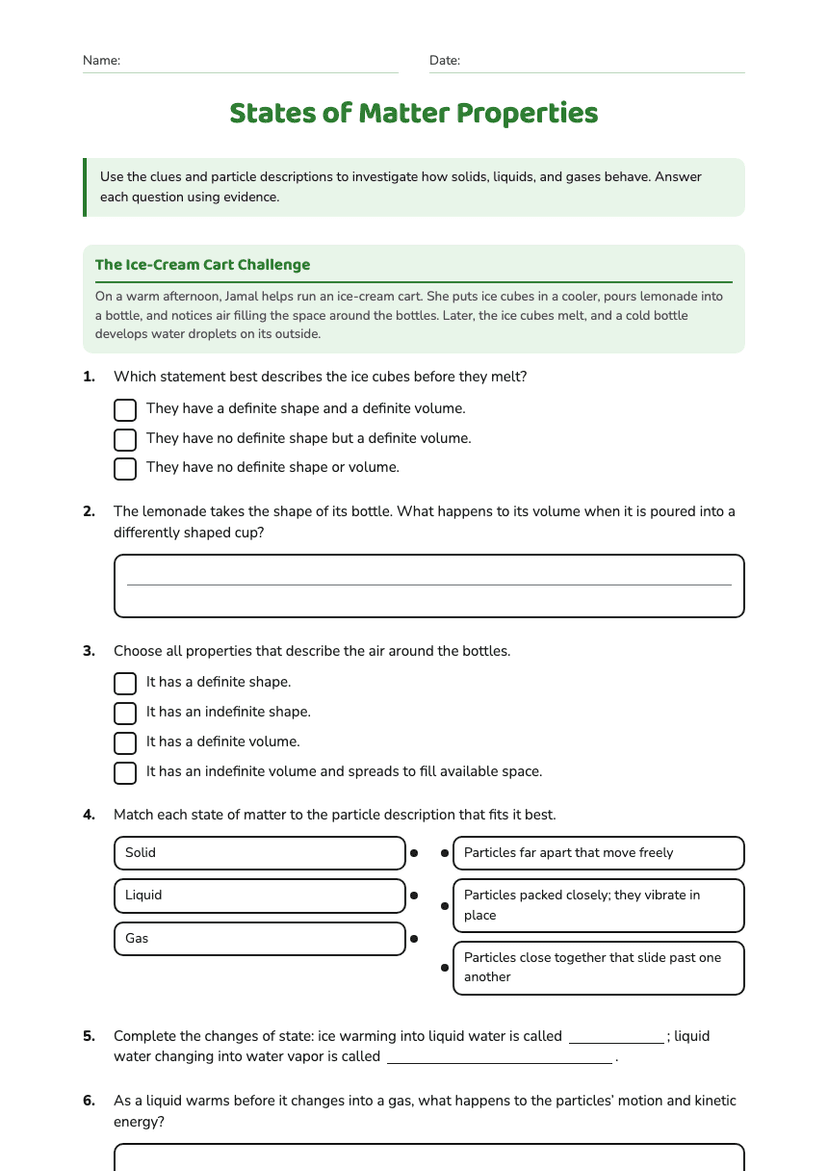
States of Matter Properties
Free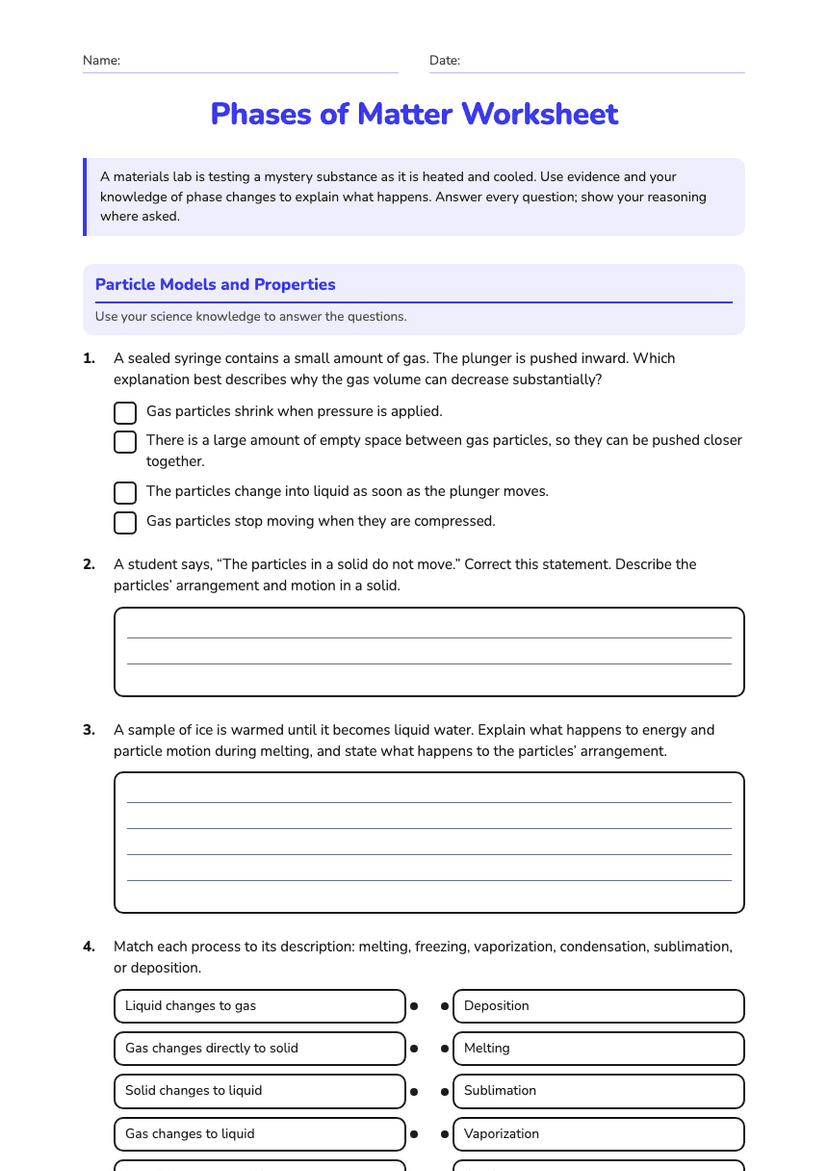
Phases of Matter Worksheet
Free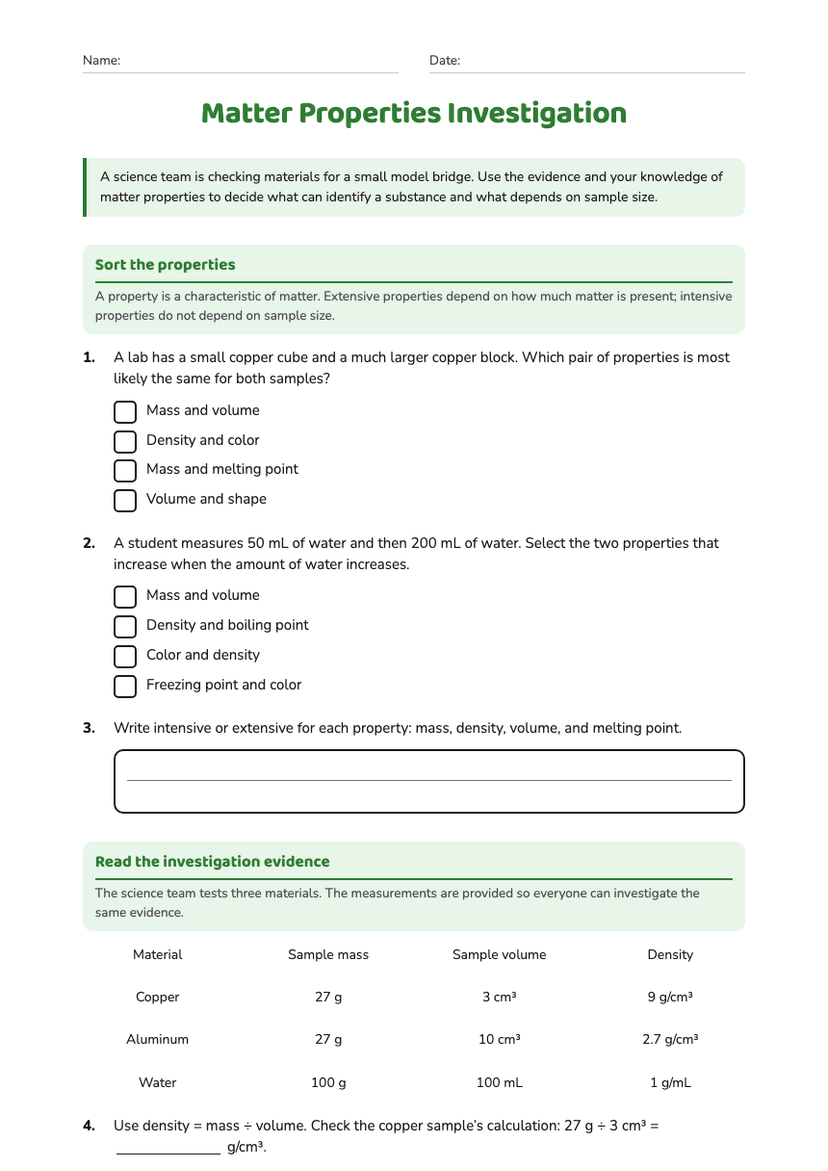
Matter Properties Investigation
Free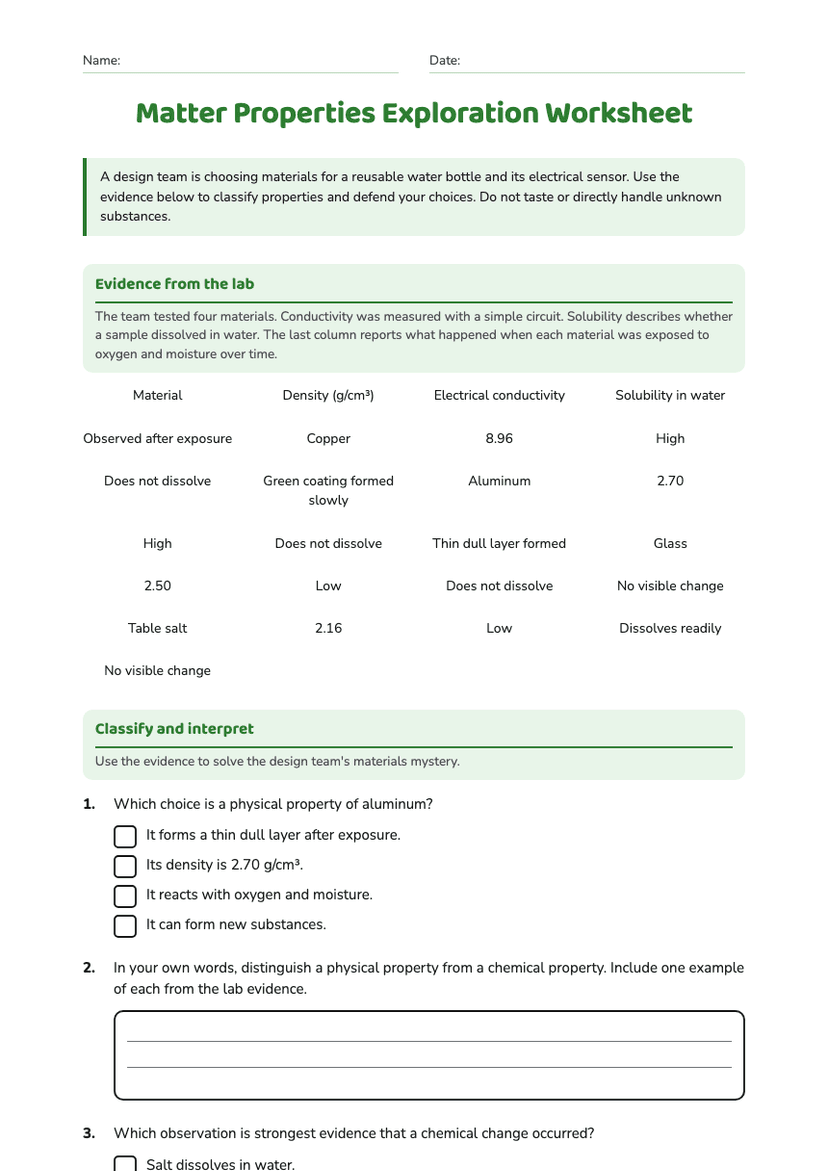
Matter Properties Exploration Worksheet
Free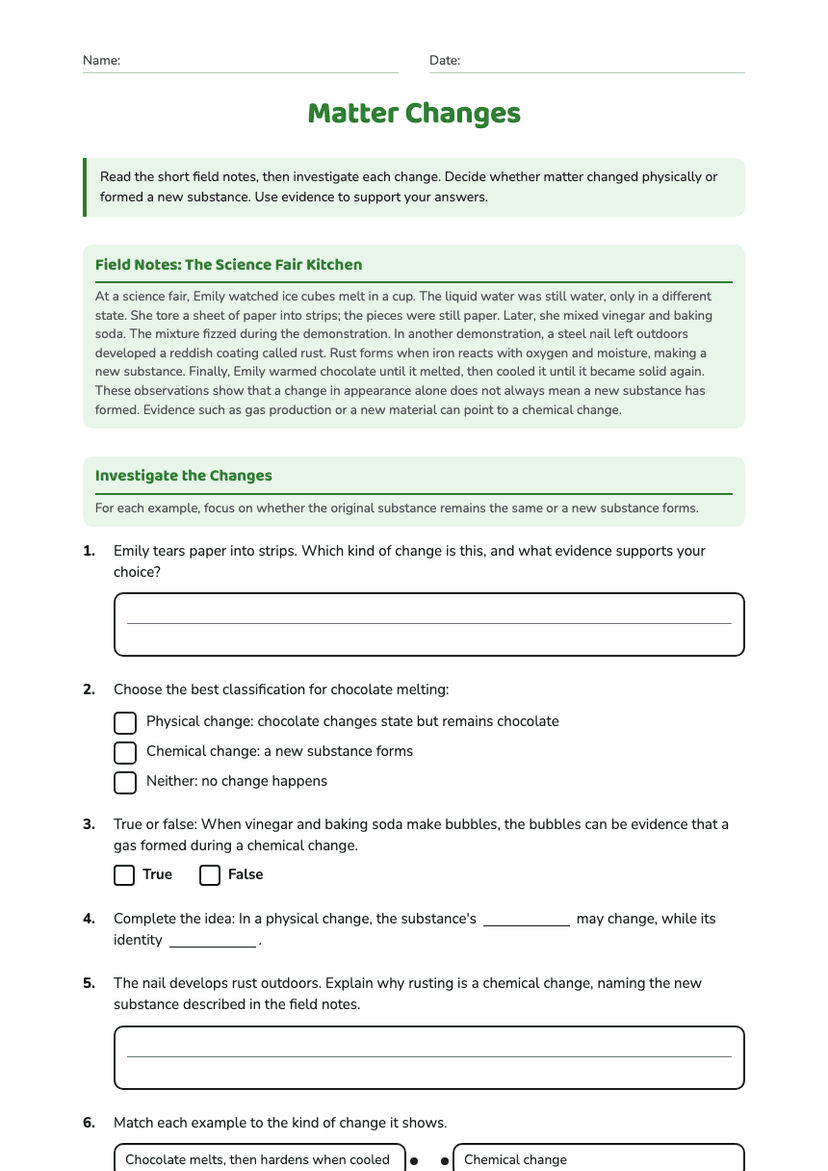
Matter Changes
Free