Neolithic Era and Mesopotamia
A free social studies worksheet ready for your classroom. Open in Kuraplan to grab the print-ready PDF, customize it for your students, or generate a fresh version in seconds.
Neolithic Era and Mesopotamia
📖 Reading Passage: From Hunters to Farmers
Learning Goals - I Can Statements:
- I can explain how farming changed human life during the Neolithic Era
- I can identify key features of early civilizations in Mesopotamia
- I can describe important inventions and innovations from ancient times
- I can analyze how geography influenced the development of early civilizations
The Neolithic Era: A Big Change
Long ago, people lived very different lives. They moved from place to place. They hunted animals. They gathered plants and berries. This was hard work. Finding food took all day. These early people were called hunter-gatherers.
Then something amazing happened. This was during the Neolithic Era, also called the "New Stone Age," which began around 10,000 years ago. People learned to farm. They learned to grow their own food. They also learned to raise animals like sheep, cows, goats, and pigs. This change is called the Agricultural Revolution or Neolithic Revolution.
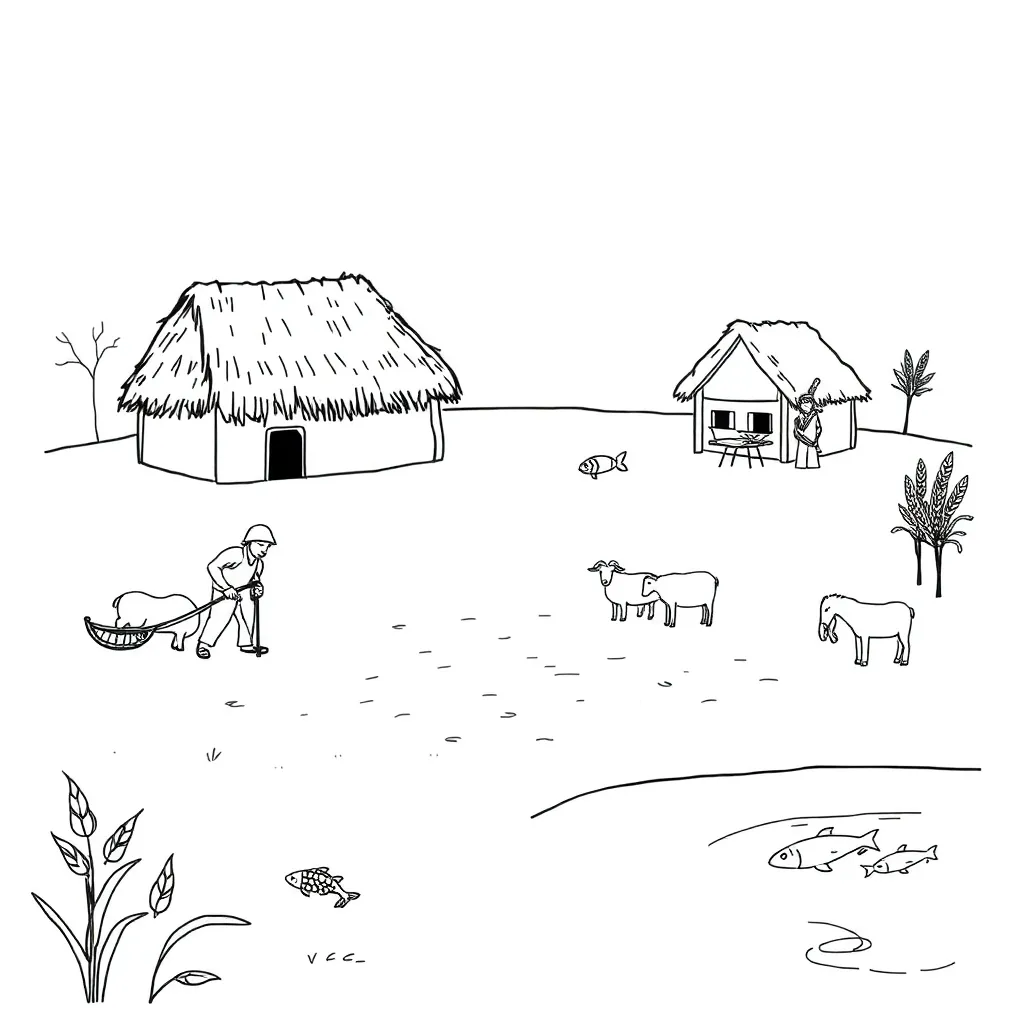
Farming changed everything. People did not need to move around anymore. They could stay in one place. They built permanent homes made of mud bricks and stone. Small villages grew into towns. With a steady food supply, populations grew larger. People had time to develop new skills and crafts.
During this time, people also made important tools. They learned to polish stone tools to make them sharper. They invented the plow to help with farming. They also learned to make pottery to store food and water. Some groups even learned to work with metals like copper and bronze.
Mesopotamia: The First Civilization
Mesopotamia was located between two big rivers in what is now modern-day Iraq. These rivers were called the Tigris and Euphrates. The word Mesopotamia means "land between rivers." This area was part of a larger region called the Fertile Crescent because of its rich soil.
The rivers made the soil very good for farming. When the rivers flooded each spring, they left rich dirt called silt behind. This helped crops like wheat, barley, and dates grow well. People could grow lots of food. However, the flooding was unpredictable, so people had to learn to control the water.
The Sumerians were the first people to build a civilization here around 3500 BCE. They lived in independent city-states like Ur, Uruk, and Babylon. Each city-state had its own ruler and patron god. The Sumerians created many important things:
- Writing: They invented the first writing system called cuneiform, which used wedge-shaped marks on clay tablets
- Laws: King Hammurabi created the first written laws called Hammurabi's Code around 1750 BCE
- Buildings: They built tall temple towers called ziggurats that reached toward the heavens
- Farming tools: They made irrigation systems with canals and dikes to bring water to their crops
- Transportation: They invented the wheel around 3500 BCE, which helped with farming and trade
- Math and Science: They created a number system based on 60, developed the first calendar, and studied astronomy
These innovations helped create the first true civilization. People had different jobs. Some were farmers. Others were priests, soldiers, craftspeople, merchants, or scribes. This specialization of labor allowed society to become more complex and advanced.
Trade was also important in Mesopotamia. Merchants traveled to distant lands to trade goods like textiles, grains, and crafts for materials like wood, stone, and metals that were not available locally. This trade helped spread Mesopotamian ideas and inventions to other parts of the world.
🏛️ Part 1: Multiple Choice
I can identify key features of the Neolithic Era and early civilizations.
✓ Part 2: True or False
I can explain how early civilizations developed and changed human life.
📝 Part 3: Short Response
I can describe the importance of early civilizations and their innovations.
📋 Answer Sheet
Teacher's Guide - Correct Answers
Part 1: Multiple Choice
Part 2: True or False
Part 3: Short Response Sample Answers
About This Worksheet
Free in Kuraplan
Sign up free, grab the PDF, and customize it for your class.
Print-Ready
Formatted for standard paper. Clean layout, easy to read.
AI-Generated
Created with Kuraplan's AI, designed for real classroom use.
For Teachers & Parents
Use in classrooms, for homework, tutoring, or homeschool.
Need a custom version of this worksheet?
Kuraplan's AI generates custom worksheets in seconds — differentiated for every learner, aligned to your curriculum.
Generate Custom Worksheets — FreeMore Social Studies Worksheets
African American History
Free
Ancient India for Kids
Free
World History Quiz Worksheet
Free
Brown v. Board Mosaic
Free
Amish American History Exploration
Free
Amish American History Overview
Free
Amish American History Overview
Free