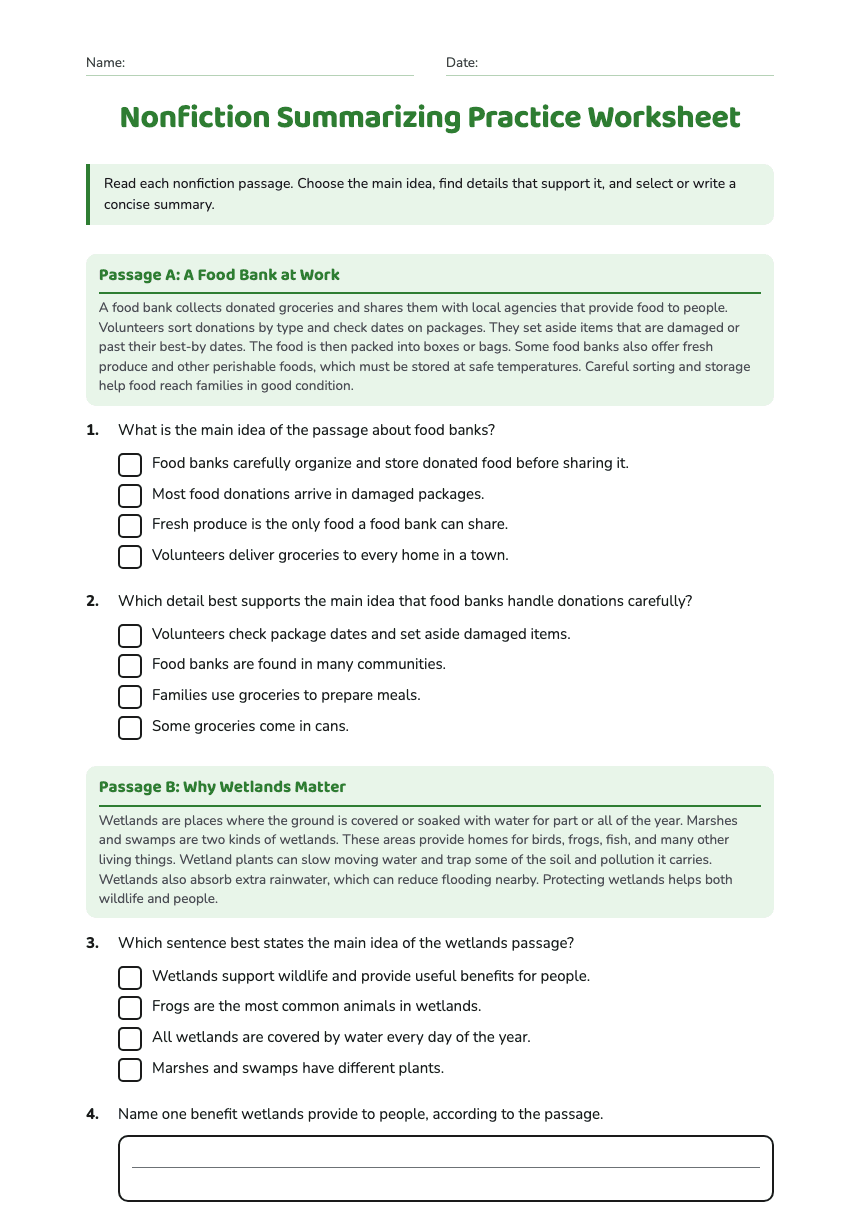
Nonfiction Summarizing Practice Worksheet
A free english (ela) worksheet ready for your classroom. Open in Kuraplan to grab the print-ready PDF, customize it for your students, or generate a fresh version in seconds.
Nonfiction Summarizing Practice Worksheet
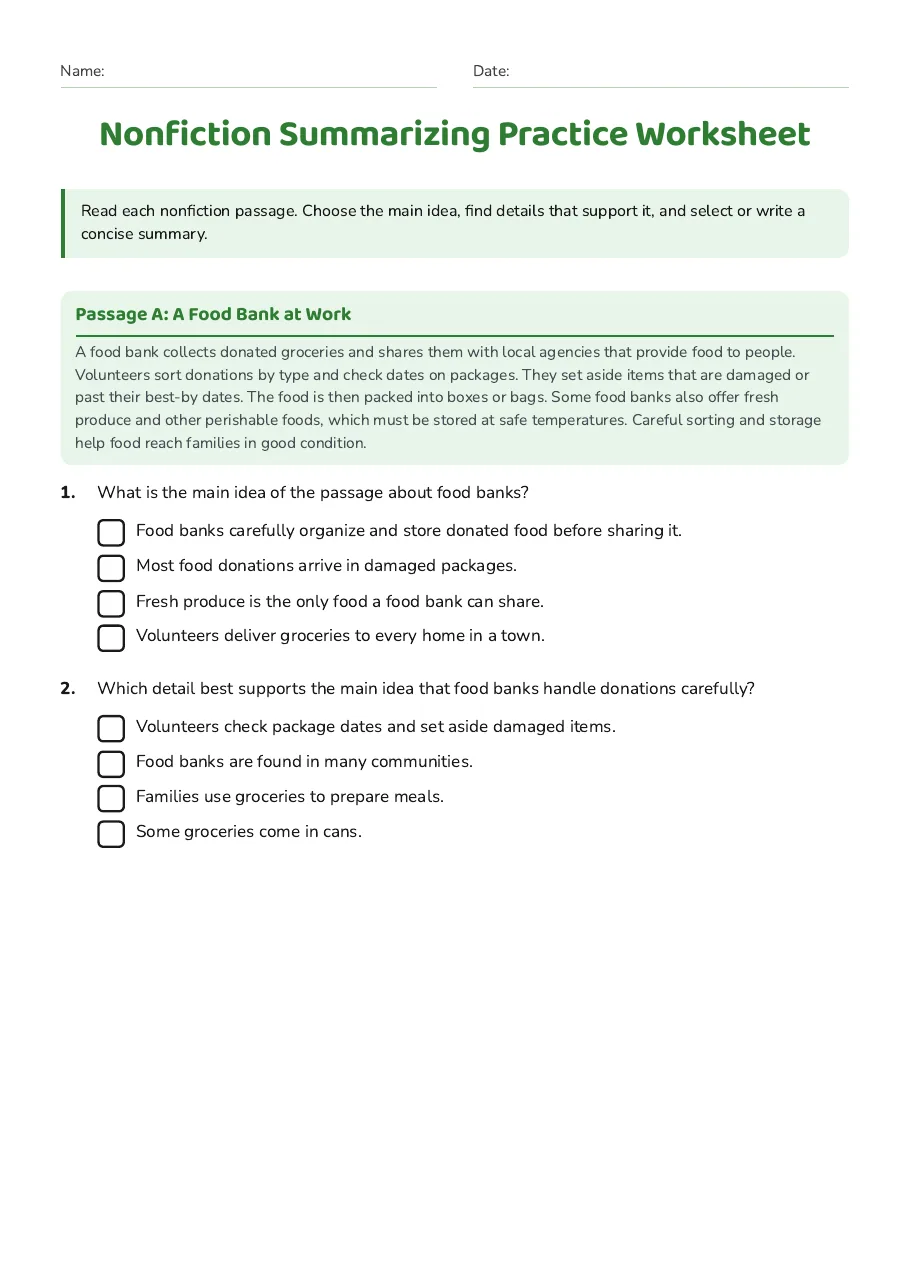
Passage A: A Food Bank at Work
A food bank collects donated groceries and shares them with local agencies that provide food to people. Volunteers sort donations by type and check dates on packages. They set aside items that are damaged or past their best-by dates. The food is then packed into boxes or bags. Some food banks also offer fresh produce and other perishable foods, which must be stored at safe temperatures. Careful sorting and storage help food reach families in good condition.
- Food banks carefully organize and store donated food before sharing it.
- Most food donations arrive in damaged packages.
- Fresh produce is the only food a food bank can share.
- Volunteers deliver groceries to every home in a town.
- Volunteers check package dates and set aside damaged items.
- Food banks are found in many communities.
- Families use groceries to prepare meals.
- Some groceries come in cans.
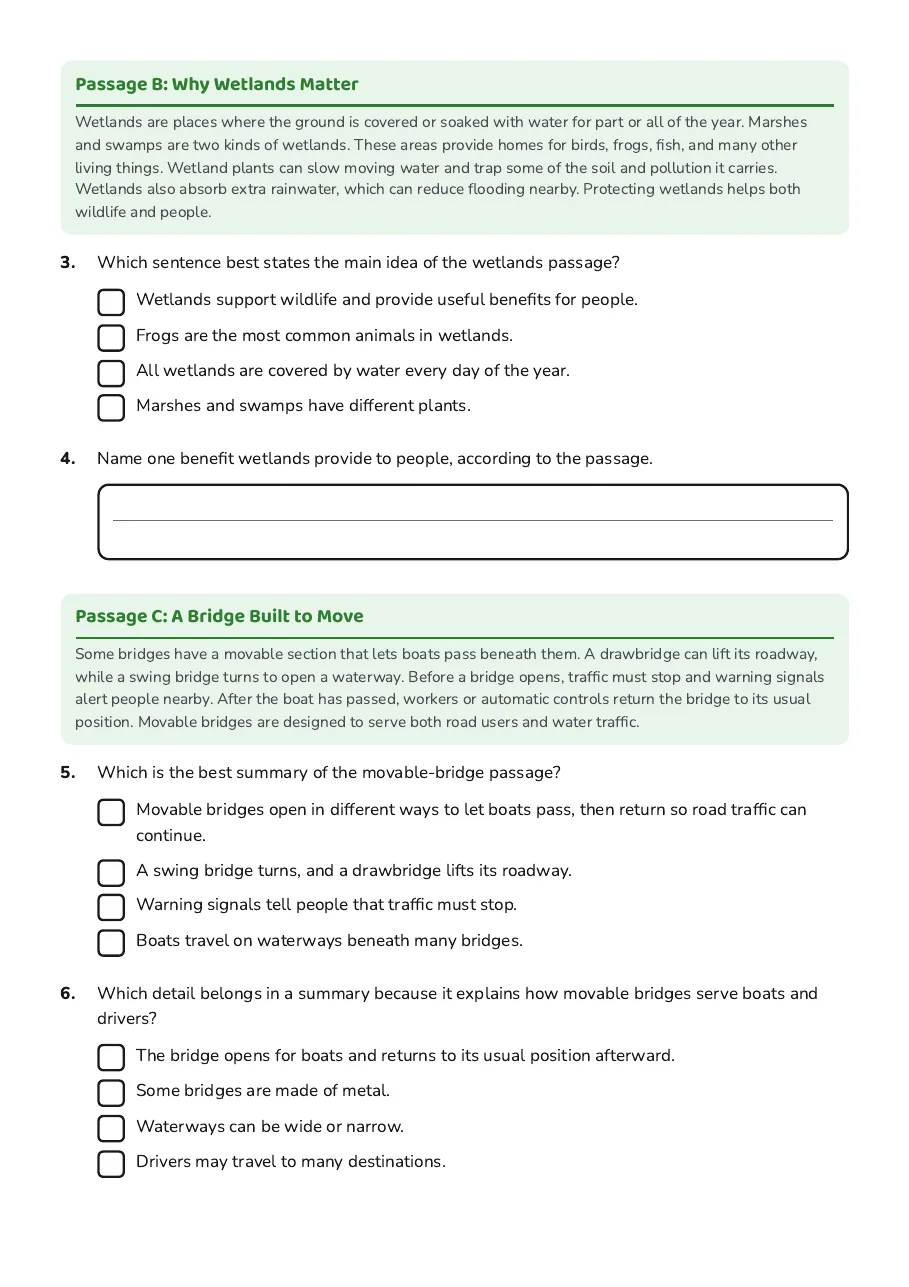
Passage B: Why Wetlands Matter
Wetlands are places where the ground is covered or soaked with water for part or all of the year. Marshes and swamps are two kinds of wetlands. These areas provide homes for birds, frogs, fish, and many other living things. Wetland plants can slow moving water and trap some of the soil and pollution it carries. Wetlands also absorb extra rainwater, which can reduce flooding nearby. Protecting wetlands helps both wildlife and people.
- Wetlands support wildlife and provide useful benefits for people.
- Frogs are the most common animals in wetlands.
- All wetlands are covered by water every day of the year.
- Marshes and swamps have different plants.
Passage C: A Bridge Built to Move
Some bridges have a movable section that lets boats pass beneath them. A drawbridge can lift its roadway, while a swing bridge turns to open a waterway. Before a bridge opens, traffic must stop and warning signals alert people nearby. After the boat has passed, workers or automatic controls return the bridge to its usual position. Movable bridges are designed to serve both road users and water traffic.
- Movable bridges open in different ways to let boats pass, then return so road traffic can continue.
- A swing bridge turns, and a drawbridge lifts its roadway.
- Warning signals tell people that traffic must stop.
- Boats travel on waterways beneath many bridges.
- The bridge opens for boats and returns to its usual position afterward.
- Some bridges are made of metal.
- Waterways can be wide or narrow.
- Drivers may travel to many destinations.
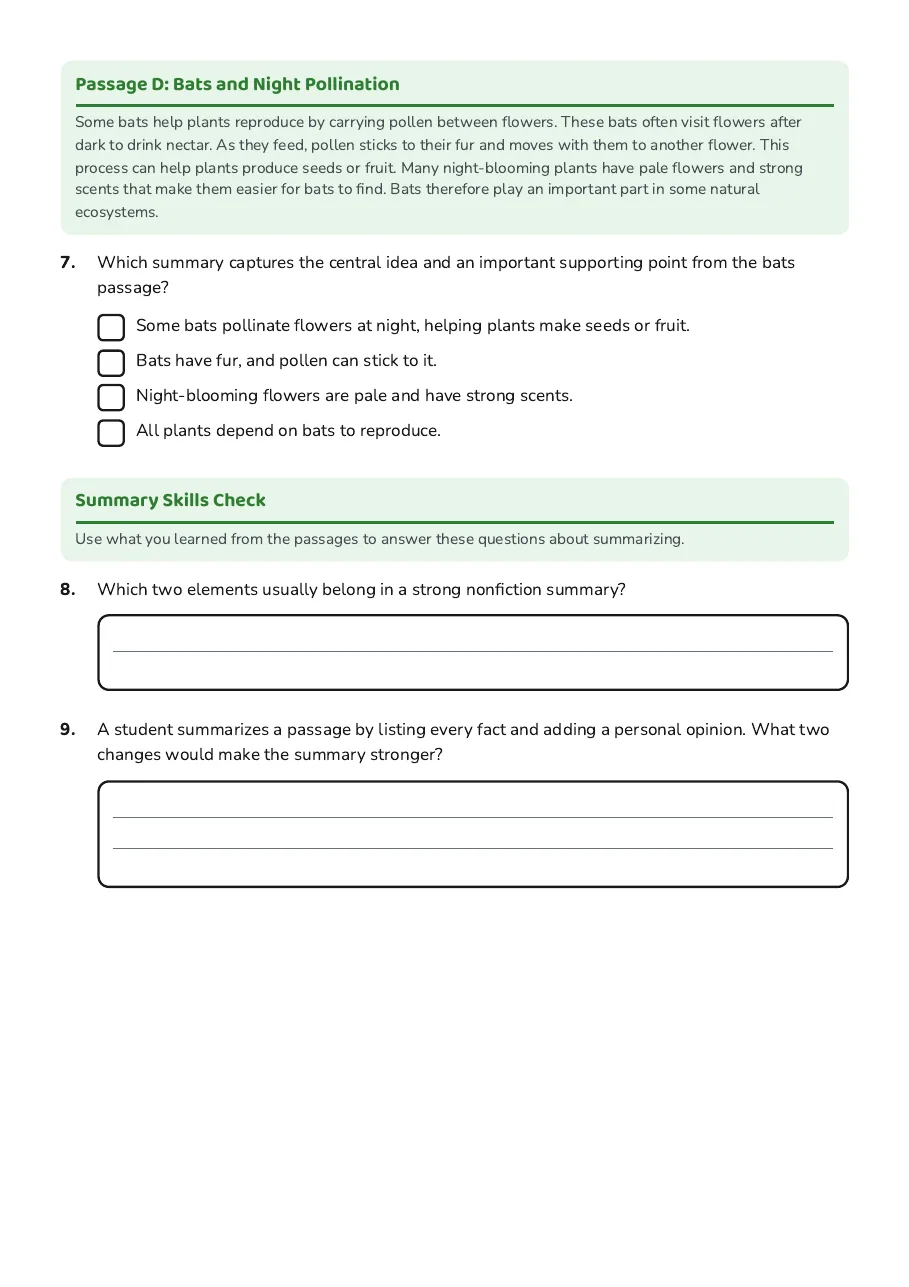
Passage D: Bats and Night Pollination
Some bats help plants reproduce by carrying pollen between flowers. These bats often visit flowers after dark to drink nectar. As they feed, pollen sticks to their fur and moves with them to another flower. This process can help plants produce seeds or fruit. Many night-blooming plants have pale flowers and strong scents that make them easier for bats to find. Bats therefore play an important part in some natural ecosystems.
- Some bats pollinate flowers at night, helping plants make seeds or fruit.
- Bats have fur, and pollen can stick to it.
- Night-blooming flowers are pale and have strong scents.
- All plants depend on bats to reproduce.
Summary Skills Check
Use what you learned from the passages to answer these questions about summarizing.
3 printable pages
Page 1
Page 2
Page 3
About This Worksheet
Free in Kuraplan
Sign up free, grab the PDF, and customize it for your class.
Print-Ready
Formatted for standard paper. Clean layout, easy to read.
AI-Generated
Created with Kuraplan's AI, designed for real classroom use.
For Teachers & Parents
Use in classrooms, for homework, tutoring, or homeschool.
Need a custom version of this worksheet?
Kuraplan's AI generates custom worksheets in seconds — differentiated for every learner, aligned to your curriculum.
Generate Custom Worksheets — Free