MathematicsFreePrintable

Number Properties Practice

A free mathematics worksheet ready for your classroom. Open in Kuraplan to grab the print-ready PDF, customize it for your students, or generate a fresh version in seconds.
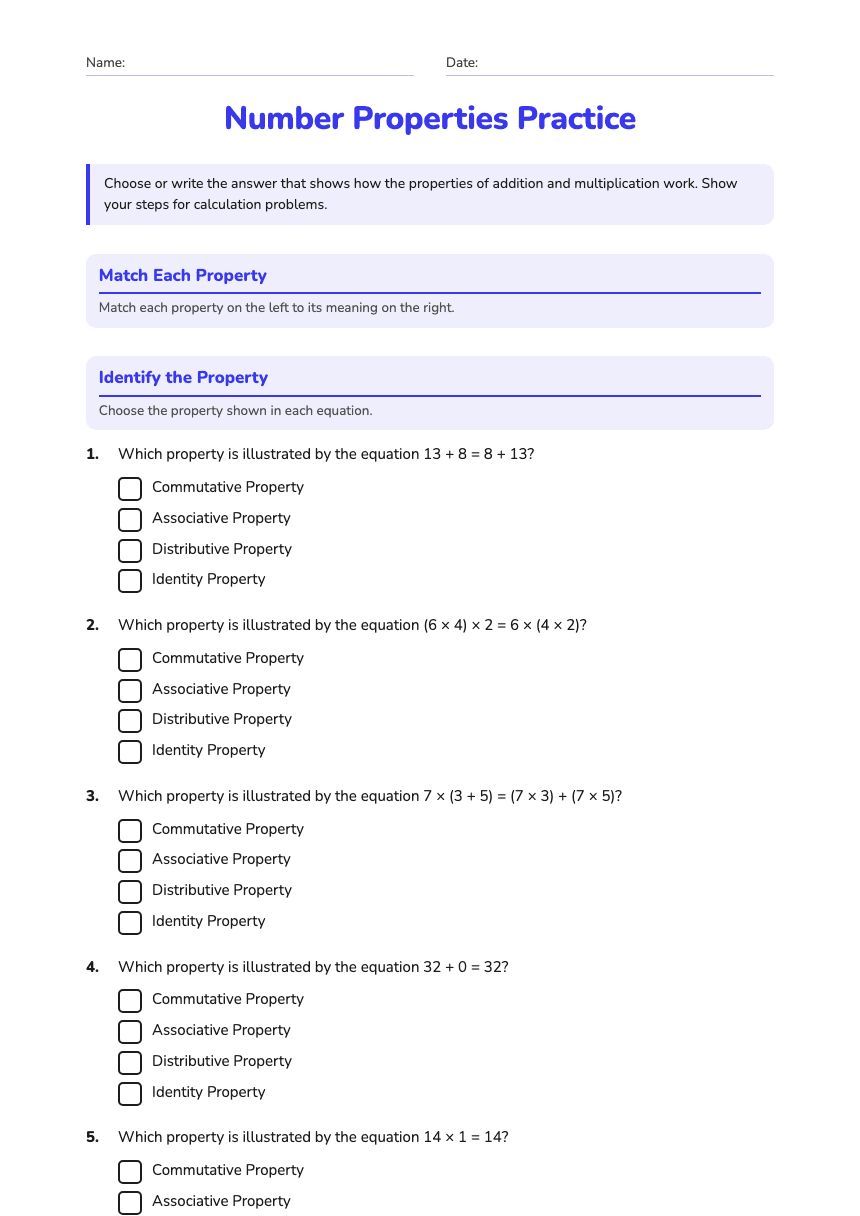
Number Properties Practice worksheet preview
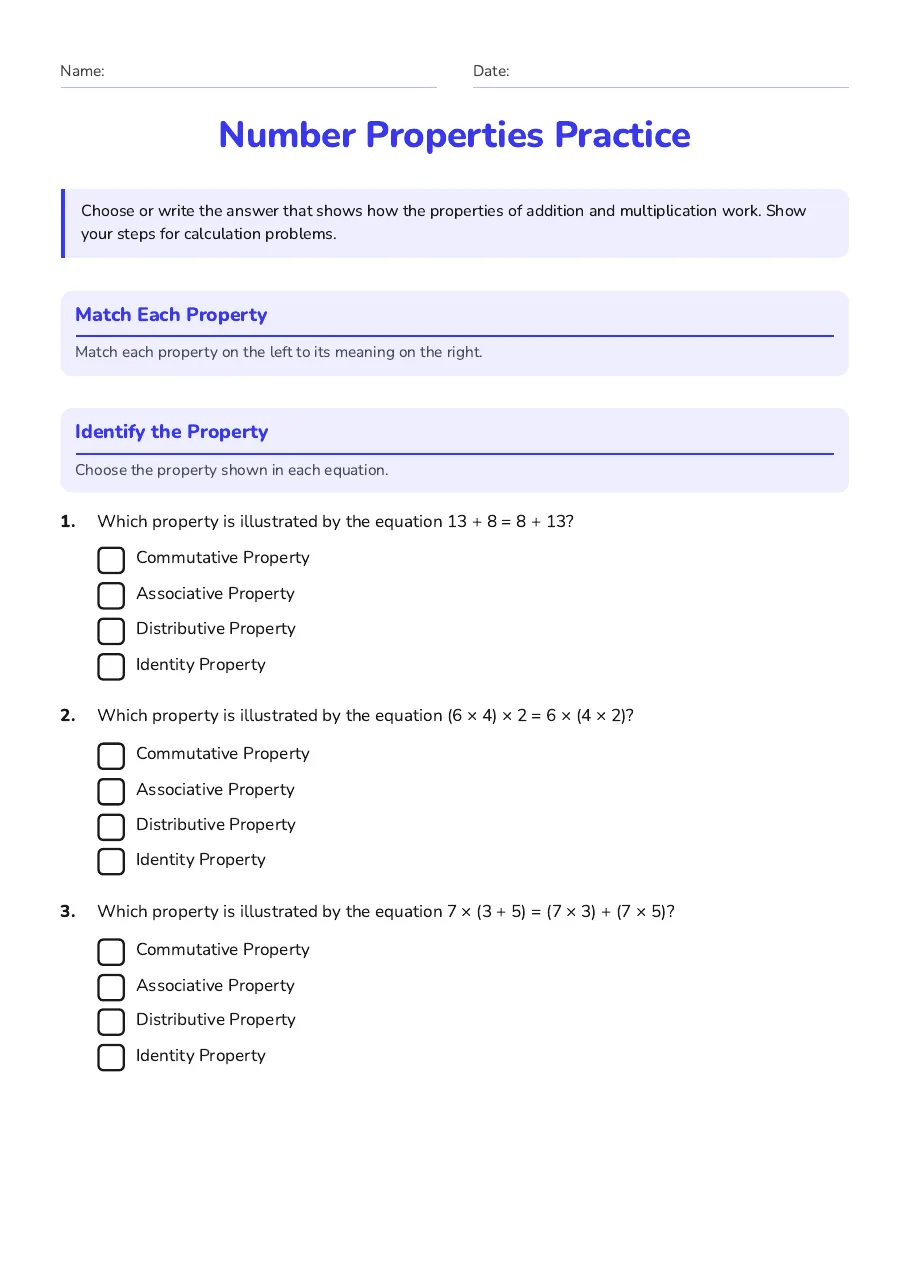
Name:Date:

Number Properties Practice

Choose or write the answer that shows how the properties of addition and multiplication work. Show your steps for calculation problems.

Match Each Property

Match each property on the left to its meaning on the right.

Identify the Property

Choose the property shown in each equation.

1.Which property is illustrated by the equation 13 + 8 = 8 + 13?
  • Commutative Property
  • Associative Property
  • Distributive Property
  • Identity Property
2.Which property is illustrated by the equation (6 × 4) × 2 = 6 × (4 × 2)?
  • Commutative Property
  • Associative Property
  • Distributive Property
  • Identity Property
3.Which property is illustrated by the equation 7 × (3 + 5) = (7 × 3) + (7 × 5)?
  • Commutative Property
  • Associative Property
  • Distributive Property
  • Identity Property
4.Which property is illustrated by the equation 32 + 0 = 32?
  • Commutative Property
  • Associative Property
  • Distributive Property
  • Identity Property
5.Which property is illustrated by the equation 14 × 1 = 14?
  • Commutative Property
  • Associative Property
  • Distributive Property
  • Identity Property

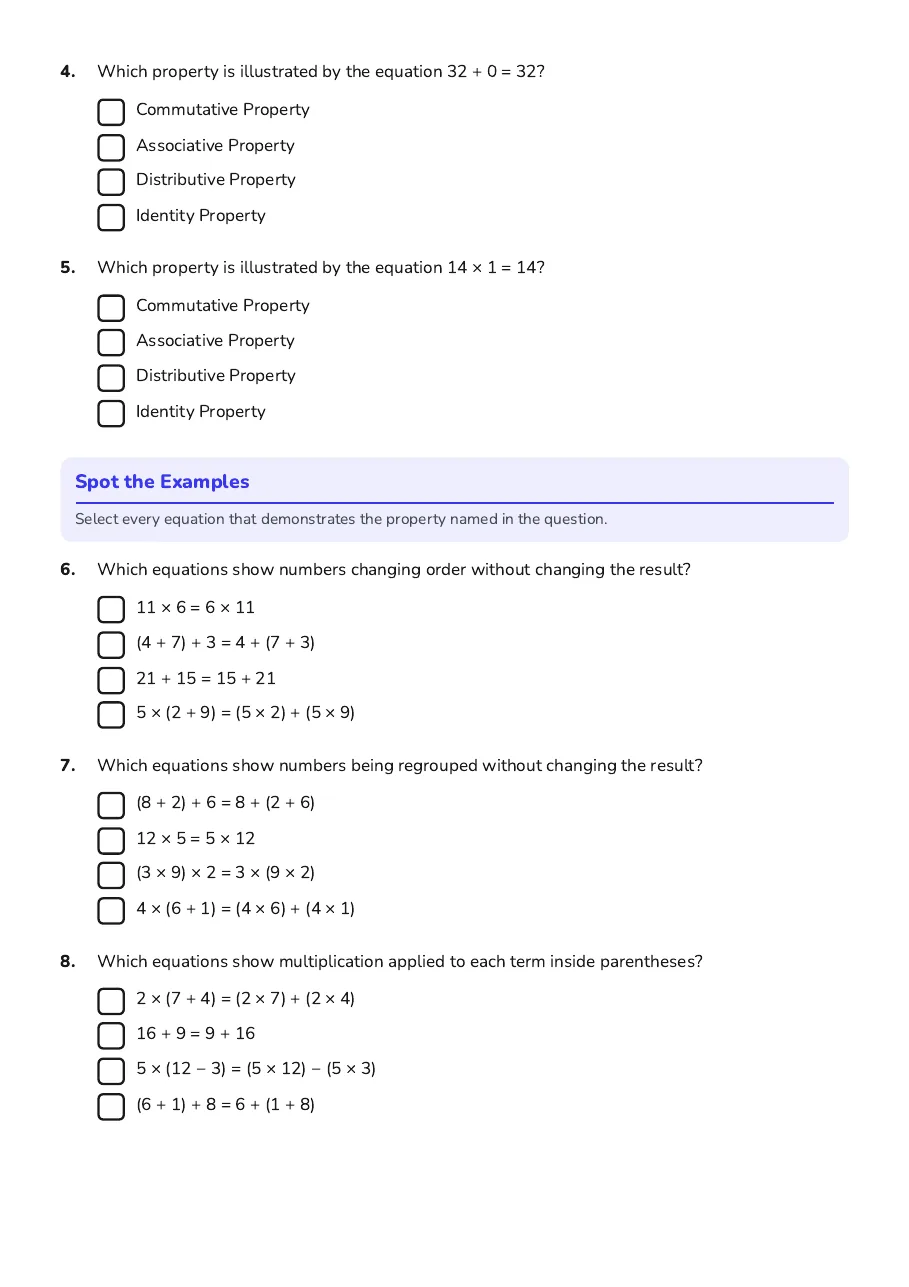
Spot the Examples

Select every equation that demonstrates the property named in the question.

6.Which equations show numbers changing order without changing the result?
  • 11 × 6 = 6 × 11
  • (4 + 7) + 3 = 4 + (7 + 3)
  • 21 + 15 = 15 + 21
  • 5 × (2 + 9) = (5 × 2) + (5 × 9)
7.Which equations show numbers being regrouped without changing the result?
  • (8 + 2) + 6 = 8 + (2 + 6)
  • 12 × 5 = 5 × 12
  • (3 × 9) × 2 = 3 × (9 × 2)
  • 4 × (6 + 1) = (4 × 6) + (4 × 1)
8.Which equations show multiplication applied to each term inside parentheses?
  • 2 × (7 + 4) = (2 × 7) + (2 × 4)
  • 16 + 9 = 9 + 16
  • 5 × (12 − 3) = (5 × 12) − (5 × 3)
  • (6 + 1) + 8 = 6 + (1 + 8)

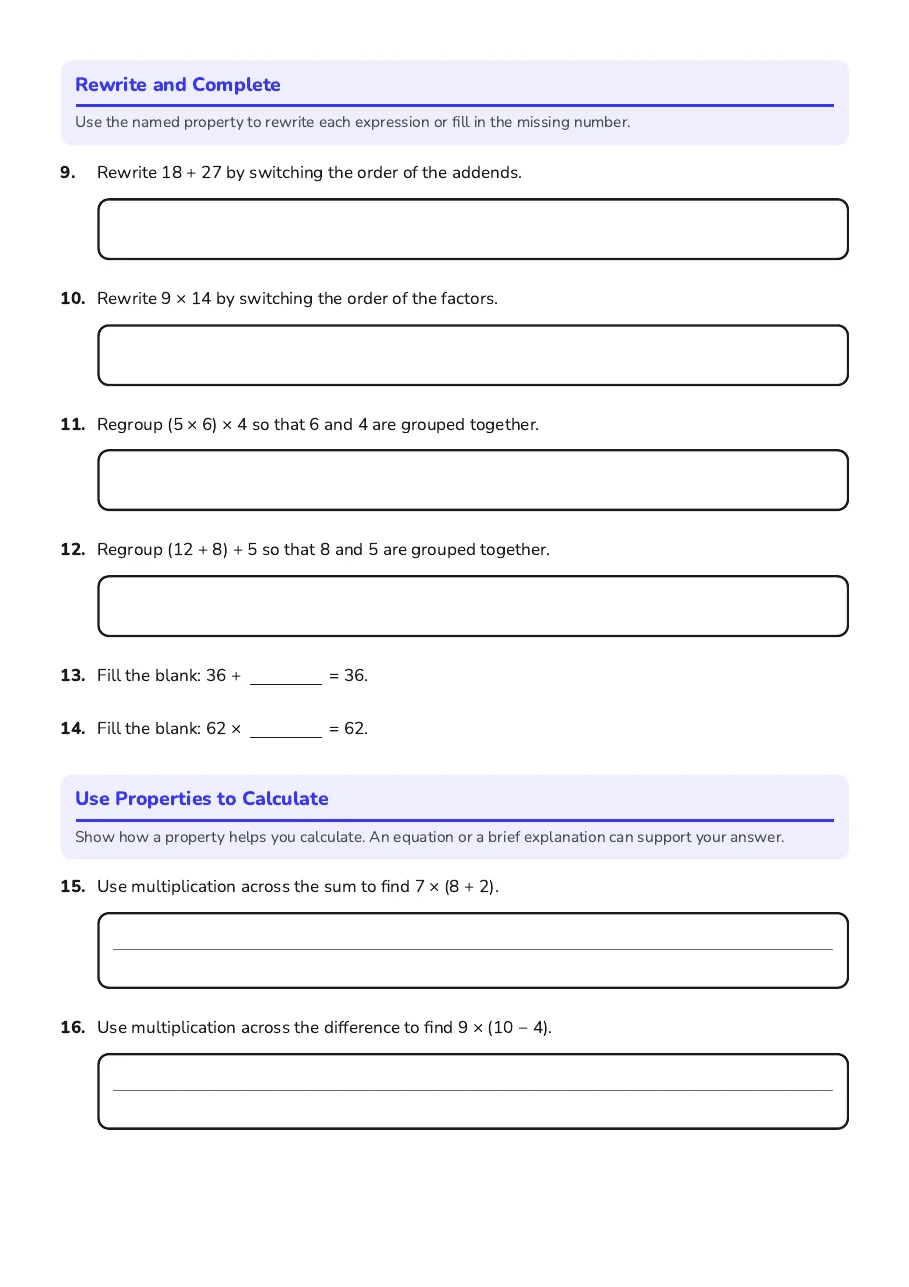
Rewrite and Complete

Use the named property to rewrite each expression or fill in the missing number.

9.Rewrite 18 + 27 by switching the order of the addends.
10.Rewrite 9 × 14 by switching the order of the factors.
11.Regroup (5 × 6) × 4 so that 6 and 4 are grouped together.
12.Regroup (12 + 8) + 5 so that 8 and 5 are grouped together.
13.Fill the blank: 36 + = 36.
14.Fill the blank: 62 × = 62.

Use Properties to Calculate

Show how a property helps you calculate. An equation or a brief explanation can support your answer.

15.Use multiplication across the sum to find 7 × (8 + 2).
16.Use multiplication across the difference to find 9 × (10 − 4).
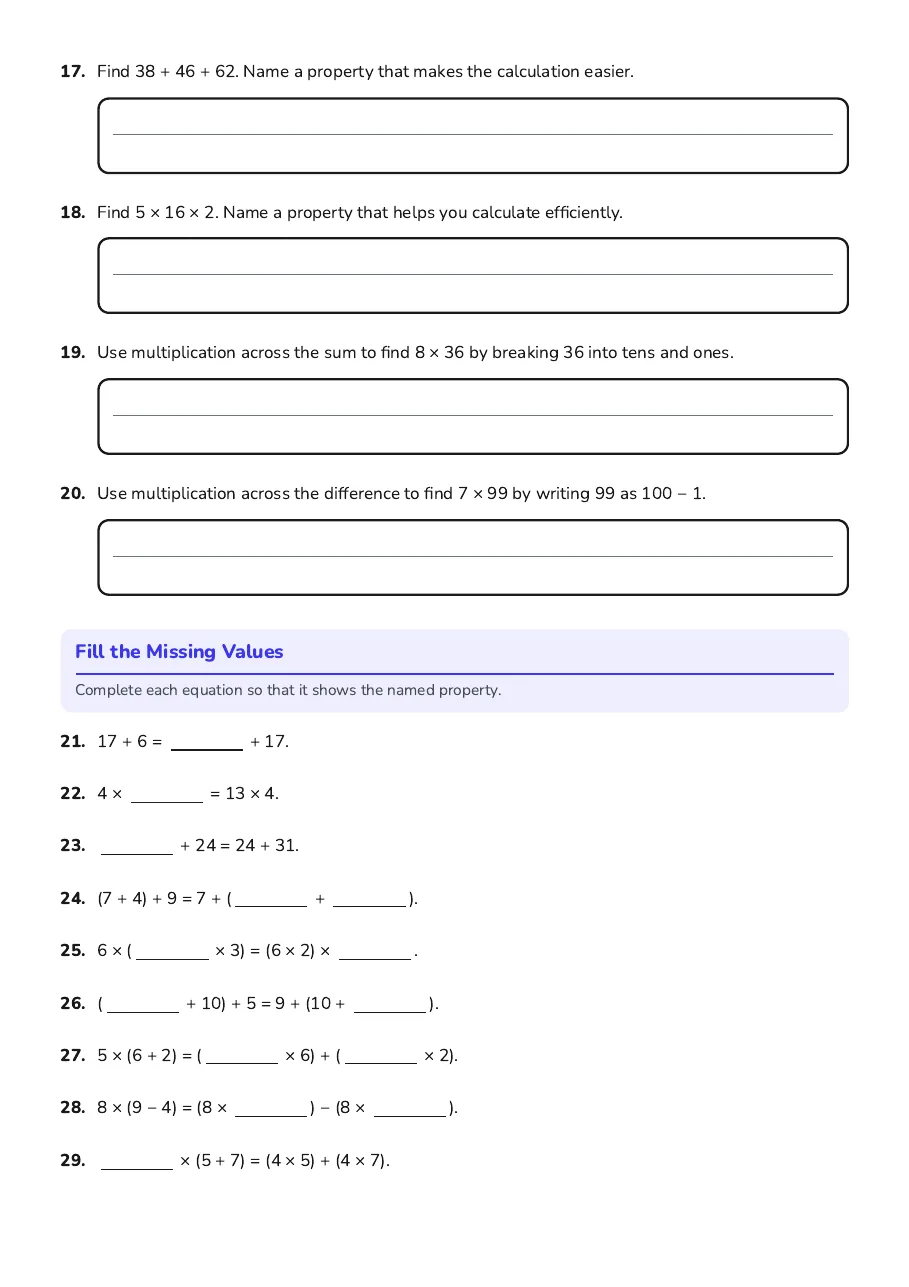
17.Find 38 + 46 + 62. Name a property that makes the calculation easier.
18.Find 5 × 16 × 2. Name a property that helps you calculate efficiently.
19.Use multiplication across the sum to find 8 × 36 by breaking 36 into tens and ones.
20.Use multiplication across the difference to find 7 × 99 by writing 99 as 100 − 1.

Fill the Missing Values

Complete each equation so that it shows the named property.

21.17 + 6 = + 17.
22.4 × = 13 × 4.
23. + 24 = 24 + 31.
24.(7 + 4) + 9 = 7 + ( + ).
25.6 × ( × 3) = (6 × 2) × .
26.( + 10) + 5 = 9 + (10 + ).
27.5 × (6 + 2) = ( × 6) + ( × 2).
28.8 × (9 − 4) = (8 × ) − (8 × ).
29. × (5 + 7) = (4 × 5) + (4 × 7).

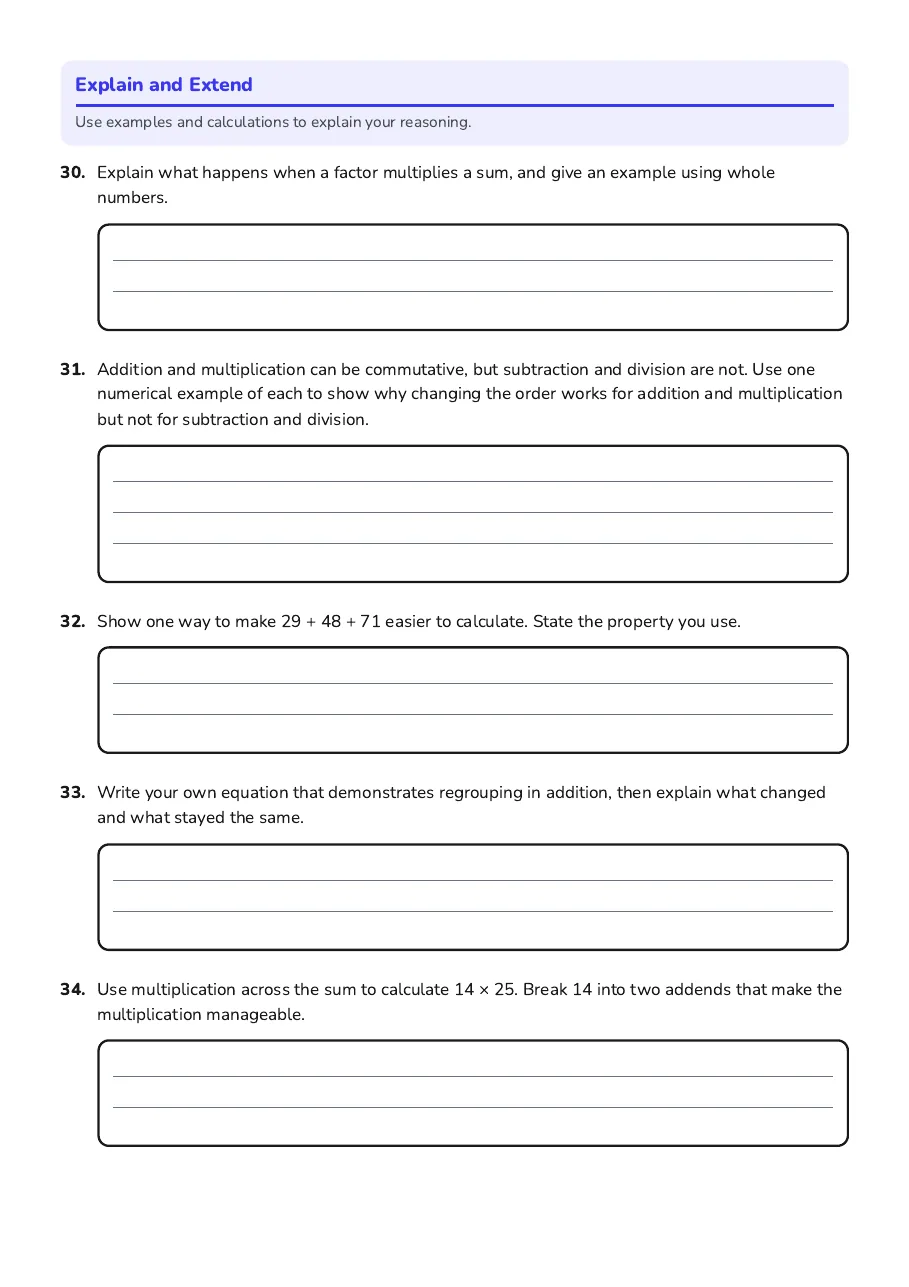
Explain and Extend

Use examples and calculations to explain your reasoning.

30.Explain what happens when a factor multiplies a sum, and give an example using whole numbers.
31.Addition and multiplication can be commutative, but subtraction and division are not. Use one numerical example of each to show why changing the order works for addition and multiplication but not for subtraction and division.
32.Show one way to make 29 + 48 + 71 easier to calculate. State the property you use.
33.Write your own equation that demonstrates regrouping in addition, then explain what changed and what stayed the same.
34.Use multiplication across the sum to calculate 14 × 25. Break 14 into two addends that make the multiplication manageable.
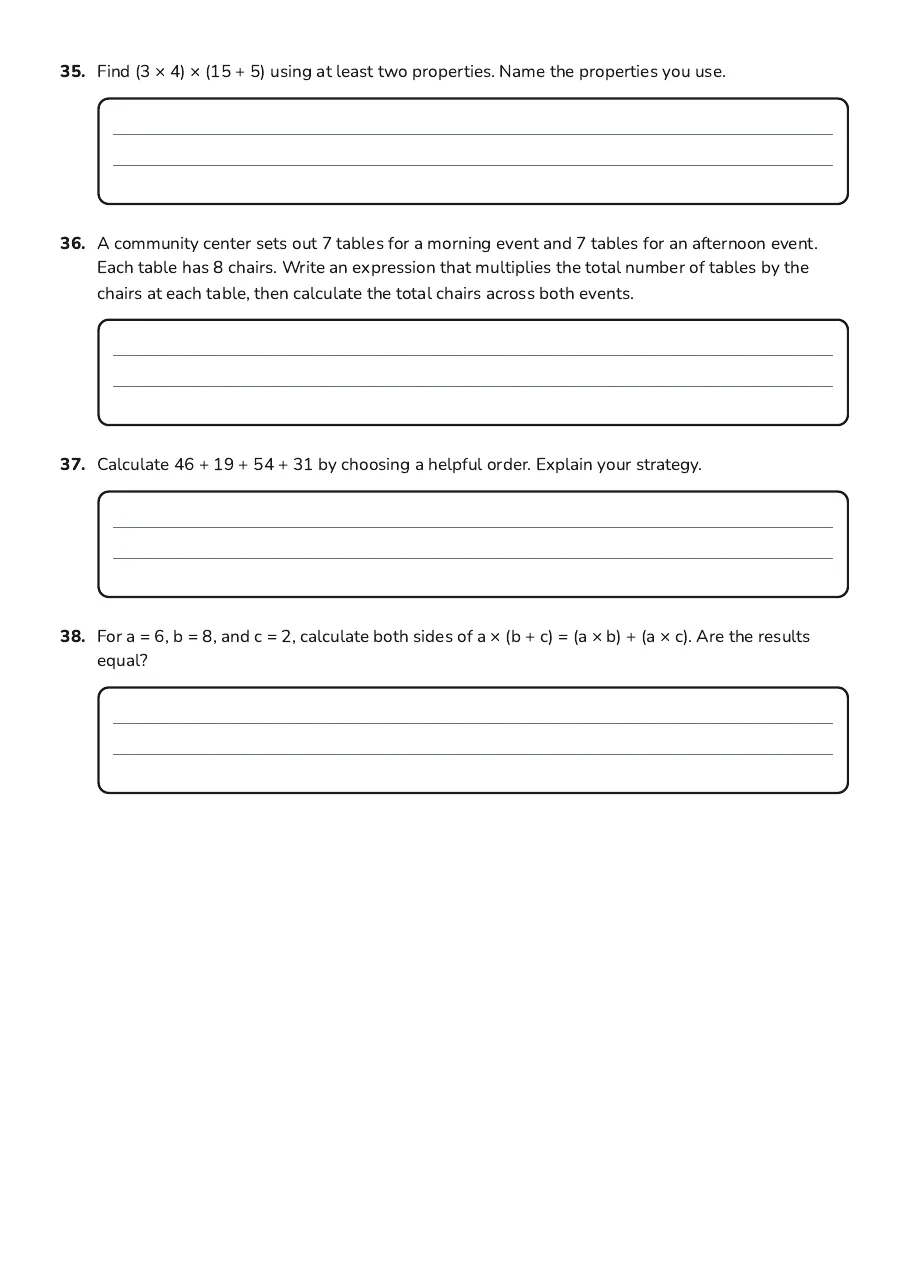
35.Find (3 × 4) × (15 + 5) using at least two properties. Name the properties you use.
36.A community center sets out 7 tables for a morning event and 7 tables for an afternoon event. Each table has 8 chairs. Write an expression that multiplies the total number of tables by the chairs at each table, then calculate the total chairs across both events.
37.Calculate 46 + 19 + 54 + 31 by choosing a helpful order. Explain your strategy.
38.For a = 6, b = 8, and c = 2, calculate both sides of a × (b + c) = (a × b) + (a × c). Are the results equal?

6 printable pages

  • Number Properties Practice, page 1 of 6: Match Each Property, Identify the Property

    Page 1

  • Number Properties Practice, page 2 of 6: Spot the Examples

    Page 2

  • Number Properties Practice, page 3 of 6: Rewrite and Complete, Use Properties to Calculate

    Page 3

  • Number Properties Practice, page 4 of 6: Fill the Missing Values

    Page 4

  • Number Properties Practice, page 5 of 6: Explain and Extend

    Page 5

  • Number Properties Practice, page 6 of 6: 35. Find (3 × 4) × (15 + 5) using at least two properties. Name the properties you use.

    Page 6

About This Worksheet

Free in Kuraplan

Sign up free, grab the PDF, and customize it for your class.

Print-Ready

Formatted for standard paper. Clean layout, easy to read.

AI-Generated

Created with Kuraplan's AI, designed for real classroom use.

For Teachers & Parents

Use in classrooms, for homework, tutoring, or homeschool.

Need a custom version of this worksheet?

Kuraplan's AI generates custom worksheets in seconds — differentiated for every learner, aligned to your curriculum.

Generate Custom Worksheets — Free
No credit card Curriculum-aligned Under 60 seconds