ScienceFreePrintable
Organism Classification Model Building
A free science worksheet ready for your classroom. Open in Kuraplan to grab the print-ready PDF, customize it for your students, or generate a fresh version in seconds.
Organism Classification Model Building
🔬 Part 1: Classification Criteria
1. Which characteristic would be MOST useful for grouping organisms scientifically?
Color of the organism
Size of the organism
Cell structure (prokaryotic vs. eukaryotic)
Geographic location where found
2. Select ALL characteristics that scientists commonly use to classify organisms:
How they obtain energy (photosynthesis vs. consuming food)
Number of cells (unicellular vs. multicellular)
Personal preference of the scientist
Presence or absence of a backbone
Type of reproduction (sexual vs. asexual)
3. Why do scientists use a standardized classification system instead of each scientist creating their own?
It makes science more complicated
It allows scientists worldwide to communicate clearly about organisms
It reduces the number of organisms that need to be studied
It makes classification faster
4. Complete the sentence: Organisms with similar _____________ are grouped together because they likely share common evolutionary _____________.
Organisms with similar _____________ are grouped together because they likely share common evolutionary _____________.
🌿 Part 2: Building Your Classification Model
5. You have been given these six organisms to classify: Oak Tree, Mushroom, Goldfish, Butterfly, E. coli bacteria, and Green Algae. List THREE scientific criteria you would use to group these organisms:
6. Using your criteria from question 5, create a classification model by grouping the organisms. Draw your model in the space below and label each group with the characteristic(s) they share:
7. Explain your reasoning: Why did you place the Oak Tree and Green Algae in the same or different groups? Use scientific vocabulary in your explanation.
8. How does your classification model help other scientists understand the relationships between these organisms?
🧬 Part 3: Reflection and Application
9. If you discovered a new organism that makes its own food using sunlight but has no cell walls, which existing group from your model would it fit into? Explain your reasoning.
10. Describe one way that understanding organism classification is important in real-world applications (medicine, agriculture, conservation, etc.):
About This Worksheet
Free in Kuraplan
Sign up free, grab the PDF, and customize it for your class.
Print-Ready
Formatted for standard paper. Clean layout, easy to read.
AI-Generated
Created with Kuraplan's AI, designed for real classroom use.
For Teachers & Parents
Use in classrooms, for homework, tutoring, or homeschool.
Need a custom version of this worksheet?
Kuraplan's AI generates custom worksheets in seconds — differentiated for every learner, aligned to your curriculum.
Generate Custom Worksheets — Free No credit card Curriculum-aligned Under 60 seconds
More Science Worksheets
9th Grade
Cell Structure and Function
Free
10th Grade
Photosynthesis Investigation Worksheet
Free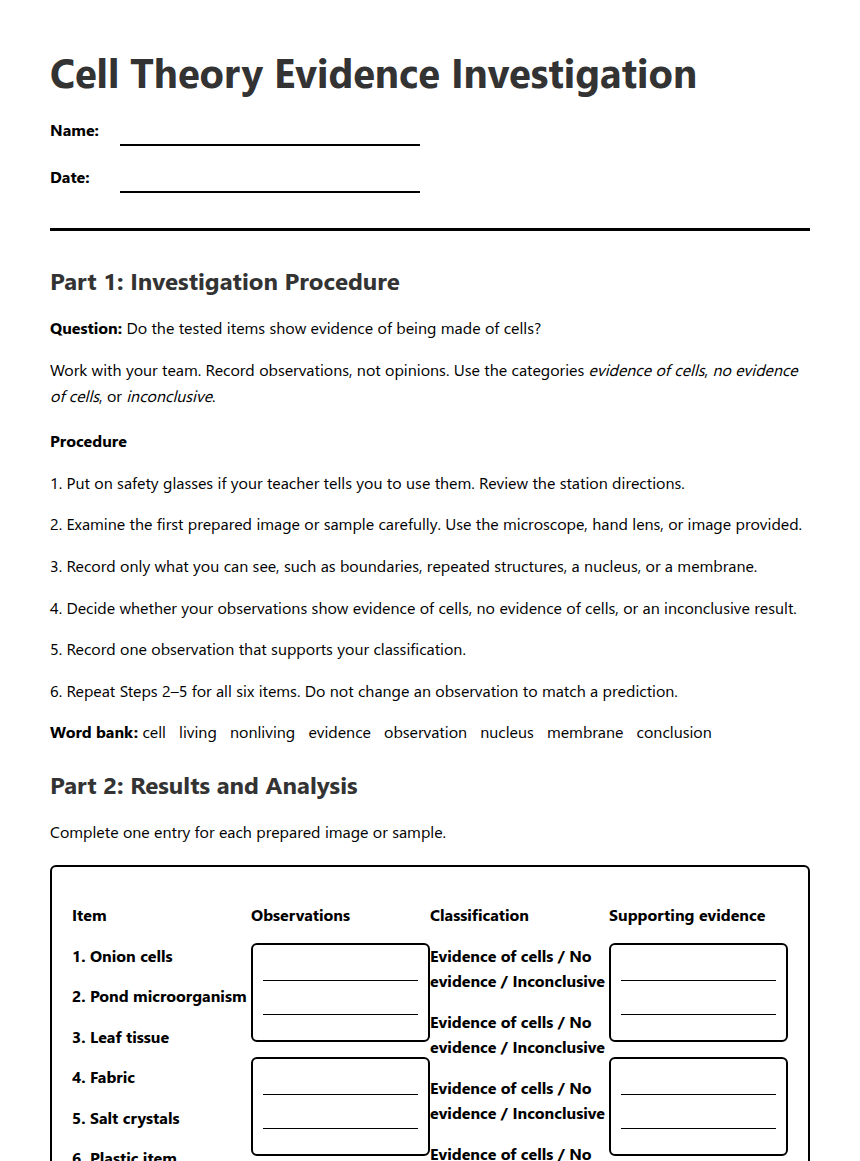
7th Grade
Cell Theory Evidence Investigation
Free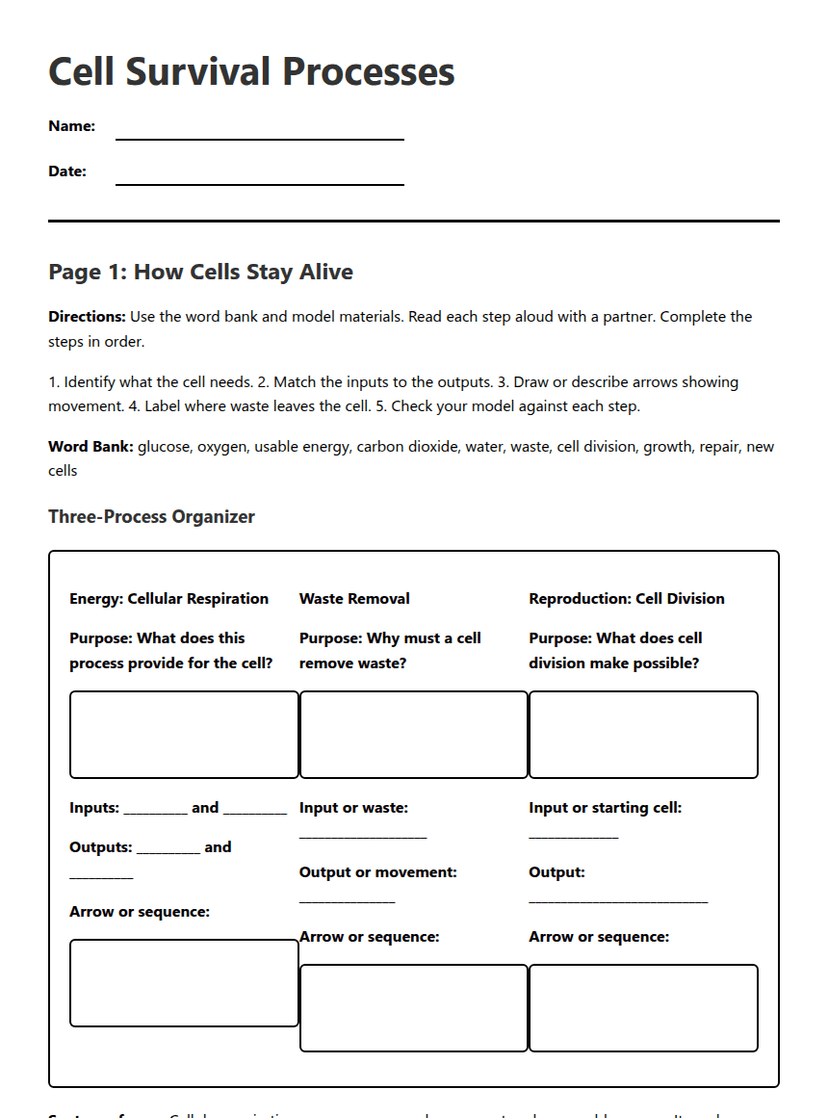
7th Grade
Cell Survival Processes
Free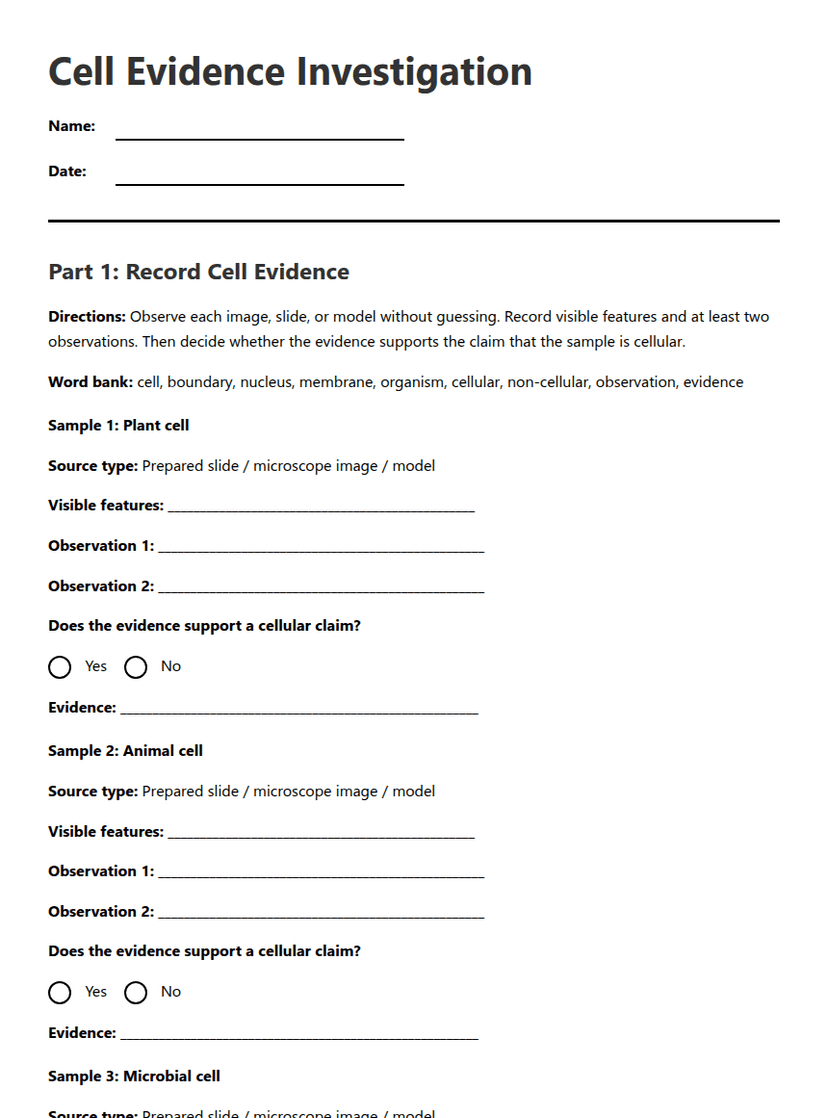
7th Grade
Cell Evidence Investigation
Free
7th Grade
Cell Theory Evidence Map
Free
7th Grade
Living or Nonliving?
Free
10th Grade