Revolutionary Events Timeline
A free english (ela) worksheet ready for your classroom. Open in Kuraplan to grab the print-ready PDF, customize it for your students, or generate a fresh version in seconds.
Revolutionary Events Timeline
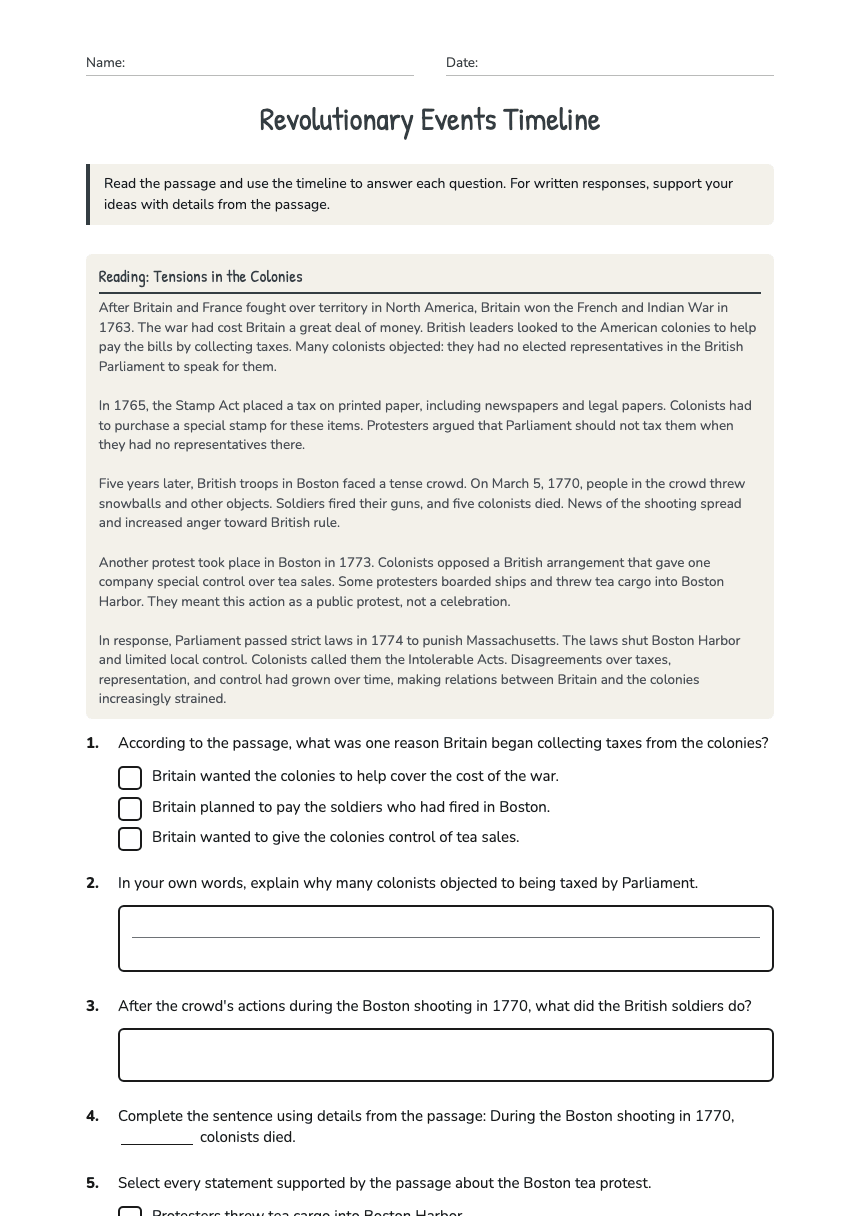
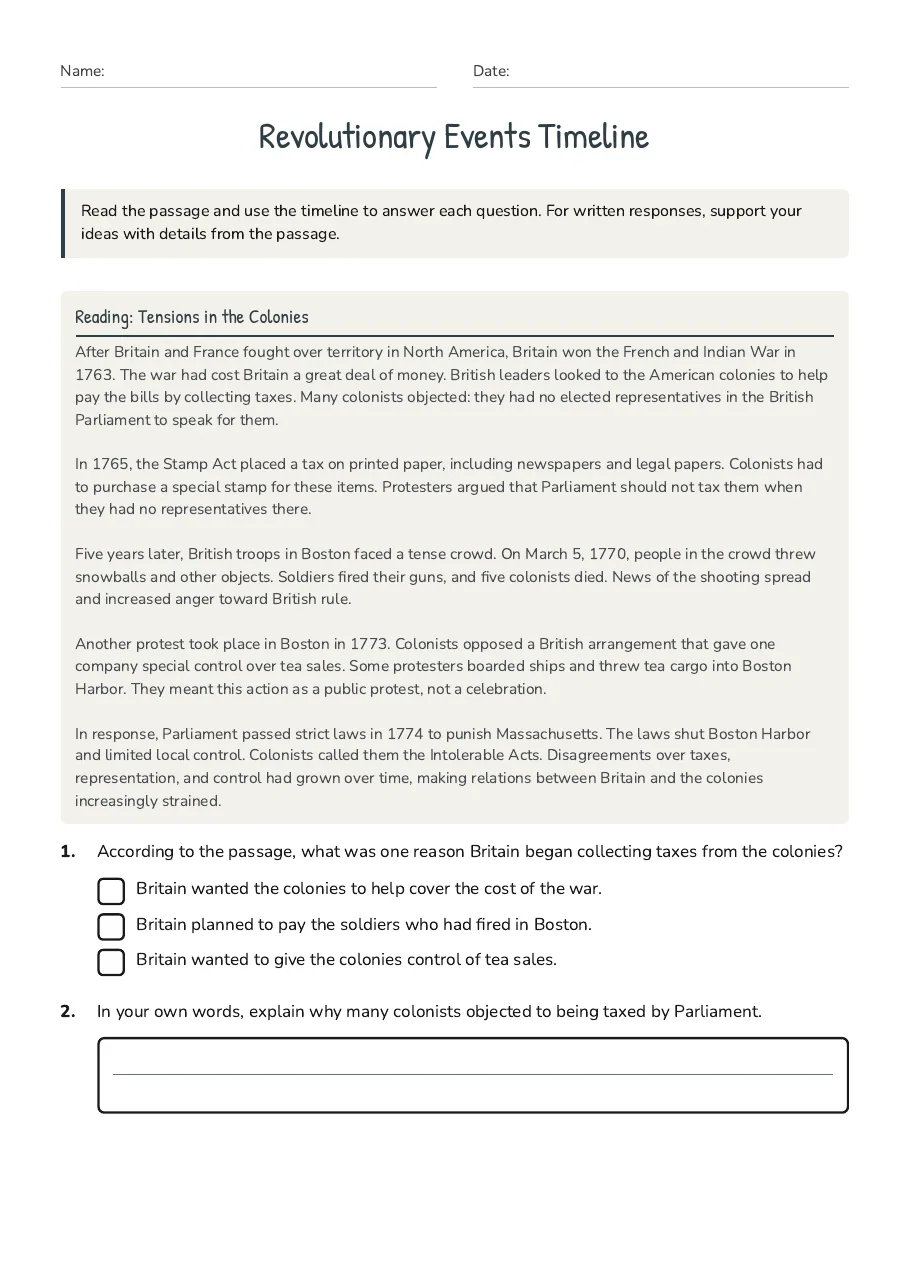
Reading: Tensions in the Colonies
After Britain and France fought over territory in North America, Britain won the French and Indian War in 1763. The war had cost Britain a great deal of money. British leaders looked to the American colonies to help pay the bills by collecting taxes. Many colonists objected: they had no elected representatives in the British Parliament to speak for them. In 1765, the Stamp Act placed a tax on printed paper, including newspapers and legal papers. Colonists had to purchase a special stamp for these items. Protesters argued that Parliament should not tax them when they had no representatives there. Five years later, British troops in Boston faced a tense crowd. On March 5, 1770, people in the crowd threw snowballs and other objects. Soldiers fired their guns, and five colonists died. News of the shooting spread and increased anger toward British rule. Another protest took place in Boston in 1773. Colonists opposed a British arrangement that gave one company special control over tea sales. Some protesters boarded ships and threw tea cargo into Boston Harbor. They meant this action as a public protest, not a celebration. In response, Parliament passed strict laws in 1774 to punish Massachusetts. The laws shut Boston Harbor and limited local control. Colonists called them the Intolerable Acts. Disagreements over taxes, representation, and control had grown over time, making relations between Britain and the colonies increasingly strained.
- Britain wanted the colonies to help cover the cost of the war.
- Britain planned to pay the soldiers who had fired in Boston.
- Britain wanted to give the colonies control of tea sales.
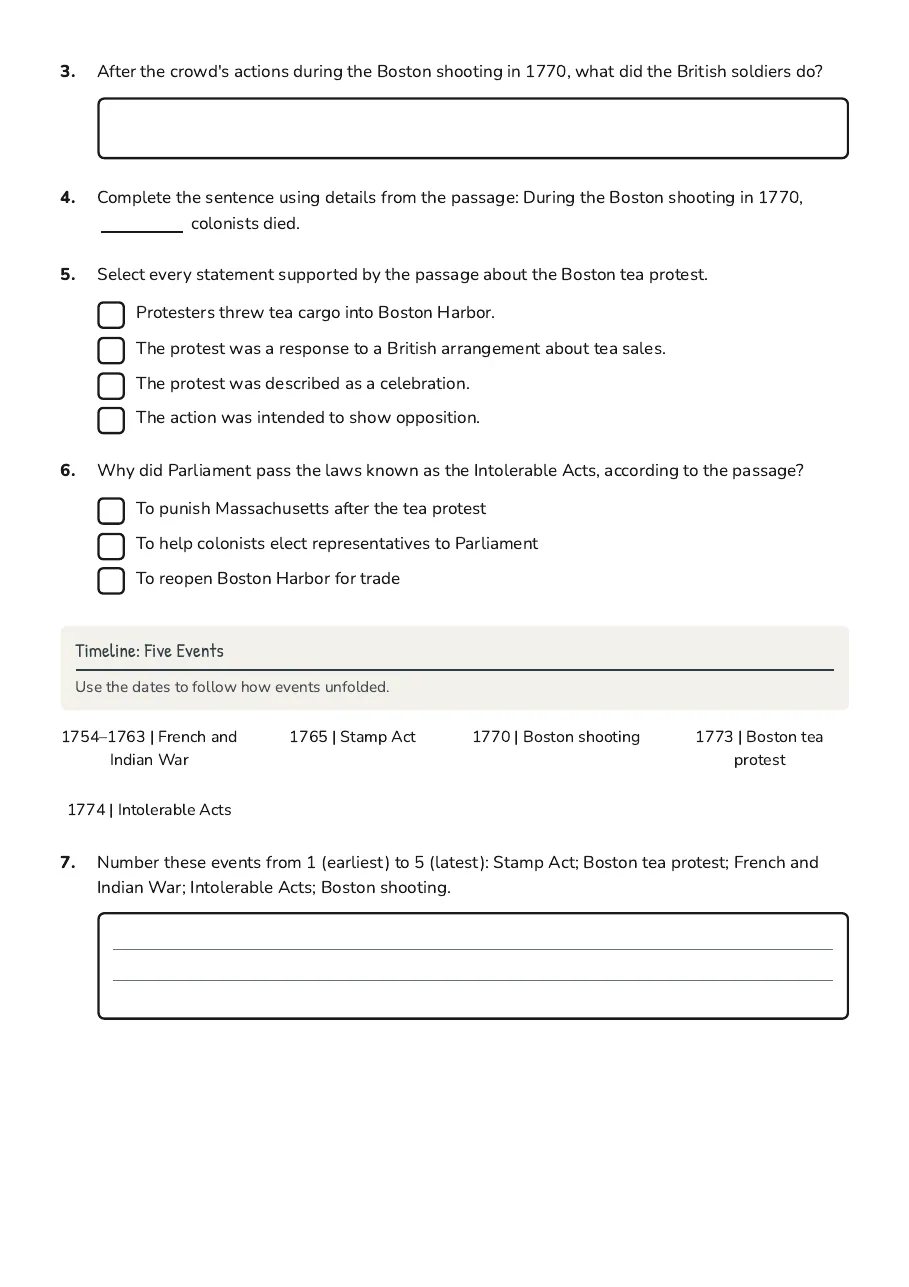
- Protesters threw tea cargo into Boston Harbor.
- The protest was a response to a British arrangement about tea sales.
- The protest was described as a celebration.
- The action was intended to show opposition.
- To punish Massachusetts after the tea protest
- To help colonists elect representatives to Parliament
- To reopen Boston Harbor for trade
Timeline: Five Events
Use the dates to follow how events unfolded.
1754–1763 | French and Indian War
1765 | Stamp Act
1770 | Boston shooting
1773 | Boston tea protest
1774 | Intolerable Acts
3 printable pages
Page 1
Page 2
Page 3
About This Worksheet
Free in Kuraplan
Sign up free, grab the PDF, and customize it for your class.
Print-Ready
Formatted for standard paper. Clean layout, easy to read.
AI-Generated
Created with Kuraplan's AI, designed for real classroom use.
For Teachers & Parents
Use in classrooms, for homework, tutoring, or homeschool.
Need a custom version of this worksheet?
Kuraplan's AI generates custom worksheets in seconds — differentiated for every learner, aligned to your curriculum.
Generate Custom Worksheets — Free