Spanish Era Analysis Guide
A free social studies worksheet ready for your classroom. Open in Kuraplan to grab the print-ready PDF, customize it for your students, or generate a fresh version in seconds.
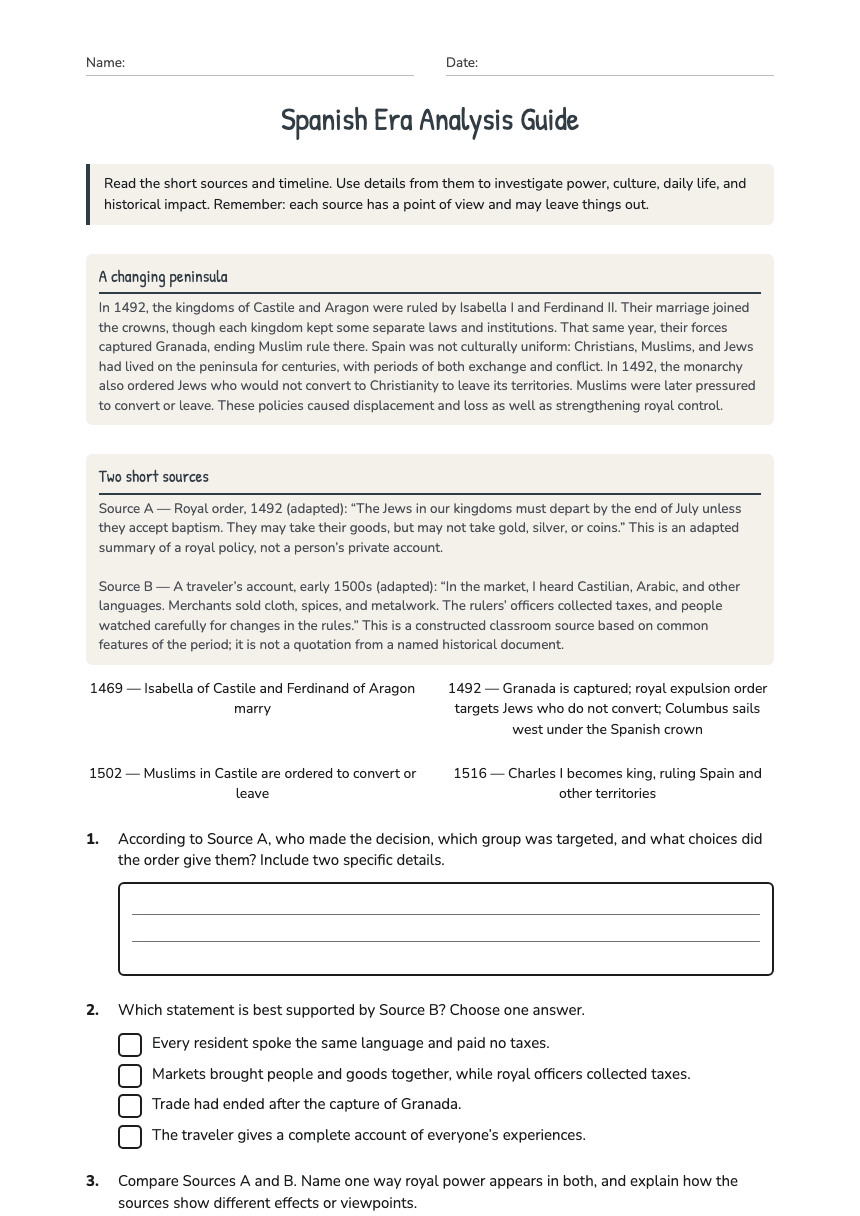
Spanish Era Analysis Guide
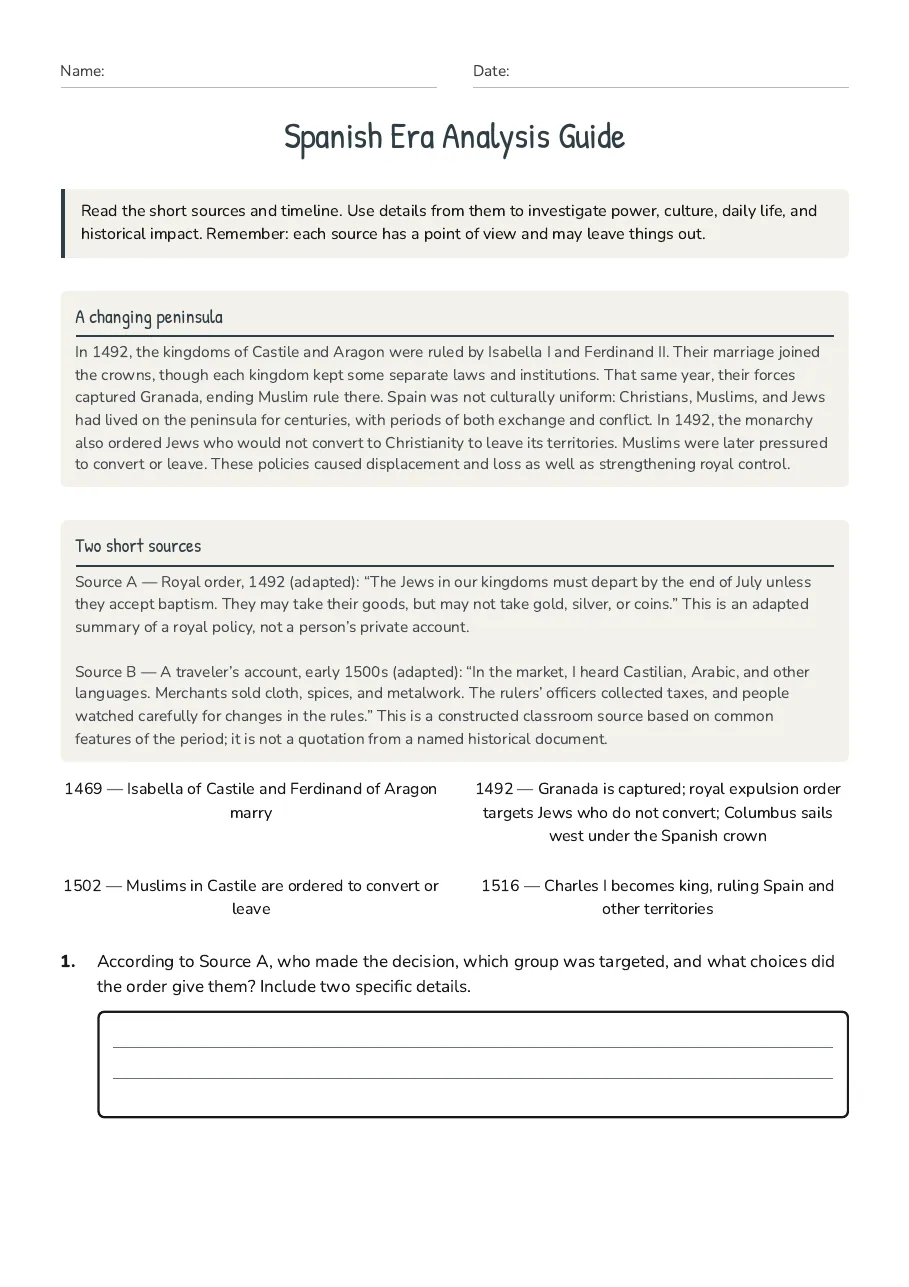
A changing peninsula
In 1492, the kingdoms of Castile and Aragon were ruled by Isabella I and Ferdinand II. Their marriage joined the crowns, though each kingdom kept some separate laws and institutions. That same year, their forces captured Granada, ending Muslim rule there. Spain was not culturally uniform: Christians, Muslims, and Jews had lived on the peninsula for centuries, with periods of both exchange and conflict. In 1492, the monarchy also ordered Jews who would not convert to Christianity to leave its territories. Muslims were later pressured to convert or leave. These policies caused displacement and loss as well as strengthening royal control.
Two short sources
Source A — Royal order, 1492 (adapted): “The Jews in our kingdoms must depart by the end of July unless they accept baptism. They may take their goods, but may not take gold, silver, or coins.” This is an adapted summary of a royal policy, not a person’s private account. Source B — A traveler’s account, early 1500s (adapted): “In the market, I heard Castilian, Arabic, and other languages. Merchants sold cloth, spices, and metalwork. The rulers’ officers collected taxes, and people watched carefully for changes in the rules.” This is a constructed classroom source based on common features of the period; it is not a quotation from a named historical document.
1469 — Isabella of Castile and Ferdinand of Aragon marry
1492 — Granada is captured; royal expulsion order targets Jews who do not convert; Columbus sails west under the Spanish crown
1502 — Muslims in Castile are ordered to convert or leave
1516 — Charles I becomes king, ruling Spain and other territories
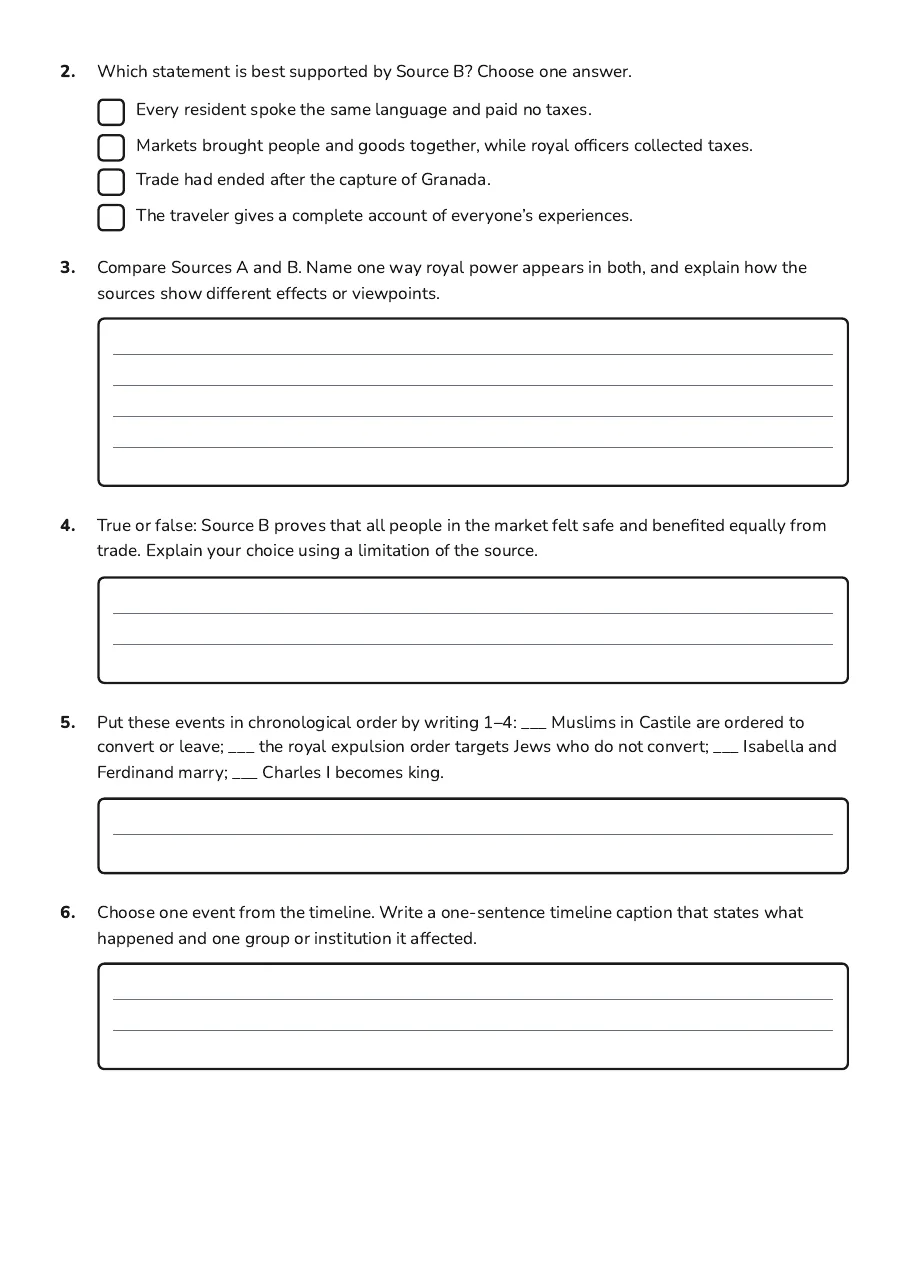
- Every resident spoke the same language and paid no taxes.
- Markets brought people and goods together, while royal officers collected taxes.
- Trade had ended after the capture of Granada.
- The traveler gives a complete account of everyone’s experiences.
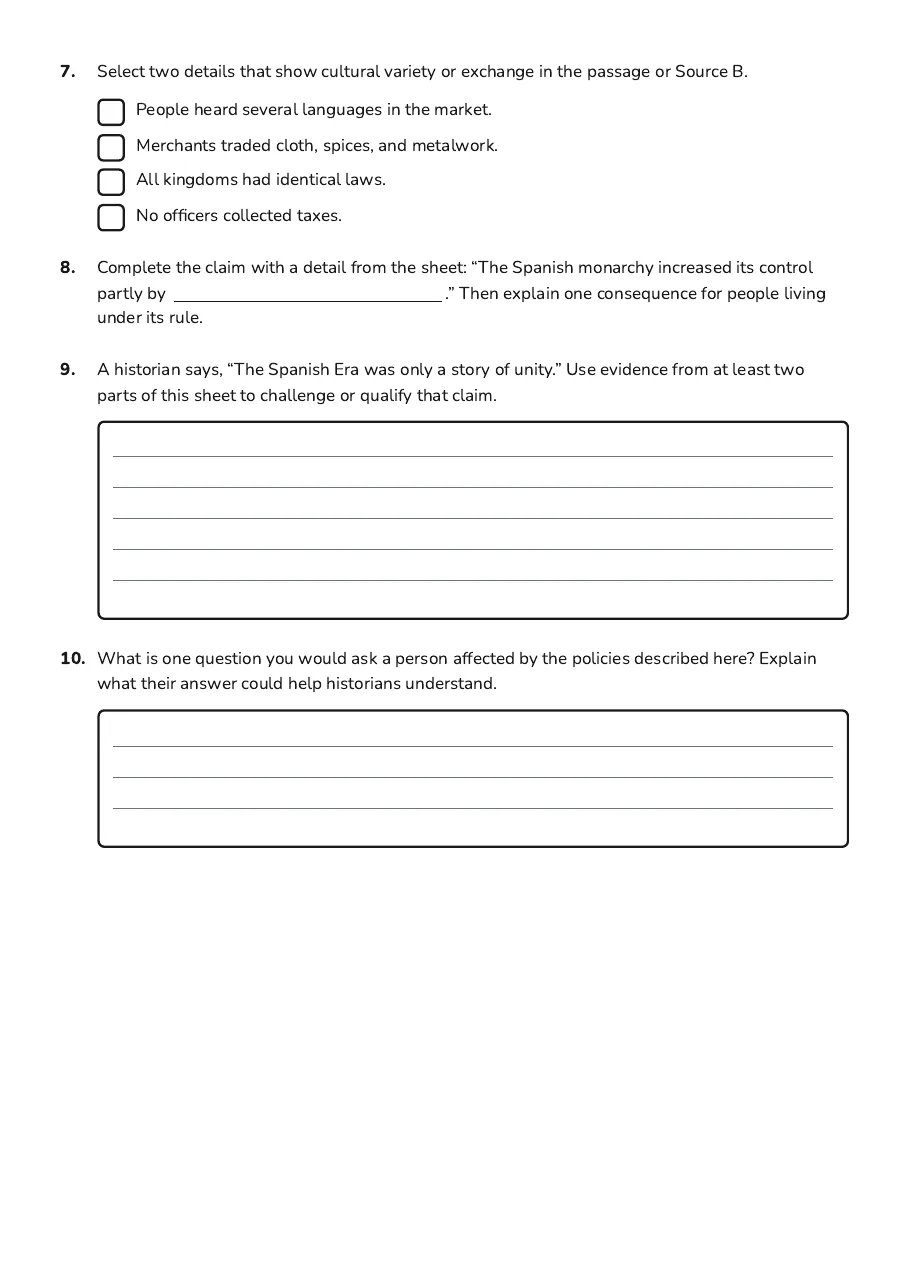
- People heard several languages in the market.
- Merchants traded cloth, spices, and metalwork.
- All kingdoms had identical laws.
- No officers collected taxes.
3 printable pages
Page 1
Page 2
Page 3
About This Worksheet
Free in Kuraplan
Sign up free, grab the PDF, and customize it for your class.
Print-Ready
Formatted for standard paper. Clean layout, easy to read.
AI-Generated
Created with Kuraplan's AI, designed for real classroom use.
For Teachers & Parents
Use in classrooms, for homework, tutoring, or homeschool.
Need a custom version of this worksheet?
Kuraplan's AI generates custom worksheets in seconds — differentiated for every learner, aligned to your curriculum.
Generate Custom Worksheets — Free