The Secret Life of Soil Annotation Check
A free english (ela) worksheet ready for your classroom. Open in Kuraplan to grab the print-ready PDF, customize it for your students, or generate a fresh version in seconds.
The Secret Life of Soil Annotation Check
📖 Read and Annotate
How to annotate: Follow each bracketed direction as you read. Underline important information. Circle unfamiliar or domain-specific words and use context clues to think about their meanings. Write a short margin note that tells the main idea of each paragraph. Write “?” beside information that is confusing or makes you wonder something.
Remember: Complete every prompt in brackets. Keep your margin notes short—about 3–5 words.
The Secret Life of Soil
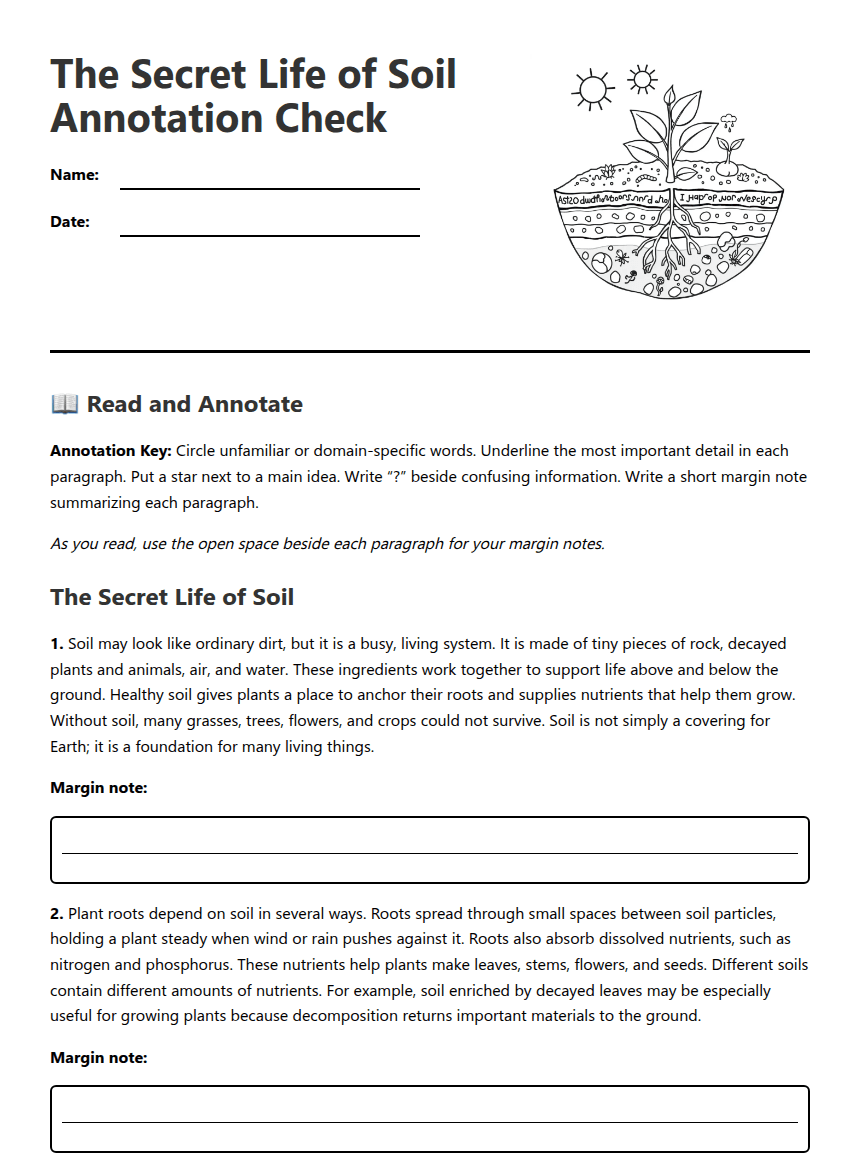
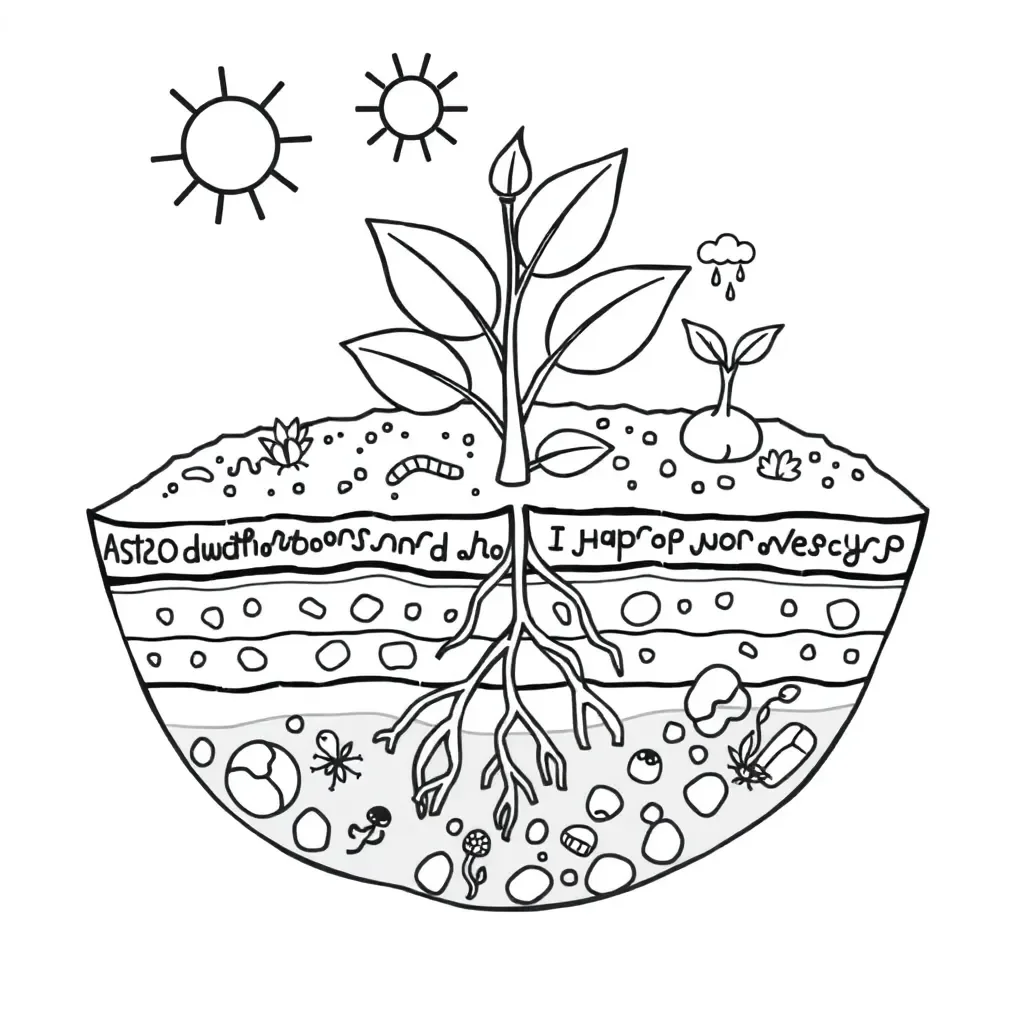
1. Soil may look like ordinary dirt, but it is a busy, living system. It is made of tiny pieces of rock, decayed plants and animals, air, and water. These ingredients work together to support life above and below the ground. Healthy soil gives plants a place to anchor their roots and supplies nutrients that help them grow. Without soil, many grasses, trees, flowers, and crops could not survive. Soil is not simply a covering for Earth; it is a foundation for many living things. [Underline the sentence that tells why soil is important.] [Circle one word that may be unfamiliar, such as nutrients or foundation.] [Write a 3–5 word margin note stating the main idea.]
Margin note:
2. Plant roots depend on soil in several ways. Roots spread through small spaces between soil particles, holding a plant steady when wind or rain pushes against it. Roots also absorb dissolved nutrients, such as nitrogen and phosphorus. These nutrients help plants make leaves, stems, flowers, and seeds. Different soils contain different amounts of nutrients. For example, soil enriched by decayed leaves may be especially useful for growing plants because decomposition returns important materials to the ground. [Underline one detail that explains how soil helps plant roots.] [Circle one piece of evidence that shows why nutrients are important.] [Write a 3–5 word margin note stating the main idea.]
Margin note:
3. Soil also acts like a storage system for water. When rain falls, some water moves into spaces between soil particles. Plant roots can later take in this stored water during dry periods. Soil with plenty of organic matter, such as compost or decayed leaves, can hold more water than soil made mostly of sand. However, soil must have spaces large enough for extra water to drain away. If soil becomes packed tightly, water and air cannot move easily, and roots may struggle to stay healthy. [Underline the sentence that explains how soil stores water.] [Circle the word organic or another word you want to figure out from context.] [Write a 3–5 word margin note stating the main idea.] [Write “?” beside any part that is confusing.]
Margin note:
4. Beneath our feet, soil provides habitats for countless organisms. Earthworms tunnel through the ground, creating pathways for air and water. Tiny fungi and bacteria break down dead materials and return nutrients to the soil. Insects, mites, and other small creatures also live among the particles. Each organism has a role in this underground community. Because decomposers break down dead plants and animals, nutrients become available for new plant growth. This process connects the living and nonliving parts of an ecosystem. [Underline the detail that explains what decomposers do.] [Circle one domain-specific word, such as organisms, decomposers, or ecosystem.] [Write a 3–5 word margin note stating the main idea.]
Margin note:
5. People can protect soil by keeping it covered with plants, adding compost, and avoiding unnecessary digging or compaction. Plant roots hold soil in place, so they help prevent erosion when wind or rain occurs. Compost adds organic matter, which improves the soil’s ability to store water and support organisms. When people care for soil, plants receive better growing conditions and underground habitats remain healthy. The secret life of soil reminds us that even the ground beneath us is part of a connected system. [Underline one action people can take to protect soil.] [Circle one piece of evidence that shows why protecting soil matters.] [Write a 3–5 word margin note stating the main idea.]
Margin note:
✏️ Show Your Thinking
Answer using complete sentences and evidence from the passage. Use your annotations to help you.
Skills assessed: CCSS.ELA-LITERACY.RI.5.2, RI.5.3, and RI.5.4
🔑 Teacher Answer Key and Rubric
Expected Annotations
Paragraph 1: Main idea—soil is a living system and foundation for life. Students should underline the sentence explaining that soil is a foundation for many living things. Possible circled terms: nutrients or foundation.
Paragraph 2: Main idea—soil supports roots by anchoring plants and providing nutrients. Students may underline that roots absorb nutrients or that nutrients help plants make leaves, stems, flowers, and seeds. Students should circle evidence showing how nutrients help plants.
Paragraph 3: Main idea—soil stores and drains water in ways that affect plant health. Students may underline that plant roots can take in stored water during dry periods. Possible circled term: organic. Students may write a question about water storage, drainage, or packed soil.
Paragraph 4: Main idea—soil is a habitat for organisms that help recycle nutrients. Students should underline that decomposers break down dead plants and animals and make nutrients available for new plant growth. Possible circled terms: decomposers, organisms, or ecosystem.
Paragraph 5: Main idea—people can protect soil, which helps plants and underground habitats. Students may underline keeping soil covered with plants, adding compost, or avoiding compaction. They should circle evidence explaining how these actions help soil.
Acceptable Responses
1. Answers should state two accurate main ideas and connect each to a relevant detail. Examples include soil supports plant growth because it anchors roots and supplies nutrients; soil provides habitats because worms, fungi, bacteria, and insects live in it.
2. A strong summary explains that soil is a living system that supports plants, stores water, and provides habitats. It may also explain that organisms recycle nutrients and people can protect soil.
3. Accept reasonable context-based meanings. For example, decomposition means the process of breaking down dead material because the paragraph explains that it returns nutrients to the ground. Compaction means soil being packed tightly because the text says packed soil prevents air and water from moving easily.
4. Possible answer: Because soil contains organic matter, it can hold more water. Another example: Because roots hold soil in place, erosion is reduced.
5. Accept any relevant, text-connected question that shows curiosity about soil, organisms, plants, water, or conservation.
Quick Rubric
4—Strong: Annotations follow the bracketed directions and identify main ideas, important details, vocabulary, and questions. Written responses are accurate, complete, and supported by the text.
3—Proficient: Most annotations and responses are accurate, with generally appropriate text evidence.
2—Developing: Some annotations are present, but main ideas, vocabulary meanings, or evidence may be incomplete or unclear.
1—Beginning: Few annotations are present, and responses show limited understanding of the passage.
About This Worksheet
Free in Kuraplan
Sign up free, grab the PDF, and customize it for your class.
Print-Ready
Formatted for standard paper. Clean layout, easy to read.
AI-Generated
Created with Kuraplan's AI, designed for real classroom use.
For Teachers & Parents
Use in classrooms, for homework, tutoring, or homeschool.
Need a custom version of this worksheet?
Kuraplan's AI generates custom worksheets in seconds — differentiated for every learner, aligned to your curriculum.
Generate Custom Worksheets — Free