Theme and Textual Evidence
A free english (ela) worksheet ready for your classroom. Open in Kuraplan to grab the print-ready PDF, customize it for your students, or generate a fresh version in seconds.
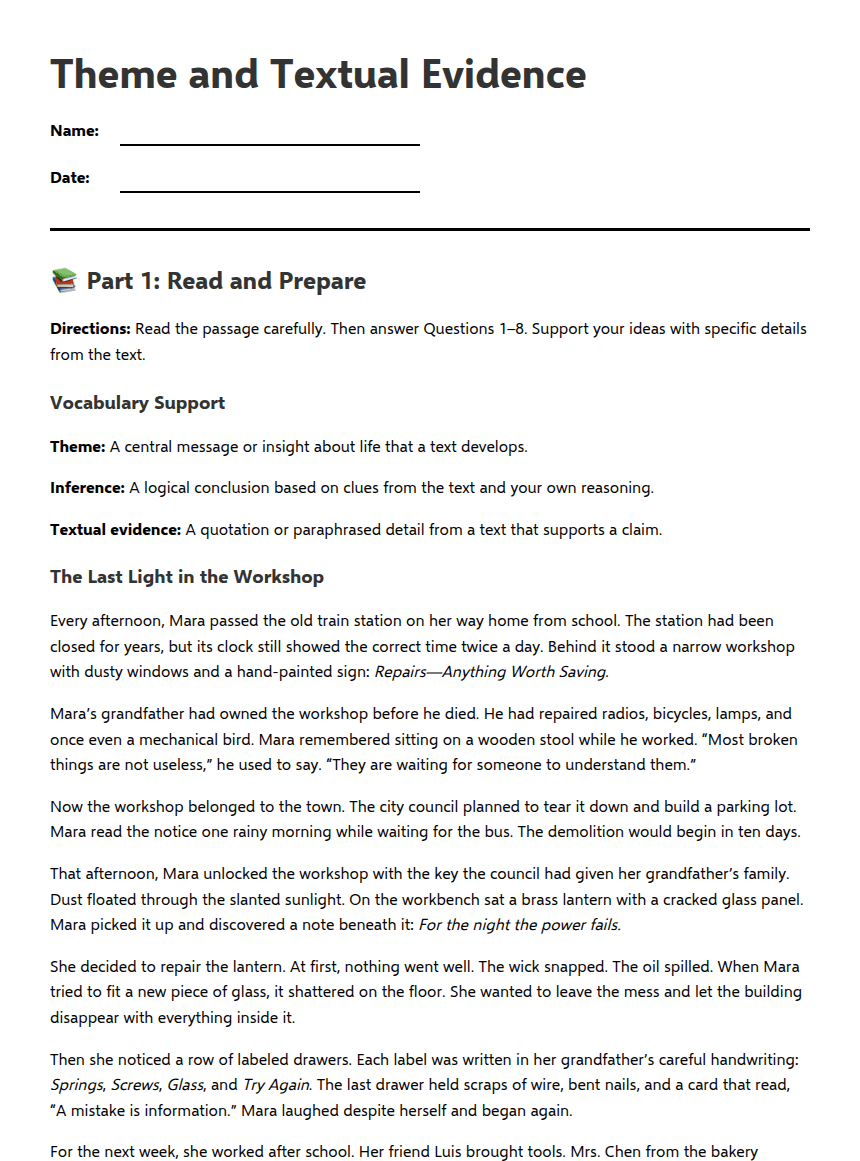
Theme and Textual Evidence
📚 Part 1: Read and Prepare
Directions: Read the passage carefully. Then answer Questions 1–8. Support your ideas with specific details from the text.
Vocabulary Support
Theme: A central message or insight about life that a text develops.
Inference: A logical conclusion based on clues from the text and your own reasoning.
Textual evidence: A quotation or paraphrased detail from a text that supports a claim.
The Last Light in the Workshop
Every afternoon, Mara passed the old train station on her way home from school. The station had been closed for years, but its clock still showed the correct time twice a day. Behind it stood a narrow workshop with dusty windows and a hand-painted sign: Repairs—Anything Worth Saving.
Mara’s grandfather had owned the workshop before he died. He had repaired radios, bicycles, lamps, and once even a mechanical bird. Mara remembered sitting on a wooden stool while he worked. “Most broken things are not useless,” he used to say. “They are waiting for someone to understand them.”
Now the workshop belonged to the town. The city council planned to tear it down and build a parking lot. Mara read the notice one rainy morning while waiting for the bus. The demolition would begin in ten days.
That afternoon, Mara unlocked the workshop with the key the council had given her grandfather’s family. Dust floated through the slanted sunlight. On the workbench sat a brass lantern with a cracked glass panel. Mara picked it up and discovered a note beneath it: For the night the power fails.
She decided to repair the lantern. At first, nothing went well. The wick snapped. The oil spilled. When Mara tried to fit a new piece of glass, it shattered on the floor. She wanted to leave the mess and let the building disappear with everything inside it.
Then she noticed a row of labeled drawers. Each label was written in her grandfather’s careful handwriting: Springs, Screws, Glass, and Try Again. The last drawer held scraps of wire, bent nails, and a card that read, “A mistake is information.” Mara laughed despite herself and began again.
For the next week, she worked after school. Her friend Luis brought tools. Mrs. Chen from the bakery donated a sheet of glass. Even the council member who had posted the demolition notice stopped by to watch. Mara cleaned the windows and placed photographs of the workshop’s repaired objects on the walls. She also wrote down the stories people told about the place: a bicycle fixed before a championship race, a radio repaired so a family could hear a storm warning, and a lamp restored for a child afraid of the dark.
On the final evening, Mara carried the lantern to the town meeting. It was not perfect; a thin line crossed the new glass. Still, when she lit it, the room glowed warmly. Mara explained that the workshop was more than an empty building. It was a record of people helping one another and refusing to give up on what seemed broken.
The council did not cancel the parking lot immediately. Instead, members voted to delay the demolition and study a community repair center. As Mara walked home, she saw the workshop’s last light shining through its dusty windows. The building had not been saved yet, but someone had finally begun to understand its value.
✏️ Part 2: Analyze the Text
✅ Answer Key
1. The city council planned to demolish the workshop and replace it with a parking lot.
2. Mara finds a brass lantern with cracked glass. She decides to repair it.
3. The drawer shows that Mara’s grandfather was patient and believed mistakes could help people learn. The label and card encourage perseverance.
4. The townspeople help because Mara shows them that the workshop has meaning and has helped people in the community. Her work reminds them of their own experiences there.
5. B. People can discover value in what others have overlooked.
6. Acceptable evidence includes: Mara explains that the workshop is “more than an empty building”; the repaired objects helped people; the lantern is not perfect but still gives a warm light; or the council delays demolition to study a community repair center.
7. Acceptable responses may include:
Claim 1 evidence: The lantern has a thin line across its new glass, but Mara still presents it and lights it. Explanation: The imperfect lantern remains useful and meaningful.
Claim 2 evidence: Luis brings tools, Mrs. Chen donates glass, and townspeople share stories. Explanation: The workshop’s value comes from the relationships and help connected to it.
Claim 3 evidence: The council delays demolition and considers creating a community repair center. Explanation: Mara’s efforts change how the council views the workshop.
8. Model response: Mara enters her grandfather’s workshop after learning that the town plans to demolish it and decides to repair an old lantern. Although she makes several mistakes, she continues working with help from her friends and neighbors. At a town meeting, she explains how the workshop has helped people and connects the building to the community’s history. One theme is that people can discover value in things others have overlooked. The lantern supports this theme because it is still imperfect, yet it gives the meeting room a warm light. The stories of repaired bicycles, radios, and lamps also show that the workshop is valuable because it has helped people. These details lead the council to reconsider the building’s future.
About This Worksheet
Free in Kuraplan
Sign up free, grab the PDF, and customize it for your class.
Print-Ready
Formatted for standard paper. Clean layout, easy to read.
AI-Generated
Created with Kuraplan's AI, designed for real classroom use.
For Teachers & Parents
Use in classrooms, for homework, tutoring, or homeschool.
Need a custom version of this worksheet?
Kuraplan's AI generates custom worksheets in seconds — differentiated for every learner, aligned to your curriculum.
Generate Custom Worksheets — Free