US Imperialism Study Guide
A free social studies worksheet ready for your classroom. Open in Kuraplan to grab the print-ready PDF, customize it for your students, or generate a fresh version in seconds.
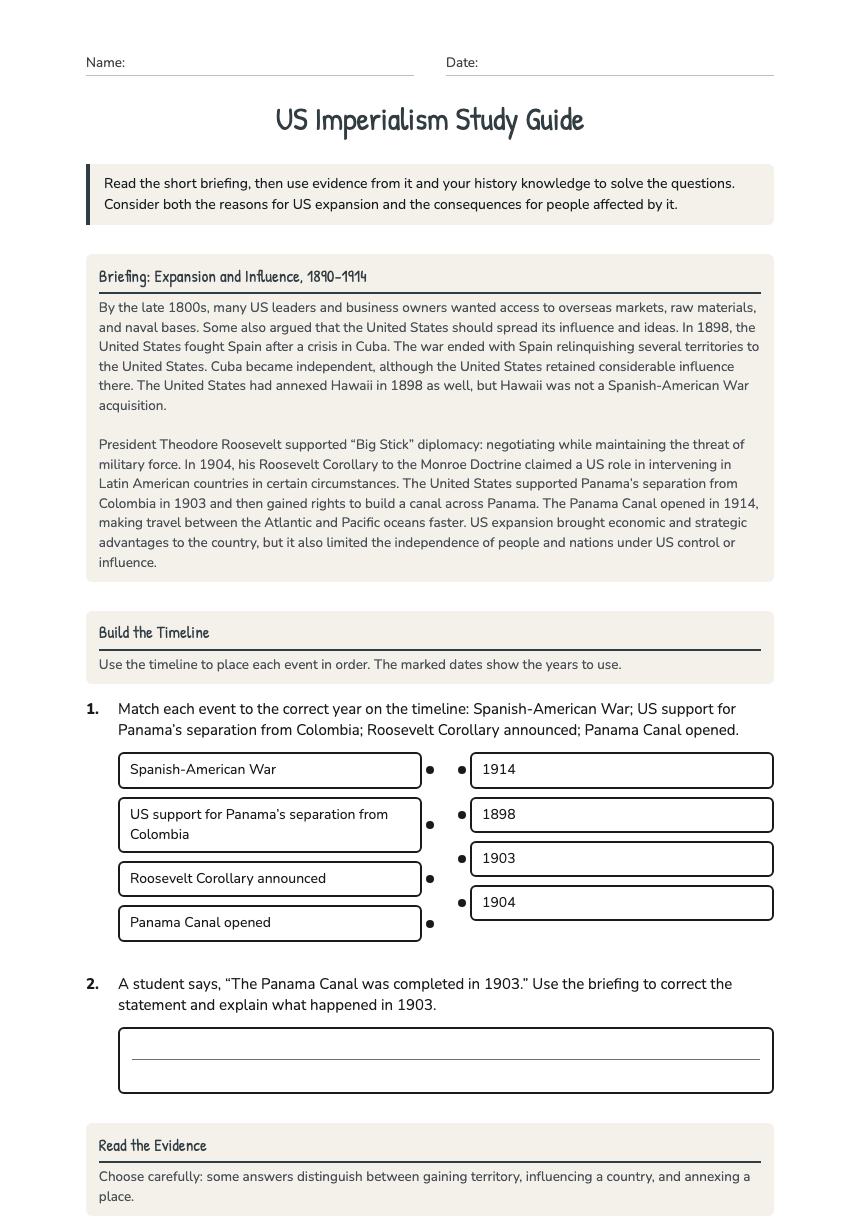
US Imperialism Study Guide
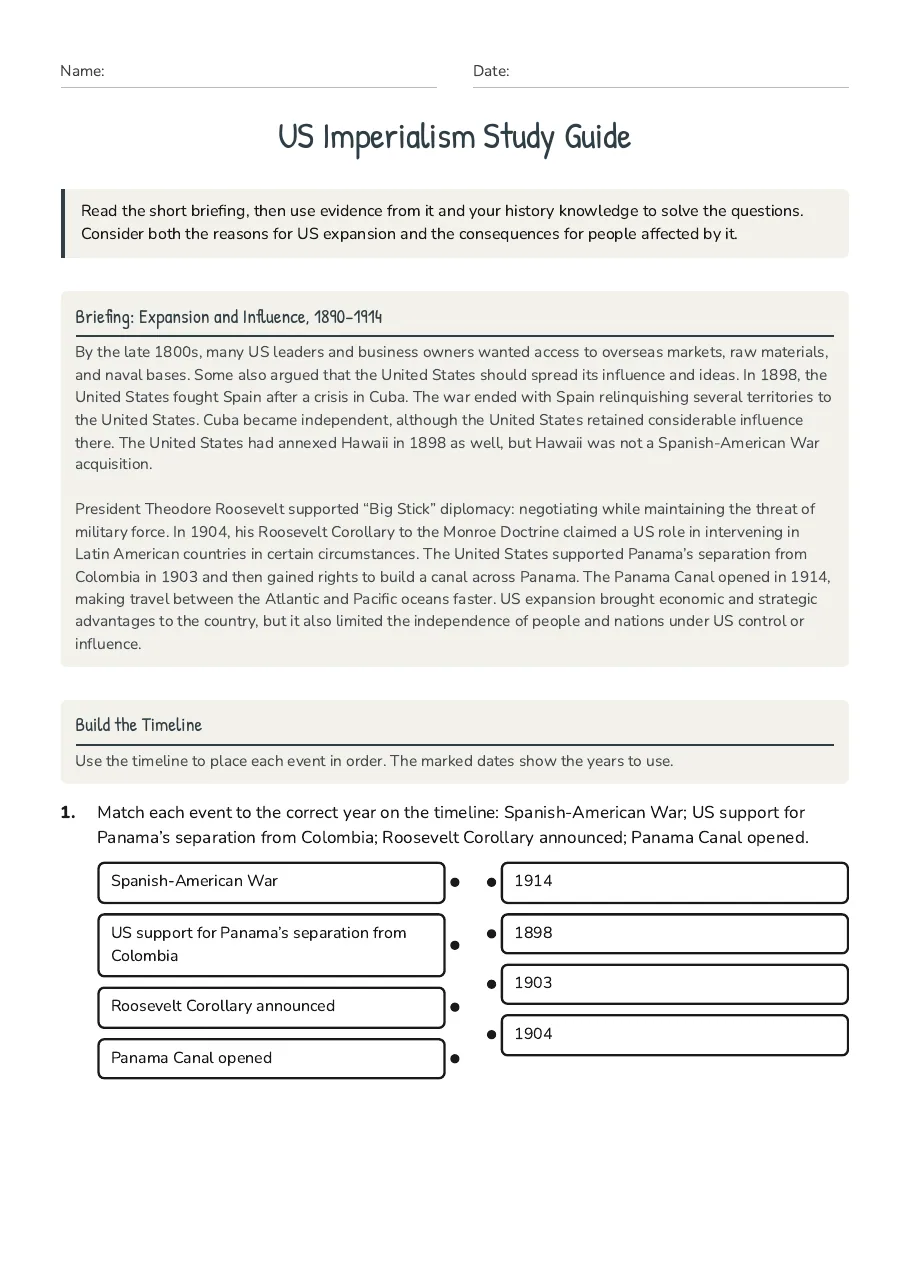
Briefing: Expansion and Influence, 1890–1914
By the late 1800s, many US leaders and business owners wanted access to overseas markets, raw materials, and naval bases. Some also argued that the United States should spread its influence and ideas. In 1898, the United States fought Spain after a crisis in Cuba. The war ended with Spain relinquishing several territories to the United States. Cuba became independent, although the United States retained considerable influence there. The United States had annexed Hawaii in 1898 as well, but Hawaii was not a Spanish-American War acquisition. President Theodore Roosevelt supported “Big Stick” diplomacy: negotiating while maintaining the threat of military force. In 1904, his Roosevelt Corollary to the Monroe Doctrine claimed a US role in intervening in Latin American countries in certain circumstances. The United States supported Panama’s separation from Colombia in 1903 and then gained rights to build a canal across Panama. The Panama Canal opened in 1914, making travel between the Atlantic and Pacific oceans faster. US expansion brought economic and strategic advantages to the country, but it also limited the independence of people and nations under US control or influence.
Build the Timeline
Use the timeline to place each event in order. The marked dates show the years to use.
- Spanish-American War
- US support for Panama’s separation from Colombia
- Roosevelt Corollary announced
- Panama Canal opened
- 1914
- 1898
- 1903
- 1904
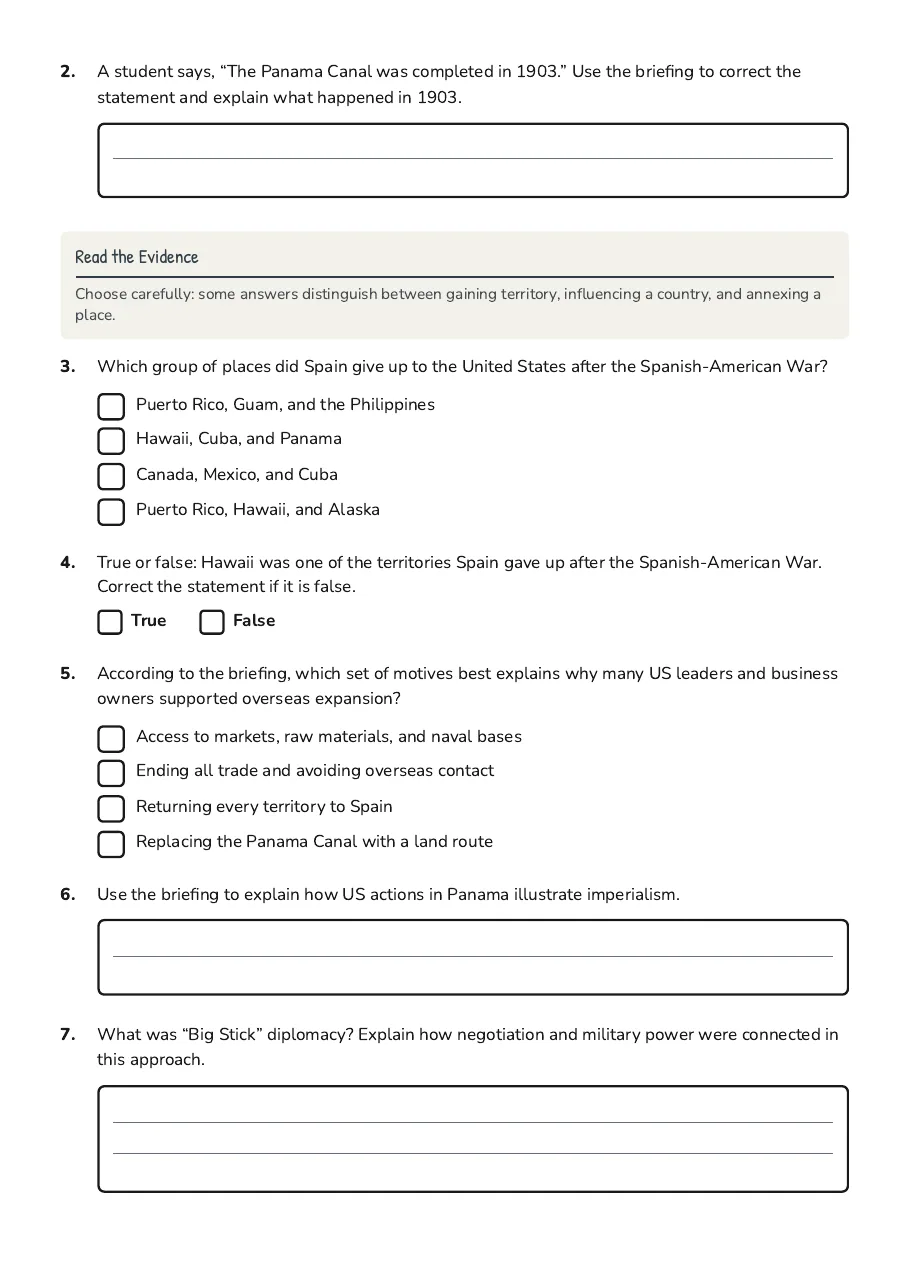
Read the Evidence
Choose carefully: some answers distinguish between gaining territory, influencing a country, and annexing a place.
- Puerto Rico, Guam, and the Philippines
- Hawaii, Cuba, and Panama
- Canada, Mexico, and Cuba
- Puerto Rico, Hawaii, and Alaska
- Access to markets, raw materials, and naval bases
- Ending all trade and avoiding overseas contact
- Returning every territory to Spain
- Replacing the Panama Canal with a land route
3 printable pages
Page 1
Page 2
Page 3
About This Worksheet
Free in Kuraplan
Sign up free, grab the PDF, and customize it for your class.
Print-Ready
Formatted for standard paper. Clean layout, easy to read.
AI-Generated
Created with Kuraplan's AI, designed for real classroom use.
For Teachers & Parents
Use in classrooms, for homework, tutoring, or homeschool.
Need a custom version of this worksheet?
Kuraplan's AI generates custom worksheets in seconds — differentiated for every learner, aligned to your curriculum.
Generate Custom Worksheets — Free