3D Medical Printing
A free technology worksheet ready for your classroom. Open in Kuraplan to grab the print-ready PDF, customize it for your students, or generate a fresh version in seconds.
3D Medical Printing
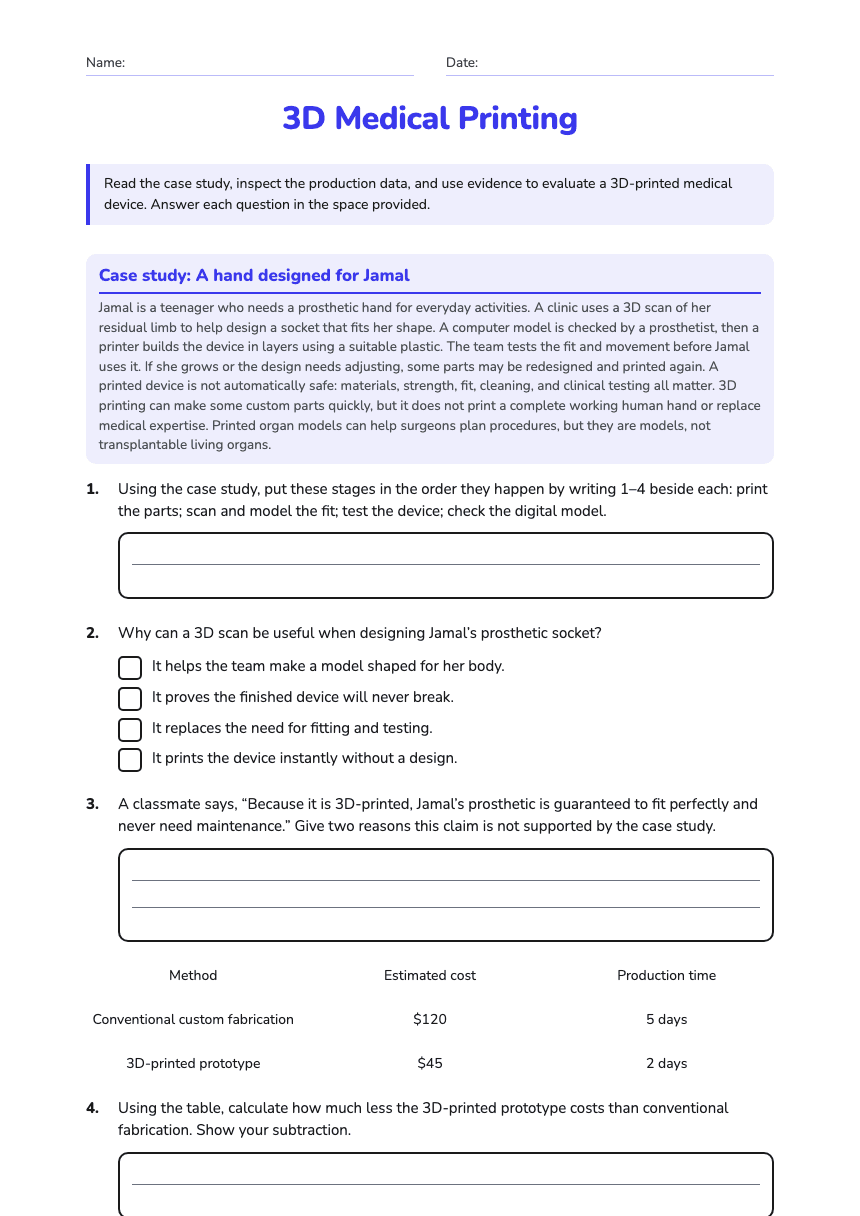
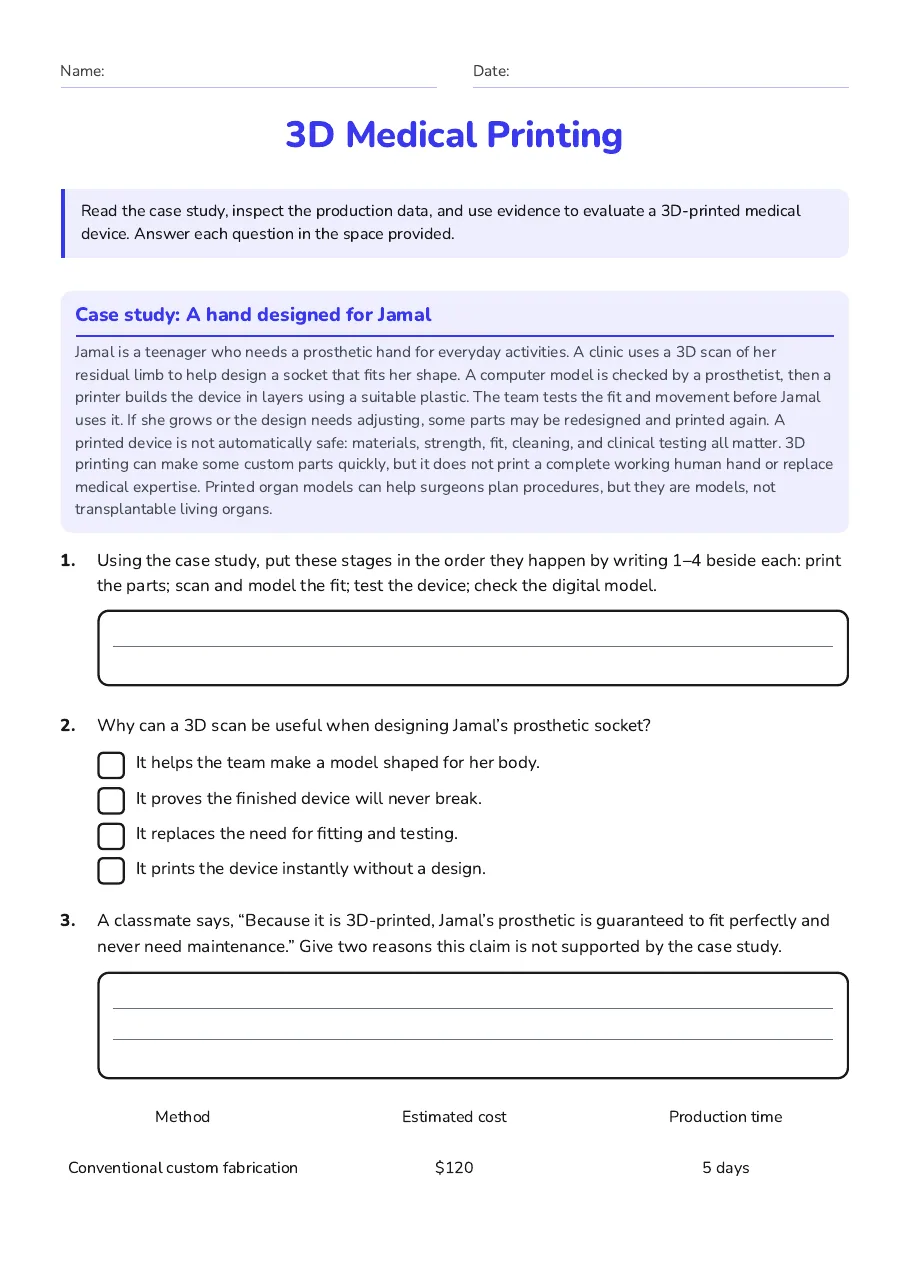
Case study: A hand designed for Jamal
Jamal is a teenager who needs a prosthetic hand for everyday activities. A clinic uses a 3D scan of her residual limb to help design a socket that fits her shape. A computer model is checked by a prosthetist, then a printer builds the device in layers using a suitable plastic. The team tests the fit and movement before Jamal uses it. If she grows or the design needs adjusting, some parts may be redesigned and printed again. A printed device is not automatically safe: materials, strength, fit, cleaning, and clinical testing all matter. 3D printing can make some custom parts quickly, but it does not print a complete working human hand or replace medical expertise. Printed organ models can help surgeons plan procedures, but they are models, not transplantable living organs.
- It helps the team make a model shaped for her body.
- It proves the finished device will never break.
- It replaces the need for fitting and testing.
- It prints the device instantly without a design.
Method
Estimated cost
Production time
Conventional custom fabrication
$120
5 days
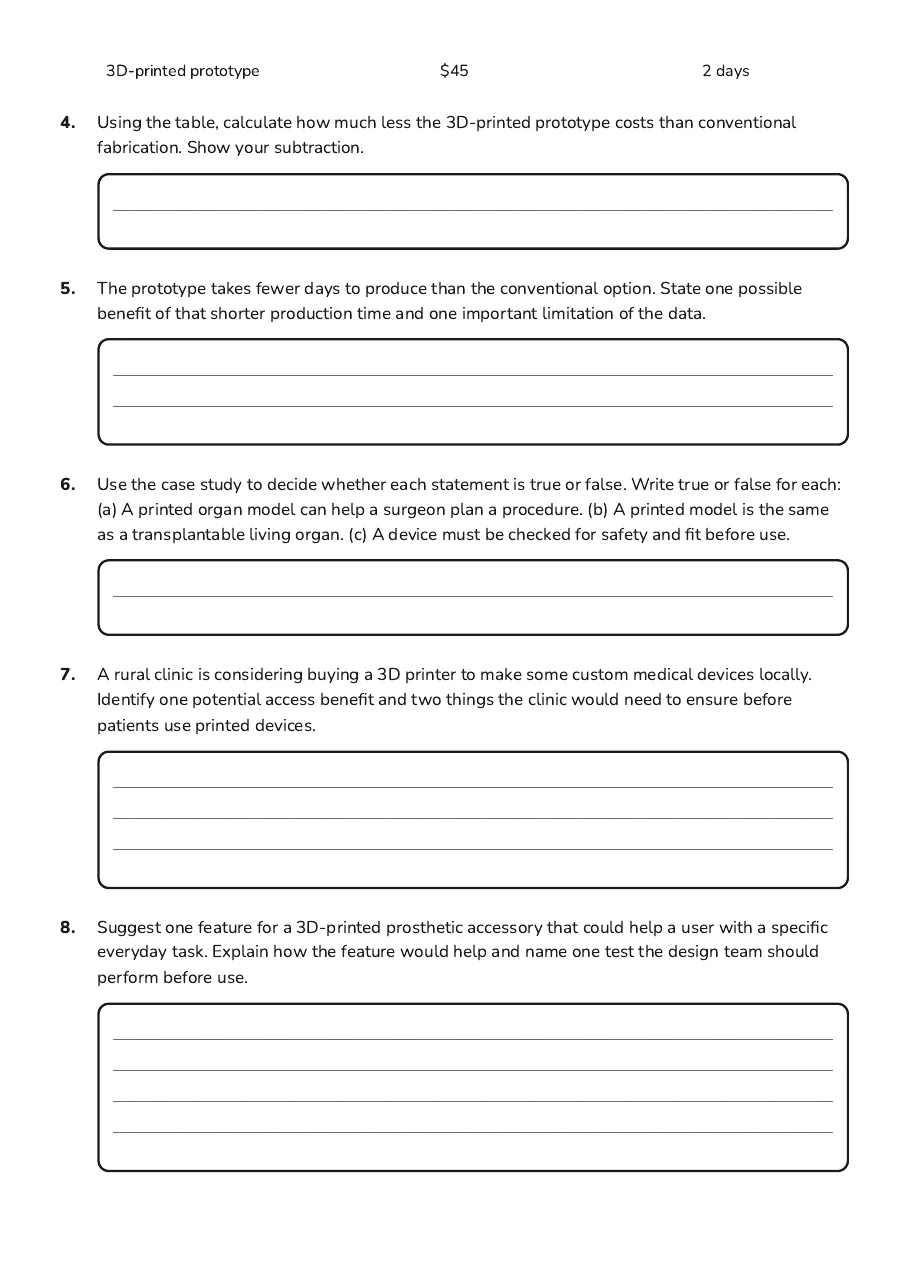
3D-printed prototype
$45
2 days
2 printable pages
Page 1
Page 2
About This Worksheet
Free in Kuraplan
Sign up free, grab the PDF, and customize it for your class.
Print-Ready
Formatted for standard paper. Clean layout, easy to read.
AI-Generated
Created with Kuraplan's AI, designed for real classroom use.
For Teachers & Parents
Use in classrooms, for homework, tutoring, or homeschool.
Need a custom version of this worksheet?
Kuraplan's AI generates custom worksheets in seconds — differentiated for every learner, aligned to your curriculum.
Generate Custom Worksheets — Free
