ScienceFreePrintable

Animal Skeleton Types

A free science worksheet ready for your classroom. Open in Kuraplan to grab the print-ready PDF, customize it for your students, or generate a fresh version in seconds.
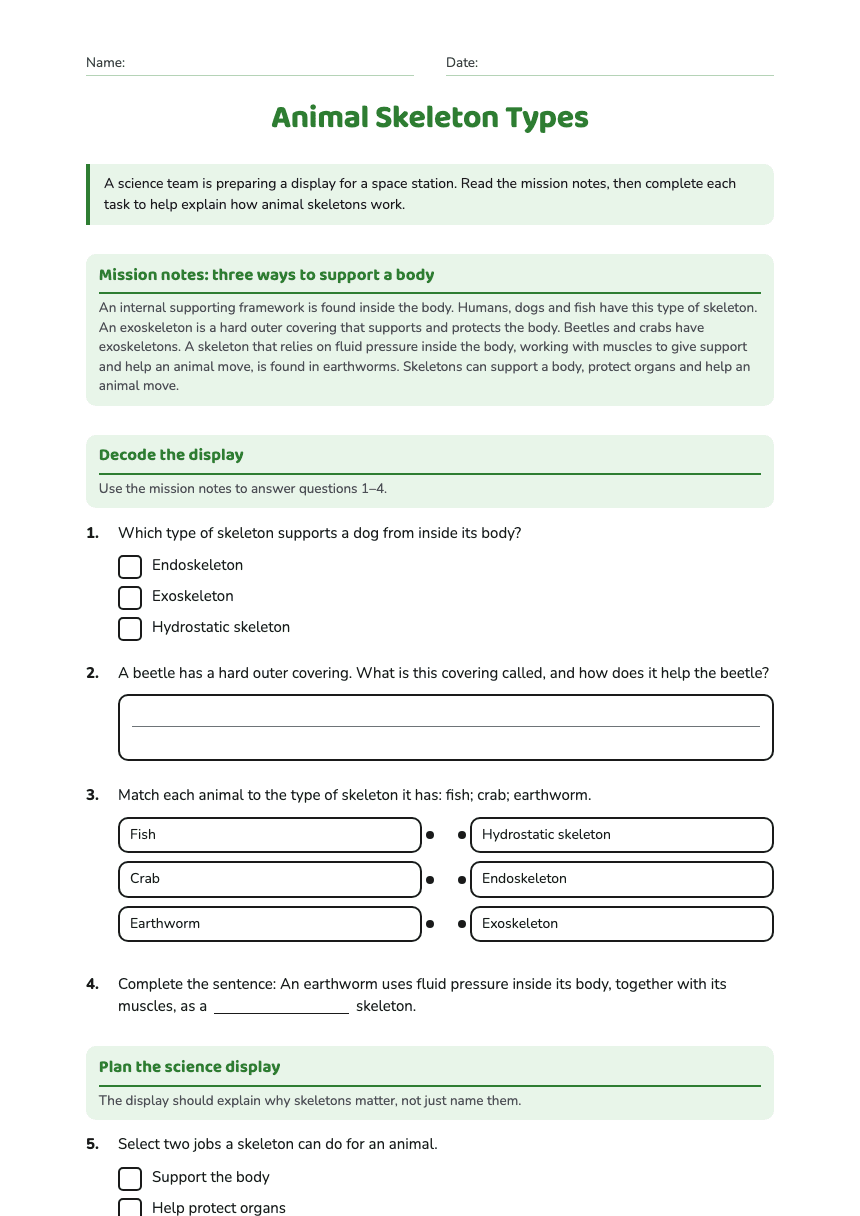
Animal Skeleton Types worksheet preview
Name:Date:

Animal Skeleton Types

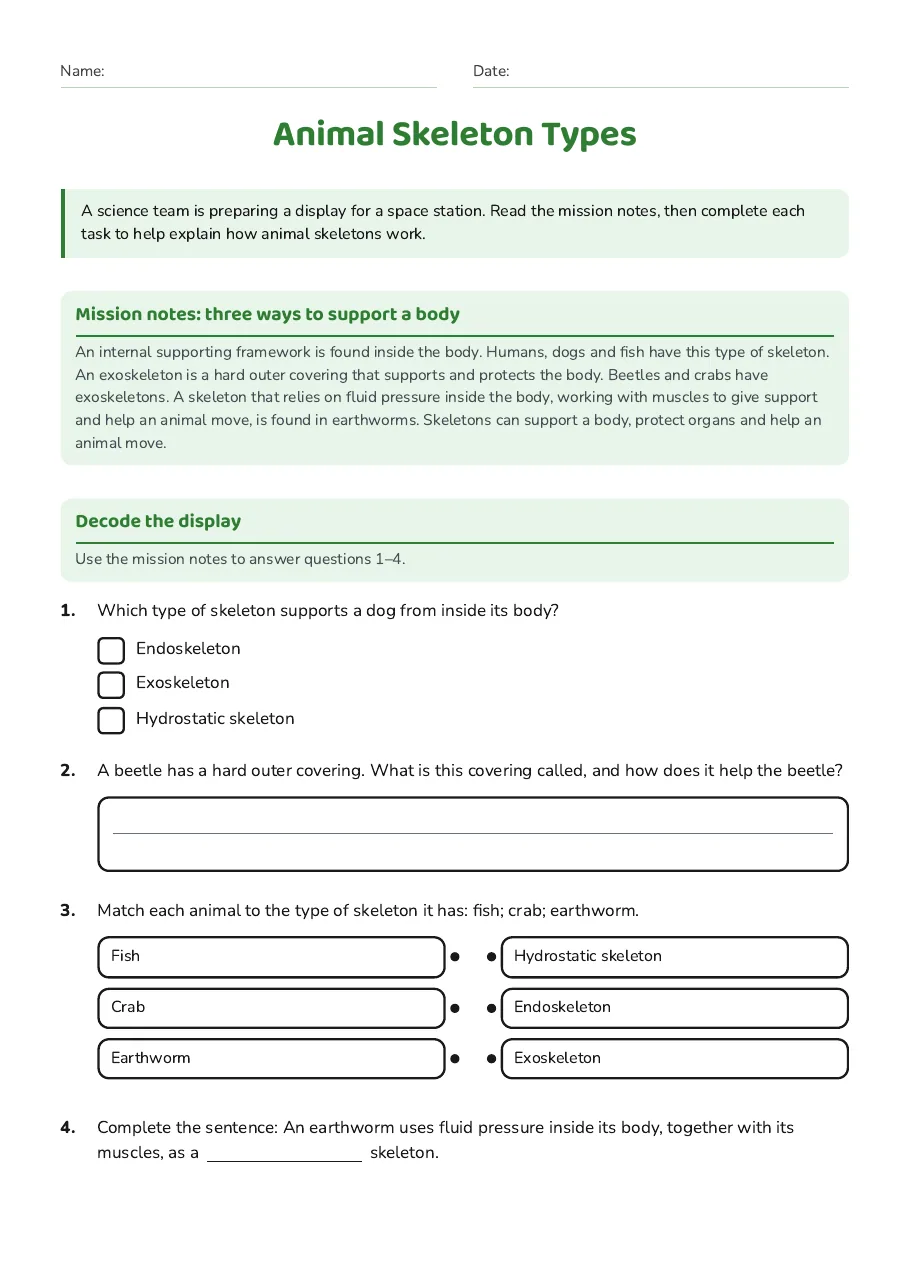
A science team is preparing a display for a space station. Read the mission notes, then complete each task to help explain how animal skeletons work.

Mission notes: three ways to support a body

An internal supporting framework is found inside the body. Humans, dogs and fish have this type of skeleton. An exoskeleton is a hard outer covering that supports and protects the body. Beetles and crabs have exoskeletons. A skeleton that relies on fluid pressure inside the body, working with muscles to give support and help an animal move, is found in earthworms. Skeletons can support a body, protect organs and help an animal move.

Decode the display

Use the mission notes to answer questions 1–4.

1.Which type of skeleton supports a dog from inside its body?
  • Endoskeleton
  • Exoskeleton
  • Hydrostatic skeleton
2.A beetle has a hard outer covering. What is this covering called, and how does it help the beetle?
3.Match each animal to the type of skeleton it has: fish; crab; earthworm.
  • Fish
  • Crab
  • Earthworm
  • Hydrostatic skeleton
  • Endoskeleton
  • Exoskeleton
4.Complete the sentence: An earthworm uses fluid pressure inside its body, together with its muscles, as a skeleton.

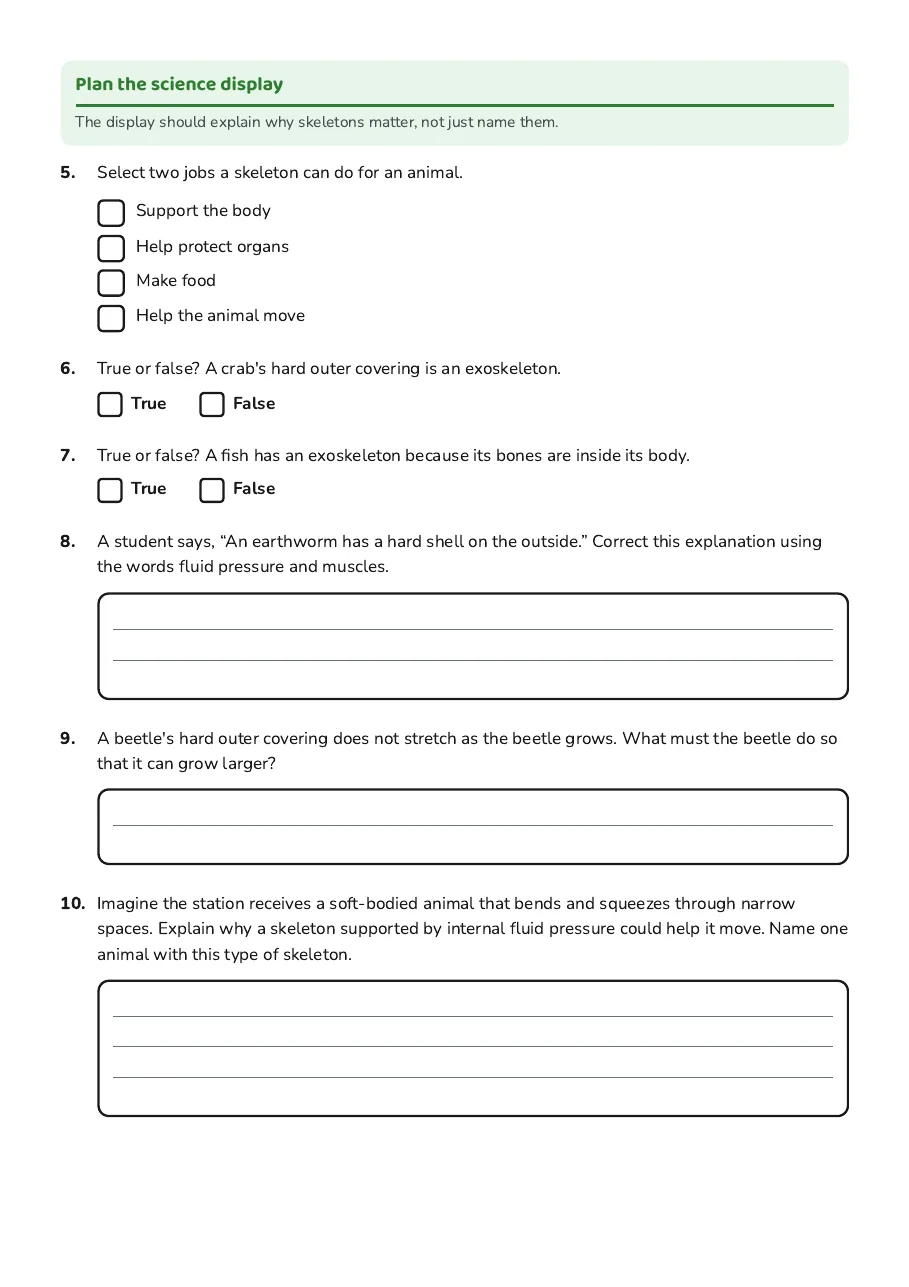
Plan the science display

The display should explain why skeletons matter, not just name them.

5.Select two jobs a skeleton can do for an animal.
  • Support the body
  • Help protect organs
  • Make food
  • Help the animal move
6.True or false? A crab's hard outer covering is an exoskeleton.
TrueFalse
7.True or false? A fish has an exoskeleton because its bones are inside its body.
TrueFalse
8.A student says, “An earthworm has a hard shell on the outside.” Correct this explanation using the words fluid pressure and muscles.
9.A beetle's hard outer covering does not stretch as the beetle grows. What must the beetle do so that it can grow larger?
10.Imagine the station receives a soft-bodied animal that bends and squeezes through narrow spaces. Explain why a skeleton supported by internal fluid pressure could help it move. Name one animal with this type of skeleton.
Draw one animal with an internal skeleton, one with a hard outer covering, and one supported by fluid pressure and muscles. Label each animal and its skeleton type.

3 printable pages

  • Animal Skeleton Types, page 1 of 3: Mission notes: three ways to support a body, Decode the display

    Page 1

  • Animal Skeleton Types, page 2 of 3: Plan the science display

    Page 2

  • Animal Skeleton Types, page 3 of 3: Draw one animal with an internal skeleton, one with a hard outer covering, and one…

    Page 3

About This Worksheet

Free in Kuraplan

Sign up free, grab the PDF, and customize it for your class.

Print-Ready

Formatted for standard paper. Clean layout, easy to read.

AI-Generated

Created with Kuraplan's AI, designed for real classroom use.

For Teachers & Parents

Use in classrooms, for homework, tutoring, or homeschool.

Need a custom version of this worksheet?

Kuraplan's AI generates custom worksheets in seconds — differentiated for every learner, aligned to your curriculum.

Generate Custom Worksheets — Free
No credit card Curriculum-aligned Under 60 seconds