ScienceFreePrintable

Classifying Matter by Atoms

A free science worksheet ready for your classroom. Open in Kuraplan to grab the print-ready PDF, customize it for your students, or generate a fresh version in seconds.
Classifying Matter by Atoms worksheet preview
Name:Date:

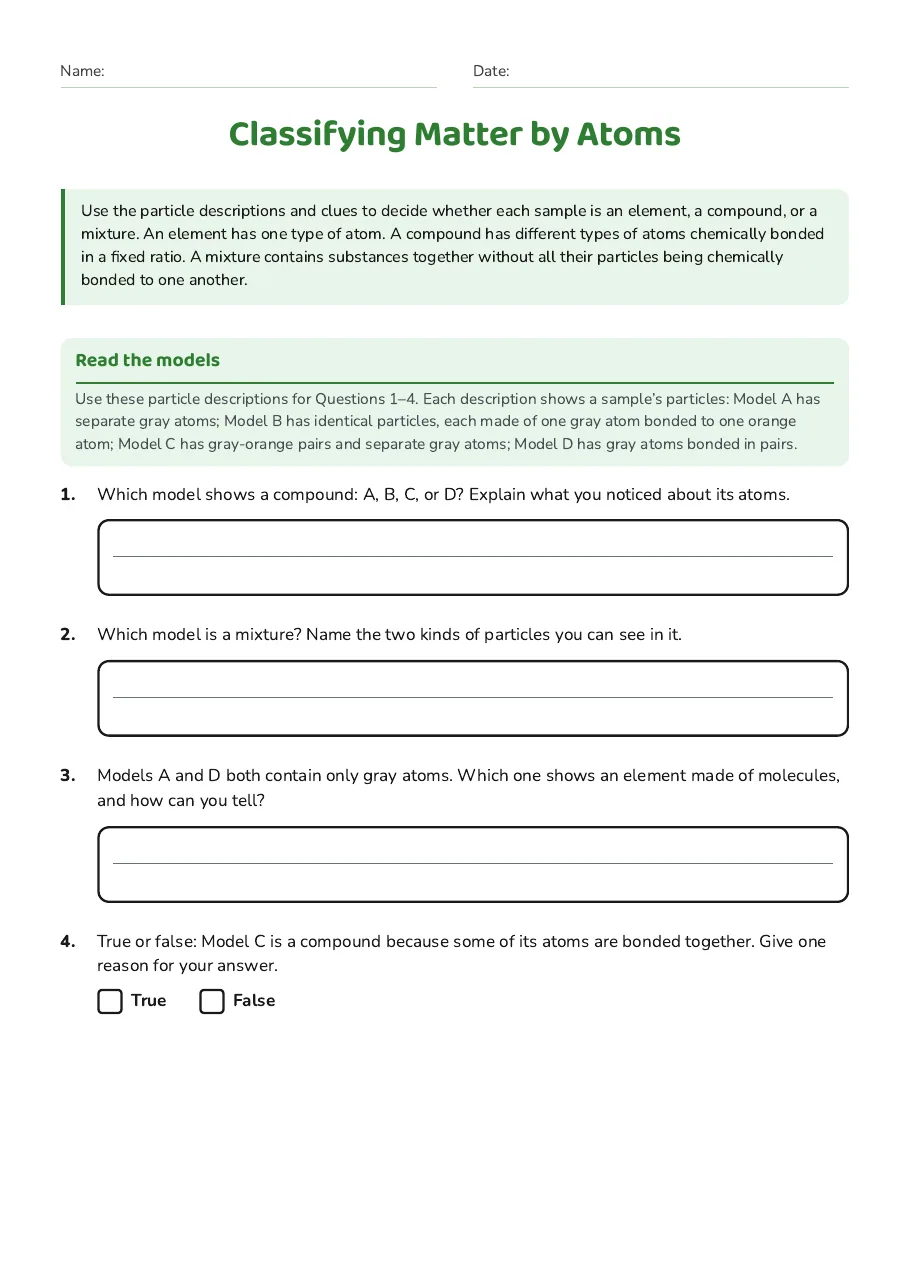
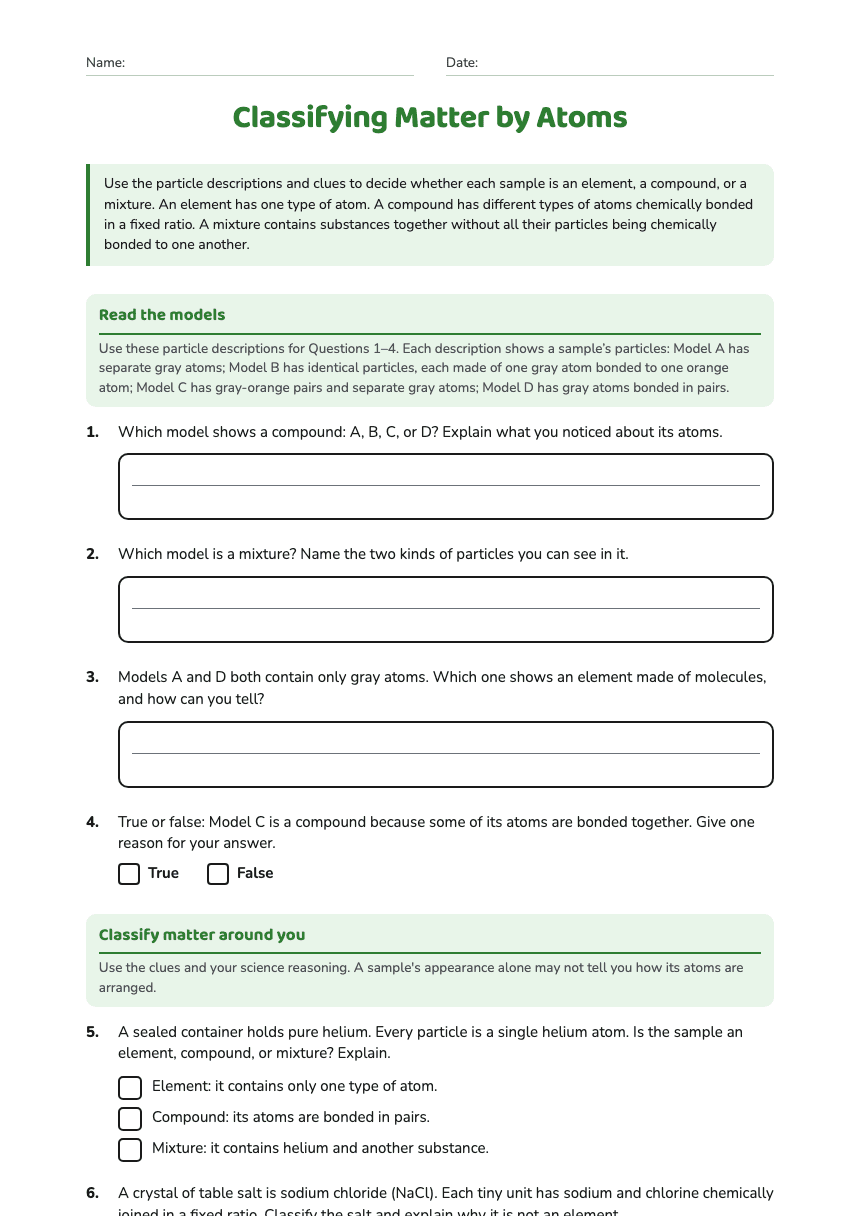
Classifying Matter by Atoms

Use the particle descriptions and clues to decide whether each sample is an element, a compound, or a mixture. An element has one type of atom. A compound has different types of atoms chemically bonded in a fixed ratio. A mixture contains substances together without all their particles being chemically bonded to one another.

Read the models

Use these particle descriptions for Questions 1–4. Each description shows a sample’s particles: Model A has separate gray atoms; Model B has identical particles, each made of one gray atom bonded to one orange atom; Model C has gray-orange pairs and separate gray atoms; Model D has gray atoms bonded in pairs.

1.Which model shows a compound: A, B, C, or D? Explain what you noticed about its atoms.
2.Which model is a mixture? Name the two kinds of particles you can see in it.
3.Models A and D both contain only gray atoms. Which one shows an element made of molecules, and how can you tell?
4.True or false: Model C is a compound because some of its atoms are bonded together. Give one reason for your answer.
TrueFalse

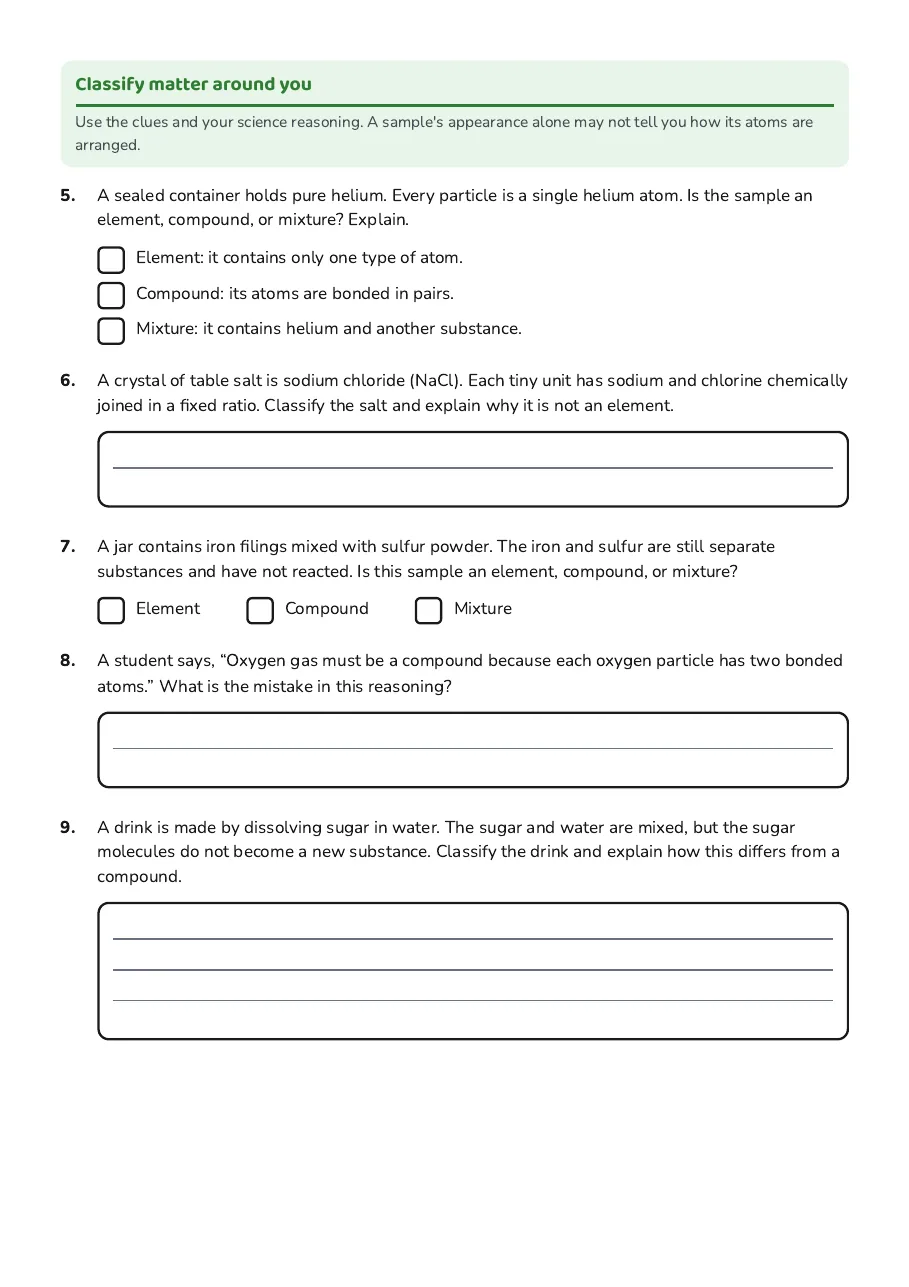
Classify matter around you

Use the clues and your science reasoning. A sample's appearance alone may not tell you how its atoms are arranged.

5.A sealed container holds pure helium. Every particle is a single helium atom. Is the sample an element, compound, or mixture? Explain.
  • Element: it contains only one type of atom.
  • Compound: its atoms are bonded in pairs.
  • Mixture: it contains helium and another substance.
6.A crystal of table salt is sodium chloride (NaCl). Each tiny unit has sodium and chlorine chemically joined in a fixed ratio. Classify the salt and explain why it is not an element.
7.A jar contains iron filings mixed with sulfur powder. The iron and sulfur are still separate substances and have not reacted. Is this sample an element, compound, or mixture?
  • Element
  • Compound
  • Mixture
8.A student says, “Oxygen gas must be a compound because each oxygen particle has two bonded atoms.” What is the mistake in this reasoning?
9.A drink is made by dissolving sugar in water. The sugar and water are mixed, but the sugar molecules do not become a new substance. Classify the drink and explain how this differs from a compound.
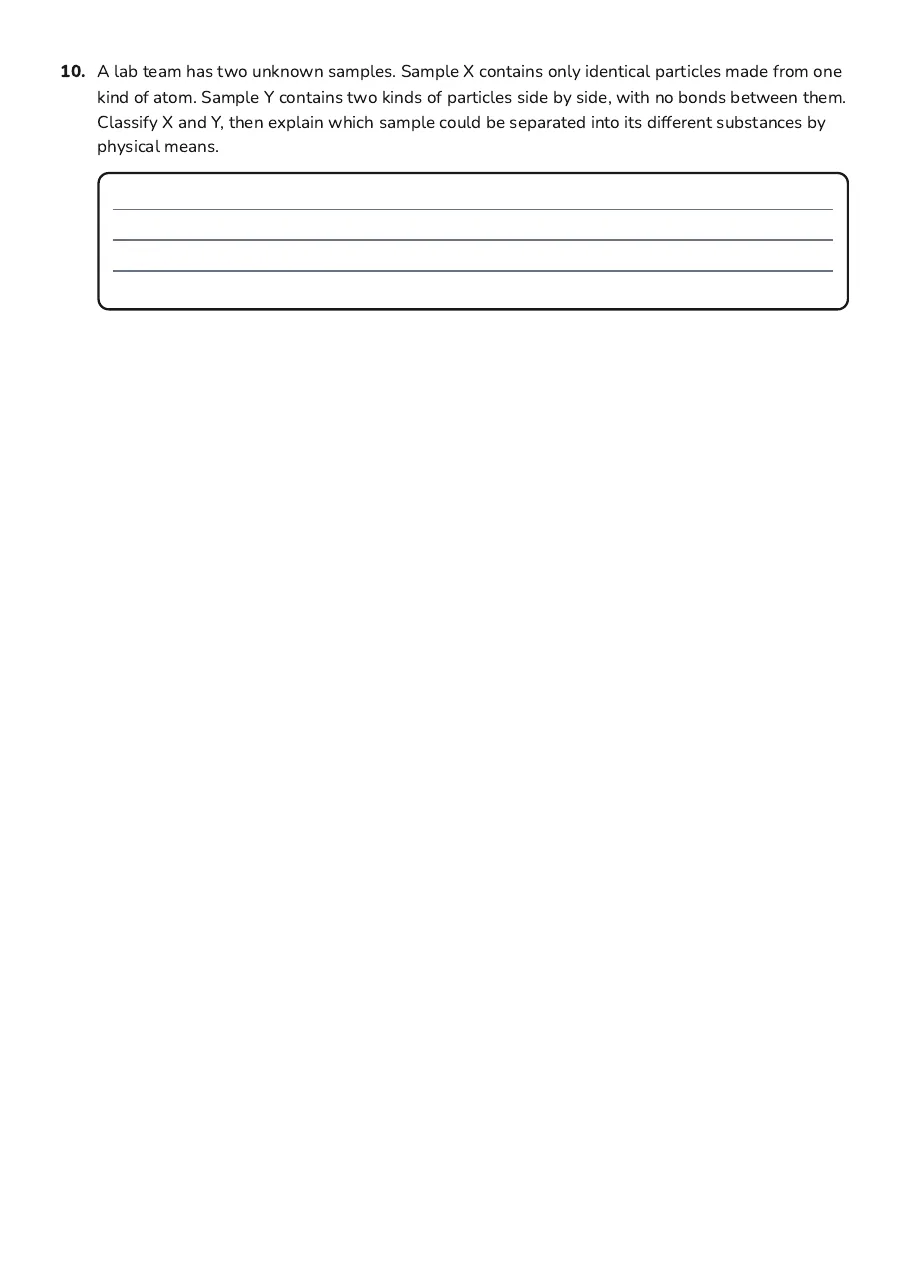
10.A lab team has two unknown samples. Sample X contains only identical particles made from one kind of atom. Sample Y contains two kinds of particles side by side, with no bonds between them. Classify X and Y, then explain which sample could be separated into its different substances by physical means.

3 printable pages

  • Classifying Matter by Atoms, page 1 of 3: Read the models

    Page 1

  • Classifying Matter by Atoms, page 2 of 3: Classify matter around you

    Page 2

  • Classifying Matter by Atoms, page 3 of 3: 10. A lab team has two unknown samples. Sample X contains only identical particles made…

    Page 3

About This Worksheet

Free in Kuraplan

Sign up free, grab the PDF, and customize it for your class.

Print-Ready

Formatted for standard paper. Clean layout, easy to read.

AI-Generated

Created with Kuraplan's AI, designed for real classroom use.

For Teachers & Parents

Use in classrooms, for homework, tutoring, or homeschool.

Need a custom version of this worksheet?

Kuraplan's AI generates custom worksheets in seconds — differentiated for every learner, aligned to your curriculum.

Generate Custom Worksheets — Free
No credit card Curriculum-aligned Under 60 seconds