Social StudiesFreePrintable
Cold War Vocabulary Worksheet
A free social studies worksheet ready for your classroom. Open in Kuraplan to grab the print-ready PDF, customize it for your students, or generate a fresh version in seconds.
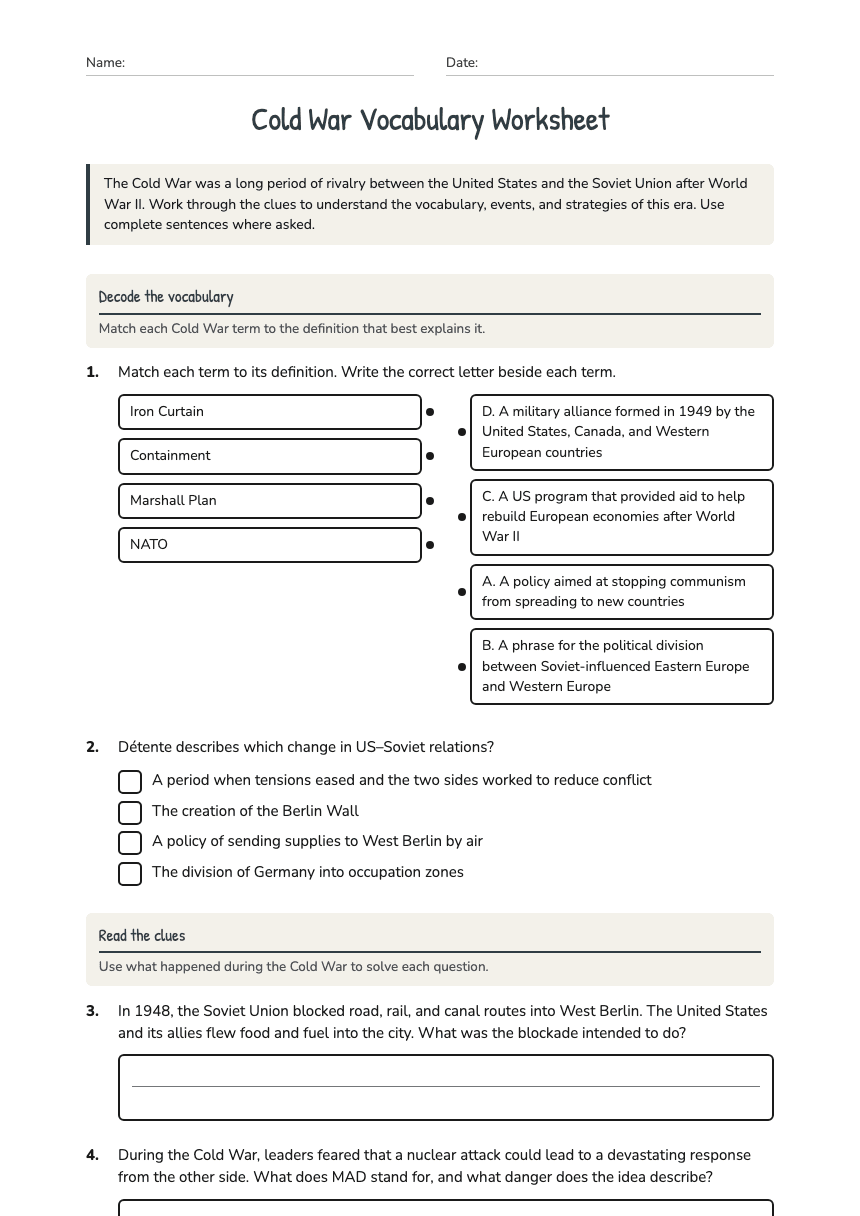
Name:Date:
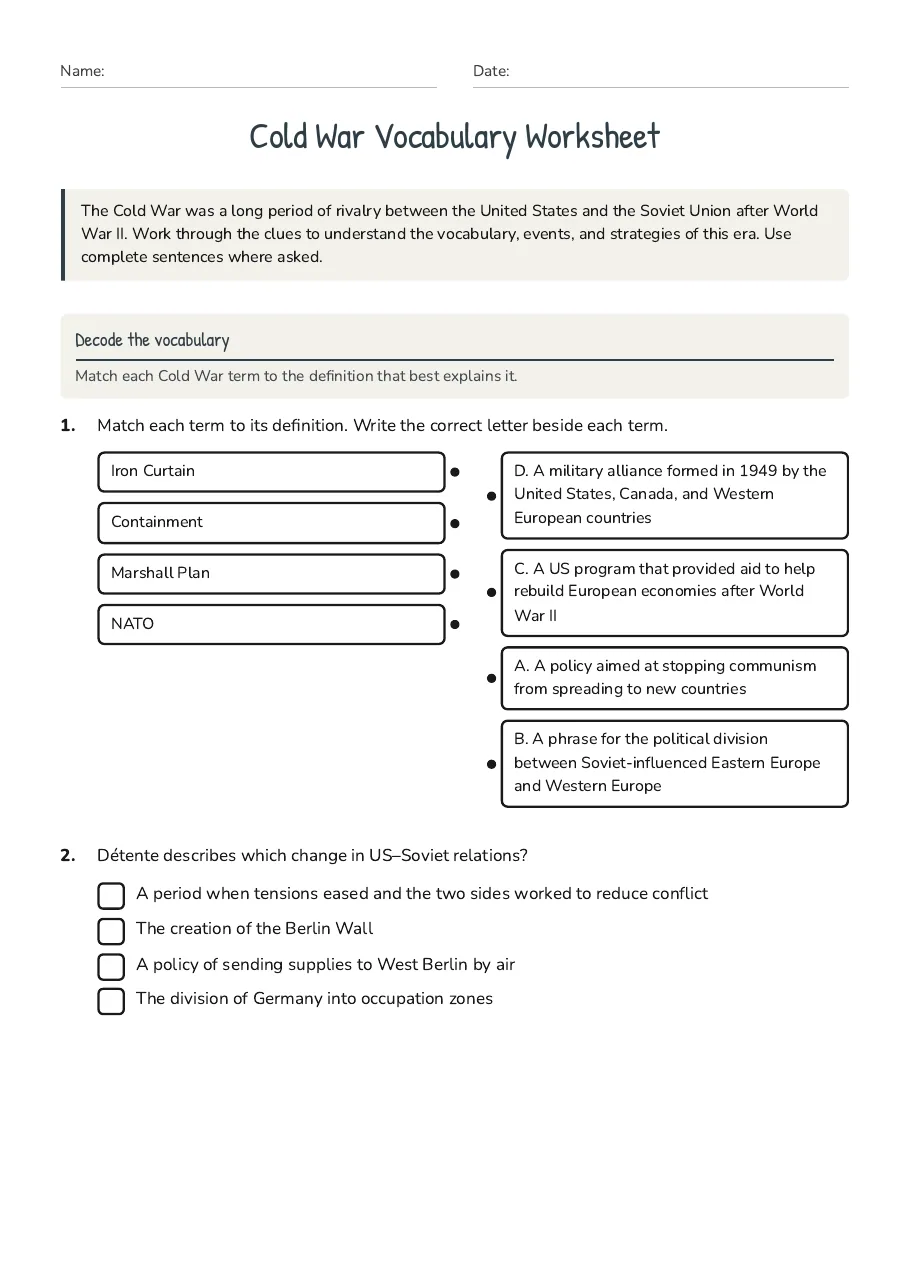
Cold War Vocabulary Worksheet
The Cold War was a long period of rivalry between the United States and the Soviet Union after World War II. Work through the clues to understand the vocabulary, events, and strategies of this era. Use complete sentences where asked.
Decode the vocabulary
Match each Cold War term to the definition that best explains it.
1.Match each term to its definition. Write the correct letter beside each term.
- Iron Curtain
- Containment
- Marshall Plan
- NATO
- D. A military alliance formed in 1949 by the United States, Canada, and Western European countries
- C. A US program that provided aid to help rebuild European economies after World War II
- A. A policy aimed at stopping communism from spreading to new countries
- B. A phrase for the political division between Soviet-influenced Eastern Europe and Western Europe
2.Détente describes which change in US–Soviet relations?
- A period when tensions eased and the two sides worked to reduce conflict
- The creation of the Berlin Wall
- A policy of sending supplies to West Berlin by air
- The division of Germany into occupation zones
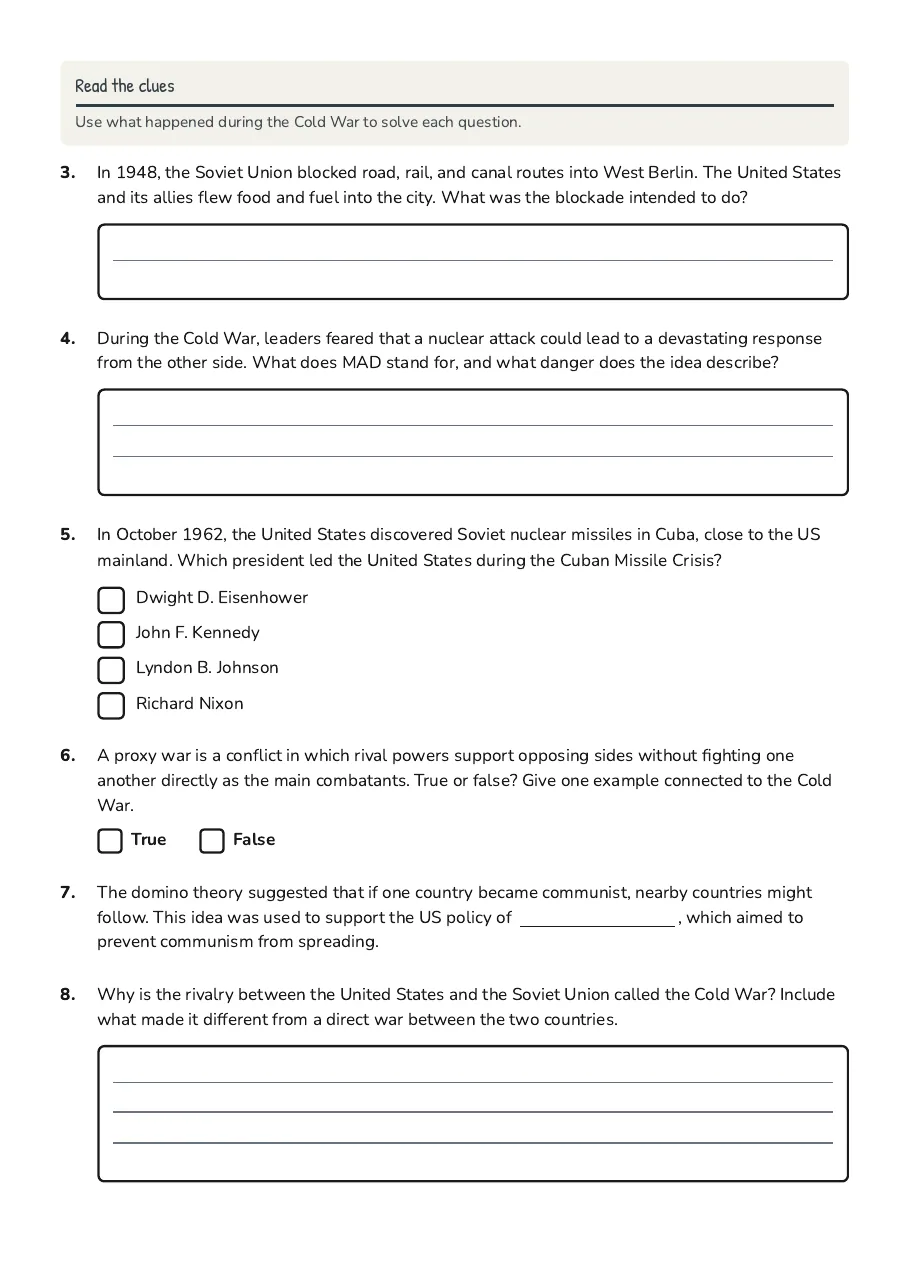
Read the clues
Use what happened during the Cold War to solve each question.
3.In 1948, the Soviet Union blocked road, rail, and canal routes into West Berlin. The United States and its allies flew food and fuel into the city. What was the blockade intended to do?
4.During the Cold War, leaders feared that a nuclear attack could lead to a devastating response from the other side. What does MAD stand for, and what danger does the idea describe?
5.In October 1962, the United States discovered Soviet nuclear missiles in Cuba, close to the US mainland. Which president led the United States during the Cuban Missile Crisis?
- Dwight D. Eisenhower
- John F. Kennedy
- Lyndon B. Johnson
- Richard Nixon
6.A proxy war is a conflict in which rival powers support opposing sides without fighting one another directly as the main combatants. True or false? Give one example connected to the Cold War.
TrueFalse
7.The domino theory suggested that if one country became communist, nearby countries might follow. This idea was used to support the US policy of , which aimed to prevent communism from spreading.
8.Why is the rivalry between the United States and the Soviet Union called the Cold War? Include what made it different from a direct war between the two countries.
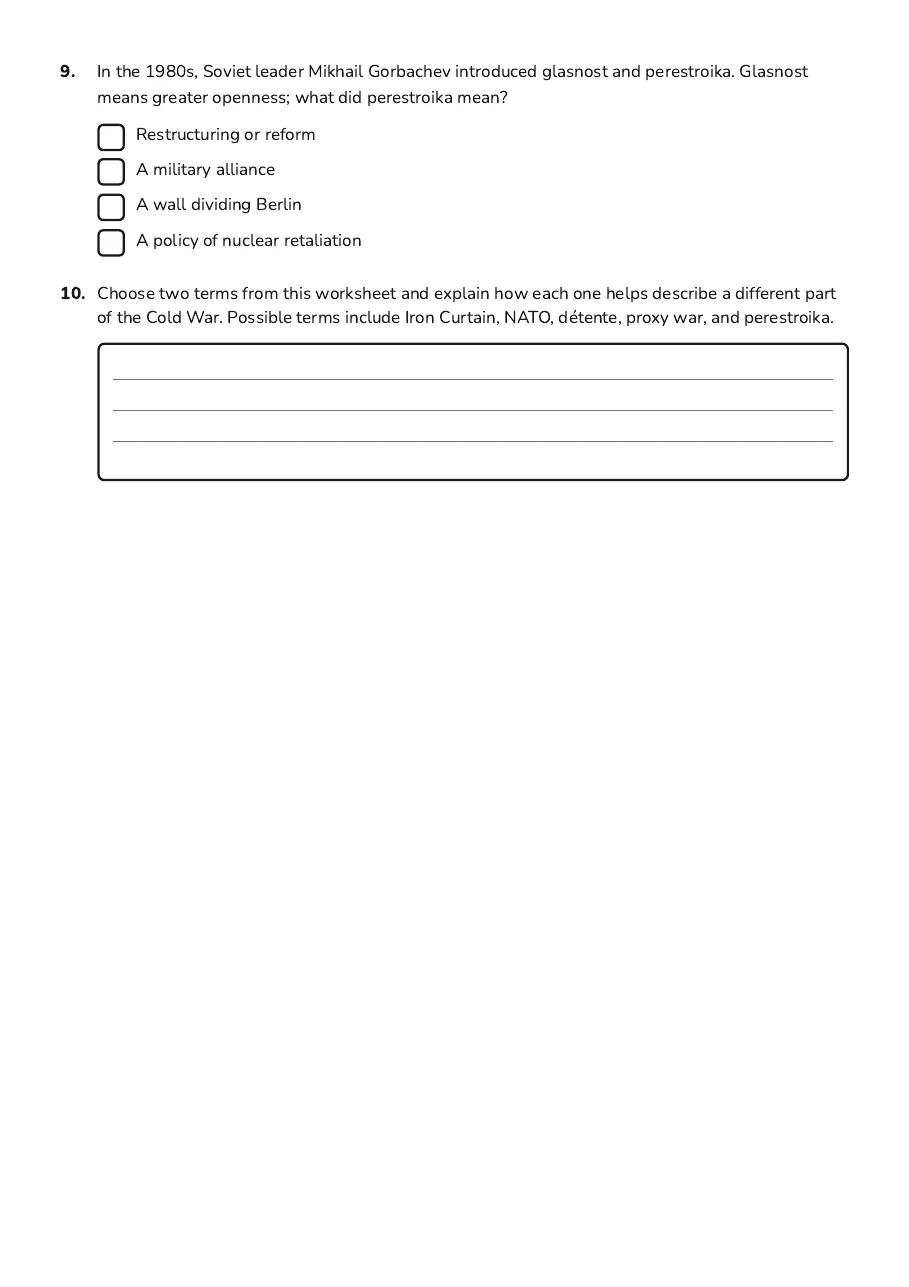
9.In the 1980s, Soviet leader Mikhail Gorbachev introduced glasnost and perestroika. Glasnost means greater openness; what did perestroika mean?
- Restructuring or reform
- A military alliance
- A wall dividing Berlin
- A policy of nuclear retaliation
10.Choose two terms from this worksheet and explain how each one helps describe a different part of the Cold War. Possible terms include Iron Curtain, NATO, détente, proxy war, and perestroika.
3 printable pages
Page 1
Page 2
Page 3
About This Worksheet
Free in Kuraplan
Sign up free, grab the PDF, and customize it for your class.
Print-Ready
Formatted for standard paper. Clean layout, easy to read.
AI-Generated
Created with Kuraplan's AI, designed for real classroom use.
For Teachers & Parents
Use in classrooms, for homework, tutoring, or homeschool.
Need a custom version of this worksheet?
Kuraplan's AI generates custom worksheets in seconds — differentiated for every learner, aligned to your curriculum.
Generate Custom Worksheets — Free No credit card Curriculum-aligned Under 60 seconds