Colonial America Cross-Curricular
A free social studies worksheet ready for your classroom. Open in Kuraplan to grab the print-ready PDF, customize it for your students, or generate a fresh version in seconds.
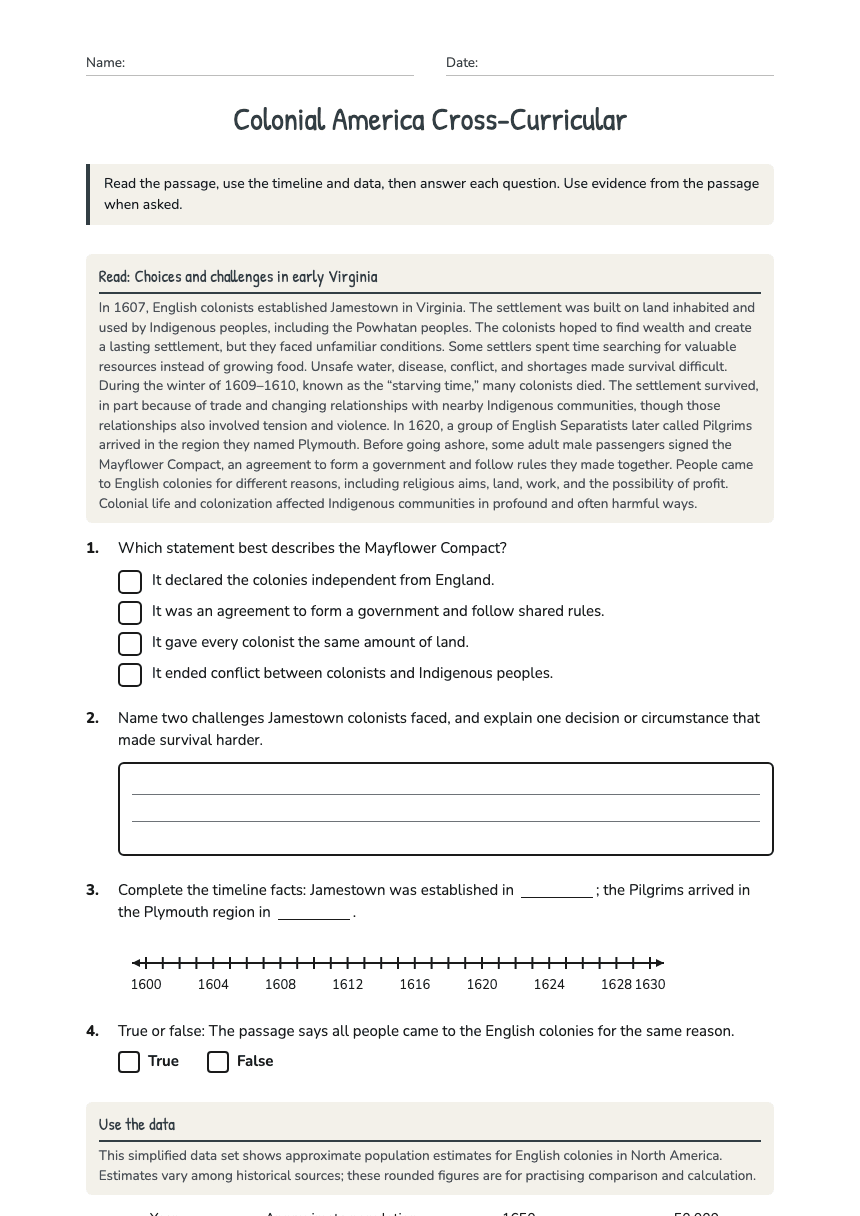
Colonial America Cross-Curricular
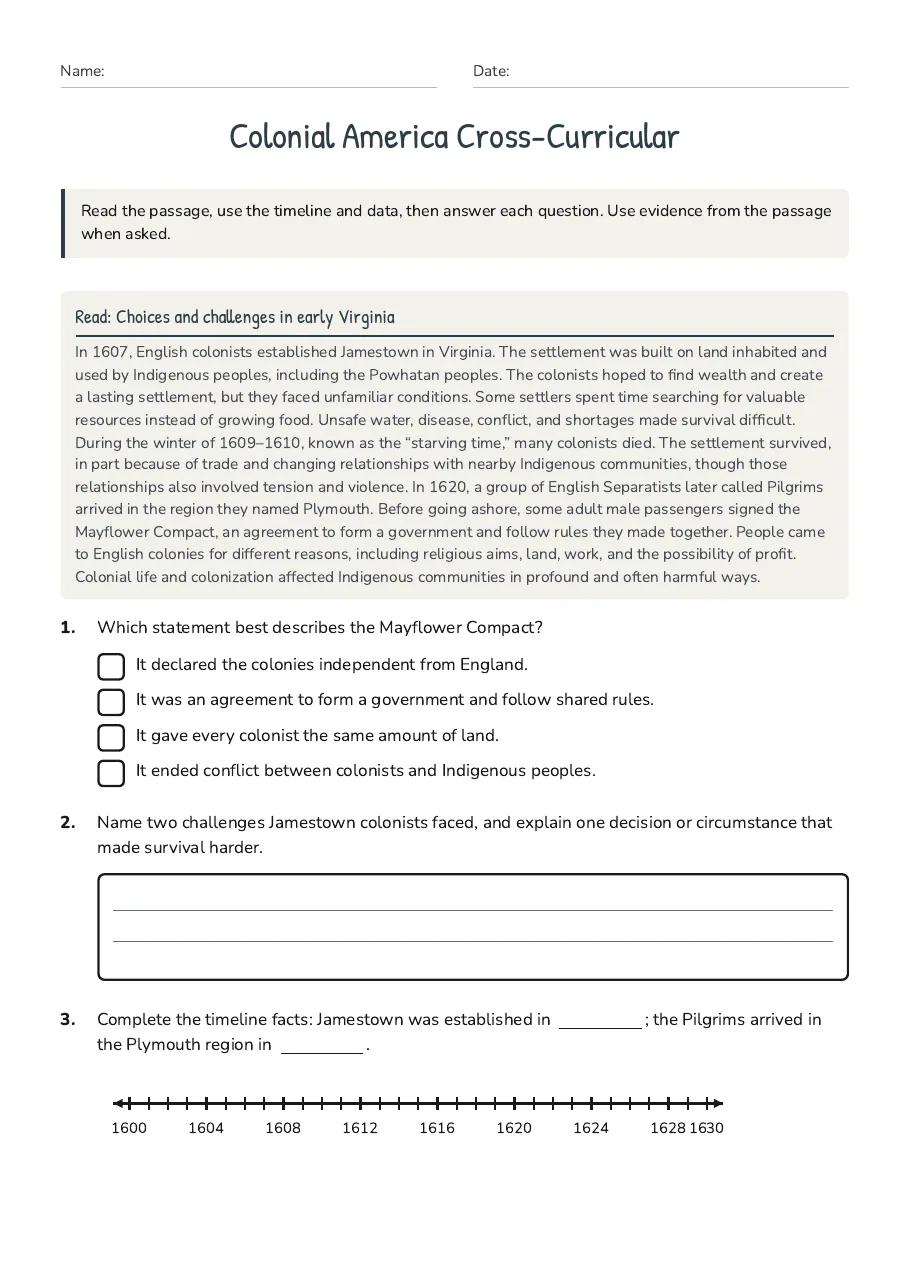
Read: Choices and challenges in early Virginia
In 1607, English colonists established Jamestown in Virginia. The settlement was built on land inhabited and used by Indigenous peoples, including the Powhatan peoples. The colonists hoped to find wealth and create a lasting settlement, but they faced unfamiliar conditions. Some settlers spent time searching for valuable resources instead of growing food. Unsafe water, disease, conflict, and shortages made survival difficult. During the winter of 1609–1610, known as the “starving time,” many colonists died. The settlement survived, in part because of trade and changing relationships with nearby Indigenous communities, though those relationships also involved tension and violence. In 1620, a group of English Separatists later called Pilgrims arrived in the region they named Plymouth. Before going ashore, some adult male passengers signed the Mayflower Compact, an agreement to form a government and follow rules they made together. People came to English colonies for different reasons, including religious aims, land, work, and the possibility of profit. Colonial life and colonization affected Indigenous communities in profound and often harmful ways.
- It declared the colonies independent from England.
- It was an agreement to form a government and follow shared rules.
- It gave every colonist the same amount of land.
- It ended conflict between colonists and Indigenous peoples.
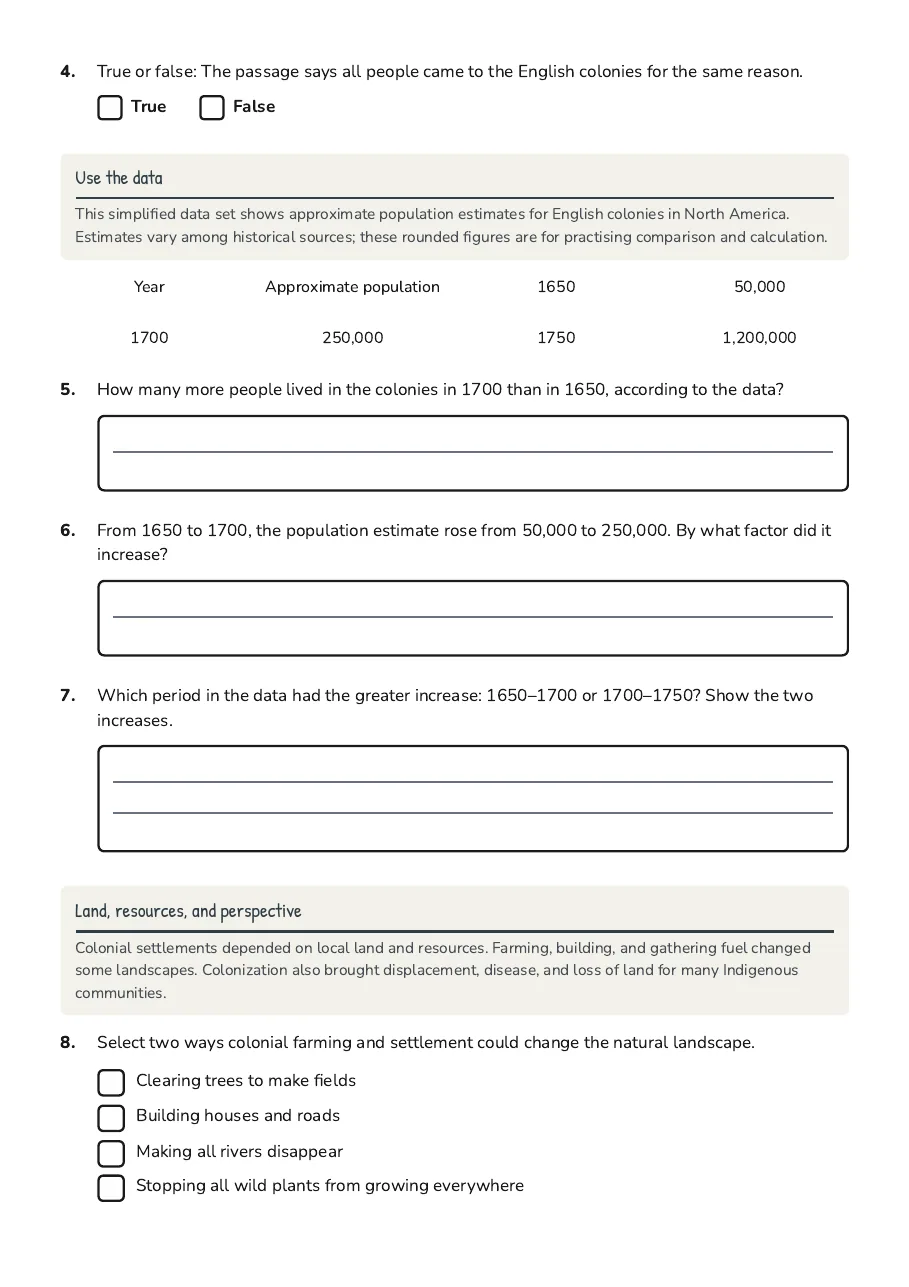
Use the data
This simplified data set shows approximate population estimates for English colonies in North America. Estimates vary among historical sources; these rounded figures are for practising comparison and calculation.
Year
Approximate population
1650
50,000
1700
250,000
1750
1,200,000
Land, resources, and perspective
Colonial settlements depended on local land and resources. Farming, building, and gathering fuel changed some landscapes. Colonization also brought displacement, disease, and loss of land for many Indigenous communities.
- Clearing trees to make fields
- Building houses and roads
- Making all rivers disappear
- Stopping all wild plants from growing everywhere
3 printable pages
Page 1
Page 2
Page 3
About This Worksheet
Free in Kuraplan
Sign up free, grab the PDF, and customize it for your class.
Print-Ready
Formatted for standard paper. Clean layout, easy to read.
AI-Generated
Created with Kuraplan's AI, designed for real classroom use.
For Teachers & Parents
Use in classrooms, for homework, tutoring, or homeschool.
Need a custom version of this worksheet?
Kuraplan's AI generates custom worksheets in seconds — differentiated for every learner, aligned to your curriculum.
Generate Custom Worksheets — Free