ScienceFreePrintable

Density and Fluid Pressure

A free science worksheet ready for your classroom. Open in Kuraplan to grab the print-ready PDF, customize it for your students, or generate a fresh version in seconds.

Density and Fluid Pressure worksheet preview
Name:Date:

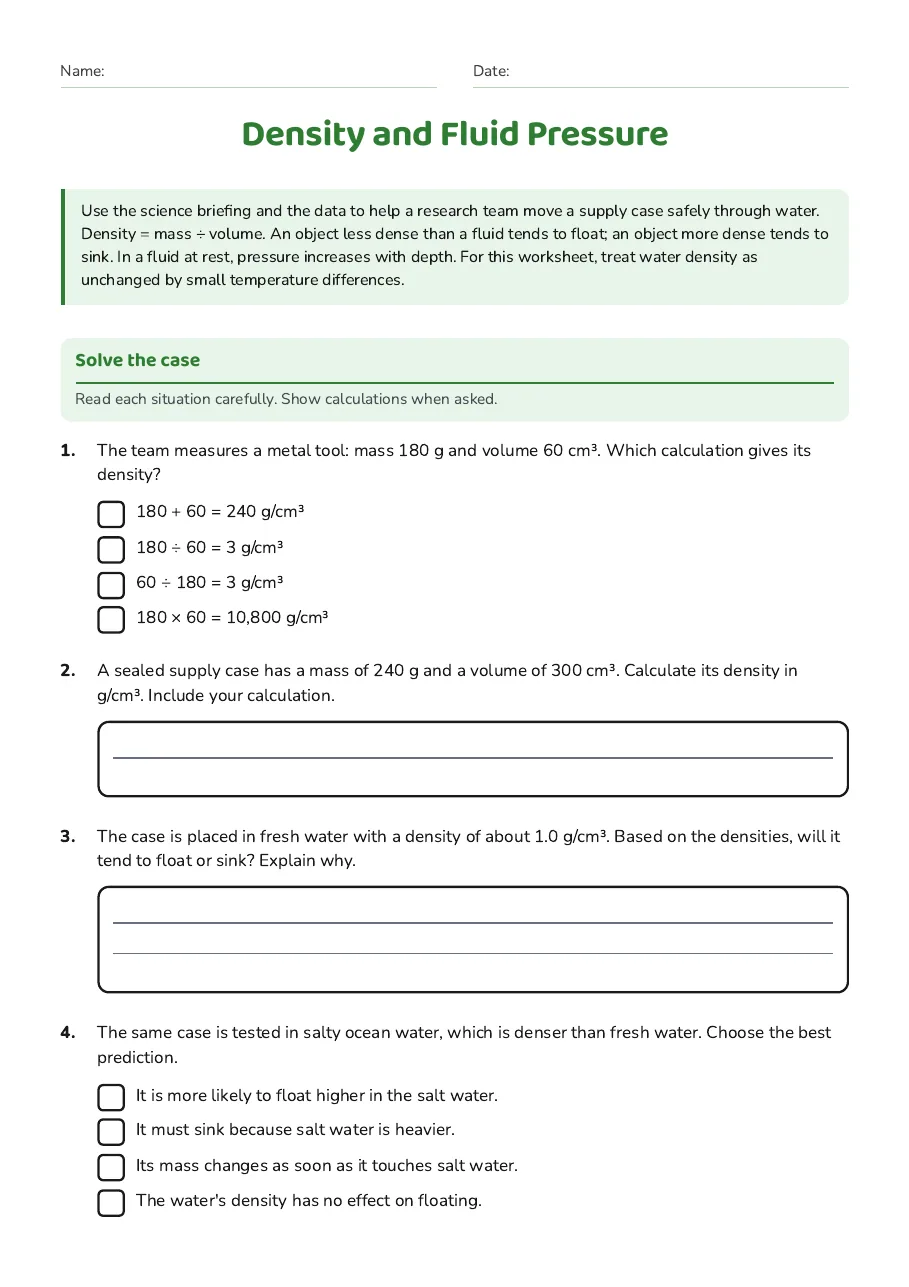
Density and Fluid Pressure

Use the science briefing and the data to help a research team move a supply case safely through water. Density = mass ÷ volume. An object less dense than a fluid tends to float; an object more dense tends to sink. In a fluid at rest, pressure increases with depth. For this worksheet, treat water density as unchanged by small temperature differences.

Solve the case

Read each situation carefully. Show calculations when asked.

1.The team measures a metal tool: mass 180 g and volume 60 cm³. Which calculation gives its density?
  • 180 + 60 = 240 g/cm³
  • 180 ÷ 60 = 3 g/cm³
  • 60 ÷ 180 = 3 g/cm³
  • 180 × 60 = 10,800 g/cm³
2.A sealed supply case has a mass of 240 g and a volume of 300 cm³. Calculate its density in g/cm³. Include your calculation.
3.The case is placed in fresh water with a density of about 1.0 g/cm³. Based on the densities, will it tend to float or sink? Explain why.
4.The same case is tested in salty ocean water, which is denser than fresh water. Choose the best prediction.
  • It is more likely to float higher in the salt water.
  • It must sink because salt water is heavier.
  • Its mass changes as soon as it touches salt water.
  • The water's density has no effect on floating.
5.A sensor is lowered from 10 meters to 40 meters below the surface. What happens to the water pressure on it, and what causes the change?

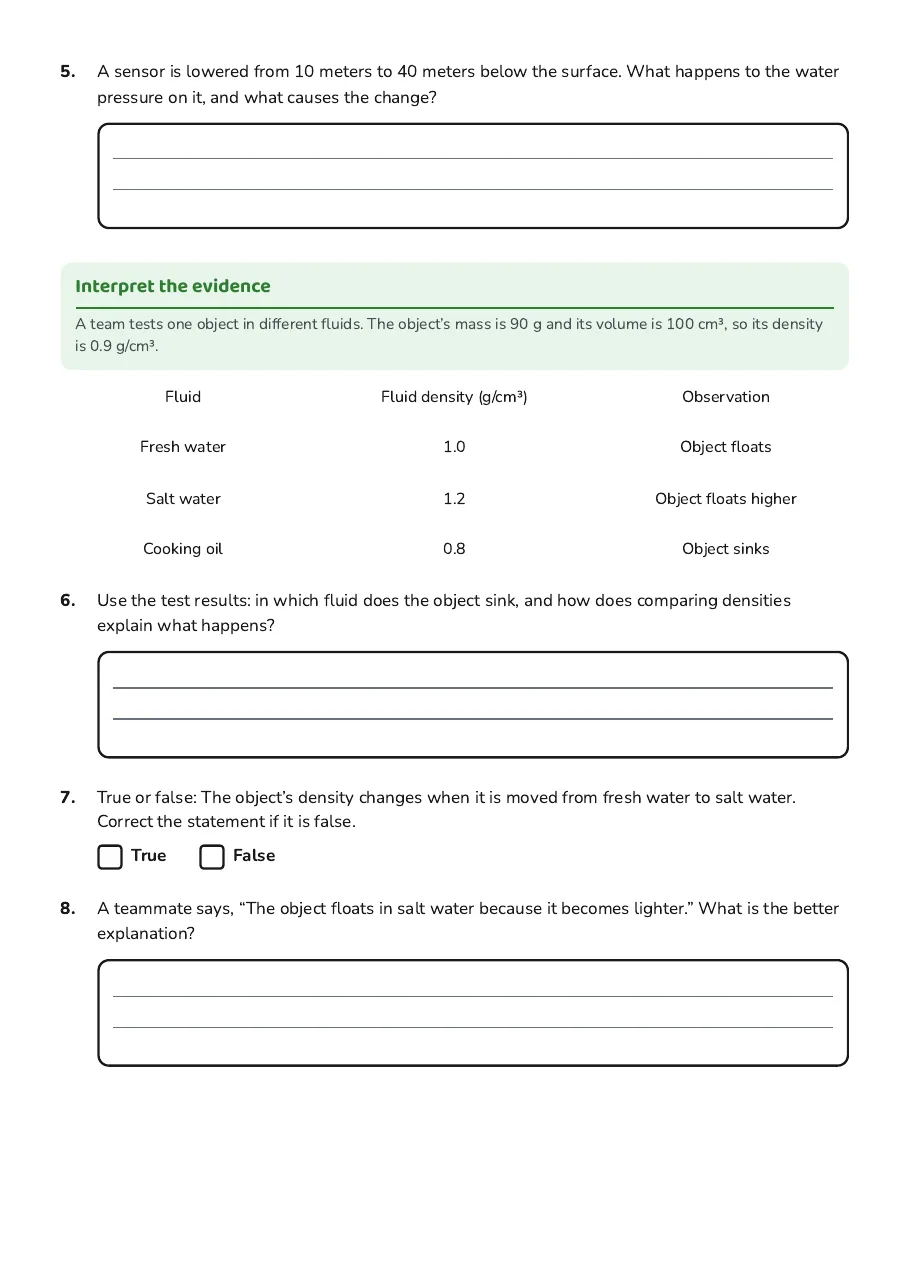
Interpret the evidence

A team tests one object in different fluids. The object’s mass is 90 g and its volume is 100 cm³, so its density is 0.9 g/cm³.

Fluid

Fluid density (g/cm³)

Observation

Fresh water

1.0

Object floats

Salt water

1.2

Object floats higher

Cooking oil

0.8

Object sinks

6.Use the test results: in which fluid does the object sink, and how does comparing densities explain what happens?
7.True or false: The object’s density changes when it is moved from fresh water to salt water. Correct the statement if it is false.
TrueFalse
8.A teammate says, “The object floats in salt water because it becomes lighter.” What is the better explanation?

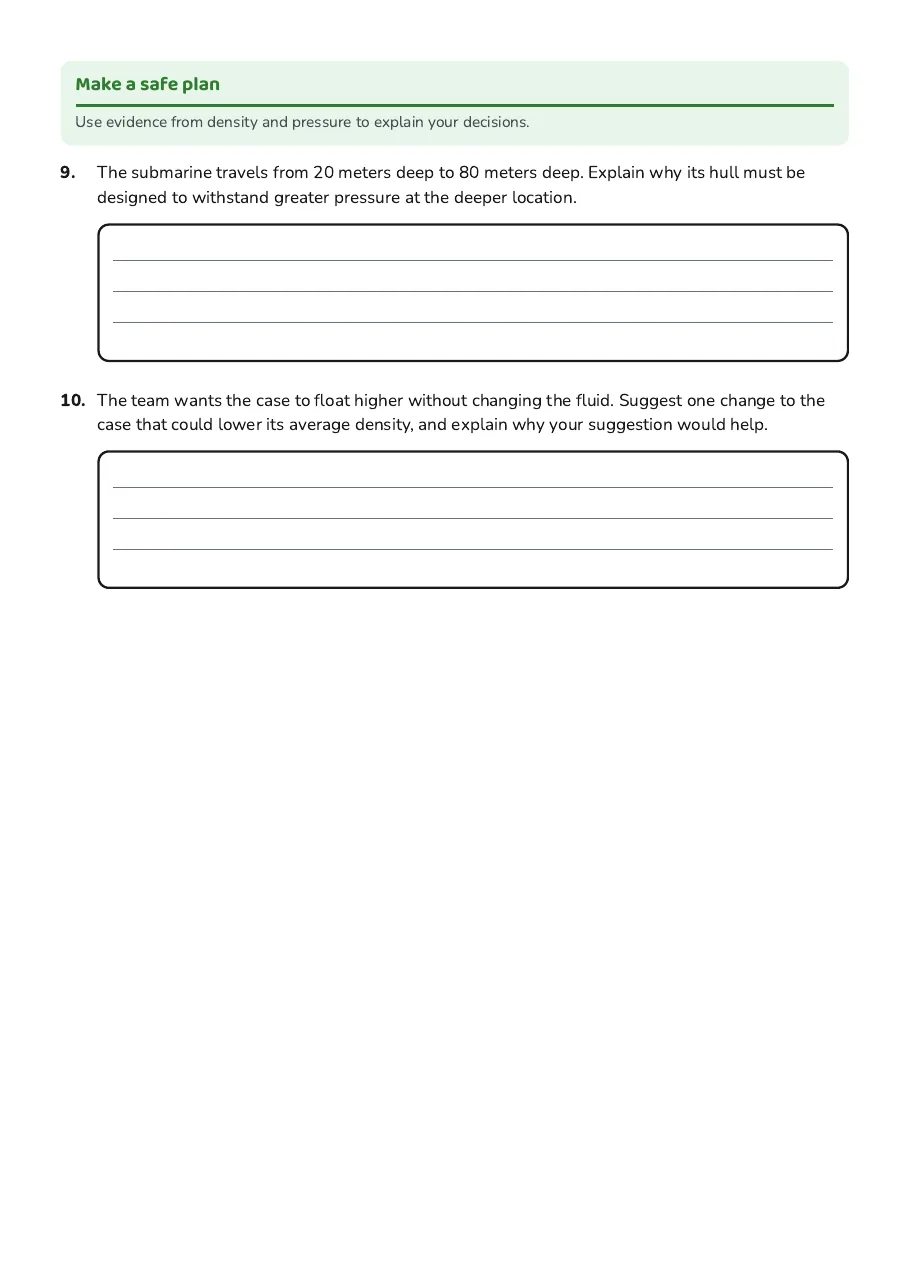
Make a safe plan

Use evidence from density and pressure to explain your decisions.

9.The submarine travels from 20 meters deep to 80 meters deep. Explain why its hull must be designed to withstand greater pressure at the deeper location.
10.The team wants the case to float higher without changing the fluid. Suggest one change to the case that could lower its average density, and explain why your suggestion would help.

3 printable pages

  • Density and Fluid Pressure, page 1 of 3: Solve the case

    Page 1

  • Density and Fluid Pressure, page 2 of 3: Interpret the evidence

    Page 2

  • Density and Fluid Pressure, page 3 of 3: Make a safe plan

    Page 3

About This Worksheet

Free in Kuraplan

Sign up free, grab the PDF, and customize it for your class.

Print-Ready

Formatted for standard paper. Clean layout, easy to read.

AI-Generated

Created with Kuraplan's AI, designed for real classroom use.

For Teachers & Parents

Use in classrooms, for homework, tutoring, or homeschool.

Need a custom version of this worksheet?

Kuraplan's AI generates custom worksheets in seconds — differentiated for every learner, aligned to your curriculum.

Generate Custom Worksheets — Free
No credit card Curriculum-aligned Under 60 seconds