Digital Childhood Themes
A free english (ela) worksheet ready for your classroom. Open in Kuraplan to grab the print-ready PDF, customize it for your students, or generate a fresh version in seconds.
Digital Childhood Themes
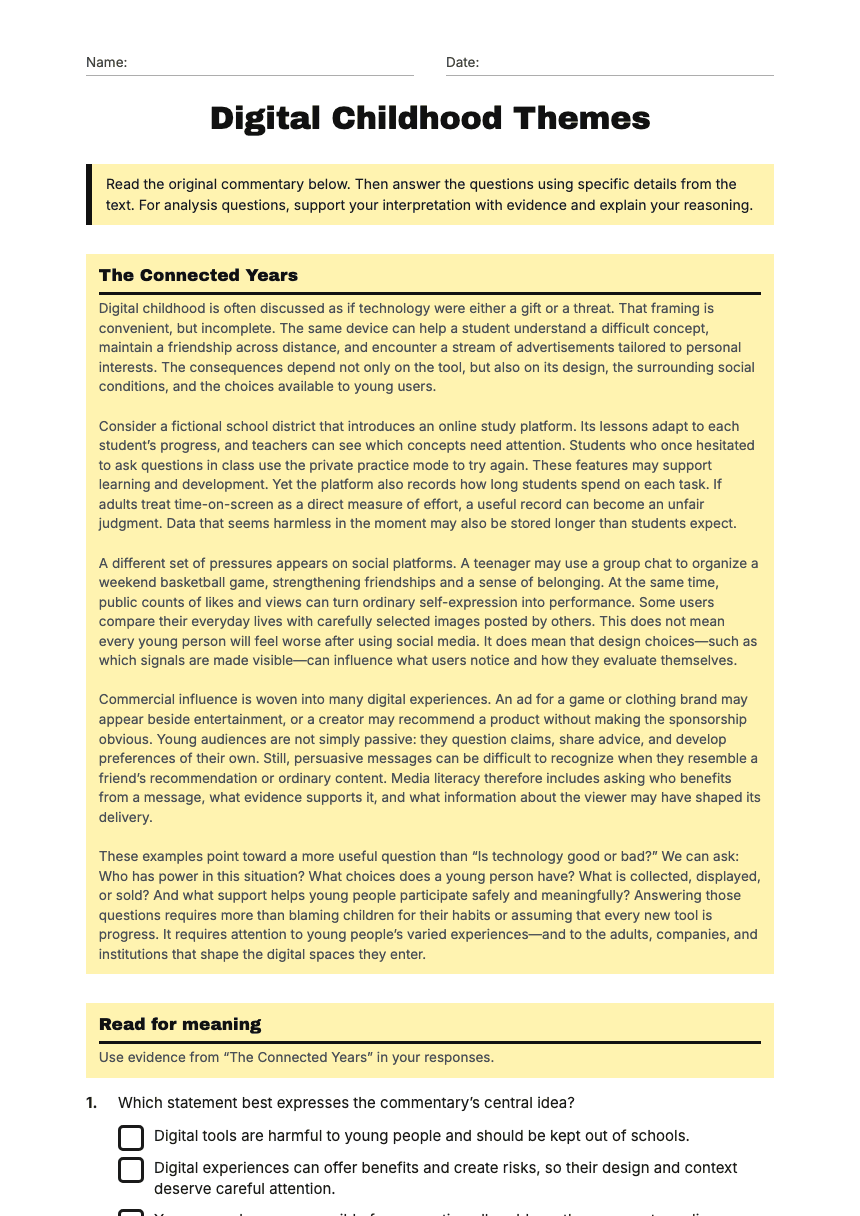
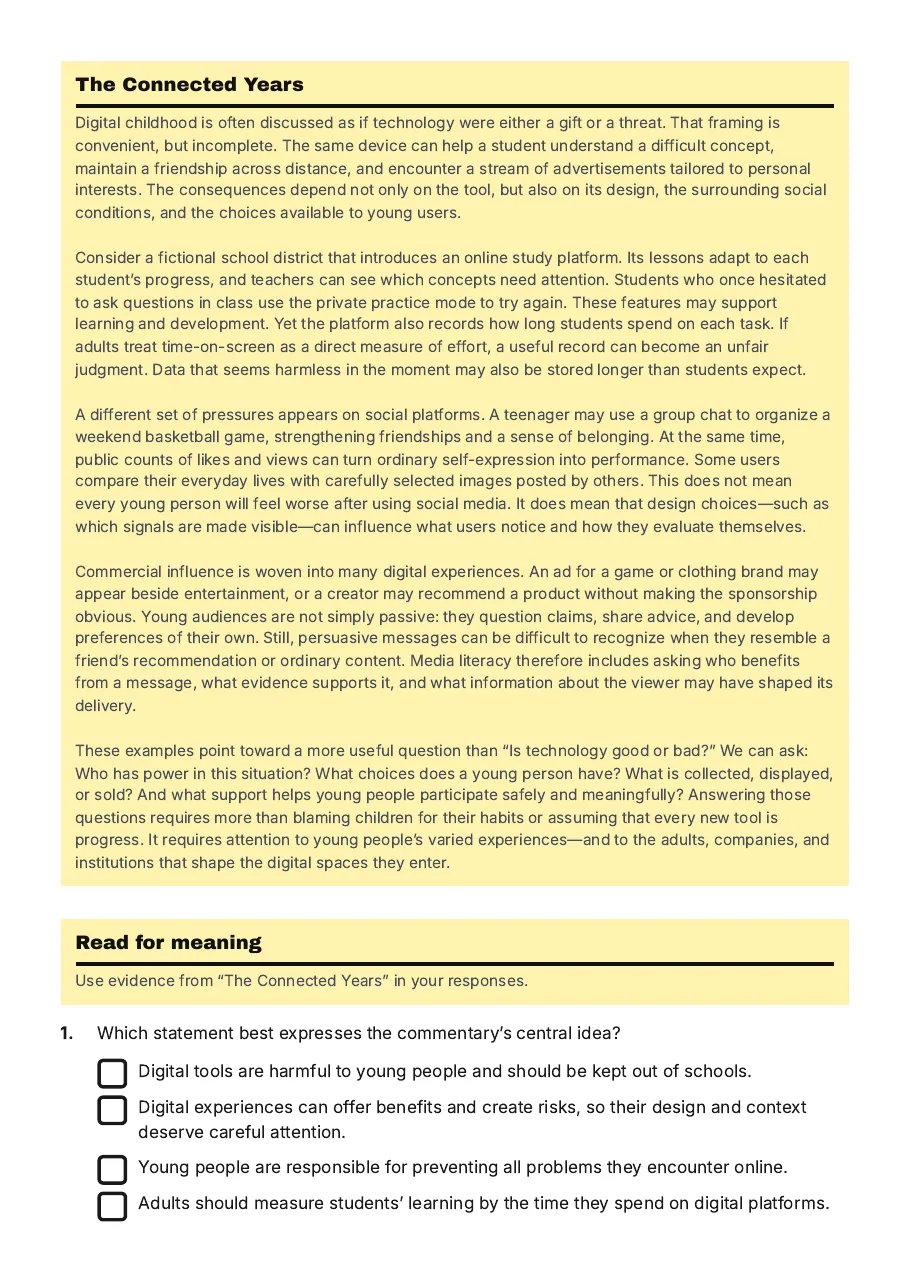
The Connected Years
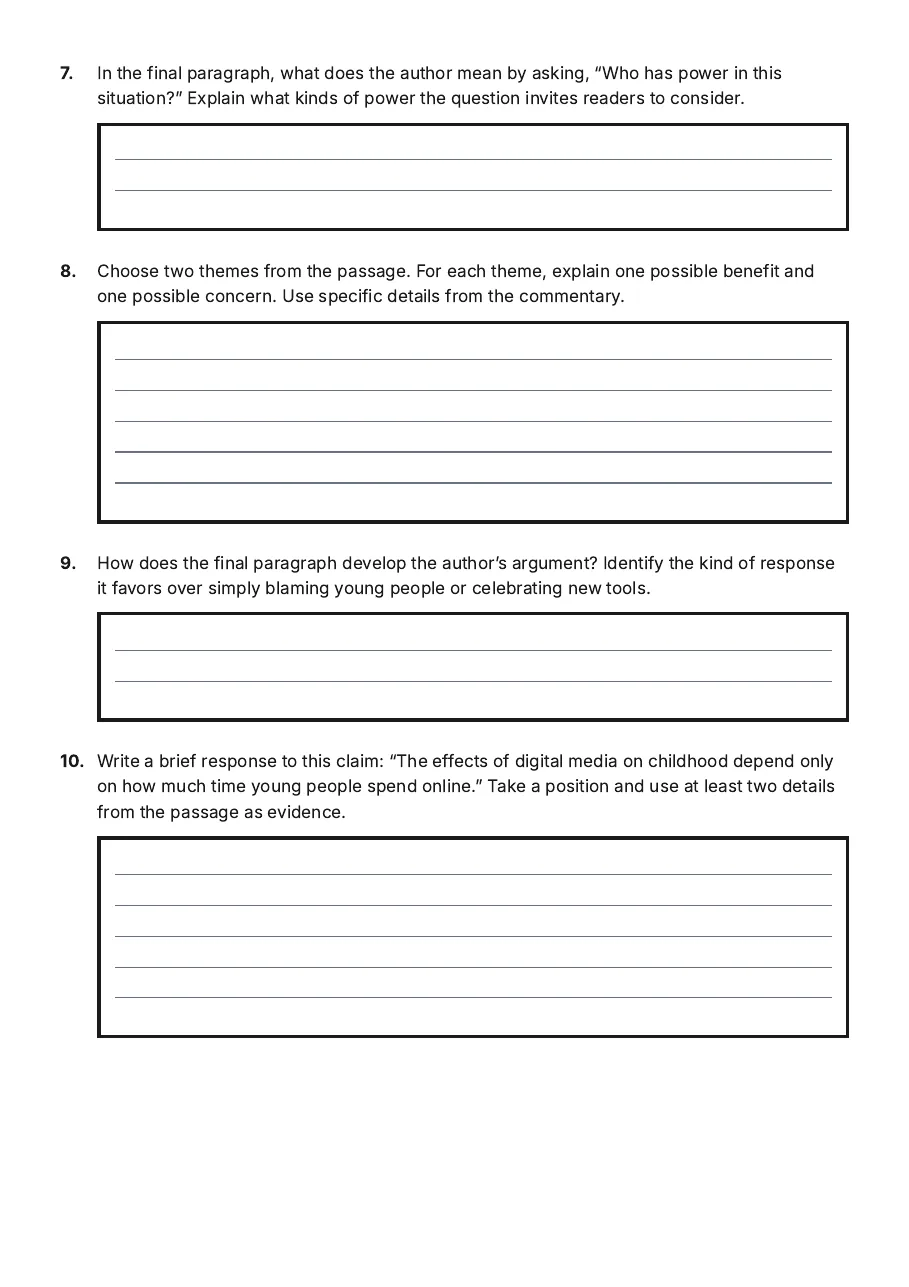
Digital childhood is often discussed as if technology were either a gift or a threat. That framing is convenient, but incomplete. The same device can help a student understand a difficult concept, maintain a friendship across distance, and encounter a stream of advertisements tailored to personal interests. The consequences depend not only on the tool, but also on its design, the surrounding social conditions, and the choices available to young users. Consider a fictional school district that introduces an online study platform. Its lessons adapt to each student’s progress, and teachers can see which concepts need attention. Students who once hesitated to ask questions in class use the private practice mode to try again. These features may support learning and development. Yet the platform also records how long students spend on each task. If adults treat time-on-screen as a direct measure of effort, a useful record can become an unfair judgment. Data that seems harmless in the moment may also be stored longer than students expect. A different set of pressures appears on social platforms. A teenager may use a group chat to organize a weekend basketball game, strengthening friendships and a sense of belonging. At the same time, public counts of likes and views can turn ordinary self-expression into performance. Some users compare their everyday lives with carefully selected images posted by others. This does not mean every young person will feel worse after using social media. It does mean that design choices—such as which signals are made visible—can influence what users notice and how they evaluate themselves. Commercial influence is woven into many digital experiences. An ad for a game or clothing brand may appear beside entertainment, or a creator may recommend a product without making the sponsorship obvious. Young audiences are not simply passive: they question claims, share advice, and develop preferences of their own. Still, persuasive messages can be difficult to recognize when they resemble a friend’s recommendation or ordinary content. Media literacy therefore includes asking who benefits from a message, what evidence supports it, and what information about the viewer may have shaped its delivery. These examples point toward a more useful question than “Is technology good or bad?” We can ask: Who has power in this situation? What choices does a young person have? What is collected, displayed, or sold? And what support helps young people participate safely and meaningfully? Answering those questions requires more than blaming children for their habits or assuming that every new tool is progress. It requires attention to young people’s varied experiences—and to the adults, companies, and institutions that shape the digital spaces they enter.
Read for meaning
Use evidence from “The Connected Years” in your responses.
- Digital tools are harmful to young people and should be kept out of schools.
- Digital experiences can offer benefits and create risks, so their design and context deserve careful attention.
- Young people are responsible for preventing all problems they encounter online.
- Adults should measure students’ learning by the time they spend on digital platforms.
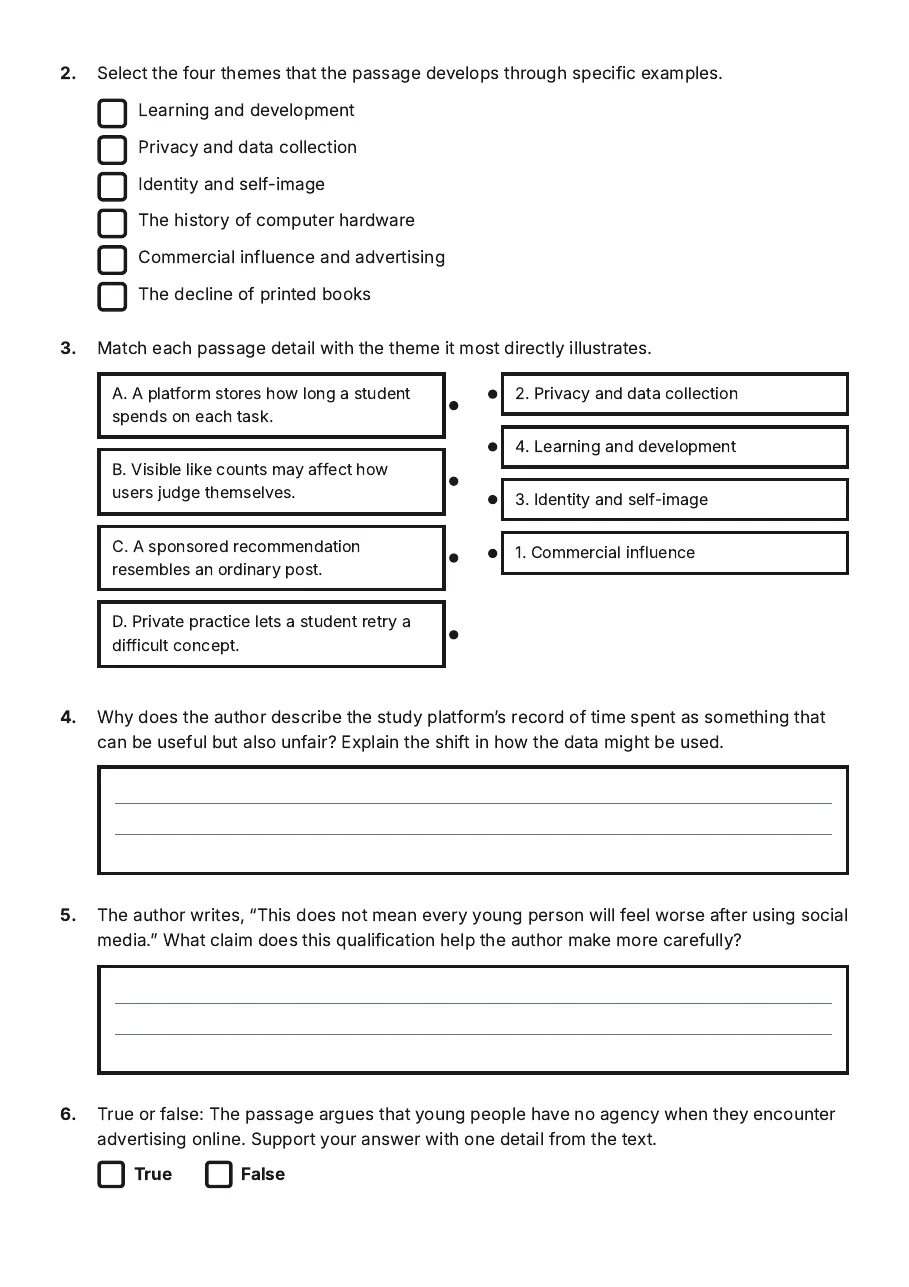
- Learning and development
- Privacy and data collection
- Identity and self-image
- The history of computer hardware
- Commercial influence and advertising
- The decline of printed books
- A. A platform stores how long a student spends on each task.
- B. Visible like counts may affect how users judge themselves.
- C. A sponsored recommendation resembles an ordinary post.
- D. Private practice lets a student retry a difficult concept.
- 2. Privacy and data collection
- 4. Learning and development
- 3. Identity and self-image
- 1. Commercial influence
4 printable pages
Page 1
Page 2
Page 3
Page 4
About This Worksheet
Free in Kuraplan
Sign up free, grab the PDF, and customize it for your class.
Print-Ready
Formatted for standard paper. Clean layout, easy to read.
AI-Generated
Created with Kuraplan's AI, designed for real classroom use.
For Teachers & Parents
Use in classrooms, for homework, tutoring, or homeschool.
Need a custom version of this worksheet?
Kuraplan's AI generates custom worksheets in seconds — differentiated for every learner, aligned to your curriculum.
Generate Custom Worksheets — Free