ScienceFreePrintable

Earth Materials Cycle Model

A free science worksheet ready for your classroom. Open in Kuraplan to grab the print-ready PDF, customize it for your students, or generate a fresh version in seconds.
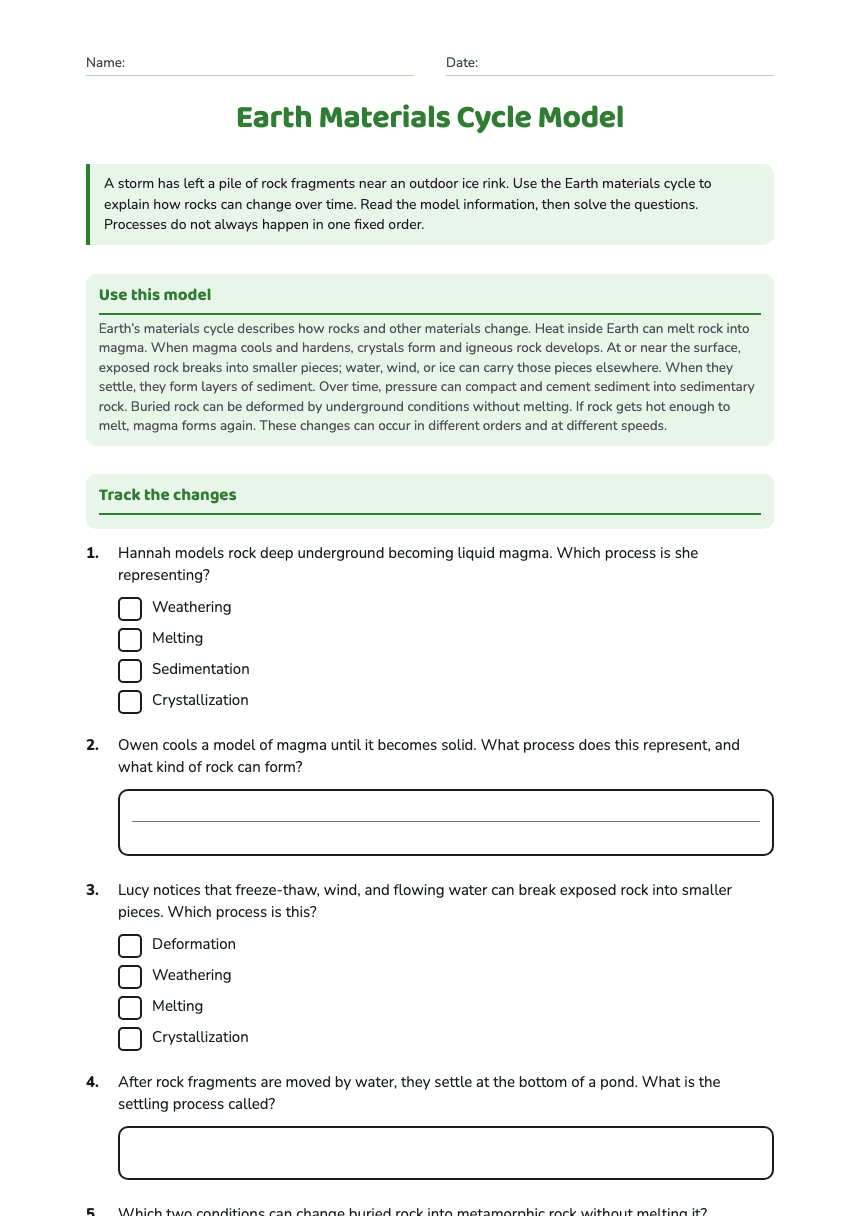
Earth Materials Cycle Model worksheet preview
Name:Date:

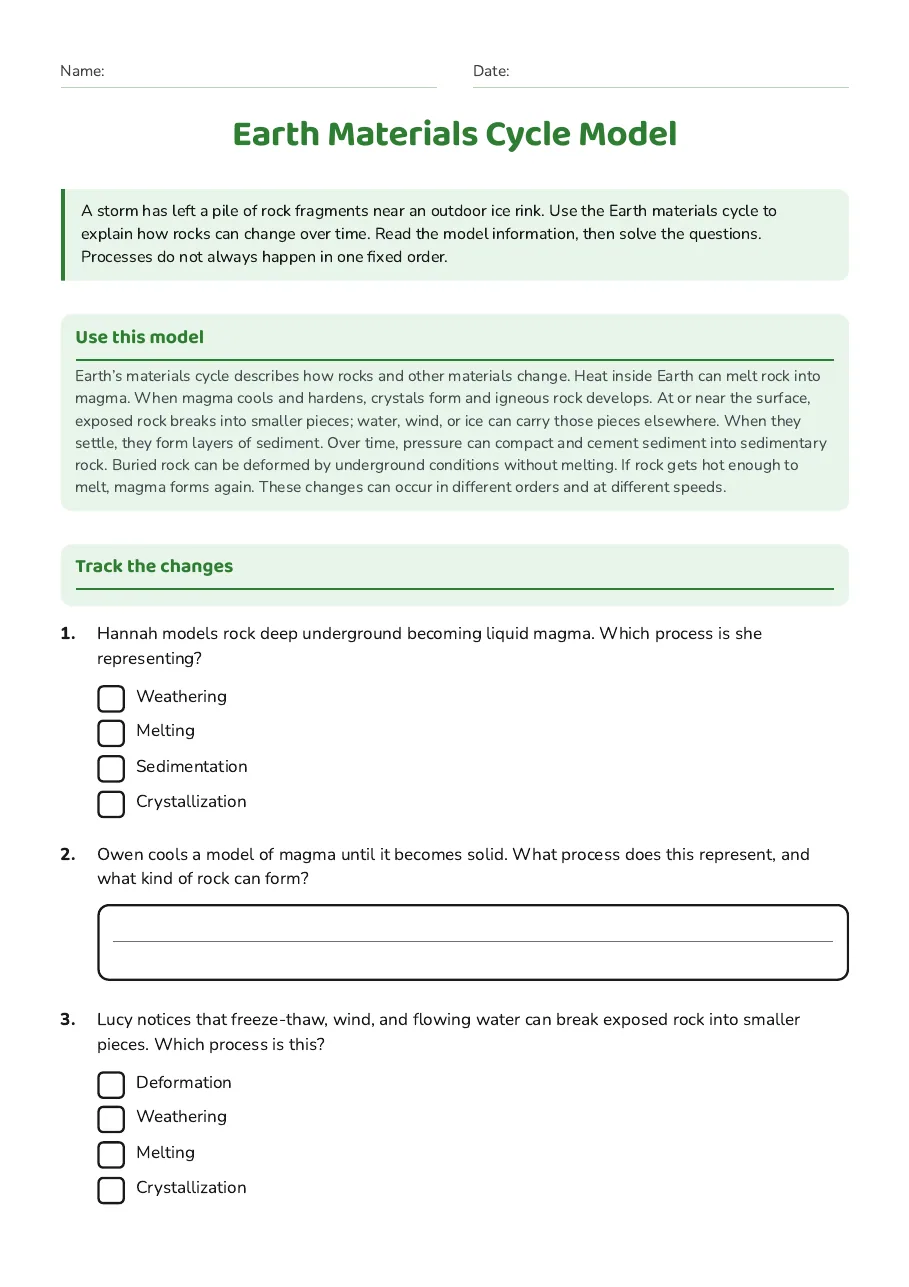
Earth Materials Cycle Model

A storm has left a pile of rock fragments near an outdoor ice rink. Use the Earth materials cycle to explain how rocks can change over time. Read the model information, then solve the questions. Processes do not always happen in one fixed order.

Use this model

Earth’s materials cycle describes how rocks and other materials change. Heat inside Earth can melt rock into magma. When magma cools and hardens, crystals form and igneous rock develops. At or near the surface, exposed rock breaks into smaller pieces; water, wind, or ice can carry those pieces elsewhere. When they settle, they form layers of sediment. Over time, pressure can compact and cement sediment into sedimentary rock. Buried rock can be deformed by underground conditions without melting. If rock gets hot enough to melt, magma forms again. These changes can occur in different orders and at different speeds.

Track the changes

1.Hannah models rock deep underground becoming liquid magma. Which process is she representing?
  • Weathering
  • Melting
  • Sedimentation
  • Crystallization
2.Owen cools a model of magma until it becomes solid. What process does this represent, and what kind of rock can form?
3.Lucy notices that freeze-thaw, wind, and flowing water can break exposed rock into smaller pieces. Which process is this?
  • Deformation
  • Weathering
  • Melting
  • Crystallization
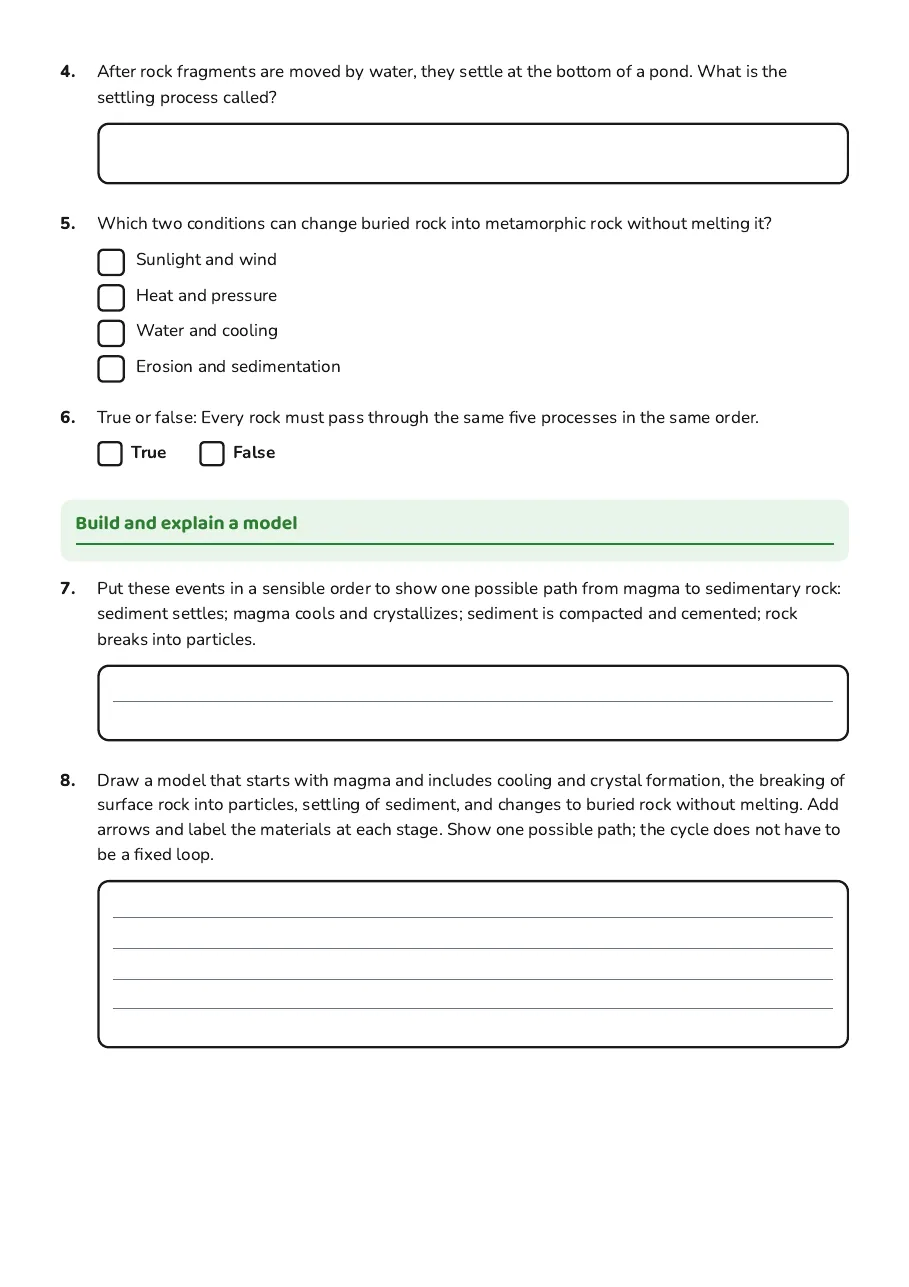
4.After rock fragments are moved by water, they settle at the bottom of a pond. What is the settling process called?
5.Which two conditions can change buried rock into metamorphic rock without melting it?
  • Sunlight and wind
  • Heat and pressure
  • Water and cooling
  • Erosion and sedimentation
6.True or false: Every rock must pass through the same five processes in the same order.
TrueFalse

Build and explain a model

7.Put these events in a sensible order to show one possible path from magma to sedimentary rock: sediment settles; magma cools and crystallizes; sediment is compacted and cemented; rock breaks into particles.
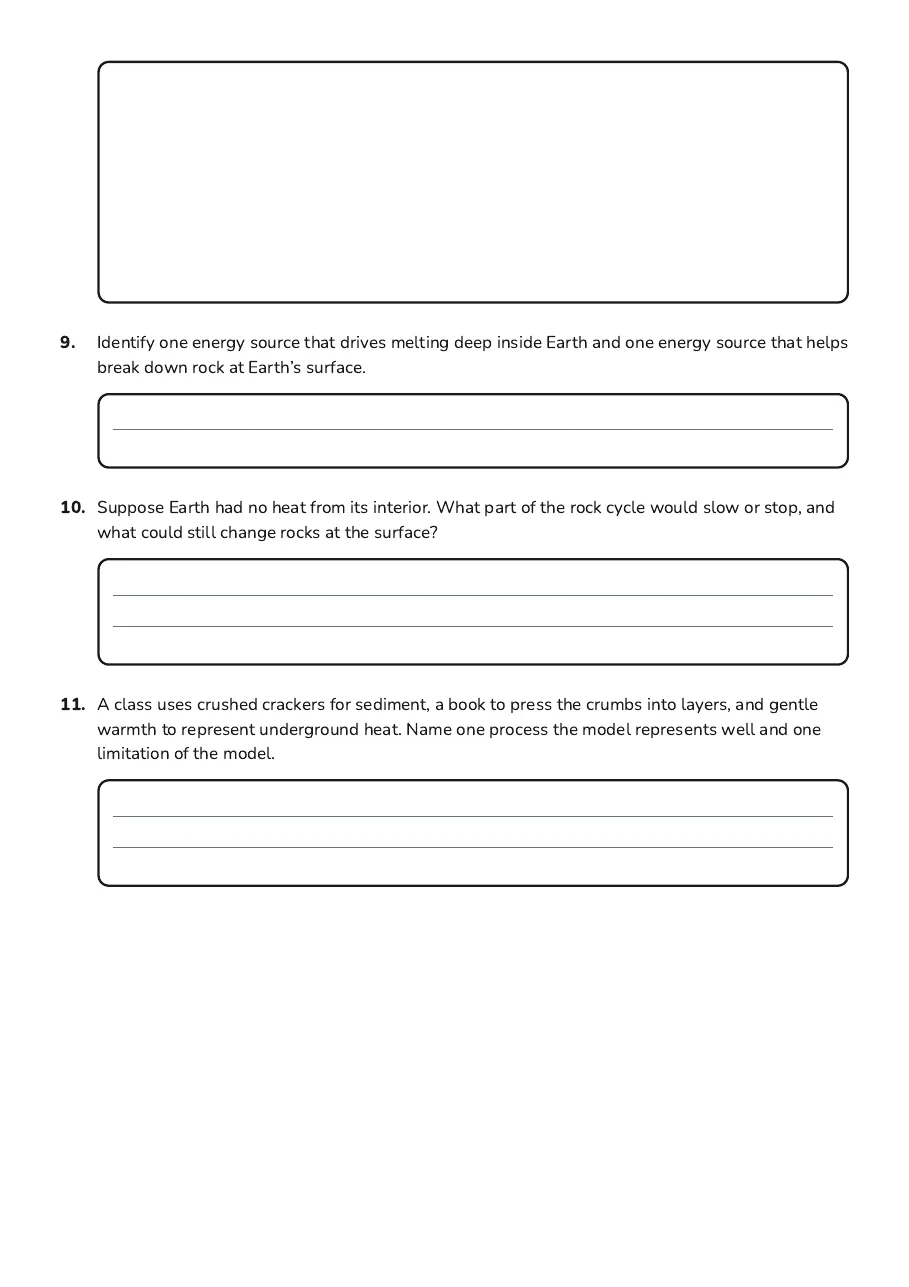
8.Draw a model that starts with magma and includes cooling and crystal formation, the breaking of surface rock into particles, settling of sediment, and changes to buried rock without melting. Add arrows and label the materials at each stage. Show one possible path; the cycle does not have to be a fixed loop.
9.Identify one energy source that drives melting deep inside Earth and one energy source that helps break down rock at Earth’s surface.
10.Suppose Earth had no heat from its interior. What part of the rock cycle would slow or stop, and what could still change rocks at the surface?
11.A class uses crushed crackers for sediment, a book to press the crumbs into layers, and gentle warmth to represent underground heat. Name one process the model represents well and one limitation of the model.

3 printable pages

  • Earth Materials Cycle Model, page 1 of 3: Use this model, Track the changes

    Page 1

  • Earth Materials Cycle Model, page 2 of 3: Build and explain a model

    Page 2

  • Earth Materials Cycle Model, page 3 of 3: 9. Identify one energy source that drives melting deep inside Earth and one energy source…

    Page 3

About This Worksheet

Free in Kuraplan

Sign up free, grab the PDF, and customize it for your class.

Print-Ready

Formatted for standard paper. Clean layout, easy to read.

AI-Generated

Created with Kuraplan's AI, designed for real classroom use.

For Teachers & Parents

Use in classrooms, for homework, tutoring, or homeschool.

Need a custom version of this worksheet?

Kuraplan's AI generates custom worksheets in seconds — differentiated for every learner, aligned to your curriculum.

Generate Custom Worksheets — Free

No credit card Curriculum-aligned Under 60 seconds